


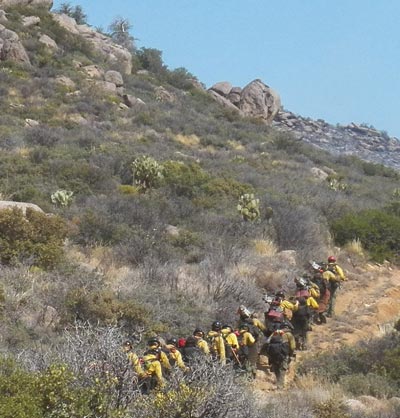
It has been almost a year since 19 firefighters were killed on the Yarnell Hill Fire, June 30, 2013. The dust has settled near Yarnell, Arizona and many claims have been filed against various government agencies. One of those was converted into a lawsuit Monday when it was filed in Maricopa County Superior Court in Phoenix. It lists 162 property owners who name the state and the Arizona State Forestry Division as defendants. From the suit:
If the Arizona State Forestry Division had competently managed, contained and suppressed the Yarnell Hill Fire, no member of the Granite Mountain Interagency Hotshot Crew would have died. And Yarnell and its people would have escaped devastation.
That was the first of several lawsuits that will probably be filed. The second was issued Wednesday by 12 of the families of the firefighters killed in the fire.
While the sudden deaths of 19 people is horrific, it would ease our pain somewhat if we thought that something, anything, could come out of this that resembled lessons learned. If a few tidbits could be found in the ashes of the fire that could help others avoid a similar fate, maybe we could move forward with a glimmer of hope.
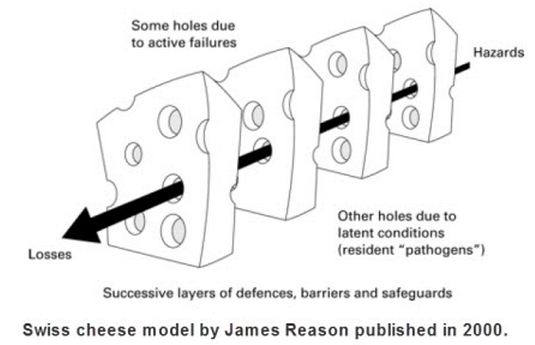 An experienced firefighter can analyze the two official reports about the fatalities, and combined with reading between the lines and drawing conclusions based on their knowledge, they can nit pic using 20-20 hindsight like a Monday morning quarterback. We succumbed to what we saw as inevitable and after the second report came out in December wrote a piece listing 19 issues, or holes in the slices of Swiss cheese, that when combined, the holes align, permitting (in James T. Reason’s words) “a trajectory of accident opportunity”, so that a hazard passes through holes in all of the slices, leading to a failure.
We put the 19 issues into four categories: supervision of aerial resources, supervision of ground personnel, planning, and communication. This was not the first time these issues, or deficiencies have been seen on wildland fires. Communication, for example, is listed in almost every investigation report for a fatality on a fire. And it was not the first time that firefighters took on an assignment without an adequate briefing, without a current map of the fire, had incorrectly programmed radios, no safety officer, no written incident action plan, or that an incident management team arrived on the third day of a fire without any Division Supervisors.
When you combine all of the slices of the Swiss cheese and their 19 holes, failure is not inevitable, but it becomes more difficult to avoid. When a sleepy fire awakens and becomes complex all within the space of a few hours, it taxes the infrastructure that has been put in place. A robust organization can be resilient in the face of adversity, recovering quickly from difficult conditions, possibly even compensating for 19 holes. But if the organization and decision making, affected in some cases by little sleep over the previous 48 hours, is stressed and tested beyond its limits, undesirable results are more likely to occur.
It is conceivable that if one or more of the issues, or holes, had not occurred, we would not be mourning the 19 members of the Granite Mountain Hotshots.
One thing we don’t know about the fatalities on the Yarnell Hill Fire is why, exactly, the 19 firefighters walked into what became a lethal firetrap in a canyon. Nothing in the reports shed much light on how that decision was made, or by whom. It seems counter-intuitive that experienced firefighters would leave the safety of a previously burned area and expose themselves to the fire as they walked through unburned, very flammable vegetation, especially after a warning had been issued over the radio about an approaching thunderstorm cell with strong winds.
As the lawsuits work their way through the court system, the discovery process may yield information the government agencies that commissioned the reports preferred to be kept out of the public eye. Questions may be answered.
We can label them mistakes or unfortunate decisions, but what was done on the fire has been done before. Most of the time firefighters are lucky and get away with it, returning to their families when the fire is out. Other times they become documented in fatality reports.
While there may be few cultural changes coming out of this fire, other than perhaps being more aggressive and attacking new fires with overwhelming force, many firefighters and managers will move some basic safety principles closer to the surface of their ongoing evaluation of conditions on a fire. Supervisors may double and triple-check the location of their fire resources, and confirm through active listening techniques that orders and assignments are absolutely clear and understood. And that works both ways, up and down the chain of command. Fire managers could evaluate the supervision of aerial resources more often to ensure that the workload and span of control are within reasonable limits. Agency administrators could be certain that the management structure on a fire is appropriate for the complexity, and that “short” incident management teams are rarely if ever used. Transitions from one incident management organization to another may be watched more carefully.
Based on what we know about the fire, there is no earth-shaking revelation that can become a lesson learned. They have already been taught. Firefighters have been making the same mistakes for decades. They end up in reports that sit on shelves or hard drives. Unfortunately, another firefighter will repeat them. And they might be lucky, or resilient, and go home to their family when the fire is out.







