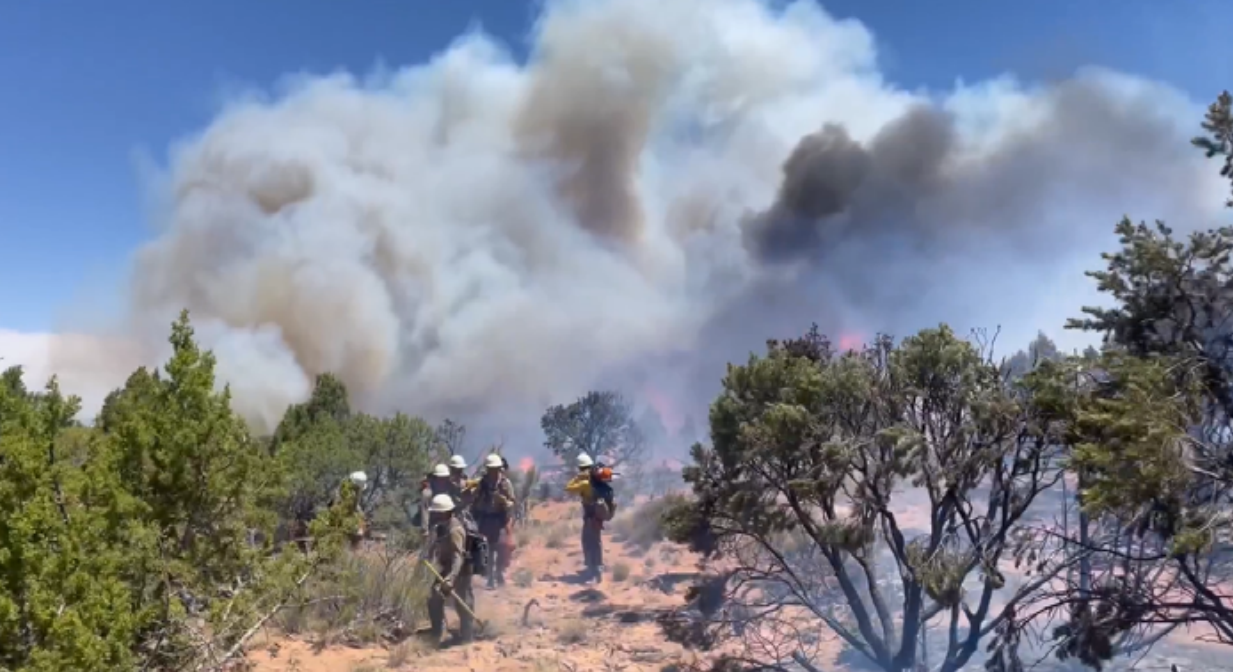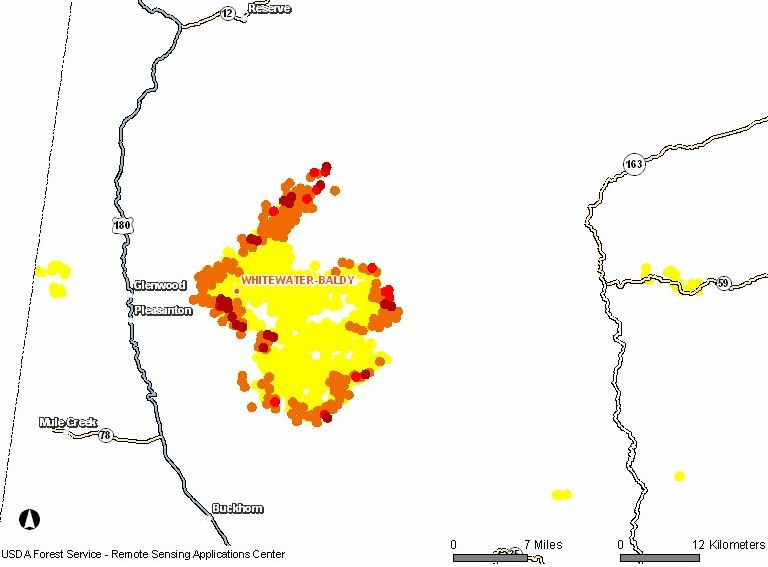
The Whitewater-Baldy fire on Saturday, pushed by strong southwest winds gusting up to 37 mph, added another 40,000 acres and ran 12 miles beyond Highway 159 toward the northeast as far as Reserve-Beaverhead Road. The fire has now blackened a total of 122,000 acres, but that may pale in comparison to the ultimate size of this monster fire. The Incident Management Team has planned a fireline which would triple its size to over 360,000 acres. The Team apparently concluded that this may be the only viable alternative. The fire continually outflanks the shorthanded firefighters, with the rapid rate of spread exceeding their capabilities to construct effective fireline.
Massive burnout operations from indirect firelines miles from the main fire are not unprecedented on major fires. In recent memory they have been used, mostly successfully, on fires on the Los Padres National Forest in southern California, including the Basin Complex, Indians, Iron Alps, and Zaca fires. Bill Molumby who was Incident Commander of a Type 1 Incident Management Team during phases of these fires, successfully directed (along with others) huge burnouts that ultimately stopped the spread of the fires after they had burned for weeks or months. But implementing large, risky plans like these require the best of the best — highly skilled and experienced Incident Commanders, Operations Section Chiefs, Division Supervisors, and firefighters on the ground. They can take weeks or months to complete, and we hope that the necessary personnel, equipment, and firefighters can be found that can safely execute such an ambitious plan. Maybe Bill Molumby, or someone else equally skilled, can be brought out of retirement to assist during the next several weeks or months.
And there is always the chance that the weather will change and mother nature will put out the fire.
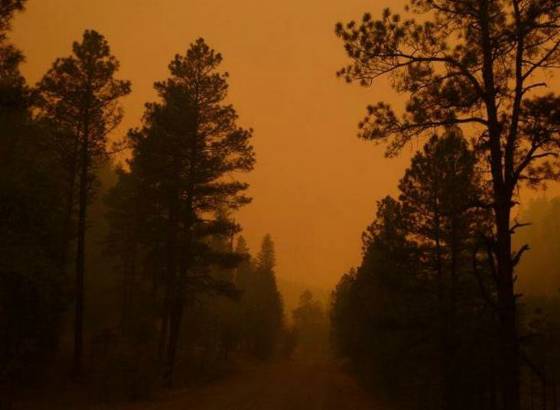
So far the relatively small force of 586 personnel, 26 Engines, 2 Dozers, 4 helicopters, and 2 air tankers has been largely ineffective in suppressing the fire. As we noted on Saturday, the number of resources assigned to this 122,000-acre fire is much less than was on the 4,100-acre Banner fire earlier this week which had 73 engines, 2 dozers, 6 air tankers, 7 helicopters, 47 hand crews, and 965 personnel. Thanks to the aggressive initial attack and favorable weather, the Banner fire is expected to be fully contained on Monday. But the degree of difficulty facing the firefighters on the Whitewater-Banner fire is real, with rough country, and powerful winds.
Smoke from the fire is having a significant impact over much of the United States, as you can see from the map below. Some residents of Colorado are detecting a strong odor of smoke and are assuming that there is a nearby fire, but depending on their location, it is most likely coming from the Whitewater-Baldy fire in western New Mexico.
Dense and very visible smoke is drifting into the Albuquerque area, 150 miles northeast of the fire, as seen in this video.

On Saturday the fire spread to within 2.6 miles of Mogollon, which is frequently described as a ghost town, but has structures listed on the National Register of Historic Places.