


A wildlife biologist died at a prescribed fire at Fort Jackson Army Base in South Carolina Wednesday, May 22. Angela N. Hawkins, 45, of Columbia, who many knew as Nicole, died shortly after noon in a training area where the prescribed fire was taking place. The Army did not release details of the circumstances, or if the death of the mother to two pre-teen sons was directly related to the prescribed fire.
She had worked as a civilian at the base since 2007, with much of her time spent in helping to bring back an endangered species, the red-cockaded woodpecker. One of the techniques used to improve the bird’s habitat was the use of prescribed fire.
The Soldiers, civilians and family members at Fort Jackson are a close-knit family and those who worked with Nicole are deeply saddened. “She will be missed and our thoughts and prayers go out to her family,” said U.S. Army Training Center and Fort Jackson Commander Brig. Gen. Milford H. Beagle, Jr.
Our sincere condolences go out to Ms. Hawkins family, friends, and co-workers.
Below is an excerpt from an article by Elyssa Vondra (Jackson) last November about Ms. Hawkins’ work at the base:
…The [red-cockaded woodpecker (RCW)] population was officially considered “endangered” in 1970 and won the protection of the 1973 Endangered Species Act. Fort Jackson has since made conservation efforts. The Wildlife Branch of the Directorate of Public Works has built up the RCW’s ecosystem.
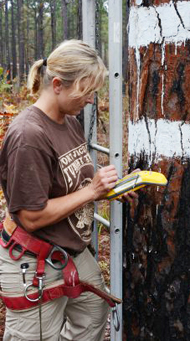
This woodpecker’s primary habitat is the longleaf pine ecosystem. Roughly 97% of it has been destroyed in the U.S. by advancements such as settlement, timber harvesting, urbanization and agriculture. Also, 6,801 acres of longleaf pine have been restored at Fort Jackson since 1994.
Installation biologists are using herbicides to convert some slash pine forests to longleaf pine forests and keeping underbrush low to improve the bird’s habitats.
On average, over the past five years, 11,819 acres have been burned on post annually, along with 2,388 thinned.
“It creates a habitat (RCWs) prefer,” said Nicole Hawkins, a wildlife biologist at Fort Jackson. It allows for open park lighting.
One side effect is increased vegetation that RCWs thrive under, she added. Artificial cavities — RCW homes — have also driven up the population count.
Left to their own devices, RCWs can spend as many as ten years making a single cavity. Humans can craft one in 45 minutes.
The Habitat Management Unit at Fort Jackson makes up 26,645 of the installation’s total 51,316 acres, excluding 8,787 for mission requirements. Of them, only 391 total acres, distributed throughout the installation, carry training restrictions related to the species. The acreage is broken down into small sections. Trees with cavities have a 200-foot buffer zone around them where limitations apply.
“That’s very minimal,” Hawkins said. Some training can still take place, provided it doesn’t last more than two hours.
Some installations have been able to entirely remove training restrictions because of population stabilization. Within the next year or two, a review of post policies could potentially allow for change here, too, Hawkins said.
That would benefit the training mission, Morrow said.
With restrictions lifted, “the bird will be invisible to the Soldier, essentially,” Morrow said.
The Army would have more flexibility. For instance, a new range could potentially be built in RCW territory, if necessary.
The 2018 nesting season was the best on the books, according to many measures. There was a 7 percent uptick in active clusters, groups of trees with inhabited cavities, in the past year — from 41 to 44. An increase of just 5 percent was the goal. There were 41 potential breeding groups, RCW gatherings with at least one fertile male and female — an 8 percent rise — among them. Thirty-seven reportedly attempted nesting, 150 eggs were laid — 125 was the former record — and more than 80 hatched. Seventy-two were banded for tracking purposes. At 7-10 days old, some baby birds have uniquely-colored bands placed on their legs. It allows them to be seen with spotting scopes and be individually identified.
This year’s statistics represent record highs.
Thanks and a tip of the hat go out to Tom and Micah. Typos or errors, report them HERE.


