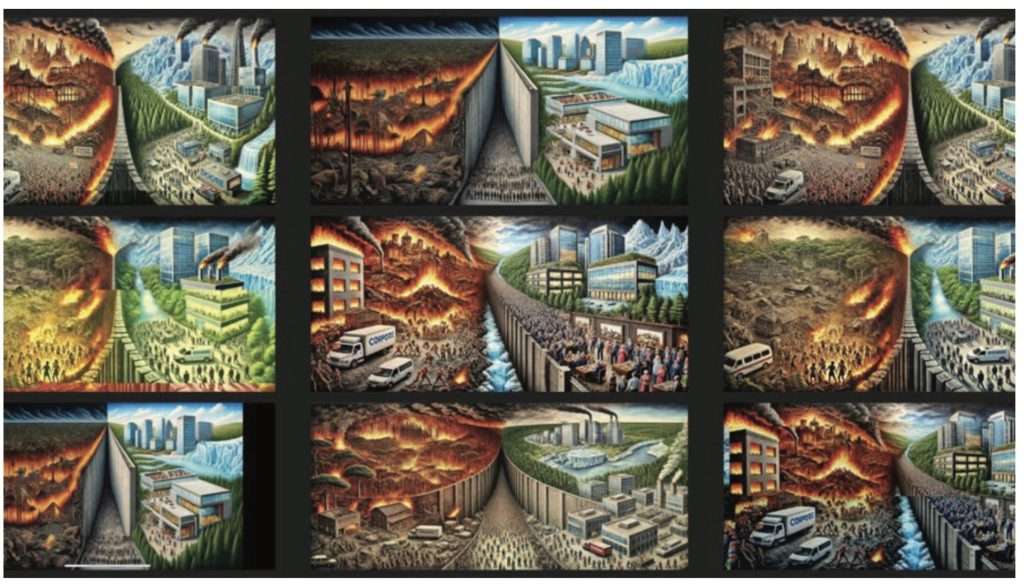
The outcome of this collision of science and art provides a refreshing way of communicating complex scientific ideas with easily understood graphics and narrative, to a range of audiences including local communities or schools.
Lecturer Scarlet Sykes Hesterman led the project. “I saw this as a great opportunity for my third-year students to take on a creative and meaningful challenge; adapting complex scientific concepts into visual storytelling,” she said.
“I have a strong interest in ecology and the environmental sciences, so Hamish’s proposal was both exciting and fascinating. We quickly discovered a shared passion for the intersection of science and art, and for exploring how these fields can communicate information and ideas through new approaches.
“The resulting short videos can be viewed as stand-alone works or presented together as a mini-series. We found that the students responded enthusiastically to the brief and its themes. For many, it was their first experience working with a real client, and they were intrigued by the real-world implications of Hamish’s research.”
Wildland firefighters are facing a formidable battle, coping with labor shortages during one of the most intense fire seasons in recent years. As a California firefighter for over 45 years — including 15 years as Ventura County Fire Protection District chief and Nevada State Forester — I know firsthand that when it comes to stopping the spread of wildfires, there is no replacement for a well-trained and equipped firefighting force.
But it takes more than a quick and skilled response to prevent a wildfire catastrophe. We also need to prioritize wise management of federal lands.
As Californians in San Luis Obispo County are currently witnessing this summer, wildfires that start on state/federal lands can quickly spread to surrounding areas, threatening many lives, damaging health, destroying homes and businesses, and devastating communities. While wildfires on federal lands only make up approximately one-fifth of the total wildfires recorded across the country, they are typically responsible for nearly half the acres burned.
I applaud the lawmakers who are working to address the workforce gaps by ensuring adequate funding for hiring, training, and support. As they do so, I ask them to make it part of a holistic approach to wildfire prevention and response. This is paramount if we want to truly address the worsening wildfire crisis.
Why are wildfires burning so much of our federal land? One reason is that under current regulations, federal land management policies and environmental clearances make wildfire prevention arduous and sometimes impracticable. For example, formulating and conducting prescribed burns takes time, and needed labor resources are in short supply. Additionally, electric grid operators and electrical workers cannot easily gain access to powerlines and other infrastructure on federal lands. We need to reduce the unnecessary challenges to perform vegetation management and other wildfire risk management activities. Without success, this means that our federal lands — and our people — are left more vulnerable.
These fires cause enormous human suffering. Clouds of harmful smoke can travel thousands of miles to neighboring states and linger in the air for weeks. This contaminated air can be dangerous for Americans with pre-existing health issues and can even trigger cardiovascular and lung health issues. It also impacts the health of our first responders who are battling these wildfires. As policymakers look to improve our wildfire preparedness and response, protecting firefighters from the adverse health risks of wildfire smoke needs to be a part of effective policy solutions.
Along with the health impacts, we are all too familiar with the financial cost. Wildfires already cost the United States between $394 and $893 billion annually due to property and capital losses along with insurance and liability costs. A new report from Gallagher estimated that the two wildfires that impacted much of Los Angeles County in January will cost $65 billion in economic losses. During my years as a firefighter, I’ve seen businesses crumble from wildfires and struggle to get back on their feet and cope with the combined property and wage losses.
With more than 4,000 wildfires already recorded and 3.7 million acres burned this year alone, we need Congress and federal agencies to take action and help address this crisis. For starters, the President’s June Executive Order aims to create a more effective wildfire response through the U.S. Wildland Fire Service (USWFS). It is encouraging to see the Administration take actions to increase collaboration and efficiency, but sufficient resources for first responders will be crucial to the success of USWFS.
Additionally, the House and Senate should pass the bipartisan Fix Our Forests Act. This much-needed step from Congress will help improve federal land management and coordination across federal, state, and local authorities. But this legislation is just one piece of a much larger, national wildfire strategy. We also need to address labor shortages among wildland firefighters and ensure that state and local partners have the resources needed to train and recruit skilled individuals.
As a country, we cannot continue to approach wildfires with the same patchwork of solutions that have been in place for decades. Let’s take decisive and comprehensive actions to keep our families and our communities safe from the growing wildfire threat.
Bob Roper is the Senior Wildfire Policy Advisor for the Western Fire Chiefs Association. He has been in the fire service for over 45 years, starting as a volunteer firefighter and then rising to executive positions. He served in the Ventura County Fire District for 34 years, the last 15 as Fire Chief and as the Nevada State Forester.
A 29-year-old man has been arrested and is facing charges for allegedly starting Los Angeles’ historic Palisades Fire in January.
Acting U.S. Attorney for the Central District of California Bill Essayli, in a post on social media on Wednesday, said authorities arrested Melbourne, Florida, resident Jonathan Rinderknecht for maliciously starting the fire on New Year’s Day.
“Investigators determined that the Palisades Fire reported on Jan. 7 was caused by an intentionally set fire near a viewpoint along the Temescal Ridge Trail in Topanga State Park on Jan. 1,” Acting Bureau of Alcohol, Tobacco, Firearms and Explosives Agent in Charge Kenny Cooper said at a press conference on Wednesday. “We know this arrest cannot erase the pain or grief or losses endured, but we hope it is a step forward.”
Authorities believe Rinderknecht set the fire on Jan. 1, and it continued to burn in dry brush before eventually evolving into one of the region’s deadliest and most destructive wildfires on record. Investigators reportedly identified Rinderknecht on Jan. 24 as a potential suspect.
During his interview with authorities, Rinderknecht allegedly lied, telling investigators he wasn’t near the fire. Geolocation data for a 911 call he made about the fire allegedly showed he was standing 30 feet away from the fire after he dropped someone off there while driving for Uber around midnight.
Investigators also said Rinderknecht previously lived in the area and they allegedly found numerous ChatGPT-generated images depicting burning cities among the evidence collected from Rinderknecht’s possessions.
His initial court appearance is scheduled for the U.S. District Court in Orlando at 1:30 p.m. EDT on Wednesday. Rinderknecht has no previous criminal history.
Credit:
Acting U.S. Attorney Bill Essayli
The Palisades Fire killed 12 people and destroyed more than 6,000 homes and buildings in the wealthy Pacific Palisades neighborhood in Los Angeles. A recent Redfin analysis estimated that the fire caused $51.7 billion worth of damage by damaging over 11,000 residential properties in the region.
“The council shared a list of 11,125 residential parcels in the city of Los Angeles that were inspected by the Los Angeles Department of Building and Safety after the wildfires,” the company said. “Redfin was able to match nearly 11,000 of those parcels with Redfin property value estimates as of December 2024—the month before the fires. Many, but not all, were completely destroyed by the fires.”
Nearly 70,000 people in the United States are expected to die annually from wildfire smoke by 2050, according to newly published research.
Findings of a study were published in Nature on Sept. 18, which prompted public discussion due to the strikingly dire figures. The analysis estimated that smoke from wildfires already contributes to around 40,000 deaths each year in the nation. The additional 30,000 annual deaths by 2050 are primarily attributed to climate change, which is making already fire-prone regions in the U.S. hotter and drier.
The study, however, identifies the location of the forecasted spike in wildfire smoke deaths as eastern US, where historically there are fewer large wildfires compared to the western US. The research team, from a range of universities including Stanford, University of California, Harvard, and the National Oceanic and Atmospheric Administration, said that over half of the 70,000 wildfire smoke deaths will come from eastern states, due to higher population densities and damage from low smoke concentrations.
“Because of the mortality effects we uncover at low annual smoke concentrations, we project large mortality burdens not only in heavy smoke regions but also in populous regions with low smoke concentrations (e.g., the eastern US),” the researchers said. “Similarly, we estimate substantial mortality increases even in the low warming scenario because of projected increases in low-level annual smoke concentration.”
The study’s findings, however, directly contradict separate research published a week beforehand, which found that an overlooked aspect of wildfires overinflates mortality estimates.
This study – published in Science – was conducted by a research team from several Chinese universities with input from colleagues in the US and Canada and funded by the National Natural Science Foundation of China. It found that most predictive wildfire models currently do not include heat-induced weather changes caused by wildfires.
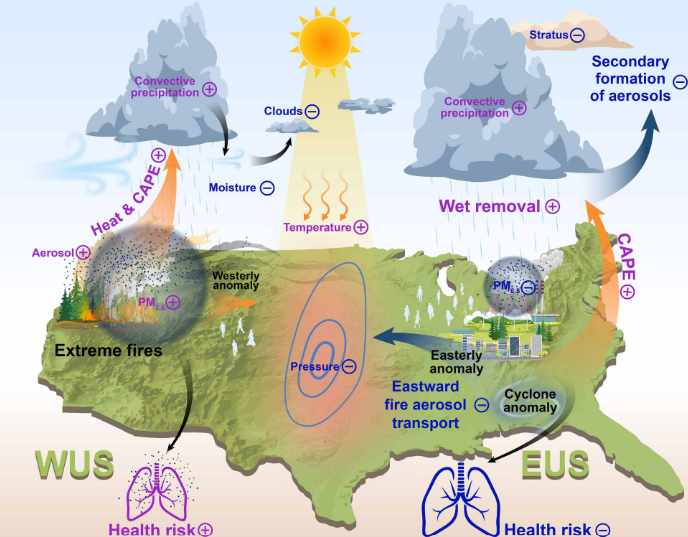
Schematic diagram illustrating how fire heat in the WUS influences PM2.5 air pollution in the EUS. Extreme fires in the WUS release heat that triggers convection, which reduces moisture transport from the WUS to the central US although westerlies are enhanced. The resulting dryer and warmer central US features low-level pressure anomalies, inducing anomalous easterlies and promoting convective precipitation over the EUS. As a result, PM2.5 air pollution and associated health risks in the EUS are alleviated. It should be noted that the PM2.5 air pollution and health consequences in this figure include the contribution of fire aerosols. Source: Science.
The phenomenon, called heat-induced convection, and subsequent meteorological changes actually lower air pollution in eastern states while worsening particulate matter in western states. The researchers said that current models overestimate wildfire smoke deaths by 1,200 and overestimate economic losses by $3.3 billion USD, particularly in eastern states.
“The findings … imply that wildfire-excited jet-stream waves can propagate atmospheric energy eastward, beyond North America, to alter the global air circulation,” according to a commentary in Science that accompanied the main research paper. “This underscores the need to approach wildfire research from a broader, global perspective. Strengthening cross-border and interdisciplinary collaboration is key to improving predictability and driving more effective solutions for wildfire control and recovery.”
The weather data used in the study published in Nature included air temperature, precipitation, relative humidity, soil moisture, vapor pressure deficit, wind speed, and runoff, but there is no indication that the researchers accounted for fire-induced convection.
The phenomenon is one of many uncertainties that fire researchers are continually working to address, including the current limitations of scientific models addressed in the paper, like the difficulty of predicting wildfire impact at local scales and evaluating the repercussions of future unprecedented climate conditions with historical data.
“Addressing these uncertainties could further improve understanding of the climate influences on wildfire pollution and health, and thus inform relevant policies,” the Nature study’s researchers said.
Wildfire Today reached out to both research teams for further insight into the different findings of the two studies, but received no reply.
The U.S. government has shut down after federal funding expired without a continuation decision at 12:01 a.m. on Wednesday.
It is the first time the government has shut down since 2018, which was the longest shutdown in US history at 35 days. That shutdown, however, happened between December and January. This shutdown is happening as wildfires continue to burn across the nation.
The Department of the Interior and the Department of Agriculture both released contingency plans for the lapse in federal funding just days before the shutdown was expected to happen. Both plans state that personnel directly related to wildfire response will largely be exempt from furloughs.
The Department of the Interior’s plan said National Park Service employees involved in fire suppression or fire monitoring activities will not be furloughed. The Department of Agriculture’s plan said that employees who respond to and prepare for wildland fires will not be furloughed.
But multiple wildland firefighters have told Wildfire Today that furloughs will still hit employees who do not have primary fire duties. Employees who are red-carded, or have wildland fire incident qualification certification, have anecdotally been furloughed because wildfire duties were secondary to their official duties. Those individuals provide critical help to wildland firefighters.
The loss of support mirrors the mass firings executed on the Forest Service and National Park Service earlier this year. Around 75% of the 6,000 USFS probationary employees whom the Trump Administration fired had secondary wildland fire duties, Grassroots Wildland Firefighters Vice President Riva Duncan previously told Wildfire Today.
“While ‘primary firefighters’ were exempt, the positions that were cut made some pretty huge contributions to operational wildland fire,” Duncan said. “For example, eastern national forests rely much more heavily on these collateral duty folks to do a lot of prescribed burning and initial attack of wildfires…There were people working the LA fires who, because it was the offseason, weren’t primary fire but were filling in on engines and crews.”
The USDA was eventually ordered to hire back all of the workers it had laid off in March. But, if this shutdown is anything like 2018, firefighters may be without support for some time.
What impacts are you seeing with this shutdown? Tell us in the Comments section.