


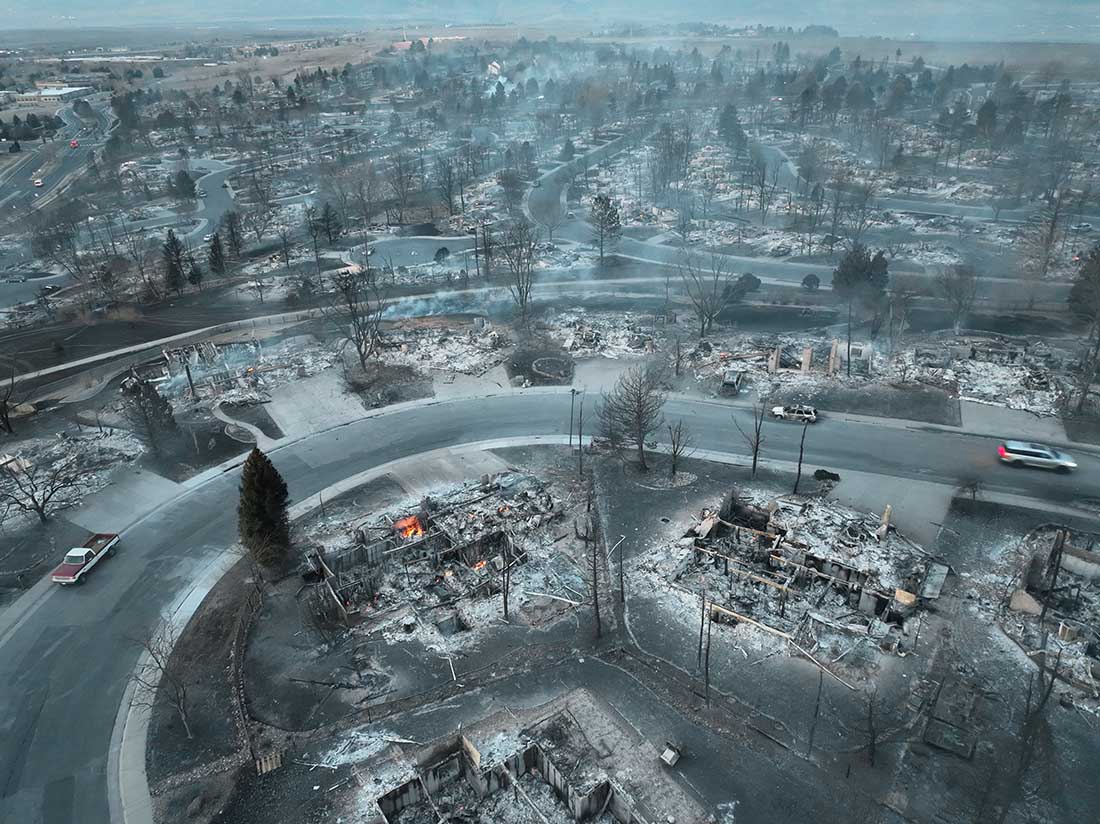
 Marshall Fire, Louisville, Colorado. Photo by WxChasing/Brandon Clement, Dec. 31, 2021.
Early Friday morning, about 20 hours after the Marshall Fire ignited, a drone operated by Twitter user WxChasing/Brandon Clement flew over subdivisions that were devastated by the December 30 fire. It found block after block of ash piles, some still smoldering. In many scenes there was scarcely a structure still standing. (Scroll down to see the video.)
To see all articles on Wildfire Today about the Marshall Fire, including the most recent, click here: https://wildfiretoday.com/tag/marshall-fire/
All of the reasons why some houses did not burn even though dozens around them were consumed could not be determined from the video, but there was one common feature — the survivors were more distant from the neighboring homes. Many houses in the subdivisions were only 10 to 20 feet apart based on archived imagery in Google Earth.
Each little square was a beautiful home 24 hours ago. #MarshallFire #wildfire #COwx #wx #superiorfire pic.twitter.com/Mp8CbyxVRw
— WxChasing- Brandon Clement (@bclemms) December 31, 2021
The fire was driven by very strong winds gusting at 60 to 100 mph, extremely dry conditions after months of drought, and relative humidity in the mid-20s. These are the very worst fire conditions. The weather paired with the nearly back to back structures led to the fire spreading through a continuous human-made fuel bed. When one house burned the convective and radiant heat easily ignited its neighbor, which ignited its neighbor, etc.
The fire in the vegetation and structures lofted burning materials far downwind, creating distant spot fires in the home ignition zone on bone dry lawns, mulch beds around ornamental plants, and on structures. It is unknown at this point how many had been designed and built to be fire resistant, such as the characteristics of the roof, vents, siding, doors, windows, foundation, fences, eaves, and decks. A FEMA publication (13 MB) has excellent detailed recommendations. Headwaters Economics found that the cost of building a fire-resistant home is about the same as a standard home. Local building codes could regulate these features. But if the lot size is so small that residences are only 10 to 20 feet apart, if one becomes fully involved, the neighbors also burn, especially during windy conditions.
So far we have listed some factors that affect the vulnerably of structures during a wildland-urban interface fire: home spacing and lot size, the envelope of the structure itself, fire codes, and the home ignition zone. Others are:
- Evacuation capability and planning;
- Safety zones where residents can shelter in place;
- Road and driveway width, wide enough for large fire trucks;
- Turnarounds at the end of roads;
- Signage, and;
- Emergency water supply.
The video below of the Marshall Fire devastation was shot by WxChasing/Brandon Clement at first light on December 31, 2021, the day after the fire started. Not long after, snow began falling. The National Weather Service in nearby Boulder recorded an accumulation of eight inches.





