


As aerial firefighting continues to grow as an essential component of wildfire response in the United States, planners and policy makers must ensure that existing airport and air traffic control infrastructure can continue to provide safe and efficient services.
Researchers from George Mason University in Virginia broke down the current state of the nation’s aerial firefighting force. They looked at a range of data on the use of Very Large and Large Air Tankers (VLAT / LATs) during the 2024 fire season, helping policy-makers and aircraft planning authorities to make future projections of use.
The United States Forest Service’s contracted 34 VLATs and LAT are aging, according to the report. The service’s oldest aircraft, the C-130s, are 57 years old since the date of manufacture while the newest aircraft, RJ85A, is 25 years old.
“Unlike commercial airliners, which benefit from large-scale manufacturing, the niche market for specifically designed aerial firefighting aircraft makes it difficult to achieve economies of scale, leading to high per-unit costs,” the report said. “Barring government subsidies
or changes in the economics of aerial firefighting, a clean-sheet design of VLAT/LAT is unlikely.”
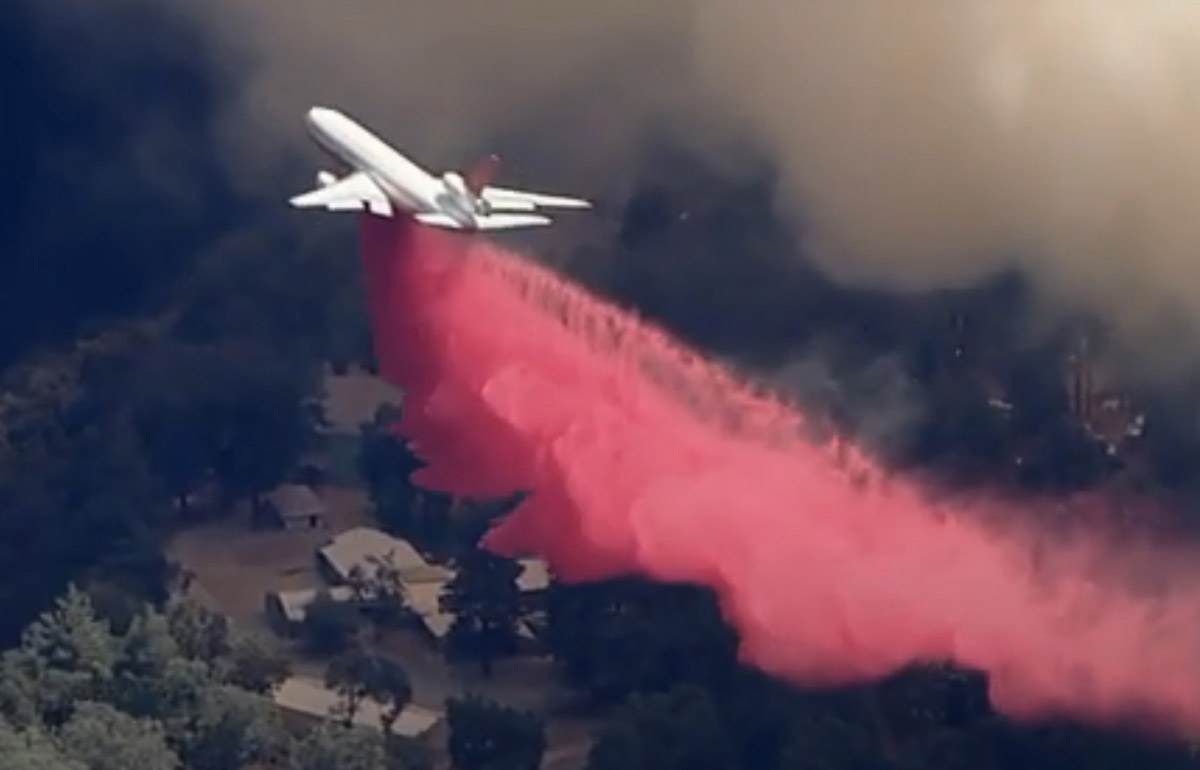
 An airtanker makes a retardant drop over the Mosquito Fire after it jumped the American River and headed north toward Foresthill, California. 09-13-22 Inciweb photo.
A total of 11,219 retardant drops and reposition flights were performed over the course of the year. There were as many as 157 retardant drop flights in a single day across the fleet.
“Flights operated on 88% of the days with an average of 35 flights per day and a maximum of 200 flights per day,” the report said. “The number of flights per aircraft across the fleet was not uniform (average 288 flights,
max 465 flights).”
The nation’s airports have also played an integral role in aerial firefighting, according to the report. More than 200 airports had VLAT and LAT departures over the course of 2024, but just 14 airports supported 50% of the departures. Redmond Airport in Oregon supported the most VLATs and LATs, with 6.4% of total flights.
Only two military airports assisted in VLAT and LAT departures, the rest of which were publicly owned airports that were part of the National Plan for Integrated Airports.
“Notably, in 2024, there were airports used east of the Rocky Mountains that have traditionally not supported aerial fire-fighting operations: Maine, Louisiana, Texas, Illinois, Ohio, Minnesota, Wisconsin, North Carolina, and South Carolina,” the report said.






2 Comments
“DejaVu all over again”. Old aircraft have been pushed to the limit in fire aviation before. When is an aircraft finally too old to continue safe operations at the edge of its design envelope? Hopefully this time we get it right. https://fireaviation.com/2018/03/05/ntsb-forest-service-work-reduce-in%e2%80%91flight-structural-failures-air-tankers/
Given todays budget environment, it would pay to know how many air tankers/ of what type/ and how many estimated sorties are required. Defending a USFS budget requires knowing what you need and having the data to prove it. Is airfield support capacity a limiting factor or is it sortie generation capability? Or something else? https://wildfiretoday.com/2021/04/16/a-9-year-usfs-aerial-firefighting-study-left-many-questions-unanswered/
Gary Barrett
There’s a name I haven’t seen in a few years
We all predicted the BAe 146 / RJ85 and the VLATs that will come due on airframes and engines….but thank God for the mechanic, crew chiefs, and pilots that will continue to instill this on the LMAs ……that aircraft have a time limit
Good to see your name pop up again, SIR!!
Comments are closed for this article!