


Today I was reading an article about how the communities in Northern California are dealing with the risk from wildfire. One item that got my attention was where a “forestry and wildfire specialist” was quoted describing the Fountaingrove area of Santa Rosa which was devastated by the Tubbs Fire in October of last year.
…a housing development in a rural area that had been built following the highest fire safety standards. Vegetation had been cleared as required, and the homes were built of fire-resistant materials.
The article correctly stated that the development had been “reduced to ashes by the Tubbs Fire”.
“How could that have happened?”, I thought. Fire resistant building standards and cleared vegetation? Firefighters know that if those two characteristics can be checked off, a structure has a much better chance of survival. So how did the community get wiped out?
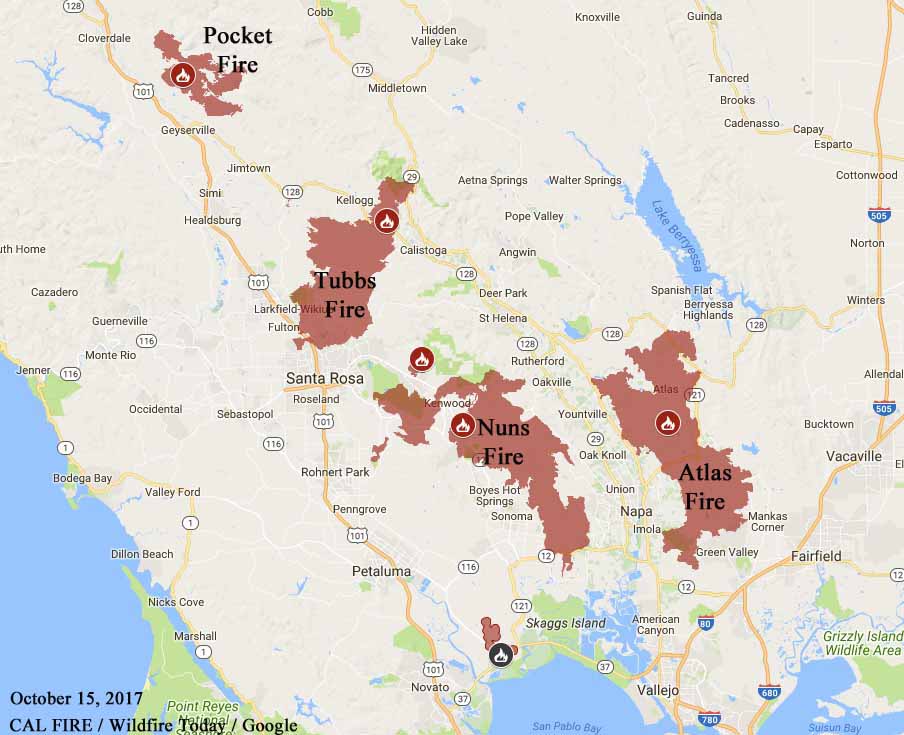
The Fountaingrove community is 4 miles north of the intersection of Highways 101 and 12 in Santa Rosa. The Tubbs Fire, the deadliest of the fires in 2017, burned into the north section of Santa Rosa, including the Fountaingrove area. It killed 22 people, destroyed 5,643 structures, and burned 36,807 acres.
I would not call Fountaingrove a “rural area”. The thousands of homes there are very tightly packed, as you can see in the satellite photo below taken about five months before the Tubbs Fire.

The next three photos are all of the same area, showing structures on Fir Ridge Road before and after the Tubbs Fire of October, 2017.


The photo below was taken before the fire, a few blocks south of the ones above. This home and all others around it burned.

The Fountaingrove area burned in the 1964 Hanley fire. During the 53-year period until the next fire, the 2017 Tubbs Fire, the houses grew back along with a great deal of vegetation. Most of the homes have shrubs in the yards and multiple large trees, often between the houses that are very close together. Some of the structures are partially obscured from aerial photos by limbs hanging over the roofs.
It is difficult to tell if the homes in these photos were constructed of fire resistant materials. But it is clear that other Firewise principles were not being followed.
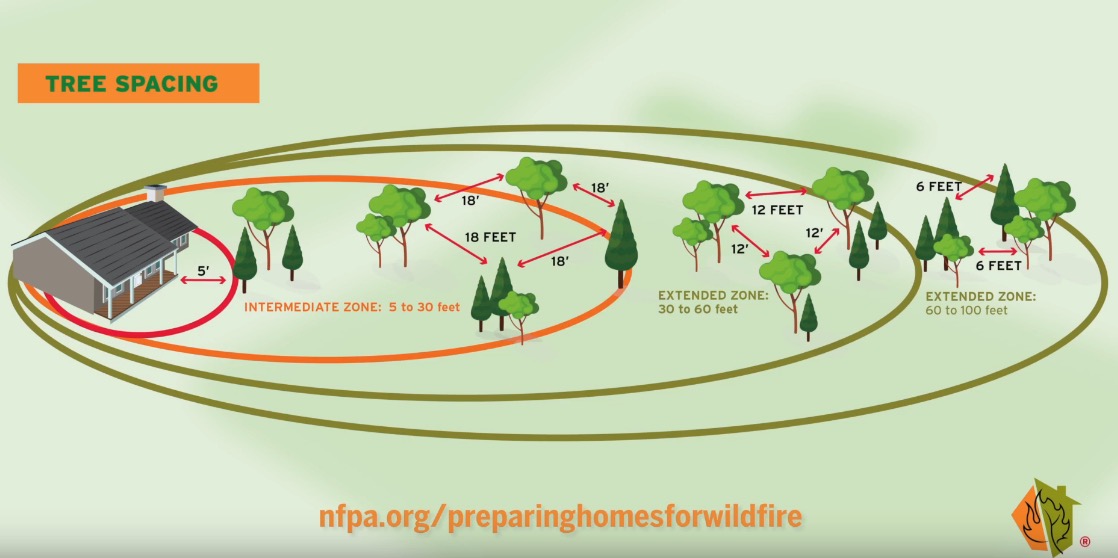
In a fireprone environment there should be no flammable material within 5 feet of a structure, and in the Home Ignition Zones 5 to 100 feet away, trees need to be 6 to 18 feet apart depending on the distance from the building. If on a slope, these distances have to be increased substantially.
An excellent video that elaborates on these principles has been produced by the NFPA. It points out that the areas in between the trees do not have to be nuked. But to be fire resistant they need to consist of green grass or fire resistant small plants, and should be raked or mowed close to the ground.
If a structure meets these Firewise guidelines, it stands a much better chance of surviving a wildfire. However, if the weather conditions are extreme, such as 60 mph winds and single digit humidity which can lead to spot fires igniting a mile ahead of the main fire, it can be difficult to save a structure.
Most homes are ignited not by the main flaming front of a fire, but from burning embers that land out ahead and start new fires. Likely receptors for these embers are leaves in a gutter, mulch, wooden decks, lawn furniture, attic vents, and accumulations of dead grass, pine needles, leaves, and other flammable material.
When a community is initially planned, the engineers may have done some things right, such as the design of the streets, and water systems. But if everything else is left up to the knowledge and discretion of developer and homeowner, very important principles might be ignored.
Fountaingrove did not meet all of the Firewise guidelines, but the streets were wide, making it easier for large fire trucks to access the structures. The very close spacing of the homes means that if one burns, the radiant heat alone can ignite its neighbor.
Other things to consider in mitigating the wildfire threat include multiple evacuation routes — if one becomes compromised by the fire, another could remain open. Large open spaces without flammable vegetation can serve as safety zones for residents who can’t escape. Backup electrical power sources that can keep pumps running so that community water tanks remain full can ensure firefighters have water at hydrants.
With the warming climate leading to extreme fires and fire seasons that are nearly year round, it is inevitable that deadly fires will strike many wildland-urban interface communities. Under the conditions we have seen in recent years, casually ignoring the threat will lead to more fatalities and property damage. It is not IF a fire will hit a fire prone area, but WHEN. The best solution is to learn to live with and adapt to fire, not ignore it.
Many factors can lead to an area being vulnerable to wildfire, including fire suppression leading to a buildup of vegetation, density of homes like at Fountaingrove, failure of homeowners to use Firewise principles, lack of community standards, insurance companies not understanding the issue, the federal government reducing expenditures for vegetation management and prescribed burning, lawsuits that halt vegetation management projects, and cutting the numbers of firefighters, air tankers, and Type 1 helicopters. When politicians take hold of just one of these issues while ignoring the rest, it can make it impossible to have a rational conversation about adapting to fire.
Discussions need to be thorough and nuanced, not politicized and influenced by industry that profits from using just a single, ill-conceived concept. And zeroing in on one vague term like “raking” and “poor forest management” simply confuse the general public when the complete picture is not illuminated.


