Timeline of LA’s historic wildfires outlined in new report

What started as a wildland fire quickly catalyzed into a widespread urban wildfire in Los Angeles on Jan. 7. In the wake of the tragedy, researchers are understanding more about just what fueled the conflagration.

A new report from the Insurance Institute for Business & Home Safety outlines the timeline of both the Palisades and Eaton fires. Institute researchers also entered the community in the days following the destruction and uncovered what types of homes were worst-hit by the fires, and which were more fire resistant.

The Palisades Fire ignited near Skull Rock in the Summit neighborhood at 10:30 a.m., when gusts were reaching up to 60 mph, relative humidity was falling, and severe Santa Ana winds created a highly volatile environment for rapid fire spread. The fire quickly spread downhill and eastward, spreading 771 acres in 4 hours, 2,920 acres in 8 hours, and 15,832 acres in nearly 27 hours, which accounted for 70% of the fire’s total growth, despite it going on to burn for 43 more days. The Palisades Fire was fully contained on February 20 after burning over 23,000 acres, destroying 6,833 structures, and claiming 12 lives.

The Eaton Fire ignited in the Eaton Canyon area of the San Gabriel Mountains at around 6:20 p.m., around eight hours after the Palisades Fire began. At that time, peak gusts surpassed 60 mph, sustained winds exceeded 40 mph, and relative humidity had dropped to around 10%, creating extreme fire weather conditions. Just 16 hours after igniting, the fire had grown to over 10,000 acres. Although the fire continued burning for 42 more days, its initial 24-hour growth of over 13,600 acres would be 96% of its final size. The fire was fully contained on Feb. 20 after burning over 14,000 acres, destroying 9,418 structures, and claiming 17 lives.

Flames from burning tightly spaced buildings only worsened the fires’ spread, according to the report. Each home ignition generated short-range and ground-traveling embers, further amplifying the fire, specifically in downtown Altadena and Pacific Palisades. Fire-resistant building materials, however, reduced damage severity and interrupted the chain of conflagration.

Click here to read the full report.

Natural Hazards Research Australia is holding a public webinar on the report at 11:30 a.m. AEST on April 16 (9:30 p.m. ET on April 15). Click here to register.

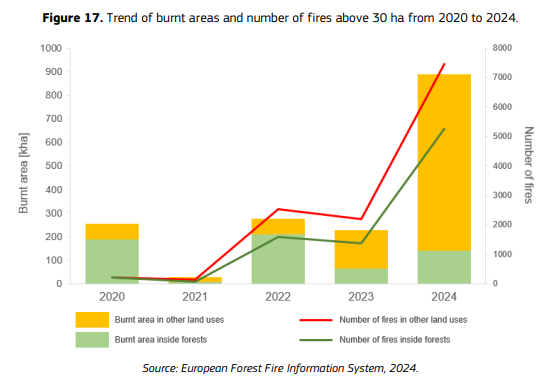
 

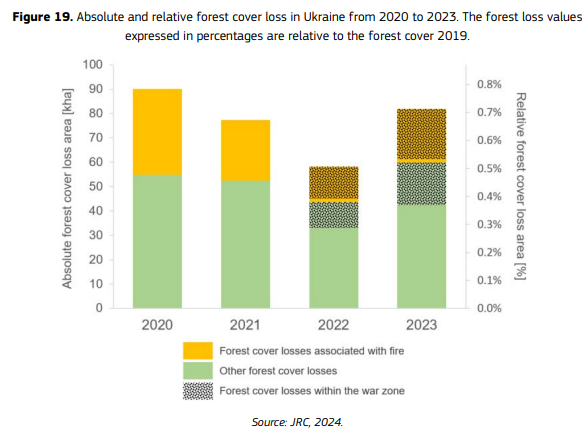
War sparked Ukraine’s worst wildfire year in history

New research published by the European Union found Russia’s ongoing invasion has worsened environmental challenges in Ukraine, including ongoing wildfire trends.

The risk of large forest fires has “significantly increased” in the nation. The country’s worst wildfire years happened over the last 5 years, by far the worst of which was in 2024, the EU study said.

“The ongoing conflict in Ukraine has severely hampered efforts to prevent and control large fires,” researchers said. “Restrictions on public access to forests and natural landscapes, introduced by Martial Law, have blocked fire prevention activities such as patrolling and establishing firebreaks.”

Numerous other wartime impacts have caused issues for wildfire mitigation, including the enlistment of firefighters and the destruction of fire management infrastructure.


Credit: Publications Office of the European Union

Wildfires account for between 45% and 65% of forest cover loss in the nation annually, cover loss that has worsened since the invasion began.

The spike was driven by more frequent heat waves, droughts, and windy weather, which Ukraine’s forest management and emergency response systems were not prepared to deal with.

“Explosive remnants and other potential causes further increase the risk of wildfires, and reallocation of fire-fighting resources makes it more difficult to prevent or control large fires,” the study said. “Climate change also contributed to forest cover loss by significantly increasing the risk of large forest fires, especially in the last five years.”

The largest forest fires in the nation happened in the Eastern and Southern regions, specifically Kharkiv, Luhansk, Donetsk, and Kherson oblasts. The fires tended to cluster along the front lines of military, underscoring the close relationship between conflict and forest fires.

Click here for the full study.

Credit: Publications Office of the European Union

Early Alaska wildfire season has quick snowmelt to blame

Teams competing in Alaska’s famous Iditarod Sled Dog Race know to be prepared for blizzards, sub-zero temperatures, and gale-force winds. Competitors in the 2025 race, however, were forced to add wildfires to their already treacherous list of extreme conditions in the race.

The race was moved to its northern route in early March after the Alaska Division of Forestry & Fire Protection declared an early wildland fire season, requiring burn permits starting March 17 instead of April 1, according to the Bureau of Land Management Alaska Fire Service.

Alaska’s most populous areas in the Kenai Peninsula and the Mat-Su Valley had two fires spread in snow-free grasses before the Iditarod’s 1st place racer crossed the finish line.

“The risk of human-caused fires has become evident, with at least 17 requiring a response as of April 6,” the Service said. “Most were the result of negligent burning, emphasizing the critical importance of ensuring that burn piles are monitored, keeping fire tools on hand, and never leaving a fire unattended.”

The state’s official first wildfire of the year was the result of an escaped burn set by a Mat-Su resident who was later found to be in violation of Alaska law regarding the “uncontrolled spread of fire,” according to the region’s local newspaper.

Credit: Alaska Division of Forestry and Fire Protection

Early snowmelt is largely to blame for increased wildfire risk throughout the state, according to recently published research from the University of Alaska Fairbanks. Each of the state’s largest and most extreme wildfire seasons was preceded by early snowoff, accompanied by large-scale climate patterns that keep a high pressure over the state.

“Three of Alaska’s four largest wildfire seasons occurred during years with earlier than average snowoff dates,” the researchers found. Many Alaskans will remember these seasons. In 2004, 6 million acres burned, and another 4.4 million acres burned the next year. In 2015, 5.1 million acres burned. Years with early snowoff were also responsible for more than half of the historical area burned in Alaska.”

Read the full press release regarding the research here.

New wildland firefighter pay scales released by US feds

Women in Fire Bootcamp

The U.S. Office of Personnel Management recently released new local pay scales for the nation’s wildland firefighters after lawmakers passed the Wildland Firefighter Payment Protection Act last month.

Lawmakers passed the act as part of the 2025 Department of the Interior, Environment, and Related Agencies Appropriations Act when they narrowly avoided a government shutdown on March 14. The act increases wildland firefighters’ special hourly base rates depending on an employee’s GS, or General Schedule, level. The increases include:

At least 28 dead as South Korea’s worst wildfire continues to burn

Fire crews are continuing to fight South Korea’s worst wildfire outbreak in history which has left 28 people dead, triggered the evacuation of nearly 40,000 people, and has burned nearly 40,000 hectares (99,000 acres).

Korea Forest Service Chief Lim Sang-seop on Thursday gave an update on the fires that have been burning throughout the nation since last Friday. He said the service had deployed thousands of firefighters, along with aerial and ground firefighting units.

The deaths have included firefighters, including a pilot in a firefighting helicopter who died when his aircraft crashed in a mountain area, officials said.

Sang-seop said crews have an uphill battle ahead. Less than 5mm of rain (0.2 inches) fell in some regions on Thursday, and only 1mm was forecast for Friday. The overall containment and extinguishment rate of the fires sit at around 60%.

Credit: Korea Forest Service

“We will do our utmost to prevent the spread of forest fires…We will do our utmost to prevent damage to firefighters and local residents…We will do our utmost to prevent damage to property,” Sang-seop said at the press conference.

Research published last year in the “Agricultural and Forest Meteorology” scientific journal found recent “unprecedented” wildfires across Korea are part of an increasing wildfire activity trend across the region. Korea’s climate regime has reportedly shifted from cold and wet to warm and dry winters, along with a 4°C (7°F) increase in temperature, an 8% decrease in relative humidity, and a 17mm (0.7 inches) decrease in precipitation.

“Dry winter weather has become increasingly severe, resulting in extreme drought in winter 2021 and early spring 2022, with the (fire weather indices) calculations revealing great potential dangers from fires,” the researchers said. “This study highlights that climate change may make forests more vulnerable to fire in temperate and mid-latitude monsoon-affected regions, where large-scale wildfires were not previously a concern.”

Click here to read the full study.

‘Extreme’ wildfire warning issued for Scotland as nation braces for peak fire season

Most of Scotland’s rural communities are under multiple wildfire warnings through Friday as authorities brace for the region’s “most critical period for wildfires.”

An “extreme” wildfire warning will go into effect on Friday for the nation’s low-lying areas, according to the Scottish Fire and Rescue Service. Until then, all of Scotland’s rural environments will be under a “very high” wildfire warning through Friday.

Once fires ignite in Scotland, they have the potential to burn for days, the service said.

“We are asking the public to exercise extreme caution and think twice before using anything involving a naked flame,” said Scottish Fire and Rescue Service Group Commander Murray Dalgleish. “Livestock, farmland, wildlife, protected woodland and sites of special scientific interest can all be devastated by these fires – as can the lives of people living and working in rural communities.”

Credit: Scottish Fire and Rescue Service

Nearly 80% of Scotland’s large outdoor fires since 2010 have burned between March and May, an average of 170 wildfires annually. Prolonged wet weather in 2024 significantly dropped that year’s total to 55, but has fueled the growth of new vegetation across the nation.

In 2023, Scotland and the United Kingdom experienced their worst wildfire in recorded history. The Cannich Fire burned 30 sq miles of woodland in the Scottish Highlands and over half of the Corrimony nature reserve. Before that, the largest fire to burn in the UK was a wildfire in the peatland of Sutherland’s Flow Country in 2019.

The Fire Brigaders Union, which supports firefighters in the UK, said the Cannich Fire was directly connected to the world’s ongoing climate crisis.

“July last year saw the temperature in parts of the UK exceed 40 degrees centigrade for the first time in recorded history, increasing the risk of wildfires,” the union said in 2023. “All governments must heed this stark warning: the climate crisis is here now. We need urgent climate action to prevent loss of life, and that must also involve serious investment in our fire services.”

Around two-thirds of Scotland’s wildfires are accidental, with the most common cause being discarded cigarettes or unattended campfires, the service said.

“To address these risks, SFRS is advancing its Wildfire Strategy, and have invested £1.6 million in specialist equipment and firefighter training to improve its response capabilities,” the service said on its website. “It is crucial that people understand the impact of careless fire-setting. Even with the best intentions, small fires can rapidly spread causing devastating damage.”

‘Significant’ spring wildfire risk in southeast US, driven by hurricane damage and drought

Florida wildfire

A spike in wildfire activity throughout the United States has kicked off an early fire season, according to the National Interagency Fire Center.

An estimated 9,520 wildfires have burned 269,986 acres across the nation as of March 14, the NIFC said. The year’s ongoing fire total is above the 10-year average of 6,629 wildfires, but below the 10-year average burned acreage of 431,052.

Over the past decade, the only years that have had more wildfires as of March 14 were 2022 with 12,088 wildfires, and 2017 with 10,328 wildfires.

The trend doesn’t look to be slowing down in the coming months. Numerous states will have significant wildland fire potential between March and June, according to the center’s outlook.

Large portions of multiple southeast states, including Florida, Georgia, North Carolina, and South Carolina, have heightened wildfire potential for all four months, driven in part by past hurricane damage.

Credit: NIFC

“The most notable concerns will be from Hurricane Helene’s impacts across northeast Florida into southern and eastern Georgia, western South Carolina, the North Carolina mountains, and adjacent southwest Virginia into northeast Tennessee,” NIFC said. “Areas from the Florida Big Bend into southern Georgia also saw hurricane damage from Hurricanes Idalia in 2023 and Debby last year. Debris burning, access issues in the mountains, excess dead and increasingly fire-receptive fuels, along with newly opened canopies, will all contribute to enhanced wildland fire potential as long as the fire environment allows.”

Portions of Arizona, Oklahoma, New Mexico, Texas, will also have heightened wildfire potential, along with southern areas of Alaska.

Click here to read the full report.

Wildland firefighter pay boost approved by Congress after years of anxiety

Firefighter on the Cerro Paledo Fire

After years of anxiety, a pay boost for wildland firefighters approved in 2021 was just permanently signed into law.

U.S. lawmakers avoided a government shutdown Friday night after they approved the “American Relief Act” federal budget. As part of the government funding, it also approved the 2025 Department of the Interior, Environment, and Related Agencies Appropriations Act, which boosted firefighter pay.

The act increases wildland firefighters’ special hourly base rates depending on an employee’s GS, or General Schedule, level. The increases include:

It also requires firefighters to receive premium pay for instances when they’re deployed to wildfires. The daily pay is equal to 450% of one hour’s wages when they’re responding to an incident outside of their official duties or assigned to a separate fire camp.

The pay boost has been a source of anxiety for the nation’s wildland firefighting force not long after the Biden Administration approved a $20,000 retention bonus in 2021. The bonus was only supplemental and legislators intended to enact a permanent pay increase.

That boost wasn’t made into reality until Friday night, majorly due to the legislative and lobbying efforts of the Grassroots Wildland Firefighters advocacy group.

“I feel comforted by the fact that House Republicans included the Wildland Firefighter Paycheck Protection Act in the House Interior Appropriations bill and that the Senate is there to match right alongside,” Jonathon Golden, a member of Grassroots, previously told WildfireToday. “My thought is that when we see a final Fiscal Year 2025 budget, we will also see some version of WFPPA that will make into law a higher pay for wildland firefighters.”

PREVIOUS COVERAGE: After years of anxiety, U.S. wildland firefighter pay boost may finally become permanent in 2025

Trump’s EPA may change obscure rule in attempt to increase prescribed burns

A 2012 prescribed burn in Ashland, Oregon

The United States Environmental Protection Agency’s top official announced Wednesday the agency will start the process of changing a decade-old rule with the hopes of increasing prescribed burns.

EPA Administrator Lee Zeldin, appointed earlier this year by President Donald Trump, said he has asked staff to specifically revisit the agency’s Exceptional Events Rule, which Zeldin claims has partially stood in the way of communities increasing their prescribed burning efforts.

The rule has long held prescribed burning in a gray area. The policy allows states to be exempt from meeting national air quality standards during “exceptional events,” or times of high pollution readings that states can’t control, like wildfires. However, a study published in February said prescribed fires may not always meet the exemption.

Since the practice is human-caused, is likely to recur, and is preventable, the current EPA policy would disqualify them as “exceptional events” and may lead to federal violations and financial penalties for states, according to the researchers. For this reason, EPA staff said that prescribed burns are virtually never nominated for exclusion under the rule.

“The relevant parts of the rule are very complex, but, to simplify, they indicate that if a prescribed burn complies with certain regulations and standard practices, it will be deemed by the agency to be “not reasonably controllable or preventable” and classified as a “natural” rather than “human-caused” event, such that the “unlikely to recur” requirement no longer applies,” the study said. To qualify, prescribed burns must comply with smoke management plans that reduce pollution effects and multiyear land resource management plans that set the frequency and location of burns. These requirements are quite complex and potentially burdensome.”

Zeldin affirmed that prescribed fires are necessary to protect communities from future catastrophic wildfires, but it’s unclear what changes he could make to the rule in order to increase prescribed burn activity. The EPA could have outright excluded as prescribed fires from the Exceptional Event Rule, but doing so may have incentivized states to avoid such burns and, instead, risk wildfires that are already exempt, the researchers said.

“As air quality standards are tightened, and as efforts are made to increase the pace and scale of prescribed fire on the landscape, it is possible that emissions from prescribed fires could have increased implications for nonattainment status,” the study said. “Indeed, the recent rulemaking process that lowered the annual PM2.5 standard raised significant concern within the forest management community over potential constraints the revised standard might impose on use of prescribed fire.”

USDA hires back all 6,000 fired workers from past month, including public land employees

Forest Service fire research

The United States Department of Agriculture on Tuesday announced each of the 6,000 probationary employees it had terminated since Feb. 13 now has their job back, the department said in a press release.

“By Wednesday, March 12, the Department will place all terminated probationary employees in pay status and provide each with back pay, from the date of termination,” USDA’s statement said. “The Department will work quickly to develop a phased plan for return-to-duty, and while those plans materialize, all probationary employees will be paid.”

The Merit Systems Protection Board, an independent federal court that focuses on government employee complaints, issued a stay order against the USDA on March 5. The Board ordered the reinstatement of every position terminated within the department since Feb. 13 to be reinstated for at least 45 days, on the grounds that USDA’s mass and indiscriminate termination was likely unlawful.

Wednesday, March 12, was the deadline for the USDA to submit proof it had complied with the Board’s order.

USDA’s mass firing on Feb. 13 included thousands of federal land employees, around 75% of which had secondary wildland fire duties, according to Grassroots Wildland Firefighters Vice President Riva Duncan, who obtained the numbers from the National Federation of Federal Employees’ Wildland Fire division.

“While ‘primary firefighters’ were exempt, the positions that were cut made some pretty huge contributions to operational wildland fire,” Duncan said. “For example, eastern national forests rely much more heavily on these collateral duty folks to do a lot of prescribed burning and initial attack of wildfires…There were people working the LA fires who, because it was the offseason, weren’t primary fire but were filling in on engines and crews.”