Laguna fire, September 26, 1970

September 26-Oct. 3 1970: The Laguna fire burned 175,425 acres, killed eight civilians, and destroyed 382 homes. In 24 hours the fire burned from near Mount Laguna, California into the outskirts of El Cajon and Spring Valley. Previously known as the Kitchen Creek Fire and the Boulder Oaks Fire, it was, at its time, the second largest fire in the recorded history of California.

The Laguna fire started from downed power lines during Santa Ana winds near the intersection of Kitchen Creek road and the Sunrise Highway in the Laguna Mountains in eastern San Diego County on the morning of September 26, 1970. In only 24 hours it burned westward about 30 miles (50 km) to the west. The fire devastated the communities of Harbison Canyon and Crest. Santa Ana winds are warm, dry winds that characteristically occur in Southern California weather during autumn and early winter.

Here is one of the pages from the report referenced below. Anyone remember when we used to make charts and graphs using colored pencils and graph paper?

From the official Laguna Fire Analysis, 1970

=======================

Laguna fire, 1970, using Google Maps, not colored pencils

For more info:
http://www.wildfirelessons.net/documents/Laguna_Fire_Analysis_1970.pdf

The day the Laguna fire started I was a crewmember on the El Cariso Hot Shots, and we were mopping up a brush fire near Corona. We heard the radio traffic that morning about the new fire and the reports that it was was cranking. It was The Big One. And there we were, stuck on the dreaded mopup on a fire that was pretty much out. For hours we kept poking around trying to find something hot to put out, as we kept hearing more about the fire on Laguna Mountain that was hauling ass. We wanted to be there.

El Cariso Hot Shots 1972
The El Cariso Hot Shots at Lake Henshaw in 1972. Photo: Bill Gabbert

Finally, late in the afternoon we were dispatched to it. By the time we got to Pine Valley it was after sunset, and for some reason, I, a first-year hot shot, was in the pickup with Ron Campbell, the Superintendent. The two open-top crew carriers were behind us. As we drove into Pine Valley the hills to the south and east were alive with the orange flames of the fire. The one radio channel we had on the Cleveland National Forest was completely jam-packed with radio traffic. You could not get a word in edgewise. We knew that this was going to be one that we would remember.

We worked on the fire all that night and then pulled several more shifts before we were transferred to the Boulder 2 fire in Cuyamaca State Park, which was a rekindle from the Boulder fire.

2008 firefighter fatalities

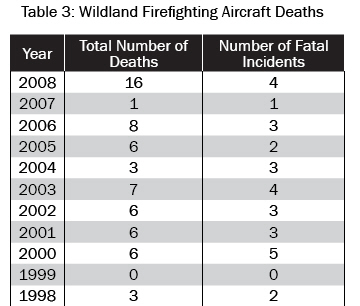
The U. S. Fire Administration has issued their annual report about firefighter fatalities. A sizeable portion of the report deals with wildland firefighters. The cover photo is from the memorial service for the nine firefighters and pilots that died in the Iron 44 fire helicopter crash in northern California.

Here are some excerpts.


Wildland Firefighting Deaths


In 2008, 26 firefighters were killed during activities involving brush, grass, or wildland firefighting. This total includes part-time and seasonal wildland firefighters, full-time wildland firefighters, and municipal or volunteer firefighters whose deaths are related to a wildland fire (Figure 5).

  • Two firefighters died when their brush truck was involved in a noncollision fall due to structural collapse of a bridge they were crossing that had been undermined by fire.
  • One firefighter was killed when the Single Engine Air Tanker (SEAT) he was piloting crashed.
  • One firefighter died of a heart attack while riding in a grass truck responding to an outdoor fire.
  • One firefighter died of multiple blunt trauma when he was struck by a vehicle entering the scene of a multiple vehicle collision. A contributing cause was heavy smoke from an outdoor fire and fog obscuring vision along the roadway. A sheriff’s deputy was also struck and killed and another deputy was injured in the incident.
  • One firefighter died from a nontraumatic brain hemorrhage several hours after returning with his Strike Team from the scene of a wildland fire.
  • One firefighter died when the medical helicopter he was being transported in collided with another medical helicopter, killing the firefighter and six others. The firefighter had been battling a fire on the north rim of the Grand Canyon National Park when he was bitten by an insect and taken to a nearby hospital for treatment. While in the hospital, he suffered anaphylactic shock from the antibiotics being used to treat the insect bite and it became necessary for the firefighter to be flown to a larger medical center.
  • One firefighter assigned the position of lookout on a wildland fire was helping carry hose up a hill when he experienced extreme fatigue and respiratory distress. He was transported to the hospital where he died the following day from a massive heart attack.
  • One firefighter working tree felling operations was struck and injured by a tree. Due to heavy smoke conditions, the firefighter had to be carried a distance before he could be evacuated by a U.S. Coast Guard (USCG) helicopter. While being transported aboard the helicopter, the firefighter went into cardiac arrest and died.
  • One firefighter, in preparation to assume management responsibility for a wildland fire, was scouting the area of operations when the fire spread quickly and burned over his position.
  • Nine firefighters, including two pilots assigned to the Iron Complex fire, were killed when their helicopter experienced a loss of power to the main rotor during takeoff, and subsequently impacted trees and terrain.
  • One firefighter died from a heart attack a short time after he returned home from fighting lightning-caused wildland fires.
  • One firefighter died from injuries sustained from a fall while scouting a fire in extremely rough terrain and dangerous rock cliffs.
  • One firefighter died from injuries sustained when he fell from a piece of heavy machinery while clearing fire breaks.
  • Three firefighters, two pilots, and the crew chief of an air tanker under contract with the USFS, crashed moments after take-off.
  • One firefighter collapsed and died from a heart attack while supervising a prison firefighting crew.

Thanks Dick

Senate passes wildfire appropriations bill

The Senate has passed a bill that provides funds for wildland fire management on federal lands in Fiscal Year 2010. Usually the Department of Interior initially receives the fire funds which are then dispersed to the other Interior agencies and the U. S. Forest Service, even though the USFS is in the Department of Agriculture. 

The bill includes an amendment supported by Senators Bingaman and Feinstein that includes the provisions of the previously proposed FLAME act, which not only provides funds for fire suppression, but also for funding to keep critical non-fire programs and services functioning even if unexpected expenses of very large fires consume a disproportionate share of the budget. 

The bill includes a 16% increase over last year’s budget.

Next, the bill needs to be conferenced to work out the differences between the Senate and the House versions.


Thanks Kelly

Missing engine part from Iron 44 helicopter crash

One “possibly crucial engine part” from the fatal helicopter crash on the Iron 44 fire last year in northern California that killed nine firefighters and pilots was missing when the crash debris was shipped from Columbia helicopters to the National Transportation Safety Board.

From Aero-News.net:

The wreckage from the aircraft involved in the so-called “Iron 44” incident had been sent to Columbia Helicopters, where NTSB and FAA officials observed while technicians tore down the aircraft’s engines. The NTSB subsequently asked that the engines be shipped to Washington, DC, but a footnote in the 500 page preliminary report indicates  “upon opening the shipping containers, an inventory of the hardware revealed that the following components from the FCU (Fuel Control Unit) Number 1 were not present: Metal position adjusting cover, snap retainer ring, spring retainer cap, spring and bellows.”

The FCU’s control the amount of fuel delivered to the engines.

A review of the video recording of Columbia employees packing the shipping containers shows the parts were not among the items shipped.

KDRV-TV reports that the general council for Columbia Helicopters said, while employees have searched “high and low” for the missing parts, they have been unable to locate them. The company says the FCU’s may not be a focus of the investigation, and therefore may not be important.
 
Greg Anderson, the attorney for William Coultas, the surviving pilot from the crash, as well as the family of one of those killed in the incident, told the station the omission of the parts from the shipment is “highly suspicious.”


Thanks Kelly

Iron 44 Crash Report

The Carson helicopter that crashed last year on the Iron 44 fire and killed nine firefighters was much heavier than U.S. Forest Service recommendations, according to National Transportation Safety Board reports. The NTSB said the weight was near maximum for vertical takeoff, requiring near-maximum engine power. So instead of climbing up on takeoff, the helicopter went forward, clipping trees before it crashed. Seven contract firefighters, the pilot, and a USFS inspector pilot were killed; four others survived.

On August 5, 2008, the Sikorsky S-61N crashed on takeoff from a remote site in the Shasta-Trinity National Forest near Weaverville, California. The NTSB is suggesting that Carson Helicopters understated the weight of its aircraft and kept spotty maintenance records; the company’s contract with the USFS was terminated last fall.

The NTSB estimated that the actual empty weight of the helicopter was 13,845 pounds, while Carson Helicopters stated in their contract proposal that the weight was 12,013 pounds. For the purpose of load calculations on the day of the crash, the pilot assumed the weight to be 12,408 pounds, which was 1,437 pounds less than the actual weight estimated by the NTSB.

The Oregonian reports that Carson, on the other hand, accuses investigators of neglecting critical facts in a rush to judgment. They say the NTSB used bad data in calculating the weather’s effect on helicopter performance, and that investigators extrapolated the temperature at 73ºF. at the site. Voice recordings from the co-pilot indicate the temperature was actually 68ºF.

Carson says the NTSB is trying to support a “preconceived conclusion” by using the higher temp in its calculations, and they also argue that the NTSB should have examined whether malfunctioning fuel control units caused the crash.

Killed on the incident were pilot Roark Schwanenberg, 54; pilot Jim Ramage, 63; Shawn Blazer, 30; Scott Charlson, 25; Matthew Hammer, 23; Edrik Gomez, 19; Bryan Rich, 29; David Steele, 19; and Steven “Caleb” Renno, 21.

Thanks, Dick

Teen Charged with Arson

The Associated Press reports that Los Angeles County prosecutors have filed arson charges against a 13-year-old boy they believe started the 2,100-acre Morris Fire near Los Angeles last month. Prosecutors in Pomona charged the boy yesterday with two felony counts: arson of a forest and recklessly causing a fire. The boy’s name was not released and he is not in custody. The District Attorney’s office says he must show up for a November arraignment; if convicted, he could be held at a juvenile facility until he turns 25.

Arsonist: 13 years old

The arsonist who torched off the Station Fire on the Angeles National Forest hasn’t been apprehended yet, but investigators do have a suspect in the ignition of the Morris Fire. And he’s 13 years old.

Prosecutors are discussing whether to file charges against the boy, who’s suspected of starting the 2,100-acre fire just north of Azusa, California. According to the L.A. Times, detectives presented the case yesterday to the Los Angeles County District Attorney’s office. They said the boy is “primarily responsible for igniting the fire.”

The Morris Fire took off on August 25 in San Gabriel Canyon — the same day the Station Fire started.
It was contained on September 3. According to an AP story, the 13-year-old suspect is not in custody, but the D.A.’s office says that charges will likely be filed today.

Southern California Public Radio reported that the L.A. County Sheriff’s Department has not identified the boy. Their report also noted that the ignition point for the Station Fire was miles away from that of the Morris Fire, to the northwest along the Angeles Crest Highway above Pasadena.
The search for the Station arsonist is also a homicide investigation, because of the deaths of Tedmund Hall and Arnaldo Quinones, two L.A. County firefighters who were killed on the fire.

———- UPDATE 09/18/09
Los Angeles County prosecutors say it could take two weeks before they decide whether to file arson charges. Jane Robison with the District Attorney’s office said the case is under review, but prosecutors want more information.

Emergency vehicle visibility study

In August a report titled “Emergency Vehicle Visibility and Conspicuity Study” was released by the United States Fire Administration in partnership with the International Fire Service Training Association. Here is an excerpt from a summary by Firehouse.

The report from the feds suggests that a lot more could be done to improve passive vehicle visibility and conspicuity. Best practices in emergency vehicle visibility, including cutting edge international efforts, are detailed in the study. Retroreflective striping, chevrons, high-visibility paint, built-in passive lighting and other reflectors for law enforcement patrol vehicles, fire apparatus, ambulances, EMS vehicles and motorcycles are all covered in the report.

Active warning systems, like lights and sirens, are part of a separate federal study and are not included in the August USFA report.

Tutterow is hoping the report catches news media attention and it gains some much needed publicity. He’s also hoping it lasts more than one news cycle.

“Drivers today have too many distractions,” Tutterow said. “They have cell phones, they’re texting, they’re using GPS navigation systems, and they’re using sound systems. They are paying attention to everything but what is in front of them.”

That’s why Tutterow subscribes to a sort of “in-your-face” approach when it comes to retroreflective material and visibility aids.

“I’m not sure that there is such a thing as overkill when it comes to retroreflective material,” he said.

The yellow and red chevron stripping on the backs of apparatus is an example of how something relatively simple and cost effective can have a dramatic affect on responder safety. New apparatus, to be National Fire Protection Association compliant, must have at least 50 percent of the rear body covered with chevron stripping. Tutterow’s hoping emergency responders will see the value and retrofit existing response vehicles to the standard.

Thanks Dick

Man appears in court on 191 charges linked to Black Saturday fire

Brendan Sokaluk, 39, appeared on Tuesday in Melbourne Magistrates’ Court in Australia via video link from prison. He is facing 191 charges related to one of the fires that burned across Victoria on February 7, including 10 counts of arson causing death, intentionally causing a bushfire, criminal damage, recklessly causing injury, and possessing child pornography. 

The Magistrate set a pretrial hearing date for May 31, where 610 witnesses are expected to testify over six weeks. The hearing will determine if there is enough evidence to begin a jury trial.

Numerous fires burned in Victoria on February 7, Black Saturday, killing 173 people and destroying more than 2,000 homes. Mr. Sokaluk is charged with setting one of the fires which killed 10 people.


Constructing fireline with high-expansion foam

Chief Charles Scripps of Painted Rocks Fire and Rescue in Darby, Montana conducted what they call a “foam experiment”. Here is their description of the video:

We flowed foam using a Chemguard foam generator to see if it would have value in the wildland environment. We used 1000 gallons of water with a 2% foam solution (Hale digital foam system). The test took about ten minutes. The foam line was about 1000-1200 feet, 20-40 feet wide and 2-4 feet deep. Further testing for ‘foam and roll’ as well as different percents of foam will take place.

(THE VIDEO IS NO LONGER AVAILABLE)

I have seen photos of this procedure before, and it has been used on prescribed fires, but has anyone ever seen it used on a wildfire?

In order to do this, you need a high-expansion foam generator, as opposed to a much smaller medium-expansion foam nozzle which is about 8-12 inches in diameter. Some high-expansion foam generators are so large they are mounted in the back of a pickup truck and most use either a water motor or a gasoline engine to drive a fan, which introduces a large quantity of air into the water/foam solution.

Thanks Chief Scripps and The Latest.

======================

UPDATE September 15, 2009

From The Latest, we have more information from Chief Scripps:

The unit is a Chemguard model 300WP. This is a water driven unit so the engine does not need extra equipment. There are units that are electric or gas driven but neither develops the rpms of the Pok water motor.

I chose this one as it weighs 115 lbs and the next size up weighs 225 lbs. There is a limit to what I can get old volunteers to load, unload and carry safely. The foam was Silvex at 2% as measured by a Hale digital unit. The engine holds 1000 gallons so that was the limit of the trial. The factory recommendation is to run it at 80 psi. So for our first test that’s what we did.

I had seen the YouTube videos of high expansion foam filling aircraft hangers. What intrigued me was when they opened the hanger doors and the foam flowed out on the apron. I wanted to see how it would flow down a mountain. It seems to do this very well. High expansion foam lacks the durability of the denser stuff but it makes a very fast wetline. I think it would be excellent for ‘foam and roll’ in low fuels. I am trying to engineer a method to mount it to my engine so it would function off either side. One of the difficulties for testing is we are running out of summer weather so testing in hot weather conditions is getting difficult.


This is the engine we used.