SDG&E leases Erickson Air-Crane helicopter

On September 9 Wildfire Today reported on San Diego Gas and Electric’s plans to lease a large helicopter that would be available to fight wildfires. They now have in place an Erickson Air-Crane S-64E Type 1 helicopter that can be ordered through the San Diego Fire Department. The first two hours will be free, paid by SDG&E, with any additional time costing $7,500 an hour. When the helicopter is not fighting fires, it will be used to build a new power line.Photo: Erickson Air-Crane

The helicopter is being leased through and operated by Erickson Air-Crane and will be stationed at Brown Field in Otay Mesa.

The San Diego Union-Tribune has an article that explores the relationship between SDG&E and the San Diego City Council, and how the Council supported the power company’s plan to shut off the electricity to large sections of the county during periods of high fire danger. 

Television special about Air-Cranes

How did we miss this? From Erickson Air-Crane’s web site:

The first ever one-hour documentary devoted exclusively to Erickson Air-Crane and our S-64 has premiered worldwide on the National Geographic Channel in the United Kingdom, South Africa, India, Southeast Asia, Australia, Iceland, Lithuania, and most recently in the United States on Thursday, September 17th and 24th under the title: “Aircrane: Extreme Helicopter” The program is currently scheduled to repeat through the rest of the year. The nationwide premiere of program on National Geographic Canada is scheduled for October 16th at 9 p.m. P.S.T. 

I was unable to find any future broadcast times for the program on the NGC’s web site. If anyone has information about this, let us know.


More debate about evacuation: stay or go.

The Ramona Sentinel in California has an article about evacuation…. stay or go.  Here is an excerpt:

The debate about whether to stay and attempt to defend your home or evacuate to a safe place when a wildfire strikes only has one answer in the mind of CalFire Battalion Chief Greg Griswold with the Ramona Fire Department. 

“If you are asked to evacuate, please do. It makes our job so much easier,” Griswold said. “If we know that you are still in an area, we have to keep that in the back of our minds, and worry about what you are doing and whether you are safe or not.

“I know that this is a very emotional subject and I understand that people want to stay and protect their homes—we all do. But in my experience, people who don’t evacuate panic when the fire gets there, and then they feel a need to leave. But by then, the visibility can be down to zero sometimes and they can run off the road.”

Or they block roads so that firefighters can’t get in and other residents can’t get out, said Griswold. 

“In the Witch fire in October 2007, we had no less than 40 rescue calls from people who wanted to stay and changed their mind,” Griswold said. 

And firefighters were not able to reach all of those needing help. Some homeowners survived by jumping into ponds and pools, but a couple on Highland Valley Road were not so fortunate and perished in the flames.

“We tried to get two fire engines in there to help but could not,” Griswold said. “I still think about that every day.”

But saving lives is not the only issue here.

“Rescue attempts take away valuable resources that could be spent on saving structures and trying to take the offense to suppress fire activity,” Griswold said. “As the years of drought have persisted, the burning conditions have become more critical and we have huge challenges in this area. The 2003 and 2007 fires burned hotter and faster than anything we’ve ever seen before. I think a lot of people were taken by surprise.”

Technically, fire and police officials cannot force people to leave their home against their will, unless they have minor children. And there are times that it might be safe to stay, Griswold said.

“But when an evacuation is ordered, we don’t have time to go to each homeowner and say, ‘You’ve got clearance, it’s OK for you to stay, but it’s not OK for your neighbor. They must leave.”

Senate passes bill that includes $4M for belly tanks for National Guard Blackhawk helicopters

Most of the National Guard Blackhawk helicopters that I have seen dropping water on fires have used a collapsible bucket hanging from a very short line, about 25-30′ long. The prop wash from the rotor blades blows the fire all over the place. At times a pilot will drop at high speed to  minimize the prop wash.

That’s why I was pleased to see an earmark in the 2010 Department of Defense Appropriations Bill that allocates $4,160,00 for fixed belly tanks for National Guard Blackhawk helicopters.

Funding would be used for engineering, evaluation and procurement of the Recoil UH-60 Blackhawk Helicopter R60 Wildland Fire-Fighting Tank System (900 gallon) for the Army National Guard (ARNG). This is in an aim to make R60 tanks become organic equipment of the ARNG be distributed nationwide to State Army National Guard to support and respond to wildland fires.


Gas strut explosion, Sacramento vehicle fire

The Sacramento Fire Department issued a “green sheet” that summarizes an interesting development that occurred during the suppression of a vehicle fire on September 26. Two gas struts that assist in opening the hood exploded, propelling the struts out the front of the vehicle. Both struts struck a garage door. One made a hole in the door and bounced off. The other penetrated the door and became embedded, leaving only about three inches of the strut exposed, making a one inch hole in the door.

Thankfully, the burning vehicle was parked one or two feet from a garage, making it impractical for the firefighters to make their attack from the front, which is not advised anyway due to the possibility of gas shock absorbers being in the front bumper assembly.

You never know for sure where these gas struts can be in a vehicle. They can also be found in rear hatch doors or the rear windows on SUV’s.
Photos from Sacramento FD Green Sheet

On January 29, 2009 we posted a video of what was probably the front bumper exploding off the front of a burning car. That is HERE.

As Sgt. Phil Esterhaus said, “Let’s be careful out there”.

Top 20 list of largest fires in California

An article in the Ventura County Star addresses the issue of escalating costs of suppressing wildfires. Here is an excerpt:

Experts say the cost of fighting fires in California is soaring for two reasons: the effects of climate change on vegetation and the development patterns that have increasingly relocated homes and residents into wildlands.

A report issued in May for the California Climate Change Center finds warmer temperatures and longer dry seasons are the principal reasons for increased wildfire risk. It notes higher temperatures have accelerated water loss from vegetation, “increasing the risk of rapidly spreading and large fires.”

Ominously, one study done for the Climate Change Center predicts the risk of wildfires that threaten residential areas will at least triple by 2050.

Compounding the challenges for firefighters, and escalating the costs for taxpayers, is the fact that urban development has increasingly encroached into the areas of highest fire risk.

“The main problem is that we have more fires in areas where there are more people,” said Carroll Wills, spokesman for the California Professional Firefighters, the state firefighters’ union. “In past decades many of these fires were in areas where there weren’t people. It was easier to surround them, and that made it less expensive.”

Upton said that when a fire breaks out in remote areas, firefighters can “catch it at a ridgeline.”

“It is much more expensive to fight a wildfire in and among homes and communities,” she said. “It tends to turn into a rescue more than anything. Meanwhile, the fire perimeter grows.”

The article also listed the 20 largest recorded wildfires in California by size:

FIRE NAME/CAUSE/ DATE/ COUNTY/ ACRES/ STRUCTURES/ DEATHS

1 Cedar (human) October 2003 San Diego 273,246 2,820 15

2 Zaca (human) July 2007 Santa Barbara 240,207 1 0

3 Matilija (undetermined) September 1932 Ventura 220,000 0 0

4 Witch (power lines) October 2007 San Diego 197,990 1,650 2

5 Klamath Theater Complex (lightning) June 2008 Siskiyou 192,038 0 2

6 Marble Cone (lightning) July 1977 Monterey 177,866 0 0

7 Laguna (power lines) September 1970 San Diego 175,425 382 5

8 Basin Complex (lightning) June 2008 Monterey 162,818 58 0

9 Day (human) September 2006 Ventura 162,702 11 0

10 Station (human) August 2009 Los Angeles 160,557 209 2

11 Mcnally (human) July 2002 Tulare 150,696 17 0

12 Stanislaus Complex (lightning) August 1987 Tuolumne 145,980 28 1

13 Big Bar Complex (lightning) August 1999 Trinity 140,948 0 0

14 Campbell Complex (power lines) August 1990 Tehama 125,892 27 0

15 Wheeler (arson) July 1985 Ventura 118,000 26 0

16 Simi (under investigation) October 2003 Ventura 108,204 300 0

17 Hwy. 58 (vehicle) August 1996 San Luis Obispo 106,668 13 0

18 Iron Alps Complex (lightning) June 2008 Trinity 105,805 2 10

19 Clampitt (power lines) September 1970 Los Angeles 105,212 86 4

20 Bar Complex (lightning) July 2006 Trinity 100,414 0 0

Beetle-killed trees affect fire behavior in Montana

The Missoulian has an article about how beetle-killed trees affected fire behavior in Montana this summer. Here is an excerpt:

For [Tyler] Brothers and pilot Matt Conant above the Bielenburg fire, the afternoon of Sept. 26 just wouldn’t quit. Even the smoke was weird.

“For some odd reason, when it got to highway, it would lift up over the highway, and then curl back down,” Brothers said of the smoke column. “People were thinking it was spotting over the highway, eight miles away.”

And then, Brothers saw the Racetrack campground, and two trucks parked there.

The wind was gusting over 40 mph, knocking the helicopter around. The fire was a mile from the campground and moving that way fast. Fire incident commander Jon Agner ordered the helicopter crew to find the campers and prepare them for evacuation. Powell County Sheriff’s Deputy Ron Cain also drove into the woods to lead them out.

The firefighters lost radio contact with Cain. Fire burned over the Racetrack campground. Brothers eventually found Cain, two fathers and two kids three miles farther into the forest, where they were surrounded by beetle-killed trees and no safety zone. Agner was able to drive up the drainage and lead the group down the blackened road.

As evening came on and the fire calmed down, Brothers made another mapping circuit of the fire. This time, he saw a truck parked at a small Forest Service cabin still farther up the Racetrack drainage. A big tree had fallen across the truck’s bed, immobilizing it.

The helicopter crew scouted several ATV trails that wove amongst the lakes at the head of the drainage, but couldn’t find the truck’s occupants before darkness forced them back to base. Forest Service law enforcement rangers had to drive up the road in the dark to find the two campers, cut their truck free and lead them out. The ground was so hot, it scorched the paint on their vehicles.


A new way to transport water to fires

Someone whose name I believe is Steve Shoap, judging from the email address he leaves, keeps leaving comments attached to various articles here on Wildfire Today attempting to promote his invention. We have not approved any of the comments for publication because our policy is to not bother our readers with spam and unsolicited advertisements.

But this invention of his is supposed to be a “new way to fight wildfires”. It involves truck-mounted reels of large diameter hose (LDH) that has high voltage electric power wires embedded into the walls of the LDH.  An electric generator energizes the wires which power water pumps at intervals along the hose. (And we all know it’s a good idea to have water and high voltage electricity in close proximity.)

From safersmallercars.com

He estimates the cost for one mile of the system would be $210,000 including the generator.

Disregarding the water/electricity combination for a moment, there may be some special situations or types of fires where a system like this would be useful, but generally, getting water to a wildfire so that it can be utilized by firefighters is not the biggest factor that prevents wildfires from being controlled.

What do you think about this new invention?

Escaped prescribed fire burns toward Williams, Arizona

Ten air tankers have been ordered from California to help slow down a fire that began as a 900 acre prescribed fire near Williams, Arizona.

Here is the news release issued by the U. S. Forest Service:

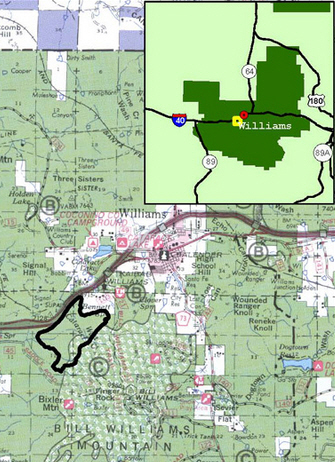
WILLIAMS, Ariz. – Kaibab National Forest fire managers today transitioned the Twin Prescribed Burn to a wildfire. Suppression actions are being taken to stop fire spread on the northeast side of the fire. The Twin Fire is approximately 950 acres, three miles southwest of Williams and west of Bill Williams Mountain.

The prescribed burn was initiated yesterday. During the burn, winds shifted from the northeast to the southwest. Several spot fires occurred outside the project area on the northeast side of the burn as a result. Today, additional resources, including air tankers were ordered to suppress the fire.

The extended forecast calls for moderate winds through the weekend with a chance of precipitation.

Map of Twin fire, October 2. USFS

The Twin fire is southwest of Williams and Friday afternoon was being pushed by a southwest wind. About 350 acres have burned since it was declared an escape. A Type 1 incident management team has been ordered.

The weather forecast (issued Friday night) for Saturday calls for the temperature to be in the high 60s, relative humidity of 19%, and southwest winds at 15-18 with gusts of 30-36. There is a 32% chance of a small amount of rain after 1 a.m. Sunday. By 5 p.m. on Sunday the chance of precipitation should decrease to 3% with an RH of 28% and southwest winds at 32 mph with gusts up to 44.

Lesson learned, flare launching

A firefighter was injured while using a flare sold by FireQuick.

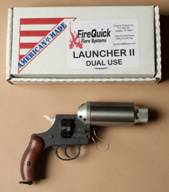
The FireQuick company, sometimes referred to as Quoin, sells a launcher that is a modified starter pistol which fires .22 caliber blank cartridges. You place the flare, which looks a little like a short fusee, into the oversized barrel. When the cartridge fires, it propels the flare and ignites a 4-second fuse. The flare they call the Hotshot will travel about 300-325 feet according to the company. The FireQuick web site includes this statement about the Hotshot flare:

This flare is to be launched only and is NEVER to be ignited by hand; serious injury may occur if hand-ignition is attempted.

FireQuick imageFireQuick makes two kinds of flares that can be launched: the Stubby (see below) and the Hotshot. They also make hand-thrown flares they call “Big Shot” and “Chubbie”.

The following lesson learned, posted HERE, raises a lot of questions.

====================================================

LESSONS LEARNED
HOTSHOT FLARE

FireQuick’s Hotshot flare

Date & Time: August 7, 2009
Location: Bear Canyon, San Carlos Agency BIA
Employee: Firefighter
Reason: Suppressing Wildland Fire

Details:
A firefighter was injured using a Hotshot flare which ignited in their hand after the fuse was lit.  The firefighter is ok at this time, but has sustained burns on his left fingers and palm.  The firefighter was not wearing gloves at the time when the incident occurred.

Lesson(s) Learned:

  • Always wear required Personal Protective Equipment; eye protection, gloves, ear protection, long-sleeve shirt (sleeves rolled down) and pants.  Clothing must be approved flame resistant fabric.
  • Wear leather non-gauntlet gloves to prevent burning slag from touching your skin.
  • If cap of flare comes loose or falls off discard in burn area and let others know of location.
  • This flare is to be used only with the firequick launcher and NEVER ignited by hand as serious injury may occur if hand-ignition is attempted.
  • Develop JHA for this device and ensure others review it before using this type of firing device.

===================================================

The document does not explain how the flare came to be in the firefighter’s hand. Was it a mis-fire that they removed from the launcher, or were they trying to use the flare without the launcher by holding it in their hand?

Does anyone have any experience using one of these Hotshot flares without the launcher?

Wildlandfire.com has some photos of a launcher that shattered when a rocket scientist attempted to launch a fusee in the device.

“Retired Flares”

The FireQuick web site has some interesting information about “retired flares”. Their 2.5-inch flares that exceed the 3-year shelf life “should be recognized as a potential for unusually energetic behavior”. The Dual-Stubby flare only launched about 80% of the time.

The “Stubby” flare

Here is a photo of the “Stubby” which is launched from a launcher having a larger diameter barrel.

Stubby flare
“Stubby” flare