Athens wildfire threatens homes

A volunteer firefighter extinguishes a bushfire in Magoula village, a few miles northwest of Athens, August 20, 2009. REUTERS/Yiorgos Karahalis

We’re bringing you the story of a fire in Greece which is threatening homes near Athens because we needed an excuse to include the photo above of the firefighter attempting to put out a vegetation fire with a dry chemical fire extinguisher. We will have to assume that for some reason that was the only option available to the firefighter at that time.

Is there a watch-out situation that addresses attacking the head of a fire with a dry chemical fire extinguisher?

There are no more details about the fire available except that a warehouse and two trucks burned, and the fire is being fought with 100 firefighters, 25 engines, and 5 helicopters.

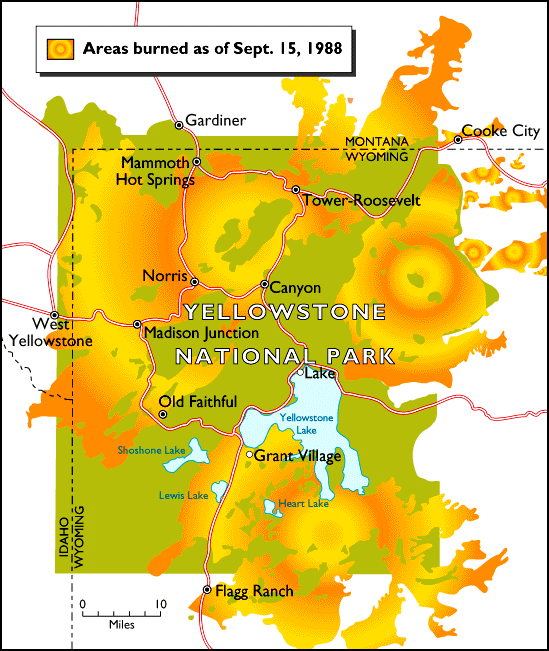
Yellowstone fires, big blowup, August 20, 1988

In the summer of 1988 numerous fires burned 793,000 acres of Yellowstone National Park as well as large tracts of land surrounding the park. Half of the acres burned inside the park resulted from fires that started outside the boundary. Nine of the fires were human-caused, and 42 were started by lightning.

Protecting the Old Faithful Inn, 1988. Photo: Jeff Henry

On the worst single day, August 20, 1988, tremendous winds pushed fire across more than 150,000 acres. Throughout August and early September, some park roads and facilities were closed to the public, and residents of nearby towns outside the park feared for their property and their lives.

Yellowstone’s fire management policy was the topic of heated debate, from the restaurants of park border towns to the halls of Congress. Following this event, the National Park Service and other federal land management agencies rewrote their policies affecting how they managed fires with less than full suppression strategies.

Helicopter pilot believed dead after crash in B.C.

Authorities now believe that the pilot who was flying the helicopter that crashed into the Fraser River in British Columbia on Friday is dead. Our sincere condolences to the family and co-workers.

From EastOttawa.ca:

Robert Christopher Woodhead, 53, of Stoney Creek, Ont., was operating a Bell 212 helicopter with a line and water bucket Friday afternoon when the aircraft went down in the Fraser River, near Lytton, B.C.

RCMP Cpl. Dan Moskaluk said Mounties believe Woodhead died soon after the chopper crashed in water 15 metres deep and with a swift current.

“We have met and spoken to the family,” Moskaluk said.

“It is believed that Mr. Woodhead perished in the river.”

Woodhead, who was based in B.C., was last seen in the water just after the crash by another pilot who was flying overhead.

That pilot tried to save Woodhead by lowering his own line and bucket into the water but the rescue attempt proved unsuccessful.

Moskaluk said search crews have recovered Woodhead’s flight helmet, as well as pieces of debris from his helicopter, but they have yet to find the man’s body in the water.

“In incidents of this nature, with the incertitude of the person’s fate, it leaves all in a suspended state of deep grief,” he said.

“Our thoughts, along with those of all British Columbians, whose lives and homes were protected in this and in past fire seasons by the courageous efforts of ground firefighters and the pilots assigned to battling these blazes, are with the Woodhead family at this time.”

B.C.-firefighting helicopter crashes into river, pilot missing

From the C.P.:

LYTTON, B.C. — The search continues in the rushing waters of the Fraser River for an Ontario helicopter pilot whose aircraft crashed while fighting one of the many forest fires burning across British Columbia.

The Bell 212, piloted by 53-year-old Robert Christopher Woodhead of Stoney Creek, Ont., was operating as a waterbucket on the 12-square-kilometre Intlpam fire near Lytton late Friday afternoon when it went down.

The helicopter is now submerged in 15 metres of water flowing at about 16 kilometres per hour, but there’s no sign of Woodhead, who was the only person in the aircraft.

Woodhead’s family in Stoney Creek say they aren’t commenting on the search.

Cpl. Dan Moskaluk of the RCMP says the federal Fisheries Department and a local search-and-rescue squad have boats on the water and a Mountie helicopter is searching from the air, but he says the water is too rough to use divers.

Moskaluk says witnesses reported seeing the pilot surface after the crash, prompting the Mounties to focus thier efforts on the water and riverbanks.

The B.C. Forest Service had contracted the chopper, which is the second aircraft the crash this fire season, although this is the first fatal crash.

A single-engine (air tanker) crashed into Okanagan Lake on July 25, but the pilot escaped without injury.

UPDATE at 5:10 p.m. MT, Aug. 15

The story has been updated by the Canadian press at 2:36 p.m. MT today. Here is an excerpt:

KELOWNA, B.C. — An Ontario helicopter pilot who was helping to fight one of British Columbia’s many forest fires was still missing Saturday, a day after another pilot flying overhead was unable to pull the man from the water in a dramatic rescue attempt.

Robert Christopher Woodhead, 53, of Stoney Creek, Ont., was operating a Bell 212 with a waterbucket Friday afternoon when the aircraft when down in the Fraser River near Lytton.

Woodhead, who was based in British Columbia, was last seen in the water just after the crash by another pilot who watched from the air as the helicopter went down, said RCMP Cpl. Dan Moskaluk.

“A valiant attempt was made by lowering his line and bucket into the river near Mr. Woodhead,” Moskaluk said in an interview.

“However, he was not successful in getting the line to him and did eventually lose visual sight of the pilot in the water.”

Moskaluk said police are still considering the search a rescue operation, and are concentrating their efforts on the riverbanks in what is considered a particularly rough part of the Fraser Canyon.

30th anniversary of the Spanish Ranch fire

The La Brea fire is burning across the highway from where the 1979 Spanish Ranch burned 30 years ago today. The August 15, 1979 wildfire claimed the lives of four California Department of Forestry and Fire Protection (CALFIRE) firefighters who were working on an indirect fireline 40 miles east of Santa Maria, California. Those four firefighters were Captain Ed Marty, and firefighters Scott Cox, Ron Lorant and Steve Manley.

Joe Valencia wrote, Area Ignition, which is a book about the 1979 fire. Joe also put together a document on the Lessons Learned site that gives a brief summary of the incident.

Here is the cover page from Joe’s document.

The Spanish Ranch fire is one of the in our recently revised partial list, by date of the year, of some of the more famous, or infamous, multiple fatality wildland fires around the world over the last 150 years.

Martin Mars video

Here is a video of the 7,200-gallon Martin Mars air tanker doing some training and pilot re-currency in southern California. Some of the video was shot in infrared, probably from the lead helicopter that works with the aircraft. The audio has been disabled.

(THE VIDEO IS NO LONGER AVAILABLE)

The Martin Mars is currently working on the La Brea fire in southern California.

Midwest Helicopters on DIY Network

Desiree Horton, the helicopter pilot who writes the blog The Adventures of Chopper Chick! is now working for Midwest Helicopters out of Chicago and just recently ferried one of their S-58T’s to Boise “for fire season”.  Her blog is always interesting to read.

She pointed out that the DIY Network featured her company in a 20 minute segment in which they were lifting heavy equipment to the tops of buildings in downtown Chicago. It’s fascinating to watch.

South Dakota, Fossil fire

Today I took some photos of action around the Fossil fire, which is about 8 miles northwest of Hot Springs, South Dakota, west of Wind Cave National Park. The last I heard, air attack was estimating the size at approximately 10 acres and the spread had been slowed.

It was a walk-in, and in addition to the firefighters on the ground, they had one single engine air tanker, one helicopter, and a dozer. A second helicopter, a national guard Blackhawk, and a heavy air tanker from Grand Junction, Colorado were also ordered; I don’t know if they ever arrived.

UPDATE at 10:30 a.m. MT Aug. 12

The local Type 3 Incident Management Team was ordered, but the fire was contained Tuesday night after burning 12 acres. Good job by the firefighters on this lightning-caused fire which initially at least, was not accessible by engines.

Oh, and the Rapid City Journal published my photo of the helicopter dipping out of the portable tank in the meadow.

A helicopter dipping at Cold Brook reservoir.


A helicopter dipping out of a portable tank near the fire. There were 3-4 water tenders shuttling water from quite a distance to keep the tanks full.


Single Engine Air Tanker #839 doing a hot refuel and reload at Hot Springs Airport.

Santa Maria air tanker base gets heavy use again

The air tanker base that was down-graded earlier this year from a full-time base to a call when needed base is again seeing very heavy use as air tankers reload there while working on the La Brea fire 24 miles east of the base. In May during the Jesusita fire the Santa Maria air tanker base set a new national record for the most fire retardant pumped in a single day–158,000 gallons, according to an article in the Santa Barbara Independent by Nick Welsh.

On Saturday, the first day of the La Brea fire, eight air tankers worked the fire. For Tuesday, ten air tankers have been requested, including four heavies, four S-2s, and one single engine air tanker. And, the 7,200-gallon Martin Mars will arrive in the area at noon today to work the fire and will be refilling its tanks by scooping water from Cachuma reservoir which is 24 miles south of the fire.

Five type 1 helicopters (three Aircranes, one S-61, and one Vertol 107) and at least four type 2 helicopters (all Bell 212s) are expected to be working the fire today.

HERE is a link to a video at KSBY about the air tanker base and the La Brea fire.

Decker fire, 50 years ago today

Decker Fire graphic

On August 8, 1959 the El Cariso Hot Shots experienced the first of two fire tragedies the crew would be involved in. The fire was the Decker Fire located in the foothills above Lake Elsinore, California. Seven people were overrun by fire and six lost their lives. Three were members of the El Cariso Hotshot Crew.

In 1966 12 members of the crew were killed when they were entrapped on the Loop Fire.

Decker Fire graphicFor more info:

http://www.wildfirelessons.net/documents/Decker_Fire_1959.pdf