


The U.S. Forest Service has 18 large air tankers on exclusive use (EU) contracts this year.
In 2020 the agency started out with 13 on contract in April and May but by June 24 had added 11 on modified call when needed (CWN) contracts for a total of 24. Modular Airborne FireFighting Systems C-130 aircraft from the National Guard and Air Force Reserve were deployed from July 23 until October 4 in 2020, usually two at a time.

This year the 18 EU large air tankers are being supplied by five vendors:
- Six, Aero Flite (RJ85)
- Four, Erickson Aero Tanker (MD87)
- Four, Neptune Aviation (BAe-146)
- Two, Coulson Aviation (C-130)
- Two, 10 Tanker (DC-10)
(Update: the schedule below created by the U.S. Forest Service was added to this article March 22, 2021)
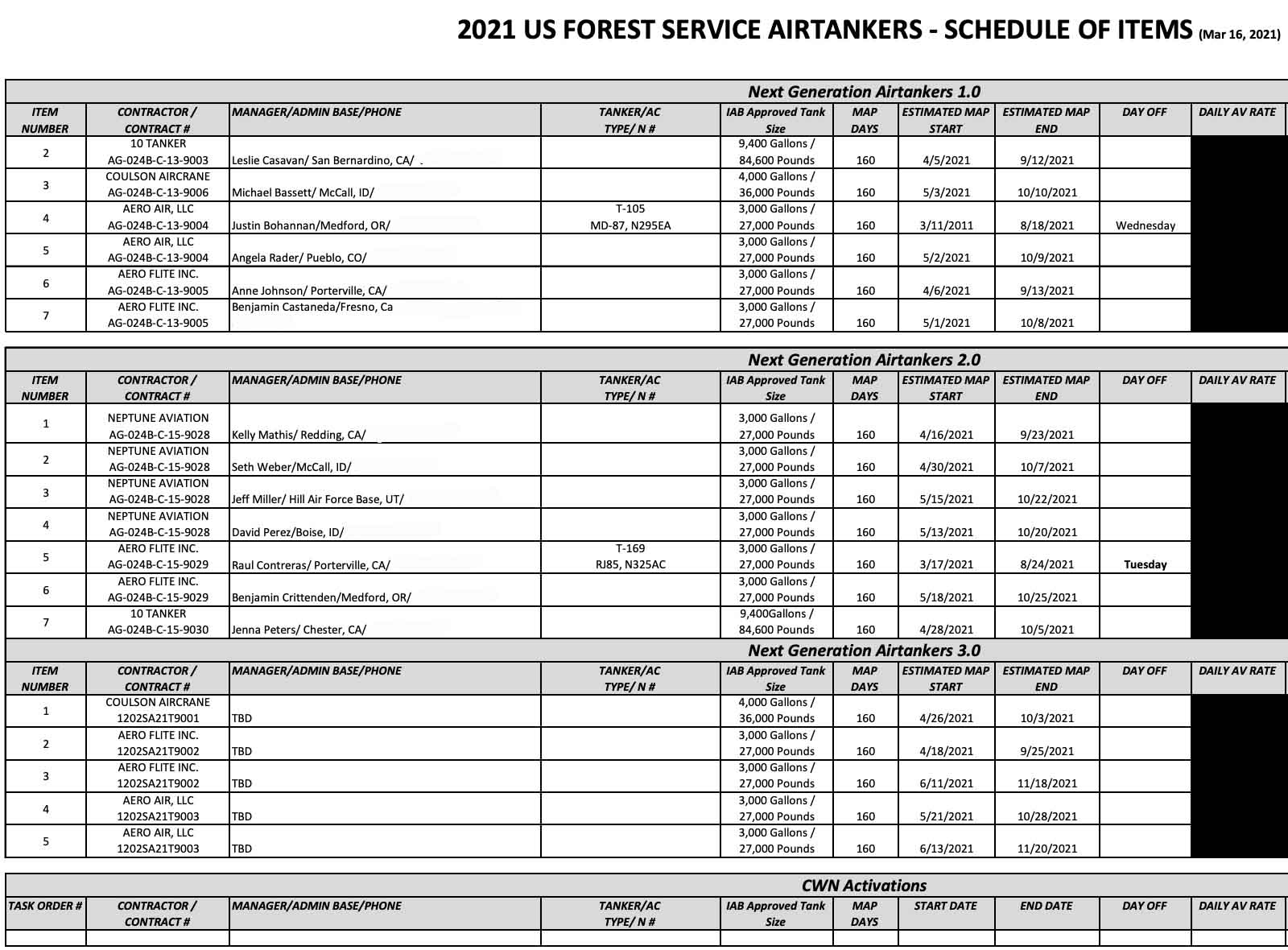
The dates they will first be on duty could change if the Forest Service decides they need to come on early, but the scheduled 160-day “mandatory availability periods” (MAP) which are different for every air tanker specify that two will begin in March (11th and 17th) and most of the rest will start in April and May. The MAPs come to a close August 18 through November 20 for the 18 aircraft, but those dates could be extended if necessary.
 Tanker 103, (an MD-87, N293EA) drops on a fire west of the Medford, OR airport Sept. 9, 2020. Photo by Tim Crippin.
The 2020 fire season started with much less activity than average (see the chart below) but when hundreds of fires began burning millions of acres in the West in mid-August, the number of large air tankers on contract was less than was actually needed. September 19 saw 32,727 fire personnel deployed, the highest number since August 24, 2015 when 32,300 were assigned. Many fires during that six-week period had numerous requests for ground and aviation firefighting resources that were unable to be filled when the fires were discovered. This allowed some of the blazes to grow virtually unchecked for days — or longer. In 2020, 34.3 percent of the requests for large air tankers were either cancelled or unable to be filled.
Since 2001 the four years with the highest number of total fire detections in Washington, Oregon, and California have all occurred since 2015, according to satellite data processed by the New York Times in September of last year.
 Published September 24, 2020 by the New York Times.
 Number of USFS Large Air Tankers on Exclusive Use contracts.




3 Comments
I think everyone who’s reasonably informed about wildfire suppression can agree on one point — the true experts are the incident commanders on the ground responsible for mitigating the risk of small fires exploding into mega or giga fires burning over 100,000 acres.
I imagine everyone can also agree that the wildfire threat is growing exponentially. There are more fires igniting every year. And the fires a burning hotter and faster.
So, is 18 large tankers enough? Would more large tankers help prevent mega disasters costing the American taxpayer billions annually? According to the only credible study I’ve ever seen on the topic, yes, large tankers are highly effective — https://fireaviation.com/2020/02/28/study-shows-correlation-between-rapid-dispatch-of-air-tankers-and-duration-of-wildfire/.
Then consider what the expert incident commanders want. They are asking for more large air tankers in order to perform their missions. But, their demands for tanker support cannot be met by the current supply (18 large tankers under Exclusive Use contracts, and no guarantees that Call When Needed aircraft will be available).
Here it is, written by U.S. Forest Service officials and released in 2020, but on nobody’s radar — hundreds and hundreds of calls from incident commanders going “Unable To Fill” (UTF). Link to report — https://www.mdpi.com/1999-4907/11/2/217/htm.
The result — billions of dollars in damage that could have been avoided by spending in the millions. Pound wise, penny foolish.
I agree with DC. It doesn’t take volumes of science or data to validate additional resources to fight fires including air tankers, lead aircraft, air attacks, hotshots, engines, type I-III helicopters, etc. As evidenced by how in-demand those resources were last year (and how taxed they were three-fourths of the way through the fire season), there is justification to contract more air tankers, and hire and equip more firefighters. It’s time for FS and DOI leadership to get out and observe firefighting operations, and bring along the Personnel, Budget, and Contracting naysayers to witness firsthand what it takes to successfully Initial Attack or control a large wildfire.
We all know how wildfires are caught and kept small…fire line rapidly built around the fire by ground resources.
Air resources play a MECE role in that (Mutually Exclusive but Collectively Exhaustive). Air resources can respond and locate fires quickly, they can then drop retardant in order to put the fire in “slow motion” for a period of time. This allows the ground to get on scene, come up with a plan and engage (or not) and it may give them a little more decision space.
Rapid line production = stopped fires. The single most valuable tool, and force multiplier to accomplish that end, are dozers. Lots and lots of quickly deployable dozers are the ultimate key to hammer fisting IA! Throw retardant in where EFFECTIVE, drop blades and use rotors to hotspot in front of the dozers or tamp down fire pushing retardant lines until the dozer can hook it. Crews can then work their way in place to tag in hand line where the dozer can’t push and drop a match where the dozer has to go indirect. $.02
Comments are closed for this article!