


 NWCG Fire Traffic Area (FTA), page 1 of 2. Revised July, 2022.
Today the National Wildfire Coordinating Group announced revisions to two documents associated with the NWCG Standards for Aerial Supervision, PMS 505.
One is the Fire Traffic Area (FTA), PMS 505d. The new two-page .pdf version dated this month can be downloaded here. Images of the revised FTA are above and below.
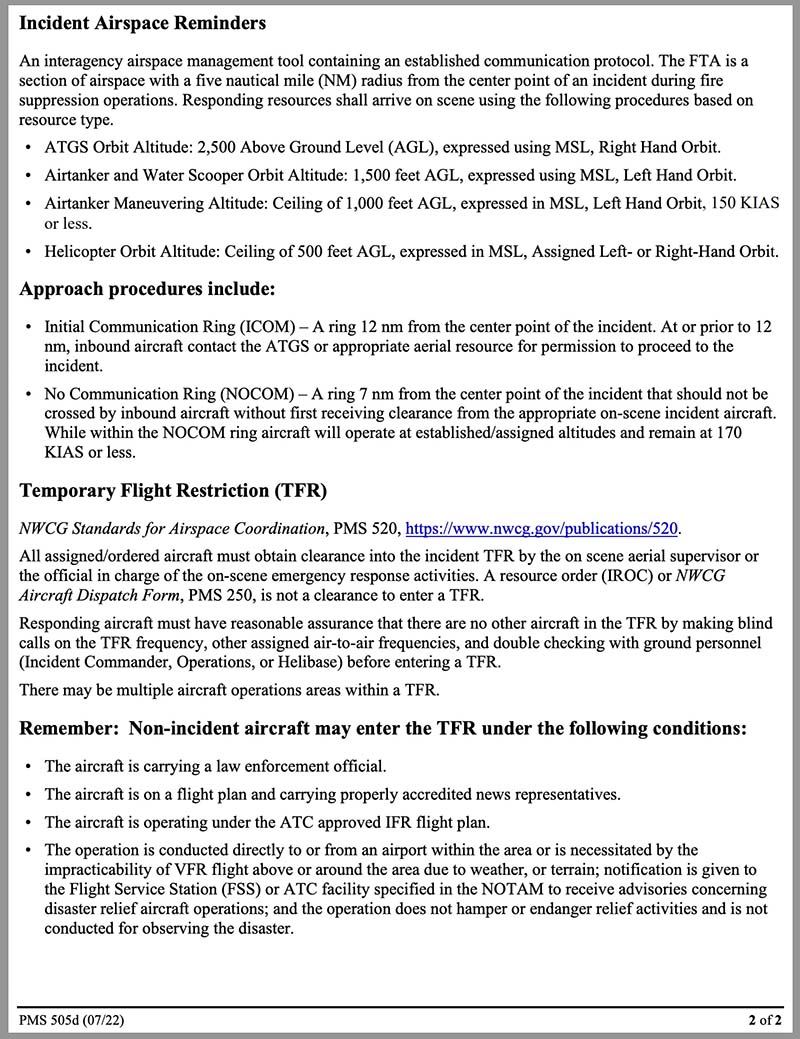 NWCG Fire Traffic Area (FTA), page 2 of 2. Revised July, 2022
The other revision is to Aerial Supervision Standard Scripts, PMS 505e.
The NWCG advises that previous versions should be discarded. (We did just that in an article published June 11, 2022.)




21 Comments
Hard to stay in the pattern, do your drops, and read this stuff all at the same time…
…and yes, you still have an FTA IN a TFR.
In Marks defense
That NAFRI ought be putting together a simulator of an SEAT AC KA series and help this out PRE season and PAY for for the sim…like Mark says…hard to stay in the pattern, do drops and read this stuff at the same time….like a CFI w/ a student..2 a days and alot of ground time
Under the TFR section, it’s confusing. One sentence says you must have permission to enter the TFR. The other sentence says to make blind calls before entering to make sure no other aircraft are in the area. So which is it? This makes zero sense.
Agreed John
Probably should have had a tabletop in the “off-season” and not introduce or at least make better corrections at a sit down prior to issuance …again pre-season not in the middle of fire season….errrrr fire year
Think this goes back to earlier discussions ….TFR= FAA…FTA= NWCG/ Agency
Clarification probably would be a good idea
How can this possibly be confusing? If arriving at an incident, make calls on assigned frequencies and on air to air, to verify an air attack or other resource is not over the fire; if an air resource is over the fire, then get clearance to enter. Same for the FTA; both require a clearance.
If you are the initial attack resource and first on scene, then others will call on the way in, and you can advise them of the status, location, altitude, etc.
This hasn’t changed, and it’s not rocket science. Make contact with air resources. If unable, contact ground resources. If unable (eg, no one there yet) and you’re the intial attack, proceed with caution.
As for reading the FTA card over the fire, let’s not be idiots. You should know this cold before you ever launch; it’s very basic, and shouldn’t be something you’re looking up for the first time on your way to a fire. Know before you go. If you don’t know this, what on earth are you doing carded and on your way to a fire in the first place? It’s hard to fathom that anyone would suggest that this simple information is going to need to be referenced over the fire, as if one didn’t know it before hand.
Authorization to enter a TFR is always required from the controlling agency. If the controlling agency has sent you to the fire as a dispatch, your authorization is implicit: if the agency has assigned aerial supervision, you’ll need permission from the aerial supervisor (air attack, ASM, lead). If you’re being sent to a fire that doesn’t have aerial supervision (not yet assigned, turned in for fuel with no relief, etc), then you will contact the IC, other aircraft over the fire, etc. The statement to make a call in the blind and to get permission, is not in conflict; get permission if there’s anyone from which to get permission, try all available resources, and if none are there, proceed carefully (as you may not be alone).
Yep
Right on!!!
Agree 100% Doug. Does one not have even a little responsibility for knowing their job? Read the document a few times and and bingo, you’re off and running. Do these guys crack out the flight manual when an engine fails!? It’s a very simple and more or less standard to most agencies document. Know your job, do your job.
Doug,
It specifically states a Dispatch form is not a clearance into the TFR.
Also, some TFR’s are so big that ground contact is not possible due to distance and terrain. Dispatch cannot clear you in.
Ground contacts don’t answer your call on the air to air frequency when you’re calling in to obtain clearance into a TFR, so I’m not sure the size of the TFR matters in that example.
Are you being obtuse, or do you really not understand this?
Don’t put words in my mouth. Speak for yourself, if able. I speak very well for myself.
The dispatch is not a “clearance” to enter the TFR, however, you are either being dispatched as the initial attack resource, or you are not. There are either personnel on or over the fire, or there are not. This is obvious.
If you are the initial attack resource and there are no fire contacts, then obviously you are not going to get a clearance into the TFR: you are representing the controlling agency, and the controlling agency has sent you to the fire. Think. Dispatch does not clear you in: your clearance as a representative of the controlling agency is all that’s required. Does the air attack require a clearance when he’s first on scene?
There are numerous scenarios to consider; you may actually be required to think for yourself. There may be an existing TFR with no aircraft overhead; you may be responding to a fire within a TFR that is not attached to the incident for which the TFR was created, perhaps a new incident. You may be the first resource to the scene; you may be going to a scene in which all aircraft are off the fire at the time; you may know that ground personnel are on scene, but terrain and ground radio limitations may prevent the ground personnel from communicating until you’re on top of them (very common). Use judgement. Very obviously, if there is nobody there to clear you in, then you may be waiting pointlessly for a clearance. If nobody is there to clear you in, and you’ve been sent by the controlling agency, then you proceed with caution into the TFR and FTA; you may be answering the call for the next aircraft to arrive, and advising them of the altimeter, altitudes, etc.
A clearance is required, when there is someone there to clear you in. Otherwise, you’ve been sent by the controlling agency. Figure it out.
If you know there are resources over the fire and you can’t make contact, then that’s why we have a communication ring and a no-communication ring. You wait until you can make contact and get your clearance.
Several years ago in Region 5, I arrived at the first ring and made calls, with no response. I tried multiple frequencies, and held at the 7 mile ring. I contacted dispatch, who assured me the air attack was over the fire. I continued to call, with no response. Some 30 or so aircraft were assigned to the fire, visibility wasn’t great. Holding out wasn’t something I was prepared to do for an extended period, given traffic going back and forth to the fire. At length, a helicopter answered me, said there had been a frequency change. He gave me the frequency, and I called the air attack.
Here’s the thing. The idiot filling the ATGS seat said he’d heard me the whole time. He knew I was holding there, and he’d heard my calls to dispatch, national, even 121.5, and all the frequencies on the dispatch sheet. He heard each call, and was well aware, but told me he wouldn’t answer me unless I called on the “appropriate frequency.” I say he’s an idiot to be generous and to be nice; he should have had his ass kicked. His decision was flawed and dangerous and nearly cost a resource, as I was about to depart the fire and return to base.
One can play these games to the hilt, and there is a point of diminishing returns.
You should NOT be over the fire reading a diagram of the FTA and air traffic procedures for the first time. You should NOT be busting into a busy TFR or FTA without a clearance. You should NOT be refusing to enter the airspace when you’re the initial attack resource and you’ve been assigned, or if you’re the only resource over the fire. You ARE expected to contact ground resources and work with them, as well as make every effort to ensure there’s no one else over the fire. You SHOULD be aware that you may not be the only resource assigned, even if the dispatch sheet shows nothing else; other agencies or locations may be sending personnel and equipment.
There have been countless times I’ve arrived at the fire ahead of an air attack or lead, and countless times I’ve arrived at the fire when other resources have set down, or have arrived to find a helicopter working the fire, without aerial supervision, or have arrived ahead of ground troops, or have helped guide ground troops in, etc. Fires are dynamic, often unique in terms of the specific situation, and one does have to exercise a modicum of brain power to determine the appropriate course of action. If that is not possible for you, then you should not be over the fire.
If someone is over the fire, call them. If someone is on the ground, call them. If in doubt, gain clarification.
We hold initial attack qualification for a reason, you know.
Doug, you sound like you’re Batman. Are you Batman, Doug? 🤣
Since you think you’re the expert “Doug”, I suggest before throwing stones…A-You correct your grammar.
B-You never mentioned calling Guard on the FM.
Let’s be real, at a fire, no one is monitoring 121.5.
AAs monitor enough as is.
Since you were in R5…you never mentioned 122.92.
I have to agree w the post above.
I call baloney.
NO Air Attack, would not respond because you were on wrong freq. And in CA? Ha!
Especially if , as you say, “Some 30 or so”, aircraft were working the fire.
They obviously had it right.
With that kind of fire, you had it wrong. You would have known about that fire for hours.
Come on man.
I was dispatched from outside the region. Go figure.
121.5 is monitored globally as guard, and on fires, too. You really missed the point, didn’t you?
Doug is right, if you’re carded or approved to fly fires, you should know the scripts in the standards for aerial supervision. If you’re resp0nding and don’t know if there are other ac over the fire, use the call in the blind script. If there are other ac and you know the call sign (AA, ASM, Lead, HLCO, other ac) call them and they’ll clear you in (or have you hold) using the clearance script. Pretty simple.
Why the hell would you call on 121.5?
That there is ridiculous.
Was it an emergency?
It’s guard. Everyone monitors it.
Think.
I’m sure that this isn’t the “Doug” most tanker pilots know.
I’m not sure this guy w all the answers actually is a tanker pilot.
You’re wrong Doug.
You should have called Guard on the FM. Think! I call nonsense on your story.
You are not the same Doug we know that flies tankers.
I did call guard on the FM. READ.
I also called every other frequency available on the dispatch sheet, national, yada, yada. Your reading comprehension is not good. Fix that.
Perhaps you don’t now as much as you think you do.
Comments are closed for this article!