


The coordination of Europe’s firefighting forces under new-look civil protection measures are getting an early season test as Central Europe faces a forecast of more heat and little prospect of rain.
With extreme fire weather affecting several countries simultaneously, scientists are looking more closely at “fire-weather synchronicity” as multiple countries call on aircraft and personnel at once. Says one scientist: “The fires are separate. The weather connecting them is not.”
The EU has deployed assistance to both France and Spain under the EU civil protection mechanism as ongoing wildfires have triggered one of the biggest evacuation operations in Europe, displacing more than 300,000 people so far in both countries with that number growing by the day.
Three firefighters have died in the wildfires with many more injured. The total number of deaths remains unclear as many are also heat-related and many people are still unaccounted for as large numbers of people – both residents and tourists – are on the move.
Other parts of Europe also impacted, including the United Kingdom, with fires in the Cairngorms in Scotland and in the south-east of England.
Prince William wrote in a post on X: “Our thoughts are with everyone affected by the devastating wildfires across France, Spain and the UK. We are deeply grateful to the firefighters, emergency services and volunteers working tirelessly in extraordinarily difficult conditions. These events are a stark reminder of the challenges posed by an increasingly extreme climate and the importance of protecting both people and nature.”

The EU has long coordinated shared resources, but following the extreme fire year of 2025 it ramped up its preparedness to a higher level for 2026. So far this month:
France has received:
7 firefighting planes and 4 helicopters from Czechia, Croatia, Germany, Portugal, Slovakia, Sweden and Türkiye. Most of these aircraft are part of the rescEU firefighting fleet.
Spain has received:
6 firefighting planes from Greece, Italy and Türkiye, as well as 134 emergency personnel and 41 vehicles from Portugal.
The EU’s Copernicus satellite service is providing emergency maps to support operations on the ground, while the Emergency Response Coordination Centre remains in constant contact with national authorities.
The 2026 fires were not so unexpected – many had predicted another severe season straight after the historically bad 2025 – several European firefighting teams were pre-positioned in France and Spain as support for local teams, enabling a rapid response when the fires broke out.
The UN Commissioner for Preparedness and Crisis Management, Hadja Lahbib, said the case for a pan-European firefighting force was clear:
‘Right now, hundreds of thousands of people have been forced to flee their homes, while firefighters battle walls of flame in dramatic conditions to save lives and communities. No country should ever have to face a disaster of this scale alone. That is exactly why Europe built a common response capacity: aircraft in the sky, firefighters on the ground, and more support standing ready the moment it is needed. To the people of France and Spain: Europe will stand with you until the fires are out.‘
Fire weather synchronicity and other observations
The current fires have generated much discussion, with the notion of “fire-weather synchronicity” helping us better understand why all the fires seem to be happening at once and what this means for sharing resources.
Several research papers have been published including Synchronized wildfires will strain global fire resources: report
Francesca Di Giuseppe, from theEuropean Centre for Medium-range Weather Forecasts (ECMWF), Reading, United Kingdom, co-authored “Large increase in extreme fire weather synchronicity over Europe”.
In a post, Di Giuseppe says that synchronicity turns separate regional fires into a shared European emergency. Extreme fire-weather synchronicity has already increased across Europe and is projected to rise further as the climate warms.
“Climate change does not provide the ignition, but it is shifting the background conditions towards hotter, drier and longer fire seasons – and increasing the likelihood that dangerous conditions develop across large areas at the same time. The fires are separate. The weather connecting them is not.”
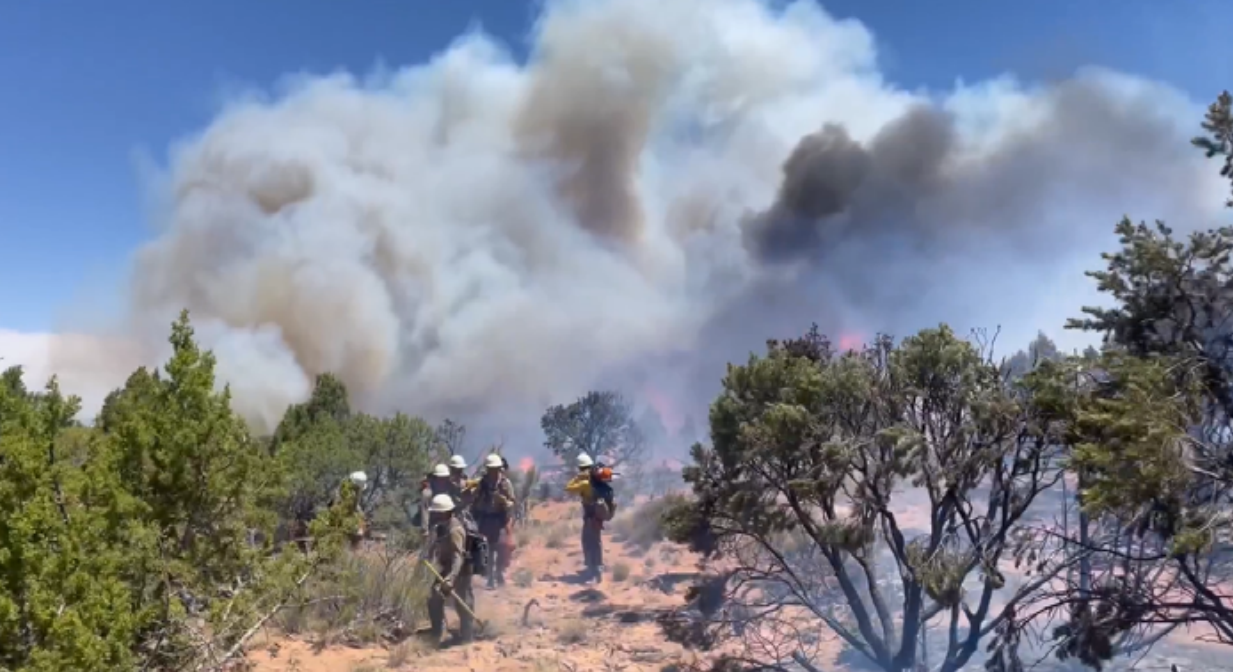
Many observers are noting the extreme nature of some of the fire activity, with a rare – for Central Europe – and possibly the first occurrence of a pyrocumulonimbus event in Bordeaux, France.
For a good summary of the fires see the BBC.
For a good photo spread see CNN.





No comment yet, add your voice below!