Circumpolar wildland fire and permafrost thaw – Global climate implications: Wildfires in the Arctic

The Arctic refers to circumpolar tundra and boreal ecosystems; within this lies the northern permafrost region. Image by Christina Shintani, Woodwell Climate Research Center.

By Brendan Rogers and Susan Natali

Wildfires have been a natural part of Arctic ecosystems – including tundra and boreal forests – for thousands of years. As in other regions, wildfire helps to shape and maintain these ecosystems, impacting plant traits, ecosystem diversity, and composition. However, climate change is making Arctic fires more frequent, intense, and widespread. The Arctic is warming two to four times faster than the rest of the planet, leading to longer fire seasons, more extreme fire weather, and increased lightning strikes that ignite fires.

This article is from a special issue of Wildfire magazine from the International Association of Wildland Fire and the Arctic Council. In this issue scientists, policy experts, community and Indigenous leaders provide clear insights on what is occurring with wildland fire in the Arctic and how best to respond, locally, nationally and internationally.

In addition to combusting vegetation, wildfires in the Arctic also burn the organic soil layers, which play an important role in insulating and protecting the permanently frozen ground, called permafrost, that underlies the tundra and much of the boreal forest. When vegetation and soils are removed by fire, this can trigger or accelerate permafrost thaw.

Most permafrost has been frozen for hundreds to thousands of years. Over time, organic carbon derived from plants has slowly accumulated in permafrost soils because the frozen conditions slow decomposition, leading to the accumulation of an immense amount of carbon – on the order of 1,600 billion tons, or roughly three times the amount of carbon contained aboveground in all the world’s forests. With climate warming, permafrost is thawing, and microbes are decomposing this ancient carbon and releasing it into the atmosphere as greenhouse gasses, carbon dioxide and methane. The release of greenhouse gasses from permafrost thaw, referred to as the permafrost carbon feedback, could be a major accelerant of global climate change in the coming decades and centuries.

Wildfires amplify the permafrost carbon feedback. At the time of burning, Arctic wildfires release large amounts of carbon in the form of carbon dioxide, methane, and other gases and aerosols due to the combustion of organic soils. In fact, the levels of carbon emitted per unit area from Arctic wildfires are among the highest on Earth, rivaled only by tropical peatland and deforestation fires. For the most part, this carbon can ultimately be removed from the atmosphere by vegetation regrowth and stored by ecosystems over a period of decades to centuries. However, by burning the upper soil layers that otherwise keep permafrost cool, Arctic fires also initiate and exacerbate permafrost thaw. In some cases, this is barely noticeable from the surface but can still generate greenhouse gas emissions. In other cases, permafrost with high ice content can thaw abruptly, leading to dramatic features such as thermokarst lakes and permafrost thaw slumps, generating even higher levels of carbon emissions.

HOW ARE ARCTIC FIRES CHANGING?
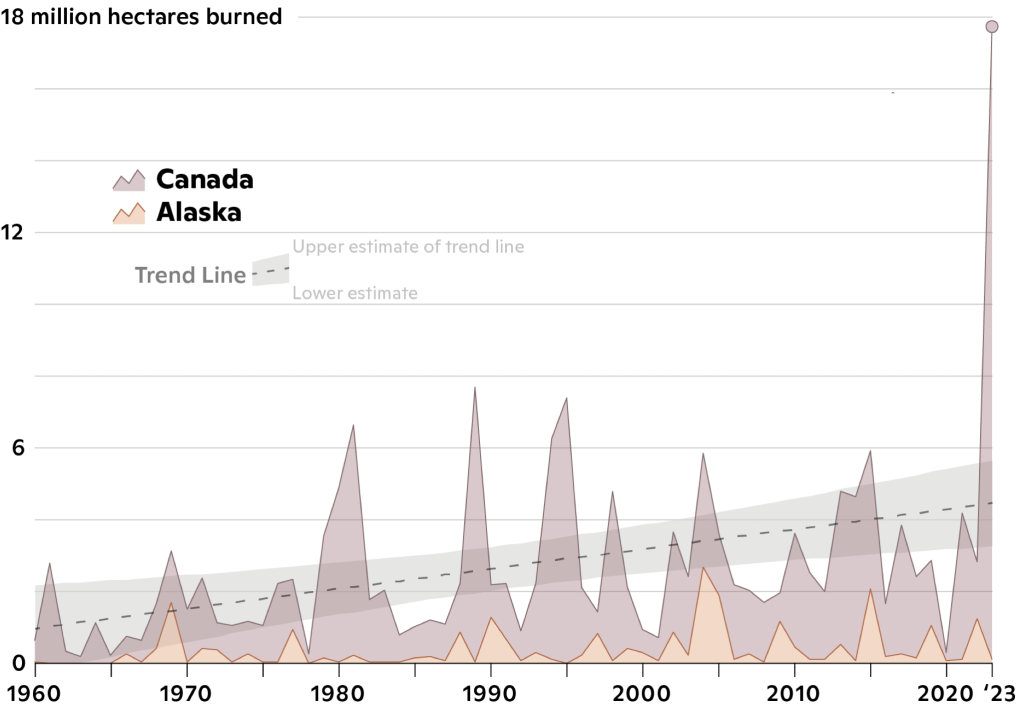
Long-term trends in area burned across Canada and Alaska, developed with data from the Canadian Wildland Fire Information System and the Alaska Interagency Coordination Center. Image by Greg Fiske, Woodwell Climate Research Center.

Many studies have documented the links between Arctic fires and climate change. The best long-term observational data come from Alaska and Canadian government databases, which detail fires and their area burned since the mid-20th century. From the databases, we know the average yearly burned area across Alaska and Canada during the past two decades is roughly twice that of pre-climate change levels. By far, the most severe fire season was 2023. Canadian wildfires in 2023 burned more than twice the area of any other year on record and emitted between 480 and 760 million tons of carbon. For perspective, that’s three to five times higher than annual emissions from all other sectors in Canada combined, and higher than every country’s annual emissions except China, the United States, and India. It should be noted that regrowing forests from these fires are unlikely to re-sequester much carbon by the mid-21st century – when the world otherwise needs to be approaching net-zero emissions to limit the most damaging impacts from climate change –and that these estimates do not include postfire permafrost emissions.

Novel fire years are not limited to Canada. Russia, for instance, experienced unprecedented wildfire activity in eastern Siberia and north of the Arctic circle in 2019, 2020, 2021 and 2024, which has been linked to warming temperatures, early snow melt, and polar jet dynamics associated with climate change. If current climate warming trends continue, Arctic fires will likely become even more frequent and intense. Studies project a 75 per cent increase in Arctic burned area for every degree Celsius of global warming.

The carbon released by these fires, combined with emissions from permafrost thaw, could rival those of major global economies. Yet these emissions are not currently accounted for in global climate models nor are they fully accounted for in the “accounting framework” used to assess progress toward the Paris Agreement goal of limiting warming to well below two degrees Celsius above pre-industrial levels.

Carbon and climate are not the only causes for concern over increasing Arctic wildfires. These fires emit smoke that degrades air quality and threatens human health for communities near and far. Wildfires impact habitat and subsistence activities for Indigenous communities, can shut down aviation and overland travel, damage infrastructure, and lead to mass evacuations.

Ground slumping in yedoma permafrost after a wildfire, in the interior of Alaska. Yedoma permafrost generally contains large amounts of ground ice, making it vulnerable to abrupt thaw after fires. Yet fires can accelerate permafrost thaw and carbon emissions in many different types of permafrost. Photo by Torre Jorgenson.

WHAT TO DO?

The situation is urgent, and solutions exist. Governments can prioritize wildfire preparedness and community protection plans, fuels treatments and fire breaks around fire-prone communities, and improve real-time forecasting and information sharing, especially with rural and Indigenous communities. Supporting cultural burning practices, where Indigenous communities conduct controlled burns to manage landscapes, can also reduce the risk of severe wildfires. Finally, the combination of improved satellite detection and emerging technology such as autonomous firefighting aircraft presents opportunities for early action suppression of the most damaging wildfires.

However, the most critical solution lies in reducing global greenhouse gas emissions. Cutting global emissions will slow Arctic warming, reducing the conditions that fuel these fires and making other wildfire prevention efforts more effective. Arctic fires are a growing global concern with wide reaching implications for the climate and communities worldwide. By investing in local adaptation, embracing Indigenous knowledge, and tackling the root cause – climate change –we can work toward a more resilient future.

Brendan Rogers is an associate scientist at the Woodwell Climate Research Center in Massachusetts. Rogers uses a combination of field measurements, satellite remote sensing, and modeling techniques to diagnose the impact of increasing Arctic fires on carbon and climate. Rogers uses science to inform natural resource management and policies for improved climate mitigation, adaptation, and ecosystem protection.

Susan Natali is a senior scientist at the Woodwell Climate Research Center whose research on permafrost thaw is motivated by an acute awareness of the risks it poses. Natali has worked extensively across the Arctic, in Alaska, Siberia, and elsewhere, combining field research of permafrost and carbon cycling with remote sensing and modeling to assess current and future climate impacts across the Arctic. Natali works with Indigenous communities, scientists, resource managers, and policymakers at all levels to craft just and effective strategies for limiting harm from Arctic warming.

Cultural burning: Wildfires in the Arctic

A cultural burn in Fort Yukon, Alaska in May 2024. The wildland fire community, along with governments, policy makers, and citizens, need to take a critical look at the role of culture file in the landscapes of northern Alaska, Canada, Russia and across the circumpolar Arctic. Photo by Edward Alexander.

By Edward Alexander

Thirty-two thousand years ago this spring, in the eastern interior of Alaska, during an ice age so severe that the Laurentide Ice Sheet covered most of the continent of North America a mile thick, a Gwich’in man, dressed in neatly tailored, tanned, caribou skin pants and a shirt, walked around the forested edge of a lake, dragging a stick through the tall grass. At the end of the stick flickered a flame that leapt to the grass. The snow in the shadows of the trees blocked the fire’s path, so the flames could travel only into the dead grass that had accumulated, thinning some of the dead willows out in its maw.

This article is from a special issue of Wildfire magazine from the International Association of Wildland Fire and the Arctic Council. In this issue scientists, policy experts, community and Indigenous leaders provide clear insights on what is occurring with wildland fire in the Arctic and how best to respond, locally, nationally and internationally.

The man continued to walk with his torch, through the portage to another lake, and then another, and another. All the while the flames did the work, clearing away the thick grass, making it easier to walk, getting rid of the early coverage for mosquitoes and biting insects where the people would camp through break-up and the summer season in their caribou skin tents.

The plants that grew back, he knew, would be a bit different than what had burned: all nature of flowers and thicker, greener, more lush plants. The areas near the berry patches would grow more berries; the bees and the birds would take the place of the gnats and the mosquitoes; and instead of a thick mat of grass that could sustain a fire that could race away, the land was neatly trimmed, down to its very root top – a black mat.

A cultural burn in Fort Yukon, Alaska in May 2024. The wildland fire community, along with governments, policy makers, and citizens, need to take a critical look at the role of culture file in the landscapes of northern Alaska, Canada, Russia and across the circumpolar Arctic. Photo by Edward Alexander
A cultural burn in Fort Yukon, Alaska in May 2024. The wildland fire community, along with governments, policy makers, and citizens, need to take a critical look at the role of culture file in the landscapes of northern Alaska, Canada, Russia and across the circumpolar Arctic.
Photo by Edward Alexander

The fire was doing its work. Not perfectly, as there were areas away from camp where the fire had dwindled due to the ground being too wet, or from the wind blowing in a certain direction. The man saw his kids following him, trying to start their little sticks on fire, and one throwing snowballs at the flames.

Migrating birds would soon arrive and would find good food to greet them; the burn would help make browse so nutritious that the birds would all be fat. The people would have good eggs to eat, birds to hunt, and the muskrat would be plentiful. Maybe the moose would have two calves, or three, instead of one. There wouldn’t be a fire to come racing down through the grass, not this summer; it could still come through the timber, the man thought, but the mosaic of lakes and meadows and sloughs that had been burned should be enough to break up any threats the family might face that summer. The man enjoyed the walk, and the way back would be an easier path, one that could help his whole family, his whole tribe.

Today, we call this man’s activity a cultural burn, and, sadly, all too often, the wisdom in that man’s actions has been forgotten, outlawed or not implemented in our landscape that sorely needs the presence of Dinjii Zhuh K’yaa, our traditional Gwich’in ways of life.

The man didn’t have to cut a fireline with a Pulaski or a chainsaw; he didn’t have to work in a bulldozer cutting a dozer line; and he didn’t have to have air support to keep the fire out of the trees. The snow did the work. The season did the work of keeping the fire cool and controllable, and the fire did its work of clearing the land and creating a green fire break for the summer. The man didn’t have to apply amendments to the soil to make the plants more nutritious, and he didn’t have to apply pesticides to keep biting insects at bay – the ash did all that for him. The man didn’t have to do anything except take a walk while his kids tired themselves out behind him inventing games along the edge of the burn.

The wildland fire community, along with governments, policy makers and citizens, need to take a critical look at the role of cultural fire in the landscapes of northern Alaska, Canada, Russia, and across the circumpolar Arctic. The Pyrocene has met the cryosphere, and the results over the last 20 years have been conclusive: NASA’s MODIS data documents some 174 million hectares of burned area in the circumpolar Arctic Boreal Zone, an area greater than Iceland, Norway, Sweden, Finland, Denmark, and Greenland. While most of these acres have burned in Russia, Canada, and the United States (Alaska), the message written in flame and ash is clear: our environment is changing, and we need to change too.

To protect the Arctic and its people, we need mildfire, not wildfire. We need a healthy environment, not a stagnant monoculture of dead grass. We need solutions that make economic sense. There aren’t enough wildland firefighters in the world to fight fires in the north. How do we tie in a fireline for fires that are larger than U.S. states, or that burn in duff that thickly covers and insulates the soil but readily dries? We must consider the economics of the responses to these fires, and whether mitigation activities are successful at the scale that is needed. To maintain the land and its people, there needs to be a cultural revitalization of Indigenous Knowledge and Indigenous mitigation techniques, not wildland fire suppression born of arbitrary rules, written for the south, and incapable of doing what Indigenous practices have proven they can: stop a fire crisis before it happens, and replace it with a sustainable, fire resilient landscape.

In the modern context, everyone in the wildland fire community has heard of, worked extensively in, or planned for wildland-urban interface (WUI) events. In the sparsely populated north, we do have traumatic WUI incidents, such as the evacuation of the capital city of Yellowknife in the Northwest Territories in 2023. People fled on the only escape route out, sometimes with fire on both sides of the only highway; the fire advanced 70 kilometers in one day and was a mere 15 kilometers from burning the largest city in the Canadian north to the ground. Usually, in the north, fires are in sparsely populated rural areas larger than any national park and they’re left to burn. These fires fill the air with smoke that threatens the health of people in the north, and, at times, it pours into cities far from the Arctic Boreal Zone – in one instance making the Statue of Liberty’s torch seem snuffed out in the orange haze that descended on New York; it looked apocalyptic, and the truth is it probably was, in ways we don’t yet understand.

We need new tools in the Arctic to help us better understand wildland fire in the circumpolar context, and what’s occurring with cultural landscapes. Ideally, a Wildland Cultural Interface, and / or an Arctic Wildland Cultural Interface could be developed, so we don’t respond to fires in the Arctic by saving the cabin – the traditional structural protection value at risk – but miss the reason the cabin is there: for the activity of trapping, and the trapline was allowed to burn over. A trapping cabin can be built in a few days. A trapline, however, is another story; imagine cutting 60 miles of fireline by yourself, and having your income taken out of the equation. We need to reframe cultural resources and values at risk into a matrix of action; we need to understand the cultural structures that need protection – which are different in the Arctic context than elsewhere – and they need to be fully accounted for.

We need to see, and protect, cultural resources on the land; we must understand that cultural landscapes have a lot of intrinsic and naturally developed value. A stand of spruce trees in the north may take hundreds of years to develop to the point that lichen grows thickly on the branches, which feeds caribou on which northern people depend.

Lichen in stands like these help these populations of caribou be resilient in winter rain events that are becoming more common and block these animals from reaching ground browse covered in ice. Shouldn’t we use a Wildland Cultural Interface to understand and protect myriad critical values like these?

Development of a Wildland Cultural Interface or Arctic Wildland Cultural Interface, coproduced by Indigenous leaders, elders, fire leaders and fire keepers with fire managers, can help us see the true picture of values at risk in the Arctic, and what we need to do to protect.

The Arctic is changing four times as quickly as southern areas; in fact, wildland fires in the Arctic Boreal Zone have become so massive the region has become a major climate change driver. We need to frame our understanding of the gravity of this correctly. We need to understand that a global climate stability is a value at risk by massive wildland fires in the largest forest on planet Earth: the Arctic Boreal Zone. Another value at risk is the collective health of communities that are choking on toxic smoke for months at a time. We need to understand the fact that the largest carbon storage device anywhere on Earth happens to be the living, biological system of the Arctic Boreal Zone, which has sequestered more carbon in its forest soils than humans have ever released from all sources since industrialization, and this system is now aflame. We need to collectively understand that a value at risk is the immense store of carbon in permafrost, which contains more than twice the amount of carbon that humanity has contributed to the atmosphere and is now rapidly collapsing in a thawed state after fire has removed the insulating layers.

There is a special kind of ancient permafrost in the north called yedoma, which, due to the new severity of wildland fires in the north, is thawing abruptly from losing its deep layers of protective vegetation, duff, and top soil, releasing not only carbon dioxide but also methane and nitrous oxide, which are far more potent greenhouse gases. Yedoma thaw is an imminent global threat to climate stability, and global carbon budgets, and it too is a value at risk, but today is virtually unaccounted for in how wildland fires are managed anywhere in the Arctic except in Gwich’in homelands. We need new tools for the Arctic.

Pyrocumulonimbus cloud / smoke from the MacDonald fire south of Fairbanks, Alaska, which ignited on June 8, 2024. The fire burned the Tanana Flats Military Training Area and grew to more than 172,000 acres before merging with the Clear Creek fire. The fire was caused by lightning and was propelled by strong winds and dry conditions.

We need a Wildland Climate Interface that can help managers, communities, leaders, firefighters, and policy makers understand how to respond to these issues. An interface can be built to increase our understanding about what we need to do to protect our world, which, when the largest terrestrial carbon storage system is burning and thawing, is a value at risk. Gwich’in have long felt that the answer lies with our ancestors, with that man and his children who passed along cultural burning techniques that are now more important than ever to remember.

Edward Alexander represents Gwich’in internationally as the co-chair of Gwich’in Council International and has been appointed by the Chiefs of Alaska for multiple terms in this role. He serves as the Head of Delegation to the Senior Arctic Officials, and to the Conservation of Arctic Flora and Fauna (CAFF) and Emergency Prevention, Preparedness, and Response (EPPR) Working Groups of the Arctic Council. He works for Woodwell Climate Research Center as the senior Arctic lead. Additionally, he served as the co-lead of the Arctic Council’s Chairship Initiative on Wildland Fire. Alexander also served as the 2nd Chief of the Gwichyaa Zhee Gwich’in for seven years.

Understanding circumpolar wildland fire capabilities: Wildfires in the Arctic

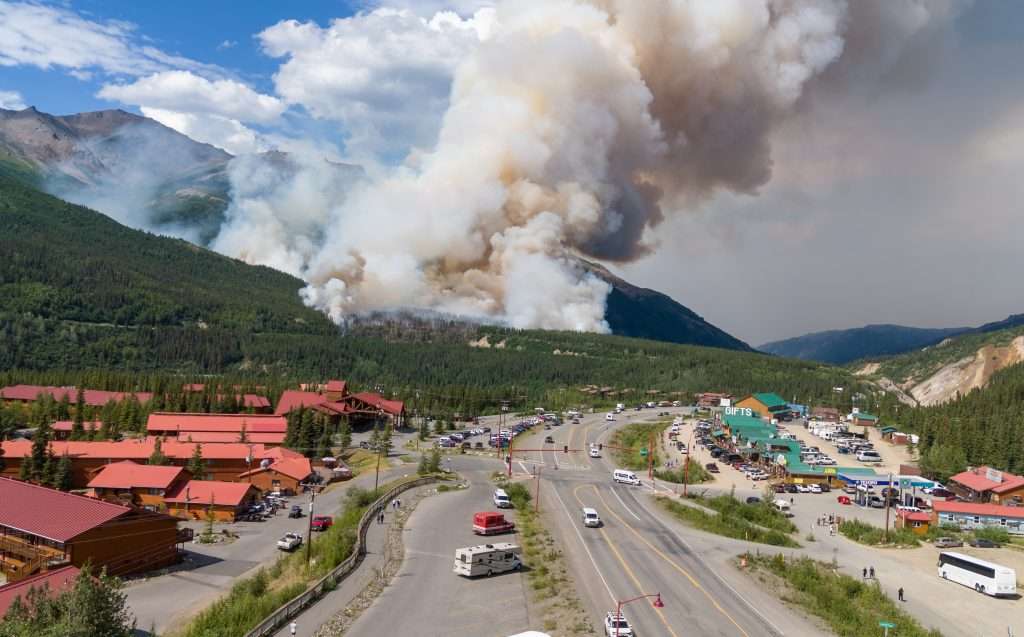
The Riley fire started June 30, 2024, near Denali National Park and Preserve in Alaska. It spread quickly, requiring park staff to evacuate. All photos by Troy Bouffard.

By Troy Bouffard and Edward Soto

The Arctic is undergoing profound environmental shifts, marked by unprecedented warming and ecosystem changes. A critical consequence of this transformation is the rise of extreme wildland fire events across all eight Arctic states, especially the United States (Alaska), Canada, and Russia.

These fires represent a shared northern challenge, transcending borders and impacting everything from carbon release and permafrost degradation to air quality and community safety. While bilateral cooperation on firefighting resources exists, notably between Canada and the United States, a comprehensive, circumpolar platform for collaboration on wildland fire preparedness, mitigation, and response has yet to develop. This gap highlights the need and opportunity for a shared understanding of how each Arctic nation manages wildland fire events.

This article is from a special issue of Wildfire magazine from the International Association of Wildland Fire and the Arctic Council. In this issue scientists, policy experts, community and Indigenous leaders provide clear insights on what is occurring with wildland fire in the Arctic and how best to respond, locally, nationally and internationally.

The Riley fire started June 30, 2024, near Denali National Park and Preserve in Alaska. It spread quickly, requiring park staff to evacuate. All photos by Troy Bouffard.

The Arctic Council Emergency Prevention, Preparedness, and Response (EPPR) Working Group publication, Circumpolar Arctic Wildland Fire Operational Baseline Report, aims to fill this research gap by establishing a foundational understanding of the existing operational capabilities and primary information sources for wildland fire response within each Arctic state.

The report’s value lies in presenting each nation’s operational picture, identifying potential areas for enhanced collaboration, and providing policymakers, operational decision makers, and researchers with the necessary baseline knowledge to engage in further studies and activities. By surveying existing governance operational structures, response systems, information resources, and logistical support mechanisms, the report serves as an important information source toward developing more integrated and effective circumpolar wildland fire management strategies in a rapidly changing Arctic.

OPERATIONAL LANDSCAPES

The report details the diverse approaches each Arctic nations takes toward wildland fire management, reflecting differences in operational governance, geography, and historical fire regimes, which can vary significantly depending on traditional management approaches and risk levels.

CANADA

Wildland fire management primarily falls under provincial and territorial jurisdiction, with the federal government responsible for Parks Canada and military lands. The Canadian Interagency Forest Fire Centre (CIFFC) plays a crucial coordinating role, facilitating resource sharing (personnel, equipment, aircraft) and information exchange both domestically and internationally, particularly with the United States through compact agreements.

By July 7, the Riley fire fire was 31 per cent contained, and evacuation status in the Denali Borough was lifted. The park resumed normal operations but some areas remained closed while crews continued to fight the fire.

Canada uses the Canadian Wildland Fire Information System for predictive services and situational awareness, incorporating data from the Meteorological Services of Canada and the Canadian Forest Fire Danger Rating System. The Canadian Armed Forces may provide support to civil authorities when requested and civilian resources are overwhelmed. Response uses a standardized incident command system, adapted for Canadian use, ensuring interoperability. Resource warehousing is also decentralized at the provincial / territorial level.

THE KINGDOM OF DENMARK (INCLUDING GREENLAND)

Denmark presents a unique structure where both civil and military emergency response capabilities reside under the Ministry of Defence, primarily executed by the Danish Emergency Response Agency (DEMA). Response follows the Emergency Preparedness Act and the National Crisis Management System, adhering to a sectoral principle for assigning responsibilities.

Given Greenland’s vast ice cover and Denmark’s relatively low wildland fire frequency, the focus is largely on an all-hazards approach with a structural fire emphasis. The Danish Meteorological Institute provides weather data, contributing to fire danger indices, often focused on agricultural settings. Response typically starts at the municipal level, escalating to DEMA if needed. Specific wildland fire equipment exists but is integrated within the broader rescue service resources.

FINLAND

The Ministry of the Interior, through its rescue services and regional rescue departments (managed by wellbeing services counties), leads wildland fire response as part of an all hazards mandate under the Rescue Act. The Finnish Defence Forces provide assistance (equipment, personnel, expertise) when requested by civil authorities. The Finnish Meteorological Institute provides essential weather and predictive services, including a forest fire index, which can trigger aerial surveillance flights. Due to intensive forest management, large wildland fires are relatively rare. Resource coordination occurs between wellbeing services counties, with the ministry coordinating international aid. Finland uses the Virve communication network, interoperable with Nordic counterparts via TETRA., the public safety telecommunications network. Training is conducted via the Emergency Services Academy Finland, emphasizing all-hazards response.

ICELAND

Civil authorities, specifically the Department of Civil Protection and Emergency Management under the National Commissioner of the Icelandic Police within the Ministry of Justice, have the sole lead for emergency response. There is no military, though the Icelandic Coast Guard assists in maritime areas and can be involved in suppressing remote wildland fires. The Civil Protection Act provides the framework for an all-hazards response structure from national to municipal levels. Wildland fires have been historically rare due to fuel types, though this may change with climate warming. Consequently, specific wildland fire information sources and specialized training are limited.

The Icelandic Meteorological Office provides general weather forecasting but focuses on more prevalent hazards such as volcanoes and avalanches. Response follows established civil protection plans, resourced locally first, with escalation pathways nationally and through the EU Civil Protection Mechanism.

NORWAY

Responsibility is shared between the Ministry of Justice and Public Security (primary authority via the Directorate for Civil Protection – DSB) and the Ministry of Defence. The DSB provides administrative oversight, while operational response resides with municipal fire and rescue services. The Norwegian Civil Defence and the Armed Forces / Home Guard can provide reinforcement and disaster assistance when needed, forming the total defence concept. Norway uses a unified management system, adapted from the incident command system, but command typically remains at the municipal level. The Norwegian Meteorological Institute collaborates with DSB, utilizing an adapted Canadian Fire Weather Index for risk assessment specific to Norwegian conditions. Resources are primarily municipal, with some national assets such as DSB-administered helicopters available during fire season or high danger periods. Norway also uses European resources such as the Copernicus Emergency Management Service (CEMS) and the Emergency Response Coordination Centre (ERCC).

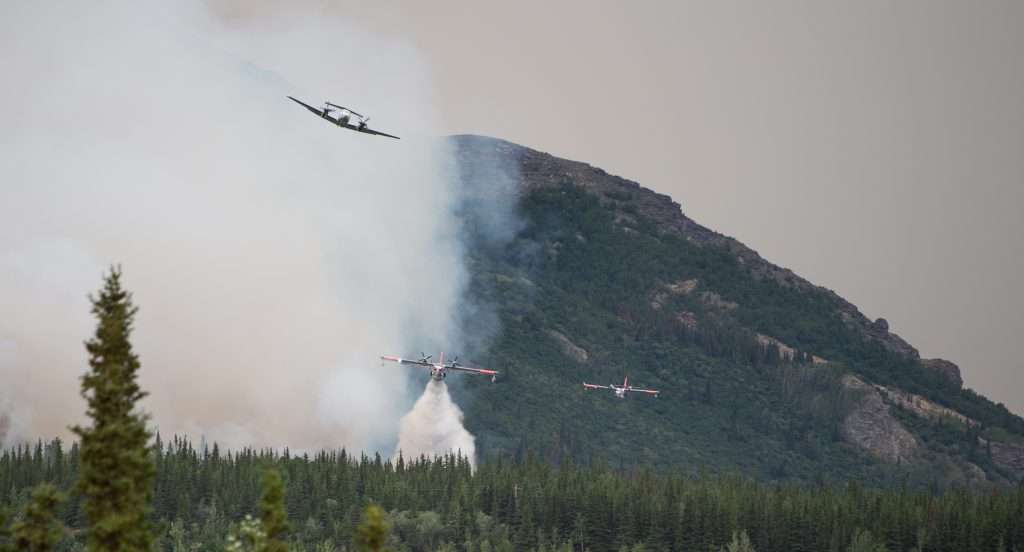
Every aircraft in Alaska that has a tank has been active on this fire today,” Danali Park public information officer Paul Ollig told alaskasnewssource.com on June 30, 2024.
Every aircraft in Alaska that has a tank has been active on this fire today,” Danali Park public information officer Paul Ollig told alaskasnewssource.com on June 30, 2024. Photo Troy Bouffard

THE RUSSIAN FEDERATION

The Federal Forestry Agency (FFA), under the Ministry of Natural Resources and Environment, is the lead agency for wildland fire protection and suppression, operating through territorial authorities. The Forest Code and federal law On Fire Safety define responsibilities, assigning coordination functions to the FFA, which establishes federal and regional headquarters. The Ministry of Emergency Situations, known as EMERCOM, handles fires in populated areas and provides support, while the Ministry of Defense’s Forestry Department manages fires on defense lands. Authority is delegated to the subjects (regions) of the Russian Federation, which develop annual consolidated fire suppression plans detailing resources (personnel, machinery, equipment) from various state, municipal, and other involved entities. The FFA oversees information reliability and coordinates interregional manoeuvring of resources. The Russian government’s Aerial Forest Protection Service (Avialesookhrana) provides specialized aviation resources, including aircraft and parachute firefighters.

SWEDEN

The Swedish Civil Contingencies Agency (MSB), under the Ministry of Defence, holds responsibility for civil protection, public safety, and emergency management, including coordinating and supporting roles in large wildland fires. Operational response is led by municipal fire and rescue departments. Sweden employs a total-defence concept incorporating emergency preparedness and civil defense, involving collaboration among government agencies, municipalities, regions, industry, and NGOs. The Swedish Meteorological and Hydrological Institute provides fire risk assessments using the Canadian Fire Weather Index during the fire season. Response is resourced locally / regionally, with cross-border municipal agreements and support from MSB, which maintains equipment depots and coordinates national / international aviation assets, including rescEU resources hosted in Sweden. If resources become scarce, MSB can prioritize allocation.

THE UNITED STATES

Wildland fire response is characterized by extensive interagency cooperation, coordinated nationally by the National Interagency Fire Center (NIFC). NIFC integrates federal agencies within the departments of agriculture and interior, state forestry agencies, and others under common incident command procedures and safety guidelines. The Department of Defense provides support to civil authorities upon request from NIFC, typically as a surge capability. Information sources are coordinated, with National Oceanic and Atmospheric Administration / National Weather Service providing key weather and predictive services. Firefighter qualifications and operational standards are standardized nationally through the National Wildfire Coordinating Group. Resources (personnel, aviation, equipment, supplies) are managed through interconnected interagency systems – Incident Qualifications and Certification System (IQCS), Interagency Resource Ordering Capability (IROC), National Fire Equipment System (NFES) caches –allowing for efficient mobilization from local to national levels. Unmanned aerial vehicles are increasingly integrated into operations.

CROSS-BORDER COOPERATION: NORDRED, RESCEU AND THE NORDIC REGION

Beyond national capacities, regional cooperation mechanisms significantly enhance response capabilities, particularly in the Nordic region. Nordred facilitates rescue collaboration (information sharing, operations) among Denmark, Finland, Iceland, Norway, and Sweden, supported by agreements at both national and cross-border municipal levels. Additionally, these nations, along with other European countries, participate in the EU Civil Protection Mechanism and its rescEU component, which provides a reserve of resources, including firefighting aircraft, coordinated through the Emergency Response Coordination Centre for international assistance. These frameworks are integral to Nordic preparedness and response culture.

This baseline report illuminates the diverse, yet often complementary approaches Arctic nations employ to manage wildland fires. While significant operational collaboration already exists within subregions such as North America and the Nordic countries, facilitated by shared systems (such as variations of the incident command system), common standards, and established agreements (such as forest fire compacts and Nordred), the frameworks and capabilities are not yet fully interoperable across the entire circumpolar Arctic.

The inventory reveals each Arctic state’s operational governance structures, key information sources (weather, predictive services, geospatial data), response protocols, and resource management systems. This foundational knowledge is crucial for identifying commonalities that can be leveraged for broader cooperation and gaps that require attention and development. As the Arctic continues to warm and wildland fire regimes intensify, understanding these national operational baselines is paramount.

Troy Bouffard, U.S. Army (Ret.), has a master’s degree in Arctic policy and a PhD in Arctic defense and security from the University of Alaska Fairbanks. He is the director of the UAF Center for Arctic Security and Resilience. Bouffard is a research fellow with the United States Military Academy – Modern War Institute. He was also the former Arctic Advisor to U.S. Senator Lisa Murkowski as a congressional fellow.

Edward M. Soto, Col, USAF (Ret.) has a forest engineering degree with a graduate certificate in Arctic securities and currently works as a project manager for the Alaska Division of Forestry. His military service includes two command tours in civil engineering and aircraft maintenance. Soto has also worked as a forest engineer and in wildland fire management throughout Alaska when not in military service.