VLAT vs. P2V: comparison of cost and effectiveness

DC-10
DC-10 dropping on the Falls Fire at Lake Elsinore, CA, August 5, 2013

An Air Tactical Group Supervisor (ATGS) has completed a detailed comparison of the use of a DC-10 Very Large Air Tanker (VLAT) and P2V Large Air Tankers to complete the same task of creating 4.6 miles of retardant line on the Colockum Tarps Fire, which is what Tanker 911, a DC-10, accomplished during 3.12 flight hours on July 30, 2013.

The DC-10 made eleven drops from five-11,600 gallon loads of retardant. The writer figured it would take 41 drops from P2Vs to construct the same amount of retardant line. Two P2Vs could do it in two days, or four P2Vs could do it one day. Depending on which scenario was used, a DC-10 would result in a cost savings of $122,078 or $136,578.

Other advantages pointed out were that the VLAT could accomplish the objective much more quickly with a wider and more consistent retardant line, and “the eleven individual drops with the VLAT significantly reduced the number of ‘pilot drop exposures’ as compared to the number of drops/passes that would have been required with heavy airtankers”.

The DC-10 was tied up for just over three hours, but it would have taken four aircraft-days if P2Vs were used. The VLAT freed up air tankers, ASM/Bravos, and lead planes for other fires. If we had 44 air tankers like we did in 2002, that would not be as critical as the present situation, where we only have about 10 large air tankers plus one VLAT on exclusive use contracts, and one VLAT on a call when needed contract.

The 747 VLAT may become available by the end of September on a call when needed contract and we may have one or two “next generation” large air tankers in the fleet within the next few weeks.
 

Washington: Colockum Tarps Fire

(UPDATE at 7:35 p.m. PDT, July 30, 2013)

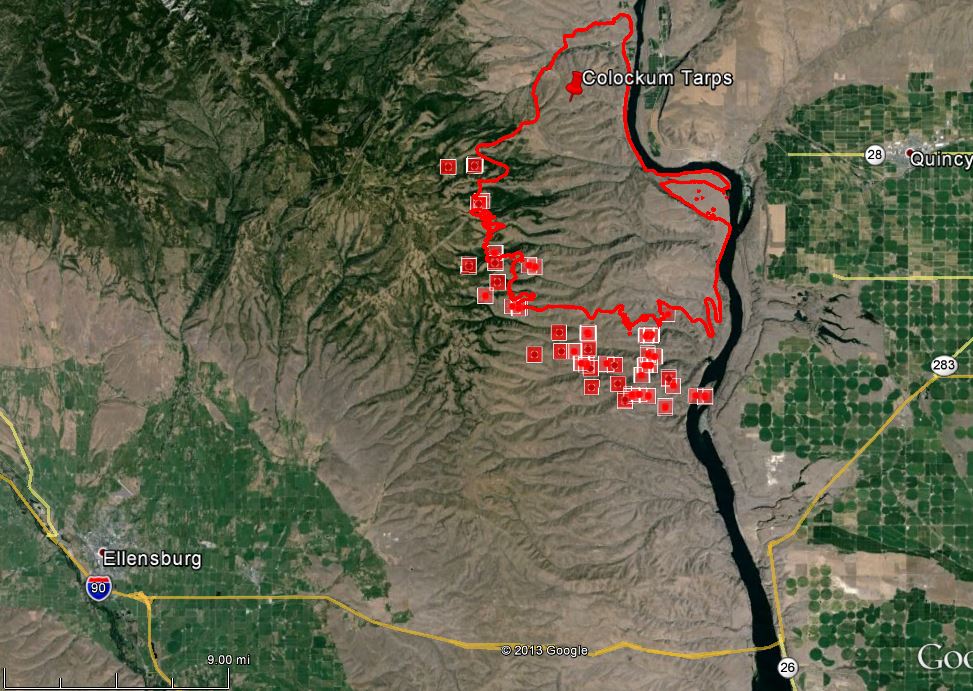
The Colockum Tarps Fire continued to spread to the south Tuesday, and according to the incident management team has now burned 59,316 acres.

In the map of the fire below, the red squares represent heat detected by a satellite during the day on Tuesday. The red line was the perimeter at 1 a.m. Tuesday. Despite the appearance of some of the red squares, the fire has not crossed the Columbia River.

Map of Colockum Fire at 2:25 p.m. PDT July 30, 2013
Map of Colockum Fire,  July 30, 2013 (click to enlarge)

About three miles southwest of the fire is a new wind farm with hundreds of wind generators. It is under a “level 2” evacuation notice, which is the next level before Get Out NOW. The fire is moving in that direction but the vegetation in the area is fairly light and firefighters are hopeful that the facilities will not be too difficult to protect. They had structure protection personnel checking it out Tuesday evening. (I wonder how retardant would affect the wind generators?)

Hotshot crews were transported by boats on the Columbia River to their assignments on the south side of the fire Tuesday.

Single engine air tankers are working the fire along with helicopters and one of the DC-10s, which is reloading at Moses Lake.

****

(UPDATE at 7:40 a.m. PDT, July 30, 2013)

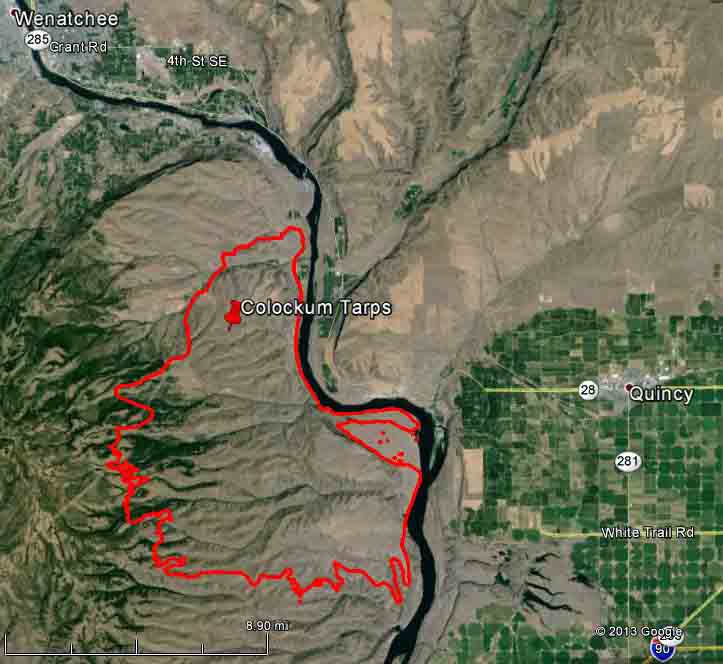
We have a more accurate map of the Colockum Tarps Fire, which, according to our sources, has burned approximately 46,000 acres, or 72 square miles. The fire is still active and continues to spread on the west and south sides. Information about evacuations can be found on InciWeb.

Map of Colockum Fire at 1 a.m. PDT July 30, 2013
Map of Colockum Fire at 1 a.m. PDT July 30, 2013 (click to enlarge)

Carl Buick explained to us, with a visual aid, how the Colockum Tarps Fire got its name. It started near Colockum Creek and the next drainage over is Tarpiscan creek. The initial attack operations were first set up at the road junction seen below.

Colockum Tarps Fire
Photo near the origin of the Colockum Tarps Fire. Photo by Carl Buick

Continue reading