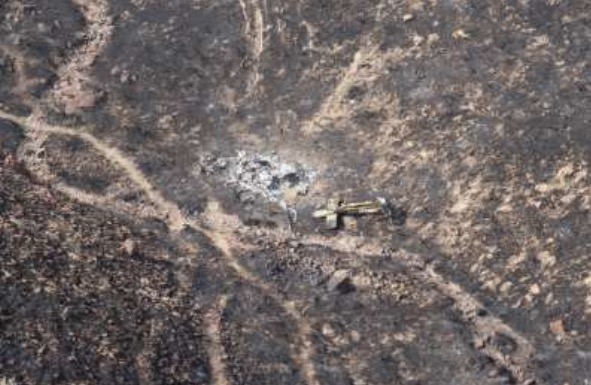
Firefighter killed in Texas helicopter crash

(UPDATED at 2:16 p.m. MDT March 28, 2019)


The firefighter that died in the Texas helicopter crash on March 27 has been identified by the U.S. Forest Service as Daniel Laird, a Captain on the Tahoe Helitack crew in California. He leaves behind a wife and young daughter.

One source tells us that the other passenger was also a USFS firefighter who was sitting in the front seat when the aircraft went down, but reportedly walked away and was treated and released from a hospital.
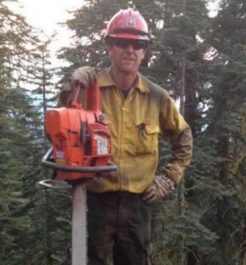
Daniel_J_Laird
Daniel J. Laird. Tahoe National Forest photo.

The pilot was also transported to a hospital in stable condition, according to the information reported yesterday by Sergeant Erik Burse with the Texas Department of Public Safety.

Below is a letter from the USFS Regional Forester in California:

“You may have already heard from Secretary Perdue and Chief Christiansen that we lost one of our own, Daniel Laird, yesterday, in a helicopter accident while conducting a prescribed burn with our Region 8 partners on the Sam Houston National Forest in Texas. Daniel was 41 years old and leaves behind his wife Heather and daughter Evain.

“Daniel started as a seasonal firefighter on the Tahoe [National Forest] and worked his way up to Helitack Captain. His passion was in aviation, but he was also known for his ability to lead a strike team of engines or a task force of hand crews and heavy equipment. He was a true leader in every sense. He was dedicated to being an instructor and a believer in the apprentice program, where he helped grow people just like himself. Daniel was originally from Graeagle, CA, and committed his working life to the Forest Service. He was extremely knowledgeable about his craft and loved his job. He had an infectious smile, natural physical talent, and his greatest love of all was his family.

“Our Forest Service family is hurting over this tremendous loss. It is an emotional time and Daniel’s loss can impact even the strongest among us. We grieve with Daniel’s immediate family, friends, and community. Please keep them all in your thoughts and prayers. The Region is providing support to the Tahoe and all who need it as they digest this sad news. I will pass more details on arrangements once they become available.

“Please continue to look out for one another and take care of one another.”

Randy Moore
Regional Forester
USFS R5


(UPDATED at 9:07 a.m. CDT March 28, 2019)

The deceased firefighter was a U.S. Forest Service employee who, along with the other firefighter and the pilot, were on an aerial ignition mission. Their equipment was dropping plastic spheres that burst into flame after hitting the ground, helping to ignite the prescribed fire. No names have been released.


(Originally published at 7:17 p.m. CDT March 27, 2019)

One firefighter was killed in the crash of a helicopter today while working on a prescribed fire in the Sam Houston National Forest about 30 miles southeast of College Station, Texas south of Highway 149.

Sergeant Erik Burse with the Texas Department of Public Safety said the Eurocopter AS350 went down at about 2 p.m. with three people on board, a pilot and two firefighters. One of the firefighters was deceased on scene. The pilot and a second firefighter were transported to a hospital in stable condition after rescuers extracted them from the wreckage using jaws and air bags.
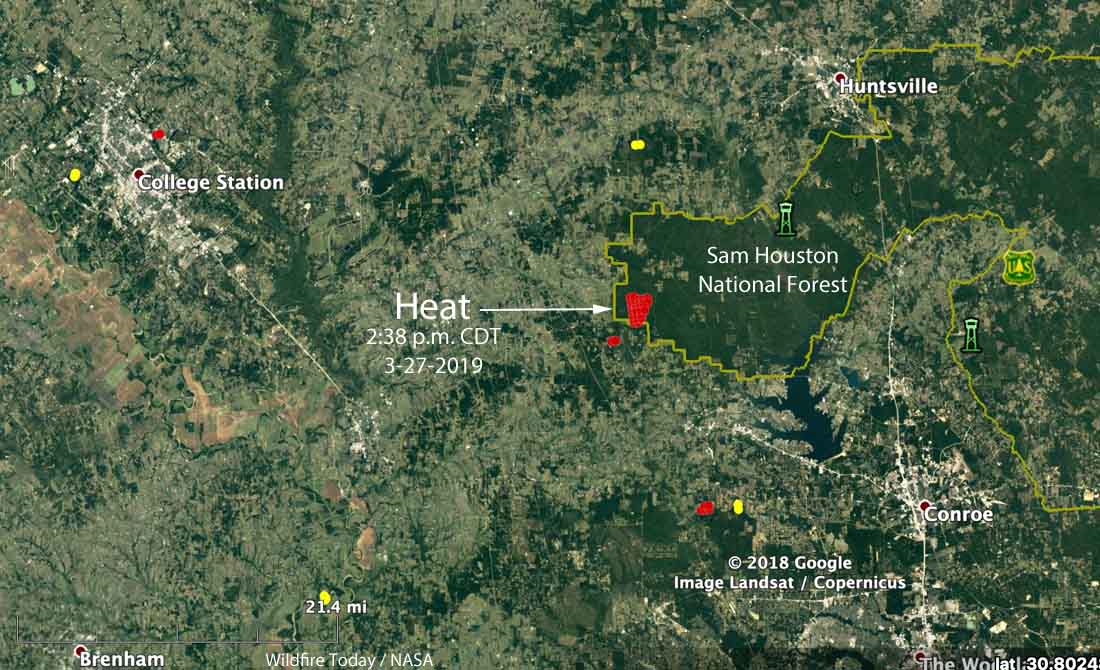
map helicopter crash sam houston national forest
Map showing heat in the Sam Houston National Forest detected by a satellite at 2:38 p.m. CDT March 27, 2019. There is a possibility the heat could have been produced by a prescribed fire.

Our sincere condolences go out to the family, friends, and coworkers of the firefighter, and we hope for a speedy recovery of the injured personnel.

Thanks and a tip of the hat go out to Perry. Typos or errors, report them HERE.

Bell 412 lands in water after tail rotor strike while refilling water bucket

The tail rotor of a Bell 412 struck a tree while it was attempting to refill its water bucket February 26, 2019 in the northwest part of Spain. The firefighting helicopter (EC-MAQ) operated by Babcock settled upright in a couple of feet of water in the Narcea River in Belmonte de Miranda, Asturias (map).

Photos show damage to the tail rotor. There were no reported injuries.

A look at the crash rescue kit

On December 18 the National Wildfire Coordinating group published a 4-minute video that gives a brief overview to the contents of the Crash Rescue Kit. It can be ordered like any other fire equipment through the fire cache system, as NFES #1040. If you desire to purchase it, the cost is $724.75.

The video implies it would be appropriate to have the kit available at an incident helibase.

Helicopter crashes, starts fire, rescuers burned over

helicopter crash site
An overview of the crash site and the extraction point for the three victims. Photo from the report.

A report has been released for a helicopter crash in a very remote area of Nevada that started a fire, injured two passengers, and resulted in rescuers being burned over. It happened August 18, 2018 about 10 miles north of Battle Mountain.

One of the passengers called 911 on a cell phone at 1357:

We just got into a helicopter crash…three occupants, all of us are alive and managed to get out…started a big fire, fire is burning all around us right now…one of the guys hit his head pretty hard…you’re gonna have to get a helicopter, it’s the only way to get in here.

Adding to the complexity was the fact that several different agencies and organizations had various responsibilities: Lander County Dispatch, Battle Mountain Volunteer Fire Department, local EMS services, a medical helicopter, Elko Interagency Dispatch Center, and Central Nevada Interagency Dispatch Center.

As might be expected the complex communication chain between the victims and the actual emergency responders created some difficulties, including a delay in extracting the three personnel.

The Facilitated Learning Analysis does not speculate what caused the crash of the helicopter that was transporting two biologists on a chukar survey, but it started a fire, which was named Sheep Creek. The biologists and the pilot self-extracted, one of them with what appeared to be a serious head injury, and they all hiked up a steep slope to a flat bench where they awaited a helicopter. About two hours after the 911 call the three were evacuated from the scene by a firefighting helicopter that was on scene, and possibly also a medical helicopter. The report is not clear about this.

helicopter crash site
A closer view of the crash site. Photo from the report.

Meanwhile a volunteer fire department Type 4 engine that had responded in a search and rescue mode toward the crash site found that the condition of the road they were traveling on deteriorated from a 2-track road to a 4×4 trail, and finally ended. At that point the fire was closing in on their location. The rookie firefighter and the Fire Chief got out, and leaving their wildland fire personal protective gear in the truck, began to spray water around the vehicle.

From the report:

Within seconds, the fire was all around Pumper- 2. Both individuals were caught outside of the vehicle while trying to spray water. Neither had on their personal protective equipment (PPE) when the burnover occurred. The Chief stated, “We were in a rescue mission, so we had no PPE on.”

During the burnover, the firefighter jumped off the back of Pumper-2, started to run around the vehicle and then took refuge under Pumper-2. “I was burning and screaming and hunkered down underneath behind the rear tires.” After the burnover, the Chief yelled for the firefighter, whom he could not see anywhere. He eventually located the firefighter under Pumper-2.

After sustaining significant burns, both the Chief and firefighter got back into the vehicle, with the Chief driving, continuing down drainage. The fire was behind them as they continued driving through the black towards the bottom of the drainage. Pumper-2 drove through the bottom of the drainage over the rough terrain until getting stuck. Both individuals got out of the vehicle and proceeded to hike up the steep ridge until they got on top of the ridge to establish communications.

At 1646, Lander County Dispatch received a 911 call from the firefighter, who said he and the Chief had been burned. “We need help.” Dispatch was asking questions to establish a location, but the cell phone was breaking up. The firefighter said, “We might need a helicopter because we are on the ridge…in the black…wearing a red shirt and just uphill right of the engine.”

Suppression resources were actively engaged on the wildland fire during the burnover of the Pumper-2. The Incident Commander of the wildland fire was unaware that Pumper-2 was on the fire until well after the burnover occurred. The dispatch centers did not know the location of Pumper-2.

At 1745 the injured firefighters were located and extracted by the air medical and suppression helicopters to awaiting ground medical resources at Battle Mountain Airport. At about 1900, fixed-wing aircraft flew the injured firefighters to the University of Utah Burn Center in Salt Lake City, Utah.

The FLA points out a number of organizational and human issues that are worthy of consideration. One topic that was not thoroughly addressed in the report was the dispatchers and firefighting personnel at times did not know the exact location of the crash site or the victims, and were not aware that the engine was responding or it’s location following the injuries to the two firefighters.

Even when, eventually, the location of emergency responders will be able to be tracked on an incident, biologists and volunteer firefighters will probably be some of the last personnel to employ this capability on a routine basis.

One injured in CAL FIRE CWN helicopter hard landing

helicopter crash Oakdale California
CWN helicopter crashes while en route to Weed, CA. Photo Courtesy of Stanislaus Consolidated Fire Protection District via Twitter.

A helicopter under a Call When Needed contract with CAL FIRE experienced a hard landing July 24 while ferrying from Southern California to Weed where it was needed to assist with a fire. According to Stanislaus County Sheriff’s Sgt. Frank Soria, the
helicopter began experiencing problems while enroute. As the pilot turned toward the Oakdale Airport the aircraft crashed.

Sgt. Soria said the pilot refused medical treatment but a passenger was admitted to a hospital.

Thanks and a tip of the hat go out to Al.
Typos or errors, report them HERE.