Largest wildfire ever in Austria being battled by hundreds of personnel

4:40 p.m EDT Oct. 31, 2021

 map wildfire in the Hirschwant region in Austria
The icons represent heat detected by satellites from a wildfire in the Hirschwant region in Austria between Oct. 25 and Nov. 1, 2021 local time. The icons represent the approximate locations.

A wildfire in Lower Austria has grown to become the largest in recorded history of the country. It started on Monday October 25 and quickly grew to 100 hectares (247 acres) but has not spread much since then.

“The emergency services can still limit the fire area to 115 hectares (284 acres),” said Franz Resperger from the Lower Austria fire brigade on October 29. A total of 500 helpers were called in.

The fire is about 62 kilometers (38 miles) southwest of Vienna.

wildfire in the region of Hirschwang in Austria
Still image of the wildfire in the region of Hirschwang in Austria, October 30, 2021, from the video below.

On October 29 the EU’s Emergency Response Coordination Center mobilized to the fire two Canadair CL-415 air tankers based in Italy, part of the EU’s rescEU transition fleet. Helicopters also responded from Germany, Italy, and Slovakia.

The CL-415s are scooping water from the New Danube River.

According to the state fire brigade commander Dietmar Fahrafellner, around 750,000 liters (198,000 gallons) of water were dropped on Saturday.

It has been extremely dry in the country, especially in Lower Austria. The last time it was this dry was 35 years ago, in September and October of 1986.

Far more wildfire hectares have burned to date in Europe than average

Wildfires to date in Europe map
Wildfires to date in Europe, May 14, 2019.

The number of hectares that have burned in wildfires so far this year in Europe is over four times the average for this date. Usually wildfire activity begins in earnest around the first of July but this year burned hectares began accumulating rapidly in mid-February. The 11-year average by May 14 is about 35,000 hectares but this year the to-date total is 197,000.

One hectare is equal to 2.47 acres.

Accumulated wildfire hectares to date in Europe
Accumulated wildfire hectares to date in Europe, May 14, 2019.

Researchers look at how warming will exacerbate the occurrence of wildfires in Mediterranean Europe

wildfire portugal
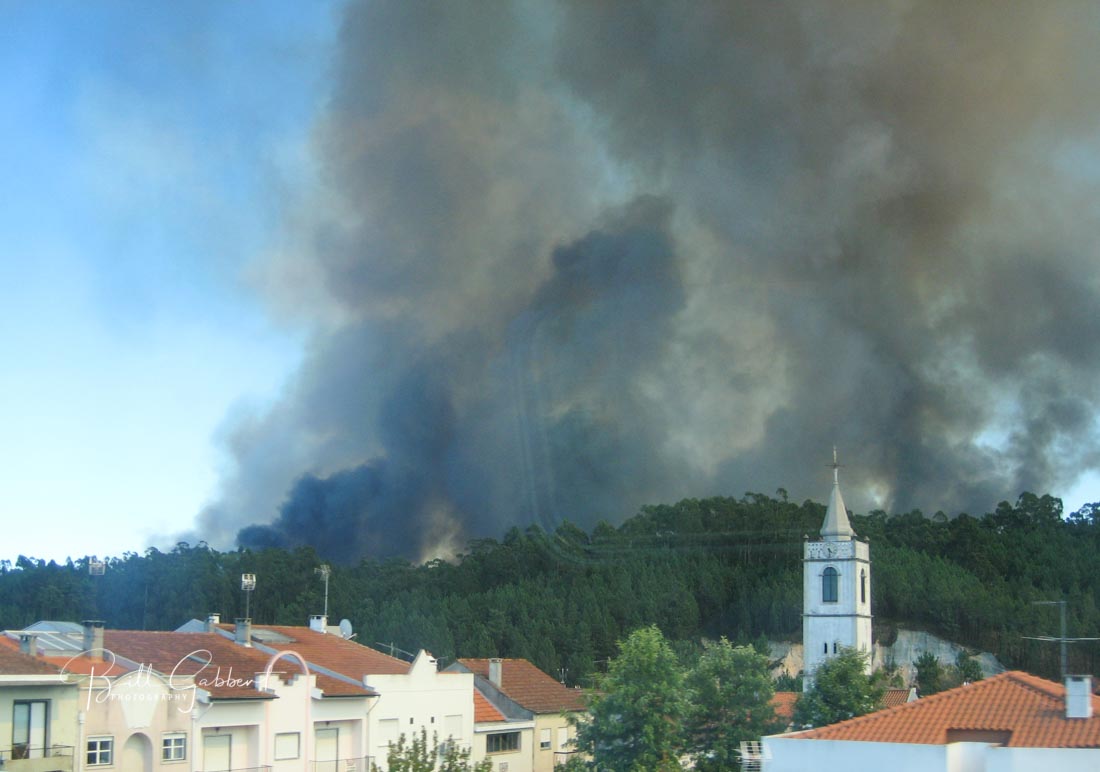
Wildfire south of Porto, Portugal, September 2, 2012. Photo by Bill Gabbert.

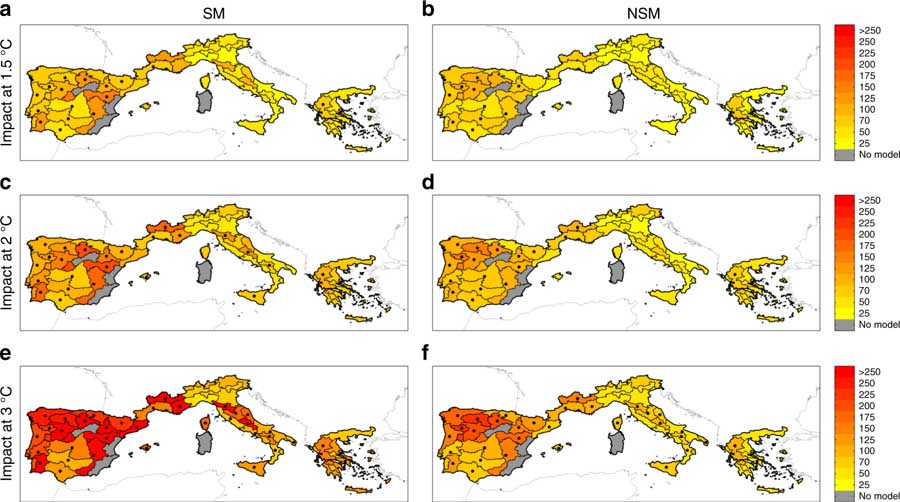
The climate warming that we have been seeing is expected to continue along with the increased risk of larger, more suppression-resistant wildfires. Scientists have examined how this will affect fires in Europe up to a 1.5°C  rise, which is the not-to-exceed target in the Paris climate agreement. Now a study is complete that examines increases of 1.5, 2, and 3°C warming scenarios. Not surprisingly, it found that the higher the warming level, the larger is the increase of burned area, ranging from ~40% to ~100% across the scenarios. Their results indicate that significant benefits would be obtained if warming were limited to well below 2 °C.

wildfires Climate Change Southern Europe
Ensemble mean burned area changes. Burned area changes (%) for a the +1.5 °C case with the stationary model SM (i.e., using Eq. 3), (b) the +1.5 °C case with non-stationary model NSM (i.e., NSM). using Eq. (4), (c) the +2 °C case with SM, (d) the +2 °C case with NSM, (e) the +3 °C case with SM, and f the +3 °C case with NSM. Dots indicate areas where at least 50% of the simulations (1000 bootstrap replications × the ensemble of RCMs) show a statistically significant change and more than 66% agree on the direction of the change. Coloured areas (without dots) indicate that changes are small compared to natural variations, and white regions (if any) indicate that no agreement between the simulations is found. Click to enlarge.

The paper, published in Nature, was written by Marco Turco, Juan José Rosa-Cánovas, Joaquín Bedia, Sonia Jerez, Juan Pedro Montávez, Maria Carmen Llasat, and Antonello Provenzale.

European Space Agency to develop regulations for the use of drones over wildfires

ViaSat Inc. today announced it is part of the consortium awarded the DeSIRE II project, a program funded by the European Space Agency (ESA) Integrated Applications Promotion (IAP) program, the European Defense Agency (EDA) and industry to define regulations and civilian usage for satellite-controlled Remotely Piloted Aircraft Systems (RPAS) also known as drones, unmanned aerial vehicles (UAVs) or unmanned aircraft systems (UAS).

As part of the consortium, ViaSat is taking the lead in developing the communication, navigation and sensing (CNS) technologies for real-time RPAS command and control across Ka- and L-band satellites. ViaSat will provide an advanced satellite communications (satcom) system that includes modems for both frequency bands and modems for system gateways to demonstrate how a satcom system can lead to the safe use of RPAS in “unsegregated” or civilian airspace.

ViaSat will also help identify civilian service applications for RPAS usage such as environmental monitoring, maritime surveillance and emergency response. One application proposed by ViaSat is the effectiveness of RPAS in early warning and response of a wildfire outbreak. ViaSat in collaboration with CEREN, the French public organization that represents 14 fire brigades, will demonstrate how the DeSIRE II project can aid in data collection and transmission; identification of risk and alarm trigger; real-time video information of wildfire outbreaks; and night flights with infra-red capabilities.

Thanks and a tip of  the hat go out to  Barbara.

Wildfires in central Europe

Hot, dry weather over the last several weeks has led to numerous wildfires in central Europe, especially in Austria and southern Germany, Georg, one of our loyal readers in Germany tells us. Some of the fires are in steep terrain, he said. Thanks Georg!

He sent us some links to sites with photos and descriptions (in German) of recent wildfires. (Thankfully, the photos are in English 😉  )

  • Here’s one
  • At this fire there were about 250 firefighters and 50 soldiers.
  • About 680 firefighters were assigned to a third fire, along with 3 helicopters and 3 Single Engine Air Tankers.

The images below are screen grabs from the video you’ll see farther down.

fire Engine on road Firefighters along a fence

Firefighters refill a helicopter bucket
Firefighters use two hoses to refill the bucket of a hovering helicopter.
Firefighters refill a helicopter bucket
Firefighters use two hoses to refill the bucket of a hovering helicopter.

Google Translate took a stab at translating the description of the above video:

From the fire of pine forest between Wiener Neustadt and Weikersdorf was affected by the fire, said Alexander Nittner by the State Fire Command in Tulln: “The big challenge for the firefighters is that the wind constantly rotates, the approach is extremely difficult and already about 15 acres forest on fire. “by Thursday evening, the fire spread to an area of ​​20 hectares.


European Union considers rapid reaction force

Athens wildfire

Athens wildfireThe European Union (EU), comprised of 27 member states, has been considering since April of 2007 the development of a rapid reaction force that could respond quickly to wildland fires, floods, and other emergencies. The parliament even passed a resolution to that effect, but little has taken place to make it happen.

I recently talked with someone in the UK who told me that in the last 2 weeks, due to last summer’s fires in Greece, the fire on the Greek island a couple of weeks ago, and the recent flooding in the UK, discussions along these lines have accelerated. In addition to other resources, they are considering a fleet of air tankers that could respond quickly to wildland fires in any of the 27 member states. The resources would be funded by the EU and is being advocated by the Directorate for Civil Protection.

Photo: Athens burning, July, 2007