Is fuel reduction the same as fire prevention?

On March 5 we posted a graphic produced by the U.S. Forest Service that indicated they were preventing wildfires “by igniting prescribed fires and by mechanical thinning to decrease the amount of combustible materials”.

We wrote, “Often we see politicians and media personnel conflate wildfire prevention with fuel management.”

One of our readers left a comment, saying, “Are you saying that prescribed fires and fuels management (e.g. mastication) do not constitute ‘wildfire prevention,’ in your view? If this is your view, can you please explain the rationale behind it?”

Our response turned out to be rather detailed, so we decided to also post it here:

****

The definition of “prevent” is “to keep something from happening”. The USFS graphic above indicates that the USFS prevents wildfires “by igniting prescribed fires and by mechanical thinning to decrease the amount of combustible materials”.

Decreasing the amount of combustible materials on USFS land does not prevent fires. It may slow the rate of spread and the intensity of wildfires, which may reduce the resistance to control, enabling firefighters, if they arrive early enough and in sufficient numbers, to stop the spread of a wildfire when it burns into a previously treated area. Fuel treatments may reduce the chances of a small to medium-sized fire from becoming a large fire or a megafire, but they don’t prevent the ignition of fires.

Wildfire prevention programs can involve the following strategies:

–School programs
–Contacting the public at events
–Marketing (ads, billboards, signs)
–Contacting recreationists, hunters, and ATV riders in the field
–Regular patrols
–Detection of illegal campfires
–Exhibits and displays
–Poster contests
–Enforcing certain laws about fireworks and campfires
–Controlling, regulating, or inspecting equipment of contractors, railroads, ATVs, and motorcyles

When budgets are reduced in land management agencies, fire prevention is usually first on the chopping block. Now it’s to the point where many people don’t even know that it used to exist. Or that fire prevention used to be a full time job for many government employees. They may vaguely remember the term, but don’t know what it involved. So even USFS public information personnel when they are designing graphic art can conflate it with fuel reduction, thinking they are the same.

Another example is Senator Ron Wyden who said recently when discussing wildfires “…there is not enough prevention…” As an example of “prevention”, he was referring to the Ashland Forest Resiliency Project which involves prescribed fire and the mechanical thinning of vegetation. There is no indication that he was actually thinking of the prevention of unwanted IGNITIONS of wildfires.

Many politicians, under pressure from lobbyists and contributors, argue passionately to increase timber cutting on public land, and sometimes say it “prevents fires”. But I’ve never heard a politician argue passionately about adequately funding programs that actually prevent unwanted ignitions of wildfires.

And it costs FAR LESS to prevent a fire than to put one out.

Here is a link to a 1998 National Wildfire Coordinating Group document titled “Wildfire Prevention Strategies”, for those who are curious about what fire prevention used to be.

Now to be fair, I’m not saying that fire prevention programs no longer exist. However, they are a far cry from when they were funded at a much more meaningful level.

1926 fire prevention poster

Mississippi Forestry Commission poster 1926

I wonder if this 1926 poster from the Mississippi  Forestry Commission gave children nightmares. Did the Fire Demon claim millions of children? Acres? Trees?

Via @ForestHistory

Report: with climate change, higher emphasis should be placed on community preparedness in BC

Norbeck prescribed fire
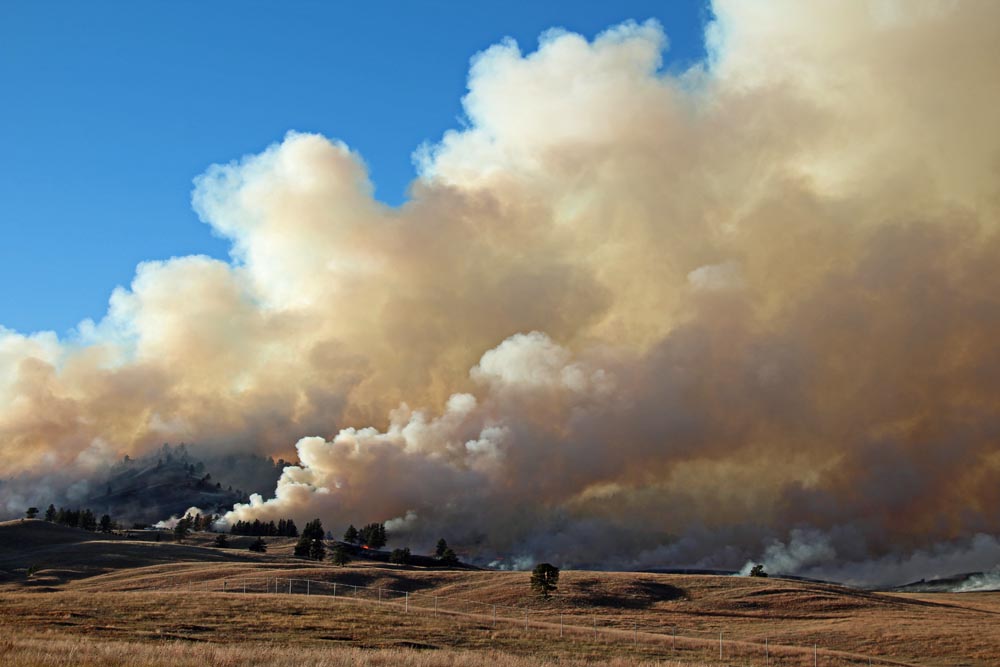
Norbeck prescribed fire, Custer State Park and Wind Cave National Park, October 20, 2014. Photo by Bill Gabbert.

A report commissioned by the British Columbia Forests Ministry suggests that with impending climate change, more emphasis should be placed on preparing structures and communities to co-exist with fire, rather than hoping to suppress every fire.

Below is an excerpt from an article in the Vancouver Sun. Unfortunately the author conflates the prevention of fires with fuel reduction and community preparedness.

As the planet heats up and the risk of “mega fires” rises, B.C. will no longer be able to lean on its world-class wildfire-fighting teams to keep people and property safe, according to a draft provincial document.

The Forests Ministry paper, called Climate Change Adaption Action Plan for Wildfire Management 2014-2024, suggests fire prevention should become the top priority of the province.

“It is not an option to continue to increase fire suppression response and associated costs, because even the most aggressive action would neither be safe nor effective for the extreme wildfire events such as those seen in Kelowna in 2003 and Slave Lake in 2010,” reads the draft, obtained through an access to information request.

“During these events, suppression response cannot be relied upon to protect communities or natural resource values. The only protection provided will be the protection established before the fire, provided through wildland-urban interface fuel reduction and landscape fire management…”

FEMA publishes EIS for proposed $5.6 million in fuel reduction projects in Bay Area

The Department of Homeland Security’s Federal Emergency Management Agency (FEMA) has released its final environmental impact statement (EIS) relating to grant applications totaling $5.67 million to fund proposed hazardous fire risk reduction projects in the San Francisco Bay Area.  The EIS evaluates the potential environmental effects of proposed vegetation management projects designed to reduce wildfire risk in the East Bay Hills of Alameda and Contra Costa counties and at the Miller/Knox Regional Shoreline in Contra Costa County.  The final EIS was filed with the U.S. Environmental Protection Agency on November 26th and will be published in the Federal Register this Friday, December 5, 2014.

Between 2005 – 2010, the University of California Berkeley, the City of Oakland, and East Bay Regional Parks District submitted a total of four grant applications to FEMA through California’s Office of Emergency Services (Cal OES) for federal financial assistance totaling $5.67 million to implement hazardous fire risk reduction projects. Based on the wildfire hazard characteristics of the East Bay Hills and the Miller/Knox Regional Shoreline, and the prolonged state-wide drought which has further intensified fire risk, FEMA has concluded that a need exists to reduce hazardous fire risk to inhabitants and structures in these areas.

The proposed grants were submitted to FEMA by the State of California on behalf of the named sub- applicants and are as follows:

  • PDMC-PJ-09-CA-2006-004 Oakland Regional Fuel Management Project (City of Oakland). Total project cost = $4,000,000; federal funding application = $3,000,000
  • PDMC-PJ-09-CA-2005-003 University of California Fire Mitigation Project – Claremont Canyon (UCB)  Total project cost = $418,143.00;  federal funding application = $291,000.00
  • PDMC-PJ-09-CA-2005-011 – University of California Fire Mitigation Project – Strawberry Canyon (UCB). Total project cost  = $404,040.00; federal funding application = $282,828.00
  • HMGP DR-1731-0016-0034 – East Bay Regional Park District, Brush Fuels Management Project. Total project cost = $3,025,210; federal funding application = $2,268,908

Continue reading