Large fires hit areas in Portugal and France

fire in France satellite photo

Above: Satellite photo showing smoke created by a fire in France, July 26, 2017. The red dots represent heat.

(Originally published at 8 p.m. MDT [UTC -6] July 26, 2017)
(Revised at 9:36 a.m. MDT July 27, 2017)

Wildfires in France and Portugal are disrupting the lives of thousands of residents and tourists. Each country has multiple large fires, but one of the largest in France is near the Mediterranean coast 77 km (48 miles) east of Marseille between La Londe-les-Maures and Le Lavandou and has forced the evacuation of about 12,000 people.

Mistral winds spread the fires quickly causing 60 people to be evacuated by boat while others spent the night in gyms, public places, or on the beach.

There was also a 2,000-hectare  (4,950-acre) fire on the French island of Corsica.

More than 1,000 firefighters are working on wildfires throughout the country.

fire in Portugal satellite photo
Satellite photo of smoke created by a fire in Portugal, July 26, 2017. The red dots represent heat. Click to enlarge.

Portugal is also struggling to contain a group of fires about 152 km (94 miles) northeast of Lisbon. It was just five weeks ago that a wildfire southeast of Coimbra, Portugal killed at least 62 people, most of whom were attempting to escape in their vehicles. Those fires were about 63 km northwest of the current blazes that are south of Perdigao burning in dense pine and in some cases non-native eucalyptus plantations. Many areas around the world grow eucalyptus in order to harvest the wood, leaves, and oil to make paper and medicine. But wildfires burn rapidly under them and through the tree crowns. Earlier this year we took this photo after a fire in Chile spread through a plantation.

wildfire eucalyptus plantation
The aftermath of a wildfire that burned through a eucalyptus plantation in Chile, February 2, 2017.

About 2,000 firefighters with 700 vehicles are battling wildfires around Portugal.  As in France, the fires are being pushed by strong winds.

Portugal’s fire season usually begins after July 1 but it got an early start this year.

Five Corsica firefighters entrapped and injured

damaged fire engines

Above: Two of the fire engines that were entrapped on Corsica. The engine on the left appears to have small water nozzles on the bar that encircles the top of the cab.

During night firefighting operations on the island of Corsica overnight on March 24 and 25 three fire vehicles were entrapped by the fire resulting in five firefighters suffering first and second-degree burns. Some of the firefighters, it is not clear how many, took refuge in one or more of the fire engines that had vehicle protection systems consisting of water nozzles positioned around the truck that could be activated as needed.

Engine protection system

The fire occurred in the French commune of Bastelica in southern Corsica (map). Matthias Fekl, the Minister of the Interior, said Saturday morning:

In the early evening, a group of firefighters found themselves trapped in flames as a result of a change in wind direction. They then took refuge in their vehicles equipped with a self-protection device.

One person is in police custody, suspected of starting the fire.

Three firefighter vehicles were damaged or destroyed in the incident.

damaged fire engines

The fire engine in the above photo appears to be the same one in the photo (on the left) at the top of this article.

Wildland firefighters in Australia have also been using similar engine protection systems for years.

Landing gear failure grounds CL-415 air tankers in France

CL-415 landing gear failure
CL-415 landing gear failure on a CL-415 in France closed the airport at Ajaccio, Corsica on Tuesday. Photo SSLIA 2A.

On Monday the right side main landing gear on a CL-415 air tanker failed while the aircraft was taxiing prior to taking off at the Ajaccio, Corsica airport. When the gear collapsed the right side wing dropped to the ground damaging the float and causing some fuel to spill from a damaged fuel tank.

There were no injuries to the crew of the air tanker but the airport was closed for several hours until the aircraft could be moved.

The entire fleet of twelve CL-415s in France are grounded until an inspection can determine the cause of the gear failure. Depending on the findings, inspections may be required on all of the aircraft.

Corsica is an island in the Mediterranean Sea belonging to France.

Below is a excerpt from a statement issued by Civil Security. It is roughly translated from French by Google:

The accident investigation office of Defense (CRDP), competent for state aircraft (…) triggered an investigation. Alongside technical survey is conducted in conjunction with the aircraft manufacturer, the Canadian company Bombardier.

Following these analyzes, which should take about 48 hours, Bombardier will determine whether it is necessary to carry out inspections on the landing gear of the Canadair fleet of civil security and in what protocol before allow the resumption of operations.

In addition to the CL-415 water scoopers, France also has access to S2-T and Dash 8 air tankers.

Thanks and a tip of the hat go out to Jerome and Jan.

Tracked vehicles for fire suppression

Converted personnel carrier, North Carolina

Yesterday we wrote about a suggestion at Fire Chief magazine that surplus military tanks should be converted to be able to suppress wildland fires. We pointed out that an M1A1 tank weighs 135,200 pounds and that even if the weapons and some of the depleted uranium armor was removed, transporting it on highways limited to 80,000 pounds and using it in an urban-wildland interface would not be easy. However there are other tracked military vehicles that are much lighter, some of which have been converted and used successfully to manage wildland fires.

Converted personnel carrier, North Carolina
Converted personnel carrier on a fire in Wilkes County, North Carolina, Spring, 2006. Photo by Michael Crouse.

For example, Michael sent us the photo above, and said:

We have a few of these around here in NC. Converted personel carriers. We call them fire tracks and the have a 500 gallon tank in the back with an electric ultra striker pump with honda motors. They are very handy to have in the more remote areas.

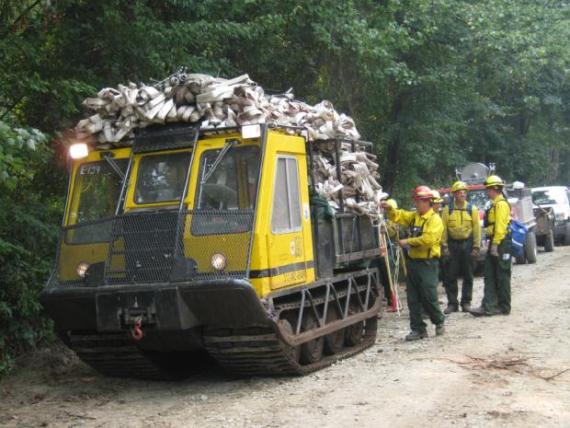
And there is the vehicle below that was used on the Lateral West Fire in the Great Dismal Swamp in 2011. It appears to be a Bombardier all-terrain vehicle. HERE is a link to examples of similar tracked commercially available non-military vehicles.

Fire hose "spaghetti" at Lateral West Fire, 2011
Fire hose “spaghetti” at the Lateral West Fire, 2011. USFWS photo by Brad Lidell

Frerson commented on yesterday’s article, saying that in France they are using a converted M113 armored tracked vehicle on wildland fires. They have a module with two of them which they use for suppressing fires in the southern part of the country. Atris Corporate appears to be involved in marketing the vehicle which is shown in the video below.

S2-T air tankers in France prepare for fire season

An S2-T practicing an air drop in France. Photo: france3.fr

S2-T Tracker air tankers are being used by the French Securite Civile in much the same way CalFire uses them in California. Their piston engines have also been replaced with turbine engines.  A French site has an article about local air tanker pilots training for the upcoming fire season with ground-based firefighters.  Here is how Google Translate translated the article that was, obviously, in French. It’s a little rough, but you’ll get the idea:

Air fight against the fire in Haute-Vienne

A year well watered!
A tracker was available to men of fire Hte-Vienne for a full scale exercise

The choice of location for the exercise of air fight against the fires had not been chosen at random: the airport of Limoges is a basic pélicandrom ”

This means that the aircraft water bombers are likely to land on the tarmac to take full of water before they speak sometimes even in the south of France. Men fire must therefore know the manipulations necessary for this operation. Moreover, they are also obliged to intervene on the ground, with the support of the Tracker. They therefore scale maneuvers in a forest near Nedde. The water bomber aircraft was refueled in Lake Vassivière and dropped its cargo under the guidance of men on the ground.

HERE is a link to a video associated with the article. I speak about three words in French, but the pictures tell the story.