Skip to content

Tag: CL-215

Spanish scoopers: a major defense against European wildfire

An article by Spanish journalist Miguel Hernández Fernández

First published by A21 — the first two images
were approved for Miguel’s final project
in his university communications degree.

The 43rd Air Force Group in Spain is one of the main weapons in the fight against forest fires there, and the Canadian-built amphibious aircraft are one of the main reasons.

It has been over 50 years since the incorporation of the first two seaplanes, a major force in the fight from the air against forest fires in Spain and the region. The 43rd Air Force Group has accumulated a brilliant history and is one of the most successful and admired units of the Spanish Armed Forces.

Its history in Spain begins in 1969 when, after the results achieved in France, Canadair, the designer and builder of the seaplane (today Viking), deployed an aircraft in Galicia at the request of the Spanish government. The results were so impressive that the Ministry of Agriculture decided to purchase two aircraft to be operated and maintained by the Air Force. The government assigned them to the 803 Squadron of the Getafe Air Base, and personnel were trained in Canada late in 1970.

Spanish scoopers
These dams are near the43 Group military base in Torrejón de Ardoz (Madrid). Photo ©2024 Miguel Hernández Fernández

Crew training and aircraft delivery were overseen by the Canadian company and delivery flights made by the Spanish crews, who accepted the planes in  February of 1971. The scoopers arrived at their base after crossing the Atlantic with stopovers in Newfoundland and the Azores. The aircraft carried out their first detachment at the Santiago de Compostela Aerodrome that same summer.

Because of the increase in forest fires and the achievements of the aircraft in the first two campaigns, in 1973 the purchase of eight more seaplanes was decided. The 404 Squadron was created, a unit dedicated exclusively to fighting forest fires and based in Torrejón de Ardoz. In 1974, the new planes arrived with some improvements – such as exploration and meteorological radar and bubble windows, which equipped the aircraft for their secondary task of search and rescue.

Spanish scoopers
Robledo de Chavela is a village in the mountains west of Madrid. This fire in 2020 was ignited by a motorcycle crash and spread very fast; it burned a great area that included three villages. The fire affected many animals, because the area is an important protected species zone, where still can be seen the fire effects. Photo ©2024 Miguel Hernández Fernández

The C-215 were seaplanes with Pratt and Whitney piston engines with a power of 2,100 hp each, as well as water tanks with a capacity of 5,400 liters. Its crew consisted of a pilot, co-pilot, and maintenance specialist who also assists the crew when necessary.

In 1978 the 404 Squadron reached 10,000 flight hours and received several decorations and recognitions for its already impressive career. In 1980, the 404 became the 43rd Air Force Group, which it maintains to this day – as well as its summer deployments in Torrejón de Ardoz, Albacete, Palma de Mallorca, Santiago de Compostela, and Zaragoza.

Spanish scoopers
Las peñotas is a dam near the city of Ávila. This 2021 fire started in the town of Navalacruz, about 20 miles to Ávila. This fire was devastating but generated a movement of solidarity throughout the country with the ranchers and farmers affected by the fire. The initial forces had to be increased, with many resources in Spain (Castilla León, Madrid, Castilla La Mancha, Galicia) and the UME (Military Emergency Unit) was deployed with many resources, including the Group’s 43 aircraft, that flew with many other planes and helicopters. Photo ©2024 Miguel Hernández Fernández

In 1989, flight hours reached 55,000 and some aircraft were modified to the CL-215T version. This variant, developed by Canadair, was enhanced when the company was purchased by Bombardier. Among other improvements, the conversion replaces the piston engines with turboprop, resulting in greater performance and power (2,380 hp), four-blade propellers, larger capacity in the water tanks, and structural reforms such as winglets at the ends of the wings and improvements in controls and flight systems.

Not all the planes were converted, but ten seaplanes of the new version were purchased, and the unconverted primitive engines were sold or operated by civil companies, which have kept some in flight to this day.

Spanish scoopers
This set was taken during a season presentation day for the media, at Valmayor dam, where two planes of 43 Group made a demonstration for fire suppression. This image is the final flight and marked the return to base. Photo ©2024 Miguel Hernández Fernández

The maintenance of the fleet has been carried out, since 1971, at the Albacete Air Master and the approvals are also conducted in Spain, a sign of the capacity of our aeronautical industry and the competence of the personnel.

In 1995, the 43 Group began operating with only the new CL-215T, reaching 100,000 flight hours in 1999 and counting thousands of hours during each season from June to September. With the passage of time and the acquisition of aircraft, the detachments have expanded: in addition to Torrejón de Ardoz, Albacete, Palma de Mallorca, Santiago de Compostela, and Zaragoza, they now also include Málaga and Badajoz, with full capacity to deploy in the Canary Islands.

In 2002, in response to the Prestige oil tanker disaster on the Galician coast, the 43rd Group collaborated with other units of the Air Force in the detection and monitoring of spills. The flights were intense and long in the harsh Atlantic winter, demonstrating the preparation and commitment of the crews and maintenance teams to help mitigate the disaster. Between December 25, 2002 and January 9, 2003, nine sorties were carried out, with some missions during that crisis lasting more than six hours with aircraft flying from sunrise to sunset.

A CL-215T carries around a 300 lb. lower payload than the CL-415 and does not have an electronic flight instrument system (EFIS) flight deck. The major visual difference is CL-215T’s two-door bomb bay; the CL-415 has a four-door bomb bay, and which aircraft is better is continuously debated by the worldwide operator base.

In 2006 the first of the four new CL-415s – an improved CL-215T – was received, and in 2012 the 43 Group reached 150,000 flight hours.

Spanish scoopers
Beginning of the 2019 season at Valmayor Dam. Photo ©2024 Miguel Hernández Fernández

The Unidad Militar de Emergencias (UME) is a branch of the Spanish Armed Forces providing disaster relief throughout Spain, and abroad if required, and it relies on the 43 Group – with more than 150 people and 18 seaplanes (fourteen CL-215T and four CL-415, with fuselage numbers 43-31, 32, 33 and 34) that, year after year, fight forest fires not only in Spain but also other countries including Israel, Portugal, France, and Morocco. All these over the years have counted on Group 43 to fight fires in their territories.

The responsibility of the 43 Group is subject to the intensity of challenging launches, over very hot areas, landing on water surfaces that are not always clear of obstacles, along with other factors that could easily trigger disaster. Fifteen crew members over the years have lost their lives fighting wildfire. Their memory and sacrifice have a permanent tribute at the Group Headquarters, as a testimony to the enormous difficulty of the job that demands the maximum from its members.

Spanish scoopers
Torrejón de Ardoz air base. The pilot is a veteran who carries proudly a patch that means he has flown in ten fire seasons. Photo ©2024 Miguel Hernández Fernández

The official motto of the 43 Group contains both the greatness and the humility with which its members fulfill their duty:  Apaga … y vamanos.  Literally translated, that is “Turn off and let’s go.” What it means is “Put this fire out and let’s go home” — or it’s all in a day’s work, not heroic, just part of the job.

In memoriam
08-09-1976

Alférez D. José Luis Herráez Soria
Brigada D. José Cachofeiro Ramón
Sargento 1º D. José Pérez Belmonte
12-10-1980
Comandante D. Óscar Sáez de Santamaría Alegría
Sargento 1º D. Luis Vélez Tarano
02-03-1981
Teniente D. Fernando Esteban Baturone
Teniente D. Aurelio Gil Laso
Alférez D. Eduardo Javier Moreno Jiménez
Sargento 1º D. Santiago García García
09-09-1988
Capitán D. Pedro Álvarez de Sotomayor Seoane
Capitán D. Jesús Cembranos Díaz
Teniente D. Carlos Ramírez de Esparza Figuerola-Ferreti
Sargento D. Juan Carlos Muyo Romero
25-03-2003
Sargento D. Manuel Fábrega Salas
Sargento D. Manuel Fernández Carrascosa


Miguel Hernández Fernández: “Since I can remember, I have been passionate about aviation. From building plastic kit airplanes I went on to photograph them and from there, when I had my first SLR camera in 1991, I became a spotter photographing real airplanes. At the same time I took the ultralight pilot course and, although I flew little, I enjoyed it to the fullest. With a journalistic vocation, I started with the magazine VOLAR, and the TV program ‘Caminos en el Aire,’ reporting on military and civil aviation with video. I obtained my university degree in communication and I maintain my passion for aviation and photography. And the best: when I hear a propeller or a jet engine, at home or outside, I always look at the sky.”

Chinook helicopter rescues stranded CL-215

A small island on a lake in Canada’s Northwest Territories (NWT) has been named “Duck Island” after a Canadair CL-215 scooper was stranded there for a couple of months till it was  airlifted out by a CH-47 Chinook helicopter owned by Billings Flying Service.

Sometimes called “ducks” for their nimble maneuvering on water, the CL-215 scooper is a twin-engine, high-wing amphibious airtanker that is a staple of aerial firefighting operations. Canada endured a severe fire season this year, with more than 300 fires and over 4 million hectares burned — almost 10 million acres.

Vertical Magazine reported that a 1968 CL-215 belonging to NWT operator Buffalo Airways Ltd. was scooping water in late August from remote Mitchell Lake north of Yellowknife.

“We were at a low water cycle,” recalled Joe McBryan, founder of Buffalo Airways. “It was four feet lower than normal. We had scooped 78 loads off that lake, but this time the aircraft struck a rock reef.” The rock punctured the aircraft underbelly and caused a fast flow of water into the keel, rendering the plane inoperational. The pilots spotted a small island nearby and were able to taxi the CL-215 over and tie it to a small tree before they were rescued by helicopter.

“It was a little northern toothpick tree,” laughed Benjamin Tessier, a technician in aerospace engineering at Buffalo Airways. He was part of the crew who were sent in to prepare the scooper for an airlift, and McBryan then found the only helicopter that could possibly airlift the CL-215 scooper back to safety — a CH-47 Chinook.

Several support helicopters, including this Bell 212HP from Great Slave Helicopters, assisted in the project. Benjamin Tessier Photo
Additional support helicopters, including this Bell 212HP from Great Slave Helicopters, assisted in the project. Benjamin Tessier photo

Meanwhile, Tessier and five of his co-workers headed for the island. They had to somehow reduce the aircraft’s empty weight to a number between 18,000 and 18,500 lbs. — and get it out of the water.

The Buffalo crew had to use trees they cut down on the island to build a “pirate raft” that engines were craned onto, then they were lifted right off the raft by Bell 205s. Benjamin Tessier Photo
The Buffalo Airways rescue crew used trees they’d cut on the island to build a “pirate raft” that the engines were craned onto. They were lifted from the raft by Bell 205s. Benjamin Tessier photo

“We did everything in September to prepare for the takeoff,” Tessier told Vertical Magazine. “We took the engines and props apart and removed them, took all fluids out (oil, fuel, foam agent), got rid of the radios, pump systems — all to lighten it up. We removed 10,000 lbs. of equipment plus about 13 drums of fluids. All of that took about two weeks.”

Tessier said the props and engines were removed while the aircraft was still on the water. “We cut trees and built a raft that we craned the engines onto,” he recalled. “We supported all the weight of the engines on that raft and a Bell 205 helicopter lifted them from there.” SimpleFlying.com reported that the retrieval operation went smoothly, with Tessier shooting video and posting it online.


Recovering the aircraft involved weeks of careful planning — and even special government approval. The main concern for Buffalo Airways was the fast-approaching winter season. Once temperatures dipped below freezing, the aircraft would be frozen into the lake ice, making things infinitely more difficult. Two things had to happen before they could airlift the CL-215; they needed an exemption from Transport Canada to move the aircraft, which took a month to acquire. And the scooper’s weight had to be reduced enough to be lifted by the Chinook.

The CL-215 also had to be pulled out of the lake; its keel was full of water, which added a lot of weight — too much for the helicopter lift. It took three days, with six men taking turns to hand-crank the plane onto the lakeshore.

The CL-215 is a twin-engine, high-wing amphibious waterbomber, and a staple of northern aerial firefighting. Benjamin Tessier Photo
The CL-215 is a twin-engine, high-wing amphibious waterbomber, and a staple of northern aerial firefighting. Benjamin Tessier photo

The CH-47 Chinook, operated by Montana’s Billings Flying Service, flew in October 30. (Imagine that phone call — you want us to what??) Mechanics from Buffalo and Billings flew in, and they were accompanied by the general manager of Alberta-based Airborne Energy Solutions; their team provided support and guidance on risk management for the operation.

“It was so bizarre to see such a big machine in remote little Mitchell Lake on Duck Island,” said Tessier. “They didn’t waste any time at all. Everything the pilot did was deliberate. He positioned himself in the wind, cable already dangling. We had a 50-foot extension cable going from the plane to where he hooked on. As soon as tension was there, it just went up. The Chinook didn’t budge, didn’t seem to struggle; there was no noticeable change in engine noise.”

Buffalo CL-215 back home at Yellowknife
Buffalo CL-215 safely back home at Yellowknife

The CL-215 took a 45-minute ride and was delivered to  Buffalo’s main base at Yellowknife Airport. They say it will take a few months of repairs to return the CL-215 to serviceable condition, but they expect it will be ready in time for the 2024 fire season.

The full story by Lisa Gordon is well worth the read — it’s online at Vertical Magazine.

 ~ Thanks and a tip of the hardhat to Jim for this heads-up.

Two Greek pilots killed in CL-215 crash

Two pilots died when a firefighting Canadair scooper dropping water on a fire in the south of Greece crashed after a water drop; Greece’s air force confirmed that the pilots were killed on the island of Evia.

The Independent reported that two Hellenic Air Force pilots, Commander Christos Moulas, 34, and his 27-year-old co-pilot Pericles Stefanidis, were killed when their Canadair CL-215 crashed on Tuesday.

The accident occurred near the town of Karystos on the island of Evia near Athens, where a fire has been burning for several days. Local media reported that the plane’s wing clipped a tree after a drop; two helicopters and several ambulances responded immediately.

An Agence France-Presse report said the aircraft plunged into a ravine after clipping the tree. A fire service spokesman told the BBC the aircraft was a Greek Air Force plane.

A third successive heat wave in Greece has pushed temperatures back above 40°C (104°F) across parts of the country following more nighttime evacuations ahead of fires that have burned out of control for many days. The latest evacuations were ordered on the islands of Corfu and Evia, and a wildfire on the island of Rhodes has been moving inland.

Hundreds of firefighters, helped by forces from Turkey and Slovakia, have been battling the Rhodes fire since Wednesday after it resurged in hot and windy conditions. Tourists have been warned of the extreme fire risk in Crete, and Greek Prime Minister Kyriakos Mitsotakis cautioned residents and visitors about tough days ahead.

“All of us are standing guard,” he said. “In the face of what the entire planet is facing, especially the Mediterranean which is a climate change hotspot, there is no magical defense mechanism — if there was we would have implemented it.”
~ Greek Prime Minister Kyriakos Mitsotakis

A three-day period of mourning in the armed forces has been announced in memory of the pilots who died. Defence Minister Nikos Dendias said they lost their lives in “the line of duty … while attempting to protect the lives and property of citizens, as well as the environment of our country.”

The accident occurred nearly 16 years to the day when two Greek pilots lost their lives fighting wildfires on July 23, 2007. (Another crash near Athens had a much happier outcome back in 2016.)

The Guardian posted video of the accident, claiming the scooper was “spraying water” before the crash.

 ~ Thanks and a tip of the hardhat to Alex, Bob, and Tim.

US Forest Service awards CWN water scooper contracts

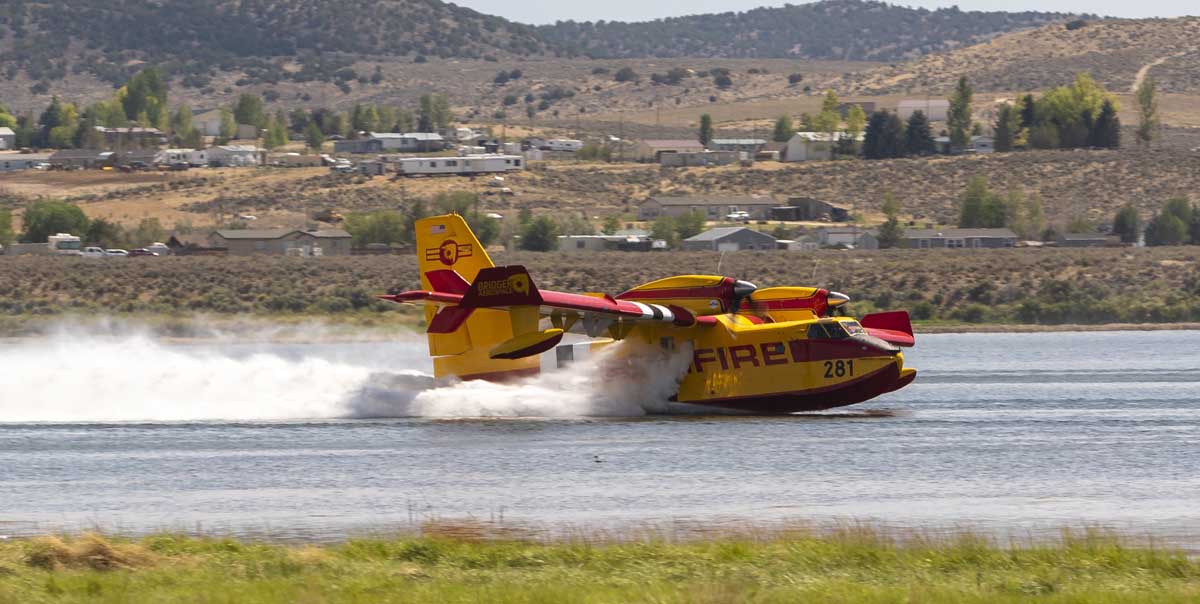
Tanker 281 Cedar Fire Nevada
Air Tanker 281, a CL-415EAF, completed over 60 water drops in support of firefighters at the Cedar Fire south of Elko Nevada on its first ever mission. Photo July 21, 2020 by K Mita, Bridger Aerospace.

Today the U.S. Forest Service announced contract awards for Call When Needed water-scooping air tankers. They went to three companies, Aero Flite Inc., Air Spray USA Inc., and Bridger Air Tanker LLC.

The estimated value of each of the contracts is about $25 million to $29 million.