This is a reminder about the National Transportation Safety Board’s two-day Public Aircraft Oversight Safety Forum that we first told you about in September. It will be held in Washington D.C. and will begin at 9:00 a.m. ET, Wednesday, November 30, 2011 and continue through Thursday, December 1st. It will be available for the public to view live on the internet at the NTSB web site.
The forum could affect the way land management agencies use firefighting aircraft, including helicopters, air tankers, and other fixed wing aircraft while managing wildfires.
I am thinking that one of the primary reasons the NTSB is looking into this issue is the helicopter accident on the 2008 Iron Complex fire near Weaverville, California in which nine firefighters died. The NTSB investigation brought to light information that made it clear the FAA and the U.S. Forest Service had inadequate oversight of the operation of aircraft used for wildland firefighting on federal lands. According to the NTSB, there was “intentional wrong-doing” by Carson Helicopters that under-stated the weight of the helicopter and over-stated the performance of the helicopter in the documents they provided to the USFS when bidding on their firefighting contract.
Some of the family members of the firefighters that died on the Iron Complex fire will attend the forum in person in Washington D.C. They have been having trouble finding out if any federal agencies are actively pursuing a criminal investigation into the activities of Carson Helicopters and the company’s role in the fatal accident.
Below is the text from an NTSB press release about the forum:
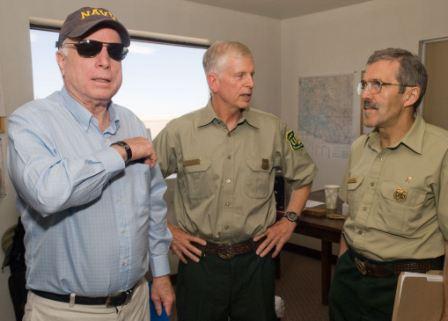
Sen. John McCain, Thomas Tidwell (Chief of the Forest Service), and Tom Harbour (Director of Fire and Aviation, USFS) at the Wallow fire, June 18, 2011. Photo by USFS.
On June 18 Senator John McCain flew with Tom Harbour, Director of Fire and Aviation for the USFS, and Thomas Tidwell, Chief of the Forest Service, to Arizona to be briefed on the Wallow fire. He met with reporters that day and started his own firestorm when he was quoted as saying:
There is substantial evidence that some of these fires have been caused by people who have crossed our border illegally. The answer to that part of the problem is to get a secure border.
McCain received a great deal of criticism for his rather vague statement, some of which accused him of unfairly pointing the finger at “vulnerable populations”. It was not clear to which fires McCain was referring, but two cousins from southern Arizona were charged with starting the Wallow fire by leaving a campfire unattended. McCain may have been thinking of the Monument fire which started June 12 near the Arizona/Mexico border and, according to a well-publicized theory by Cochise County Sheriff Larry Dever, may have been caused by illegal border crossers. We checked today and the cause of the Monument fire is officially still “under investigation”, according to the Coronado National Forest.
It turns out that in 2010 McCain and three other senators, Lisa Murkokwski, John Barrasso, and Jon Kyl requested that the Government Accountability Office (GAO) conduct a study about wildfires in the Arizona border area. The 55-page report which was released today, covers:
The number, cause, size, and location of wildland fires from 2006 through 2010;
Economic and environmental effects of human-caused wildland fires burning 10 or more acres;
Extent to which illegal border crossers were the ignition source of wildland fires on federal lands; and
Ways in which the presence of illegal border crossers has affected fire suppression activities.
From the report, here are some numbers relating to Arizona border area fires. The GAO looked at data for fires that occurred from 2006 through 2010:
2,467 fires were examined in the report
2,126 or 86% of the fires were caused by humans
1,364 fires burned less than one acre
1,553 or 63% of the 2,467 fires started on federally managed or tribal land
$35 million, the suppression costs for the fires that burned more than 10 acres
?… the number of fires ignited by illegal border crossers on federal lands is not known because not all fires were investigated
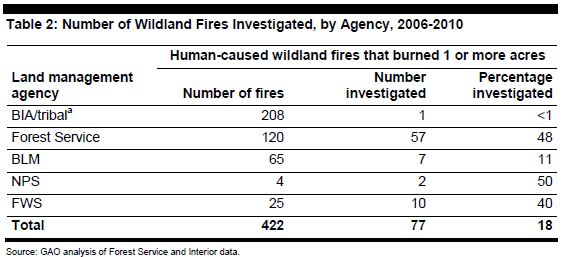
422 human-caused wildland fires occurred on Forest Service, Interior, or tribal lands and burned at least 1 acre
77 of the above 422 fires were investigated.
30 (or 39%) of the above 77 investigated fires were identified as being caused by illegal border crossers
57 additional fires were not formally investigated but were suspected (by individuals who completed fire reports) of being caused by illegal border crossers
4% of the 2,216 human caused fires were identified by investigators or by individuals who completed fire reports as being caused by illegal border crossers
Below are three graphics from the GAO report, followed by Conclusions and Recommendations:
The International Association of Wildland Fire is reporting the deaths of two pilots in separate wildfire aviation accidents in Spain. One was a single engine air tanker that crashed on October 2, and the other was a mid-air collision of two helicopters on September 30. There was one fatality in each incident.
Status: Contractor to the Airborne Firefighting Service of the Galician Regional Government (INFOCAM) (INFOGA)
Years of Service: Very experienced pilot and had flown the last four fire seasons in Galicia (Galice) Spain. He was a master of the Aeroclub of Biscay, and wrote a very popular manual for obtaining a private pilot’s license.
Date of Incident: 2 October 2011
Time of Incident: approximately 1715 hours local time
Date of Death: 2 October 2011
Company: Martínez Ridao Company
Fire Department: Airborne Firefighting Service of the Galician Regional Government (INFOCAM)
Incident Description: Pilot Zubiaga, was helping to extinguish a large fire in the Serra da Meda, Galicia near the town of Arcucelos (Laza). The plane he was piloting, an Air Tractor AT802, crashed for reasons still unknown but the pilot had time to radio his base that something was wrong with the aircraft. Nearby observers saw the “aircraft was on a strange maneuver before plunging to the ground.” Firefighters from Verín started an immediate search and when they found the aircraft the Zubiaga was not inside. He died of unknown causes and was found about 150 meters from the crashed aircraft in an area of rough terrain. His body was discovered about 1900 hours local time and was taken to the Hospital Complex of Ourense. An autopsy was to be performed to determine cause of death. The Regional Ministry of Rural Affairs announced an inquiry would take place concerning the incident.
Incident Location: Autonomous Community of Galicia, Ourense-Xunta de Galicia province, in Serrra da Meda, between Laza and Verín to 42.008999,-7.482033. Galicia (Galice) is in northwest Spain and is bordered by Portugal to the south, the Atlantic Ocean to the west and the Bay of Biscay to the north.
INCIDENT #2
Name: Leo Jenssen (from Denmark)
Rank: Pilot
Age: unknown
Gender: Male
Status: Contractor to the Airborne Firefighting Service of Castilla La Mancha Regional Government (Incendios Forestales Castilla La Mancha, INFOCAM)
Years of Service: More than 10700 flight hours and eight fire seasons in Spain
Date of Incident: 30 September 2011
Time of Incident: 1340 hours local time
Date of Death: 30 September 2011
Company: Grupo INAER
Company Address: Oficinas Centrales (INAER Helicópteros), Aeródromo de Mutxamel, Partida La Almaina, 92, 03110 Mutxamel, Alicante, SPAIN
Fire Department: Airborne Firefighting Service of the Castilla La Mancha Regional Government (Incendios Forestales Castilla La Mancha, INFOCAM)
Helicopter Contractor: Grupo INAER
Incident Description: Two helicopter Bell B212’s touched and crashed during aerial maneuvering to refill with water at the Bienservida reservoir. Pilot Jennsen (flying helicopter MSN 30775, CC-CIS) was the only one of the two pilots who died during the incident. The other pilot, Manuel Fuertes, with 13 years’ experience, (flying helicopter EC-GIC), survived with minor injuries and burns but walked away from the crash and was taken to the hospital in Ciudad Real. Pilot Jennsen was unconscious and with a pulse when extracted from the water and CPR was administered. Pilot Jennsen was pronounced dead at the hospital and reportedly died from drowning. He was working for INAER, for the Castilla La Mancha fire agency. The fire reported at 1245 hours local time was extinguished at only 6 ha. The Accident Investigation Commission and Civil Aviation Incidents (CIAIAC) of the Ministry of Development is responsible for the investigation. The helicopter had last undergone and passed a review on 22 September. At this time the cause of the accident is unknown.
Incident Location: Area known as Los Castellares in the Alcaraz Sierra, Autonomous Community of Castilla-La Mancha, Albacete province, at the Bienservida reservoir, 38.519429,-2.61137. Spain.
Three people were killed Monday September 19 when a helicopter crashed about 25 kilometers east of Granada in Spain. The Bell 412 helicopter was flying from its company’s base in Palma del Río, Córdoba province, to the Infoca fire fighting base in Alhama de Granada. It was due to temporarily replace another helicopter which is normally based there while it was being serviced.
The helicopter was operated by the FAASA company. Here is an excerpt from a February 23, 2010 article in Vertical magazine about the company:
FAASA Group Takes Delivery Of Four AW119Ke Helicopters
Tuesday, February 23, 2010 – AgustaWestland
AgustaWestland, a Finmeccanica Company, is pleased to announce that FAASA Group of Spain has taken delivery of an additional four AW119Ke single engine helicopters for fire-fighting missions. The handover brings the number of AW119Kes in service with this operator to twenty units making FAASA Group one of the largest operators of this model in the world. Two of these aircrafts will be operated by Heliduero.
FAASA Group operates throughout Spain, particularly in the Castilla-La Mancha, Andalucia and Castilla y Leon regions. The operator provided a major contribution to the 2009 fire-fighting season in Spain deploying up to sixteen AW119 helicopters.
Helicopter's hard landing on Blackburn Canyon fire. Photo credit Jeff Zimmerman, Zimmerman Media LLC
Jeff Zimmernan took this amazing photo of helicopter 205ww after it make a hard landing on the Blackburn Canyon fire near Tehachapi, California September 4, 2011. Jeff said the pilot was making water drops and had to release the bucket, then auto rotated to a hard landing. You can see that the skids flattened out as designed. Paramedics took the pilot to a hospital.
We wish the best for the pilot. And thanks, Jeff, for the photo.
On August 11 I happened to be passing by the airport at Chester, in northeast California. It was 6 p.m., quitting time, and the U. S. Forest Service helitack crew was walking over to their cars, but one of them was nice enough to give me and my motorcycle riding partner a brief tour of the three Type 1 and Type 2 “restricted use” helicopters they were managing. The term “restricted” means they are not approved for transporting passengers.
UH1 (Bell 205) operated by Archer AviationUH1 (Bell 205) operated by Trans Aero HelicoptersThe hydraulic-powered submersible pump that can fill the 330-gallon belly tank in a little over a minute.
It has been just over two years since we visited the wildfire helitack base at the Custer, South Dakota airport during their open house which commemorated 50 years of service. Unfortunateley when I stopped by the other day, there was no barbecue grill stocked with hot dogs and hamburgers like last time. Poor planning on my part.
This year Custer helitack has the same combination of helicopters they have had for the last four years, one Type 3 and a Type 1.
Boeing-Vertol 107 Type 1 helicopter at the Custer, SD helibase
The Vertol crew told me that the helicopter has been used for approximately 160 flight hours so far this fire season.
Astar Type 3 helicopter at the Custer, SD helibaseThe ground response vehicles at the Custer, SD helibase. L to R: the contractor's helicopter service truck, the NPS-supplied crew vehicle, and the USFS-supplied helitack truck.
Note the two decals, U.S. Forest Service and National Park Service, on the door of the white 4-door pickup. The helicopter operation is interagency. In addition to the obvious USFS funding, the NPS contributes that truck and a crewperson or two.
Usually a reporter from the scene of a wildfire talks about acres, engines, and steep, inaccessible terrain….. zzzzzzzz ….. I’m sorry … what was I writing about? Oh yeah. Well, reporter Suzi Theordory of Time Warner Cable in the videotaped report below had something unusual to talk about — several hundred gallons of water landing on her.
Reporter Drenched During Forest Fire Coverage – Watch more Funny Videos
What are the chances the pilot did this on purpose? 🙂 Probably unlikely. There was a lot of smoke between her and the helicopter which was probably the main target. Probably.
DC-10 dropping on the Wallow fire near Greer, AZ, June 11, 2011. Photo, Kari Greer, USFS
From reading the report that came out of the Aerial Firefighting Conference held in Washington, DC May 25-26, it must have been a very interesting gathering. Organized by Tangent Link, it assembled many of the movers and shakers in the field that work in the United States.
Discussion topics on the agenda included:
How do we calculate and what are the real costs in tackling wild land fires in the USA?
Should there be a new Federal lead agency in prioritizing and resolving wild land fire assets, resources and funding?
Is there a need for more research and development activities in finding better solutions for combating ‘Mega’ wild land fires?
Which aircraft are in development that could be used to combat these fires?
Would the use of Military technologies enable for a more direct and responsive approach to combating fires, including night time operations?
Technical advances and solutions in development
What is the correct mix of aerial assets in combating fires and should there be a centralized aerial firefighting squadron?
What is the best approach in training aerial firefighting teams in new tactics and technologies?
Confirmed Speakers included:
Tom Harbour – Director of USDA Forest Service Fire & Aviation Management
Ray Chaney – Battalion Chief, CAL FIRE – Aerial Firefighting Airborne Sensor Down Linking
Frank M. Gladics, Minority Professional Staff, U.S. Senate Energy & Natural Resource Committee, USA – The Budgetary and Political Realities of replacing the existing fleet of large fixed-wing tankers
Norman Christensen, Professor of Ecology, Duke University, North Carolina: Fire Management- Past, Present & Future
William Derr, Special Agent in Charge of California Region, US Forest Service (Retd): The Elements of Success & Measurement in Aerial Fire Fighting
Rick Hatton – CEO, 10 Tanker Air Carrier – Raising the Bar in Fixed Wing Air tanker Operations
Mark Bickham, National Program Manager (Ret’d) Bureau of Land Management, USA – Single Engine Air Tankers
USFS Task Force 36 sets backfire Wednesday on the Palo Duro Canyon fire in Texas. (Does anyone see an interesting shape in the flames?) Photo: Joe Gamm
Jumpers from lower 48 dispatched to Alaska
The @BLMNIFC Twitter account sent this message Thursday afternoon:
Boise BLM jump base sent 16 smokejumpers to Alaska today due to the increased fire weather conditions. Alaska currently has 3 large fires.
Wildfire contractor voluntarily provides crew to assist with tornado recovery
A company that usually provides contract firefighting crews to government agencies to suppress wildfires, is voluntarily providing a crew to help assist with search and rescue following the devastating tornado that struck Joplin, Missouri. Chloeta Fire, headquartered in Oklahoma City, dispatched a crew on May 24.
Need identified to implement national wildfire strategy in Canada
Following the Slave Lake fire in northern Alberta, there has been a push to implement the national wildfire strategy that was developed but not funded in 2005. Here is an excerpt from an article in the Canadian Press:
While it may have been impossible to save Slave Lake, Stocks said more funding for the national strategy could lead to fireproofing of buildings being improved, firewalls being built around communities, and public education campaigns.
Money must also be found for new firefighting equipment and hiring and training new fire personnel to replace the hundreds who retire every year, said Stocks. Declining to name a figure, the amount should be decided by the country’s forestry ministers, he said.
But convincing governments to spend money on fighting forest fires when their priorities are focused on health care, education or regional issues may be a tough sell, he said.
A spokesman for Natural Resources Canada said the strategy was created as a framework to guide decision making and jurisdiction-specific investment decisions, noting the provinces and territories are responsible for wildfire management.
Residents of Slave Lake are told 374 lots burned in the wildfire
Some of the residents are being allowed back into the town after one-third of it burned on May 15. From the Canadian Press:
Residents of fire-ravaged northern Alberta communities in and near Slave Lake are finally learning if their homes were engulfed by flames.
The town has released a detailed photographic map which shows 374 lots were destroyed by the wildfires that swept through the area Sunday evening. Another 52 lots were damaged. There is also a map of homes in the nearby Municipal District of Lesser Slave River which shows 59 lots were destroyed and 32 were damaged.
Flames forced roughly 7,000 people to flee from their homes.
Pilot identified that was killed in helicopter crash
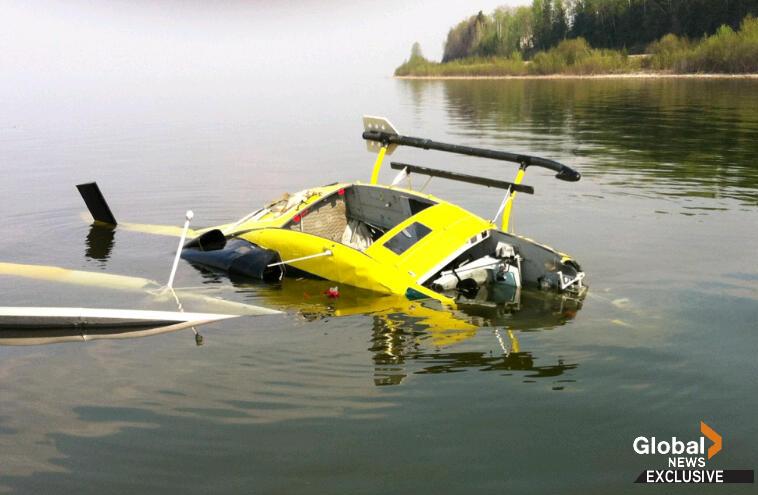
A firefighting helicopter crashed in Lesser Slave Lake. Photo Credit: Supplied, Global News
Jean-Luc Deba, 54, has been named as the pilot that died in the helicopter crash last week while working on the Slave Lake fire in northern Alberta. Mr. Deba was an employee of Campbell Helicopters out of Abbotsford, B.C. The helicopter crashed into Lesser Slave Lake, but the cause has not been released.
In tree felling accident, a laceration was caused by a hard hat
A facilitated learning analysis has been released for a tree felling accident on the Huron-Manistee National Forest in Michigan. A sawyer was struck on the head by a falling tree, but the only injury, a nasty laceration, was caused by the hard hat. Here is an excerpt from the Lessons Learned section:
5. The injury was caused by the hard hat. While the team looked at the incident the recent Tech Tip “Alternate Head Protection Available” draft released in March 2011 by MTDC came to our attention. In the Tech Tip it states, “Although Bullard Hard Hats meet safety standards a limited number of users now find the hard hats to be uncomfortable. The redesigned suspension system provides less space between the hard hat and users head and may allow sharp corners to cause pressure points.” There was discussion among the team that we could not identify which part of the hardhat had actually caused the injury (there was no blood or hair found on the hard hat after the incident). However, we can easily see how one of the corners of the rear suspension system 8 bracket could have caused the injury upon impact of the tree to the hardhat.