A California firefighter died July 11 in a hospital from injuries he suffered July 5 while fighting a wildfire near Lakeside in Southern California.
Frank Anaya, an inmate firefighter with the California Department of Corrections and Rehabilitation based at the La Cima Conservation Camp, was throwing cut brush during line construction operations when he lost his balance and fell into a running chainsaw. He suffered a severe cut to his upper right leg behind his chaps.
The 22-year old firefighter underwent multiple surgeries, but succumbed to his injuries July 11, 2017, according to the CDCR.
Our sincere condolences go out to Mr. Anaya’s friends, family, and coworkers.
Other California inmate firefighter fatalities that we are aware of in the last six years:
January 4, 2012. Crisanto Leo Lionell. Heart attack near the conclusion of a 20-minute, .66 mile exercise hike.
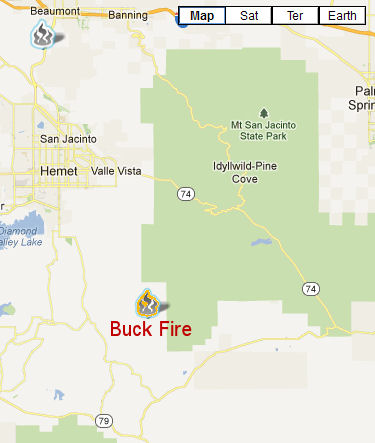
August 19, 2012. Jimmy Randolph. Anoxic encephalopathy combined with complications of heat stroke while assigned to the Buck Fire.
February 25, 2016. Shawna Lynn Jones. Struck by rolling boulder while working on the Mulholland Fire .
May 24, 2017. Matthew Beck. Struck by falling tree while doing project work with his crew.
Edited July 14, 2017 to reflect new information in the Green Sheet. The victim was not running the chainsaw, but was swamping for it (throwing the cut brush).
Now we know that the tree had been previously identified as being hazardous but it was thought to be outside the work area.
Alder Crew #4 was working on Ishi Pishi Road towards Somes Bar picking up piles of limbs and brush from the previous two days of work to feed into a chipper. The machine was running at full throttle when the crew supervisor saw the tree falling and yelled a warning, which was not heard by the entire crew due to the noise from the chipper.
The supervisor attempted to call the Fortuna Emergency Communications Center on his hand held radio but could not make contact. He got in the crew carrier truck and drove about 400 yards to a location from which he could talk to the ECC with the vehicle’s mobile radio.
Mr. Beck received a fatal blow from the tree causing blunt force trauma to the head, neck, and torso.
The tree was a 105-year-old, 146-foot Douglas-fir, with a 21.5-inch diameter (DBH). It weighed approximately 3,000 pounds and had a downhill lean of about 46 degrees. Mr. Beck was hit by a portion of the tree that was about 18 feet from the tree top.
Thanks and a tip of the hat go out to Eric. Typos or errors, report them HERE.
The California inmate firefighter in Humboldt County was killed May 24 while working on a county roads project in the northwestern part of the state in Del Norte County.
According to the California Department of Corrections and Rehabilitation, Matthew Beck, 26, was working with a crew in the Hoopa area. He suffered major head, neck and back injuries when a 120-foot tall tree uprooted and fell on him. He died before life-flight crews were able to reach him.
“We are saddened by the death of Matthew Beck, and our thoughts and prayers are with his family and friends,” said CDCR Secretary Scott Kernan. “The inmates who year after year help protect our communities from the devastation of fires perform a valuable public service, and it is a tragic event when we lose one of them.”
Mr. Beck, who was assigned to the Alder Conservation Camp in Del Norte County, was serving a six-year sentence for burglary and was due to be parolled in October. He is the fourth inmate firefighter to die on a fire since the conservation program was created in the 1940s.
Our sincere condolences go out to the friends, family, and coworkers of both firefighters.
This article has been edited to rectify incorrect information initially provided by the CDRC. The firefighter was not working on a fire at the time of the accident.
After the county Sheriff has repeatedly publicly criticized how the Fire Chief handled the first two hour of the destructive Black Forest Fire in Colorado Springs, an independent investigator has been called in.
A man whose body was found during a brush fire in Arvin, California in August was murdered, before the suspect tried covering up the crime with a fire.
Protecting archaeological sites from wildfire and extreme weather using a wireless sensor network.
Smith Ranch Fire as seen from the Jiggs Highway (SR 228) shortly after igniting from a lightning strike July 19, 2013. InciWeb photo.
A female inmate crew from a Conservation Camp in Las Vegas prepared meals for the firefighters working on the Smith Ranch Fire 10 miles north of Jiggs, Nevada. Rae Brooks, an Information Officer at the fire, wrote the article and took the photos below. In case you’re wondering, it is against the rules to take photos of the inmates’ faces.
****
Female inmate kitchen crew prepares New York steaks for firefighters’ dinner
“ELKO, Nev. — The task: prepare a hot breakfast, hearty bag lunches and a three-course dinner for 250 firefighters in a cow pasture with no running water. The pay: a dollar an hour — and a day knocked off their sentences for every eight hours worked.
A kitchen crew of 14 female inmates from the Jean Conservation Camp in Las Vegas have been providing meals for firefighters this week on the Smith Ranch Fire, about 25 miles southeast of Elko.
Ranging in age from 21 to 48, the women are all minimum-security prisoners who are being rewarded with the privilege of working outside the conservation camp fence after making it through a rigorous screening process, passing a physical-fitness test and undergoing a comprehensive training program.
Another reward: What one crew member called “big old smiles” from the firefighters working on the 2,777-acre blaze. After a long hot day building line — and a few days subsisting on Meals-Ready-to-Eat — the firefighters are not hesitant to let the kitchen crew know how much they appreciate tucking into a real meal.
“A lot of us never had that appreciation before,” said the crew member. “So to have it is great.”
The meal on tap this particular evening: 8-oz. New York steaks, black bean chili, cheesy mashed potatoes and three different types of salad, followed by freshly baked apple pie.
Eighteen apple pies baked in a transportable oven for firefighters’ dinner at Smith Ranch Fire
The Nevada Division of Forestry and the Nevada Department of Corrections jointly run nine minimum-security conservation camps throughout the state where inmates serve sentences, while doing project work and serving on emergency-response crews for wildland fire suppression, flood control, search and rescue, and ice and snow removal.
Although much of the work the inmate crews perform is unpaid, they generate about $1.4 million annually for the state’s general fund.
Only the Jean location houses female inmates. During the past two years, Jean crews have worked more than 12,000 hours on 28 emergency incidents.
When they arrive at a fire, the crew can have their kitchen up and running within an hour. Their normal workday begins at 3 a.m., and except for a few hours’ rest in the mid-day heat, ends an hour short of midnight.
Outdoor dining tables await firefighters at Smith Ranch Fire
Wearing hairnets and disposable gloves, the women prepare and cook meals on a portable outdoor two-sided range, then serve the food in a cafeteria-style line. After each meal, they do clean up. They are also responsible each day for making sandwiches and stuffing multiple lunch items into a legion of paper sacks.
At night, they bed down in tents, watched over by a female correctional officer. She takes roll call, escorts them on any night-time Porta Potty visits, counts them hourly throughout the night, and wakes them up when it’s time to go back to work.
Working on the kitchen crew teaches the women a trade, which they can use to earn a living after their release. Many of the younger women had never learned to cook.
The kitchen crews are “a good local resource” for fires that aren’t big enough to warrant a national caterer, said Jean camp supervisor Jon Shogren. The state also has two male inmate kitchen crews.
Crew boss Bruce Travis said the inmates really appreciate the opportunity to work on the crews, and the experience can bring out the best in them.
“If you get people out of that negative environment, you can see there’s more to them,” said Travis.
Another inmate said she was grateful for all the skills she has learned, including food preparation, cooking, food safety, cleanliness and presentation. Being outdoors was also a bonus.
‘Especially at night-time when it’s dark, and you see all the stars,” she said. “It’s just all-round rewarding.’ ”
Jean Conservation Camp supervisor Jon Shogren removes apple pies from transportable ovens at Smith Ranch Fire.
The 2,681-acre Buck Fire south of Hemet, California, was fully contained on Friday morning, and the North County Times reported that an inmate firefighter died yesterday after he became ill on the fire.
The California Department of Corrections and Rehabilitation (CDCR) and Cal Fire are investigating the illness and subsequent death of 44-year-old Jimmy Randolph, who died at a hospital in Palm Springs with his family at his bedside. The cause of death will be announced after an autopsy is completed.
(UPDATED July 13, 2017. Mr. Randolf died in a hospital August 19, 2012 seven hours after he was found unresponsive where he was sleeping at the fire. The cause of death was listed as anoxic encephalopathy combined with complications of heat stroke.)
Fenner Canyon Conservation Camp on the Angeles National Forest houses minimum-security inmates and is operated jointly by CDCR and Cal Fire.
The Buck Fire also had a microburst rip through the ICP early Thursday, with hard rain and hail and 60 mph gusts that sent tents and much of the camp skittering across the ground. The fire, ignited by lightning last Tuesday, was also plagued with injuries; according to the Desert Sun, one firefighter was taken to a hospital for minor injuries. Three other firefighters incurred minor injuries, along with two civilians, one of whom suffered severe third-degree burns to his legs.
Riverside County Sheriff’s deputies are investigating a marijuana patch discovered in the area. According to the L.A. Times, firefighters encountered two men trying to protect the small grove of plants.
This fire had more than its share of weirdness. The Desert Sun also reported that a 59-year-old local man was charged with driving over a fire captain’s foot on Tuesday afternoon. Gregory Lance Good is being held in lieu of $30,000 bail on charges of assault with a deadly weapon and interfering with a firefighter in the line of duty. He was arraigned in Riverside County Superior Court and entered a “not guilty” plea.
Inmate Firefighter Dies of Presumed Natural Causes
SAN LUIS OBISPO – A California Department of Corrections and Rehabilitation (CDCR) inmate firefighter assigned to Cuesta Fire Camp at the California Men’s Colony died of presumed natural causes Wednesday afternoon January 4 during a training exercise with the California Department of Forestry and Fire Prevention (CAL FIRE).
The inmate, Crisanto Leo Lionell, 54, was participating in a training exercise at the California National Guard’s Camp San Luis when he lost consciousness. Emergency personnel transported him to a local hospital where he was pronounced dead at approximately 4:45 p.m.
Lionell was received by CDCR on February 10, 2010, to serve an 11-year sentence for transportation and possession for sale of controlled substances in Tulare County.
CDCR and CAL FIRE will conduct a review of the incident.
CDCR currently operates 44 adult and two Division of Juvenile Justice Conservation Camps in California. CDCR jointly manages 39 adult and juvenile camps with CAL FIRE and five adult camps with the Los Angeles County Fire Department. Nearly 4,000 offenders participate in the Conservation Camp Program (CCP), which has approximately 200 fire crews.
Since 1946, the CCP has provided the State’s cooperative agencies with an able-bodied, trained workforce for fire suppression and other emergencies, such as floods and earthquakes.