
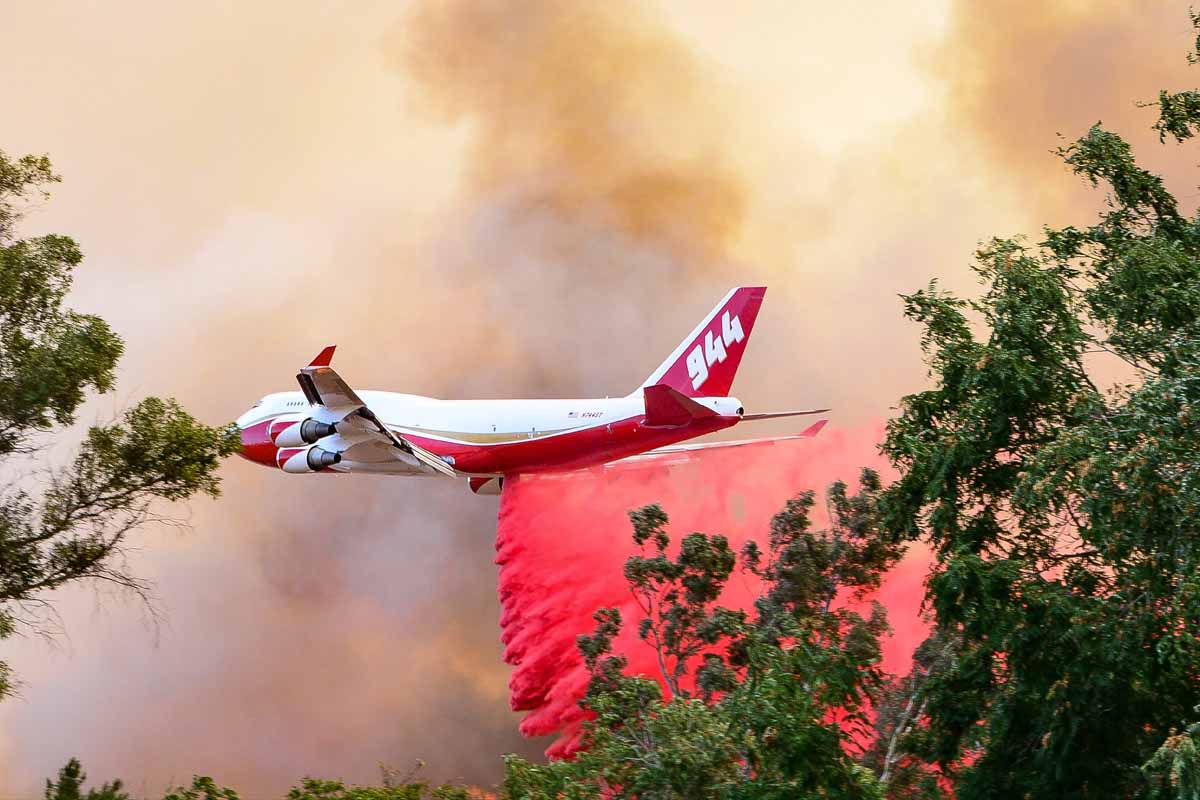
 The 747 SuperTanker 944 drops on the Palmer Fire south of Calimesa and Yucaipa in southern California, September 2, 2017. Photo by Cy Phenice, used with permission.
The 747 Supertanker is on track to be available to fight wildfires again by the end of this year.
Vandi Cooyar, President of Logistic Air, told Fire Aviation that the nose-loading 747-200 that will be equipped with the retardant delivery system (RDS) is going through scheduled maintenance, including a C-check. During that process the necessary modifications will be made to the air frame including installing the retardant doors in the belly, the wiring, and other components in the cockpit to operate the system. After that is complete, the hardware, the tanks that hold retardant and compressed air that are on cargo pallets, will be installed, then ground testing will begin by late summer or early fall.
Mr. Cooyar said the ground testing, which involves dropping water while the aircraft is parked on the ground, will confirm the recently improved algorithms and determine if any additional modifications are needed. The next step will be airborne tests.
After the complete RDS is installed, tested, and fine-tuned, if there is an opportunity to submit a bid for a contract with the US Forest Service, the company will schedule the Interagency Air Tanker Board’s (IAB) grid or cup test which measures the amount of retardant that hits the ground over a large grid.
 The 747 Supertanker at Santiago, Chile, January, 2016. Photo by Bill Gabbert.
But regardless if there is an opportunity for a US Government contract or not, after installing the RDS, conducting ground and air tests, and fine-tuning the algorithms if necessary, Mr. Cooyar said at that point the aircraft will be available again for deployment internationally. In fact he said he is in preliminary discussions with officials in multiple countries. In addition to previously having contracts with the US Forest Service, Colorado, Oregon, and the California Department of Forestry and Fire Protection, the Supertanker has fought fires in Mexico, Israel, Bolivia, and Chile.
Just before the Supertanker was mothballed last year the drop controlling system, algorithms, and other components were significantly modified to improve the delivery of retardant, reduce the trailing off of retardant after a drop, and meter the volume dispersed based on the ground speed of the aircraft. It then went through dozens of tests on the ground. The operators were waiting for it to be scheduled for the IAB grid test. But before that took place, the owner, Alterna Capital, shut down the company and sold the aircraft and the RDS. The 747 was purchased by National Airlines to be used as a freighter, and Logistic Air bought the RDS.
 Some of the tanks inside the 747 Supertanker while the system was basically in place but not fully installed and operational. McClellan Air Field, March 22, 2016.
The SuperTanker’s RDS is comprised of approximately 20 tanks that hold retardant and enough compressed air to pump the retardant out of the four nozzles that were in the belly of the huge aircraft. At various times the air tanker had interim certification by the IAB to carry 20,000, 19,200 and 17,500 gallons of retardant.
 Evergreen 747 SuperTanker 979 at San Bernardino, May 30, 2004. Photo by Steve Whitby.
The first version of the Supertanker was in a nose-loading 747 operated by Evergreen. Then it was in a conventional 747-400 freighter, and now it will be in a nose-loading 747-200 operated by Logistic Air.
This article was edited to indicate that the aircraft is expected to be available to fight fire by the end of this year.