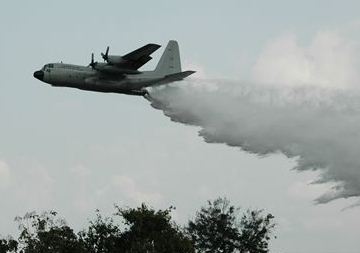
C-130 MAFFS air tanker helping to protect the ruins in Frijoles Canyon on the Las Conchas fire, June 27, 2011. Photo: Jayson Coil
After almost a month, flying 242 sorties and dropping over 609,000 gallons of retardant on fires in the southwest, the military C-130 Modular Airborne Fire Fighting System-equipped aircraft have concluded their assignment, due at least in part to the monsoons returning to the area. Four were activated on June 15 and dropped over a half million gallons of retardant until two were released on July 7. The remaining two continued working out of Albuquerque, NM until their assignment ended on July 13.
MAFFS C-130 makes a drop on the Las Conchas fire, 6-27-2011. Photo: Jayson Coil
Modular Airborne Firefighting System (MAFFS) equipped military C-130 aircraft continue to supplement the fleet of privately-owned air tankers fighting wildfires in the southwest. Initially four were activated on June 15, and two are still working out of Kirtland Air Force base at Albuquerque, New Mexico. Here is an excerpt from a July 8 news release from the U.S. Northern Command:
Since being activated by the National Interagency Fire Center in Idaho June 15, the 302nd Air Expeditionary Group has performed 242 airdrops, dropping 559,993 gallons of fire retardant to help contain wildfires in the Southwest. Recent MAFFS efforts have been concentrated on the Las Conchas fire near Los Alamos in New Mexico.
Under the direction of the Joint Forces Air Component Commander for Air Forces Northern, four C-130 Hercules aircraft equipped with fire fighting capabilities deployed to Kirtland AFB, N.M. as part of the 302nd Air Expeditionary Group. Command and control of the aircraft is being provided by the 302nd AEG from Boise, Idaho.
The 302nd AEG is comprised of personnel from the Air Force Reserve Command’s 302nd Airlift Wing, Colo., the California Air National Guard’s 146th AW, Wyoming ANG’s 153rd AW and North Carolina’s ANG’s 145th AW.
MAFFS-equipped aircraft and crews from the Air Force Reserve Command’s 302nd Airlift Wing, the California Air National Guard’s 146th Airlift Wing, and the North Carolina Air National Guard’s 145th Airlift Wing have been flying the aerial containment missions for the last three weeks. On Thursday, the 145th AW aircraft and crews were released from duty. Personnel and two C-130s from the Air Force Reserve Command’s 302nd AW will remain at Kirtland AFB, N.M. available to support U.S. Forest Service fire containment efforts.
MAFFS is a self-contained aerial firefighting system, which can discharge 3,000 gallons of water or fire retardant in less than five seconds, drawing lines of containment that can cover an area one-quarter of a mile long by 60 feet wide. Once the load is discharged, the MAFFS system can be refilled in less than 12 minutes.
The MAFFS units are owned by the U.S. Department of Agriculture Forest Service, one of several federal and state government agencies and organizations with roles and responsibilities in wildland fire suppression that make up the National Interagency Fire Center in Boise, Idaho. The Department of Defense is flying at the request of NIFC.
Update at 8:40 a.m. MT June 18, 2011: Two additional MAFFS aircraft have been activated. The second two are from North Carolina. All four will be based at Albuquerque, NM.
==================================
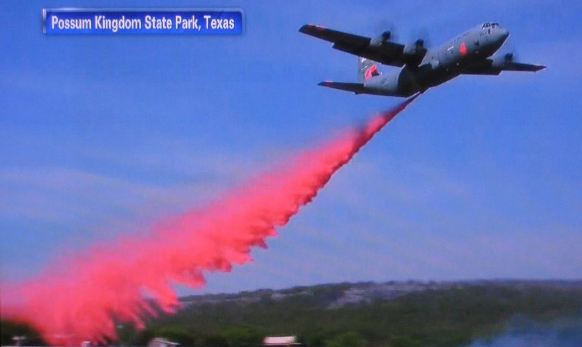
MAFFS C-130 dropping in Texas, April, 2011. CNN
Two Modular Airborne Firefighting System (MAFFS) equipped military C-130 aircraft have been activated and dispatched to the southwest to help fight the numerous large fires that have burned hundreds of thousands of acres this month. The California based air tankers left June 16 for their new temporary base at Kirtland Air Force Base at Albuquerque, New Mexico. The MAFFS air tankers can carry 3,000 gallons of retardant.
There are a total of eight MAFFS units, positioned in four states, two units per state.
In April six MAFFS from military bases California, North Carolina, Wyoming, and Colorado were activated for fires. Four were used on wildfires in Texas, while two were based at Laughlin Air Force Base in Texas but were used on fires about 60 miles away from Laughlin in Mexico. The MAFFS did not see a lot of use in Texas because about the time they were activated humid air moved into the state, slowing the spread of the fires. But two of them were pretty busy in Mexico.
The rules that govern the use of the C-130s require that privately-owned air tankers be fully committed before the military aircraft can be used on fires.
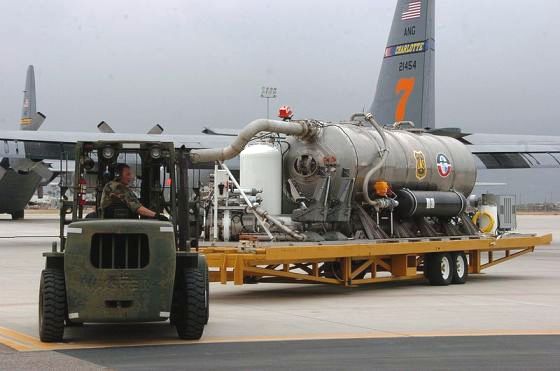
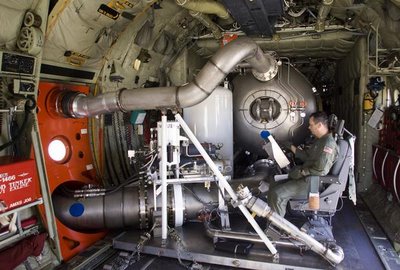
MAFFS 2 tank, the new version of the MAFFS, which is loaded into a C-130 when the aircraft is activated as an air tanker.The interior of a MAFFS 2, showing the retardant discharge and emergency high pressure air release tubes going through the side paratrooper door. Loadmaster Bill Whitlatch operates a new MAFFS 2 unit aboard a C-130J aircraft with the Channel Islands Air National Guard. Photo by Stephen Osman, Ventura County Star.
HERE is a list of some of the recent articles at Wildfire Today that mentioned the MAFFS air tankers.
The National Interagency Fire Center posted on their Facebook page (yes, they have a Facebook page!) nine photos of the Modular Airborne Firefighting Systems (MAFFS) C-130s air tankers from North Carolina and Wyoming training at Boise this week. Here are a couple of the pics.
A Type I IMT (Wilder) has been ordered for the PK West Fire and a Type II IMT (Florida Red) has been ordered to support East Texas. A tanker base has been set up in Midland to support a DC-10 airtanker. Dyess Air Force Base has set up a tanker base to support the Modular Airborne Fire Fighting System (MAFFS) units on four USAF C-130s.
The 100 acre Pinnacle Fire, now 90 percent contained destroyed 6 homes, caused numerous evacuations, and threatened 100 homes & 10 businesses. Two MAFFS units from Del Rio dropped retardant on the fire that assisted in the saving of those structures. TFS ground crews continue to work this fire. A FEMA Management Assistance Grant (FMAG) was received.
The 145th Airlift Wing, Charlotte, NC and the 153rd Air Wing, Cheyenne, WY are providing one Modular Airborne Fire Fighting Systems (MAFFS) C-130 aircraft each, along with two from the 146th Air Wing, Channel Islands, CA, and support personnel to the state of Texas. The aircraft and personnel are based at Dyess Air Force Base. On Saturday, April 16, two MAFFS from Peterson Air Force base in Colorado Springs, Colorado were mobilized to assist Mexico with two very large fires 40 to 60 miles south of the Texas border.
Below are the tracks that N144Z, the Cessna Citation infrared mapping aircraft owned by the US Forest Service, left on FlightAware Monday night and very early Tuesday morning as it mapped fires in the Midland, Abilene, and Fort Worth areas. Each group of parallel lines indicate one fire that was mapped, or multiple fires if they are close together. The imagery is then analyzed by Infrared Imagery Interpreters who map the perimeters of the fires, the heat concentrations, and any spot fires outside the main perimeter, and then they calculate accurate acreages. This may be why the size of the fire at Possum Kingdom Lake 70 miles west of Fort Worth was adjusted overnight from an estimate of 63,000 to nearly 150,000 acres.
Saturday morning two C-130 aircraft with Modular Airborne Fire Fighting Systems (MAFFS) left Peterson Air Force base in Colorado Springs, Colorado for Mexico to assist with two large fires that are burning about 60 miles south of the Texas border. They arrived later in the day at Laughlin Air Force Base, which they will use as a reload base, and are already dropping water mixed with foam concentrate on the fires. That’s right, not long-term fire retardant, but foam.
The MAFFS units, which hold about 3,000 gallons, are owned by the U.S. Forest Service and slip into the C-130’s cargo bay fairly quickly to convert the transport planes into air tankers. Normally they drop retardant but apparently they were not able to work out the logistics of acquiring it for this mission.
The MAFFS aircraft have been authorized to drop four loads per day per aircraft, for up to seven days.
Evergreen’s 747 Supertanker has been working on the fires in Mexico since April 12. Steven Daniels, of Evergreen Aviation, told Wildfire Today that the massive air tanker has dropped 12 loads of retardant, 20,000 gallons each, for a total of 240,000 gallons.
File photo of the 747 Supertanker dropping on June 30, 2010
The Bomberos, or Mexican firefighters, are not totally familiar with the use of retardant and wonder why the 747 is not dropping directly on the fire or flames, but instead is dropping just ahead of the fire. They are learning that dropping ahead of the fire is the best way to slow it down, and that an air tanker can’t put out a fire completely, it takes support from ground personnel to follow-up after the drop.
Two Air-Cranes operated by Helicopter Transport Services have also been working on the fires in Mexico.
The first-ever conference for the military crews that operate C-130 aircraft to assist civilians during natural disasters is occurring now at Peterson Air Force Base at Colorado Springs, Colorado.
Peterson is one of the four bases that host C-130’s equipped with Modular Airborne Firefighting System (MAFFS) which convert the aircraft into air tankers capable of dropping 3,000 gallons of fire retardant on fires. In addition to the MAFFS crews, military personnel that operate C-130’s that fly into hurricanes or spray chemicals on oil spills are also attending the conference. Here is link to a video from the NewsFirst5 web site which has more information.
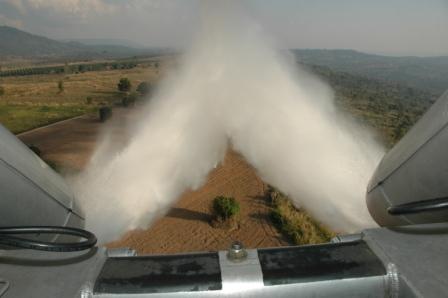
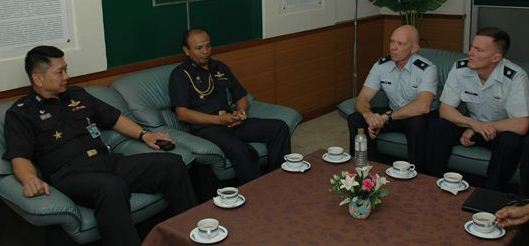
Seven members of the 302 Air Wing based at the U. S. Air Force Reserve’s 302 Airlift Wing at Peterson Air Force Base in Colorado traveled to Thailand in January, 2010 to train airmen of the Royal Thai Air Force on the C-130 Hercules aerial firefighting tactics and strategies while using the Modular Airborne Firefighting System (MAFFS). They provided three weeks of expert training that drew on decades of experience in fighting fires from the air. The training included one week of classroom instruction followed by tactical flying and actual MAFFS airdrops.
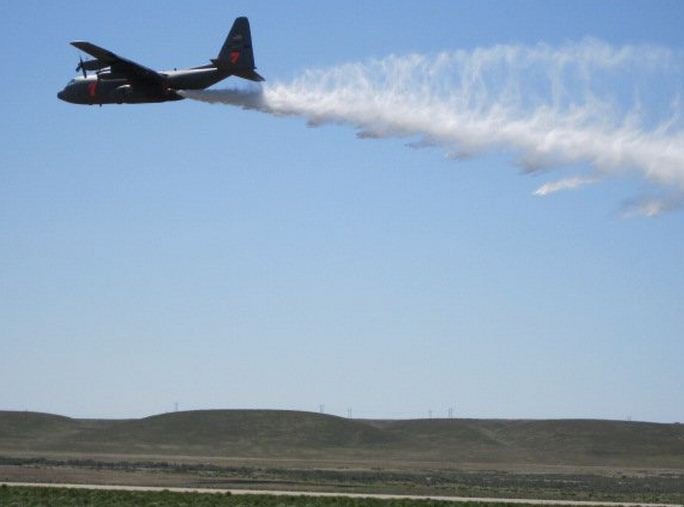
A practice air drop from a MAFFS in Thailand.
The United States has four Air National Guard and Air Force reserve bases that each have two MAFFS slip-in units to enable a military C-130 aircraft to serve temporarily as an air tanker if all commercially operated air tankers are committed. The four bases are Wyoming Air National Guard’s 153rd Airlift Wing in Cheyenne, Wyoming; 145th Airlift Wing of the North Carolina Air National Guard in Charlotte, N.C.; the 146th Airlift Wing of the California Air National Guard in Port Hueneme, Calif., and the 302nd Airlift Wing with the U.S. Air Force Reserve of Colorado Springs, Colorado.
Royal Thai Air Force and the U. S. Air Force Reserve in the back of a C-130 MAFFS.
The Royal Thai Air Force is using the first generation MAFFS, while the U.S. is transitioning to the newest version, the MAFFS II which we covered HERE and HERE.
Members of the Royal Thai Air Force meet with members of the U. S. Air Force Reserve's 302 Airlift Wing based at Peterson Air Force Base in Colorado
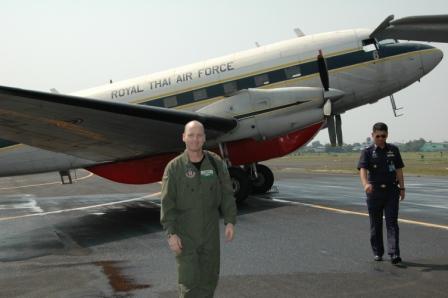
Chief Master Sgt. James D. Riley chief loadmaster with the Air Force Reserve’s 302nd Airlift Wing steps away from a PT-47, a modified version of the DC-3 at Phitsanulok Royal Thai Air Force Base, Thailand.
More information about the mission to Thailand. More photos.
The U. S. Air Force, on July 20, officially certified the new Modular Aerial Fire Fighting System, MAFFS II, for the C-130 H & J model aircraft. It was declared “fully operational” in early 2009, but now the Air Force has certified it.
Here is an excellent video about the new MAFFS II that was filmed at the Oshkosh 2009 air show.
The press release from the manufacturer of the MAFFS II, Aero Union Corporation, provides details about the system. In some documents the MAFFS II is described as having a capacity of 3,000 gallons. In others, it is 3,400 gallons. Click on “Fullscreen” for easier reading.
A C-130J Super Hercules from the California Air National Guard's 146th Airlift Wing at Channel Island ANG Station, Calif., drops water during annual training with the new MAFFS 2 in South Carolina in April, 2010. (U.S. Air Force photo/Airman 1st Class Nicholas Carzis)
Yesterday two Mobile Airborne Fire Fighting Systems (MAFFS) air tankers from the California Air National Guard were used on the Skinner fire at Lake Skinner in southern California during a lightning bust that started numerous fires across the southern part of the state. The 146th Airlift wing out of the Channel Islands base put the new MAFFS 2 units in C-130s and it was the first time that the new systems had been used on a fire.
As Wildfire Today reported on January 28, 2009, the MAFFS 2 holds 400 more gallons of retardant than the original MAFFS, for a total of 3,400 gallons. And the nozzles, instead of exiting out the rear loading dock, are now routed through a sealed portal (a modified paratrooper door) on the plane’s left side. This makes it possible for the plane to be pressurized; in addition, the crew and the rear door will no longer be soaked by the retardant since the rear door can remain closed.
The new MAFFS 2 systems were first delivered in early 2009 or late 2008, but as far we we know, no MAFFS aircraft were used on fires in 2009. If we have a fire season with average or above average activity, we may see the MAFFS used more this year, since there are only 18 large air tankers on exclusive use contracts, down from 44 in 2002.
Here is an excerpt from an article in today’s My Valley News:
RIVERSIDE – At least one California Air National Guard C-130 with upgraded retardant-dropping equipment will be available today for firefighting missions in Riverside County and other Southland locations if needed.
A three-member Air Guard crew flew the first upgraded C-130 wildfire mission Thursday evening, dropping 3,000 gallons of retardant on the Skinner fire east of Murrieta, California National Guard Maj. Kimberly Holman said.
It was the first use on a live fire of the new MAFFS II system — units that roll into and out of C-130 aircraft — which can be re-loaded at any tanker base in Southern California, including Hemet, San Bernardino and Fox Field near Lancaster, Holman told City News Service.
The new system replaces original MAFFS units that have been in use more than 30 years, Holman said.
At 6:45 p.m. Thursday, a three-member crew in a gray, four-engine turboprop C-130 flew from the Channel Islands station about one hour north of Los Angeles and made one drop on the Skinner fire, Holman said in a telephone interview.
The C-130 crew included a pilot, co-pilot and a loadmaster, who coordinated with a Forest Service pilot in a lead air attack plane to time their drop, Holman said.
The crew will be available for more drops by 9 a.m. today, Holman said, and they are expected to continue to support firefighters on the ground over the next several days.
“This is the first time we have dropped on an actual fire with the MAFFS II equipment and it performed flawlessly,” said Col. Paul Hargrove, 146th Airlift Wing Commander.
The MAFFS II system makes military firefighting less costly and more efficient, Hargrove said.
The Skinner fire, first reported at 3:42 p.m. Thursday, had burned more than 700 acres by early today, according to Cal Fire-Riverside County.
The fire burned at a rapid rate of speed and more lightning strikes are expected over the next several days, California Air National Guard officials said.
The U.S. Forest Service gave the first launch order at about 6:15 p.m., Holman said.
The Modular Airborne Fire Fighting System (MAFFS) II tank is displayed for the local media during the MAFFS 2008 annual certifying training at Channel Islands Air Guard Station, Calif., May 7, 2008. US Air Force photo by Tech. Sgt. Brian E. Christiansen.