One fatality in Colorado Springs Waldo Canyon fire

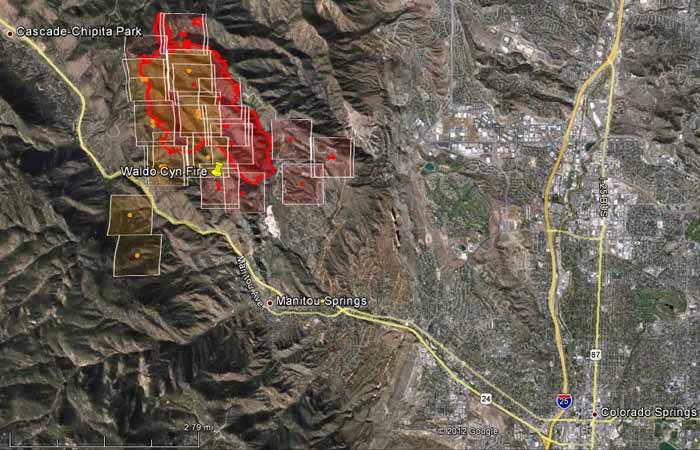
Map of Waldo Canyon fire, east side June 29, 2012

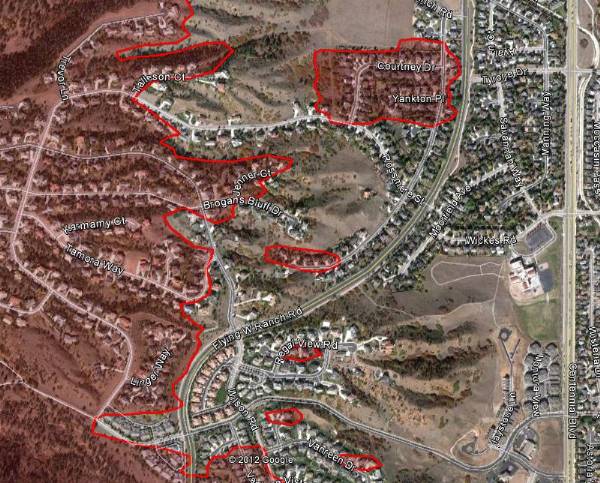
Map of Waldo Canyon fire, east side June 29, 2012(The map above is an example of how the the Waldo Canyon fire spread into the Flying W Ranch area of Colorado Springs on Tuesday, June 26. HERE is a link to a map that can zoom in to see more details. MODIS/Google)

Authorities searching through the rubble of the 348 homes that burned in the Waldo Canyon fire at Colorado Springs, Colorado found the remains of one person. A second person at that home and another nine are still unaccounted for that live in the areas that burned in the fire.

Firefighters wanted to do some burning out Thursday night to remove some of the fuels adjacent to the firelines but the humidity was too high. That same humidity also prohibited any additional spread of the fire, which has burned 16,750 acres and officially is 15 percent contained at a cost to date of $5.2 million.

President Obama will tour the fire area on Friday to inspect the destruction. Officials said this would not interfere with fire operations and the number of closed roads will be less than you would typically encounter during a Presidential visit. He will most likely fly in to Peterson Air Force Base at Colorado Springs and we are thinking that he may have a photo op with the military MAFFS C-130 air tankers working out of the base.

If the president makes any public comments during his visit it will be interesting to see if he mentions wildland fire preparedness, such as the reductions over the last few years in funding, and the reduced number of firefighters, equipment, and air tankers.

The City of Colorado Springs announced that they will release a list of the damaged homes by mid-morning on Friday. It will be posted on the city’s web site at http://springsgov.com/

A slide show with aerial photos of the destruction in the urban area is jaw-dropping.

How to install a MAFFS II in a C-130J

OK, it’s not exactly a training film, but this 5-minute raw video can give you an idea of what it takes to install a Modular Airborne FireFighting System (MAFFS) in a military C-130J. The military air tankers can help provide additional air tanker support for wildfires if all of the contracted large air tankers are committed.

The video was shot Sunday June 23, 2012 at the 153rd Airlift Wing, Wyoming Air National Guard, in Cheyenne, Wyoming as crews prepared two C-130 aircraft for missions in the Rocky Mountain Geographic Area.

Four of the aircraft became operational at Pueblo air tanker base on Monday and performed three drops on the Waldo Canyon fire since the first midday launch. As of 5:20 p.m. MT they were on hold due to poor visibility at the fire.


Thanks go out to Dick

Four military MAFFS C-130 air tankers activated

MAFFS WY ANG 6-24-2012
Members of the 153rd Airlift Wing, Cheyenne, Wyo., load a U.S. Forest Service Modular Airborne FireFighting System II onto a Wyoming Air National Guard C-130, June 24, 2012. Photo by Staff Sgt Natalie Stanley

UPDATED at 1:30 p.m. MT, June 23, 2012 to increase the number of MAFFS being activated from two to four.

============

Four Modular Airborne FireFighting Systems (MAFFS) C-130 air tankers have been activated to assist in suppressing the numerous wildfires burning in the western United States. This is the first time the MAFFS air tankers have been used this year.

Two MAFFS will be provided by the 153rd Airlift Wing of the Wyoming Air National Guard at Cheyenne and another two will be from the 302nd Airlift Wing, Air Force Reserve, Peterson Air Force Base, Colorado. They will be based at Peterson Air Force Base in Colorado Springs, Colorado and are expected to be available to fly wildfire suppression missions by no later than Tuesday, June 26th.

MAFFS WY ANG nozzle 6-24-2012
Senior Master Sgt. Jack Goeken, loadmaster, 187th Airlift Squadron, Cheyenne, Wyo., prepares to load a U.S. Forest Service Modular Airborne Firefighting System II nozzle onto a Wyoming Air National Guard C-130, June 24, 2012. Photo by Staff Sgt Natalie Stanley

The interagency agreement between the USFS and the Department of Defense requires that MAFFS be operational within 48 hours. However they usually have responded within 36 hours of the initial request.

More information about the MAFFS II system.

Waldo Canyon Fire, Colorado Springs

Map of Waldo fire, Colorado Springs

Map of Waldo fire, Colorado Springs

The map of the Waldo Canyon fire above shows heat detected by a satellite at 3:35 a.m. June 24. 

=====================

UPDATE at 2:35 p.m. MT, June 24:

The map below shows information about the fire’s location from two sources. The red line is the product of an infrared mapping flight by an aircraft at 11:07 p.m. June 23. The squares with the dots represent heat detected by a satellite about four hours later at 3:35 a.m. June 24.

Map - Waldo fire

===================

UPDATE at 12:52 p.m. MT, June 24

The Denver Post reported at 12:16 p.m. today that:

…Air resources consist of a helicopter with four helicopters on order. Two heavy air tankers and additional resources are on the way.

Surely this can’t be correct, that there is only one helicopter and no air tankers working on the fire.

===================

UPDATE at 10:32 a.m. June 24:

We have confirmed that two Modular Airborne FireFighting Systems (MAFFS) C-130 air tankers have been activated. Jennifer Jones, a spokesperson for the U.S. Forest Service, told us that the agency requested that the aircraft be in place between noon and 6 p.m. MT on Monday. This is the first time the MAFFS air tankers have been used this year.

======================

9:16 a.m. MT, June 24, 2012

The Waldo Canyon fire west of Colorado Springs has burned approximately 2,500 acres, according to the City of Colorado Springs in a 6:12 a.m. MT update. That site and InciWeb will provide detailed information about the fire, including evacuation notices. However, the InciWeb web site has been having problems, probably due to a large number of people trying to find information about the fire.

There are no reports of any structures being lost.

The map of the fire we have here shows heat detected by satellites at 3:35 a.m. MT, June 24. It shows the fire being less than two miles from the Kissing Camels golf course and very close to Manitou Springs.

Approximately 1,050 homes have been evacuated. Garden of the Gods Park and Garden of the Gods Visitor Center are closed.

A Type 1 Incident Management Team was ordered within a few hours of the first report of the fire. A Type 1 IMTeam is the largest and most qualified team that manages wildfires and other all-hazard incidents.

We are checking on an unconfirmed report that at least one military Modular Airborne FireFighting Systems (MAFFS) C-130 aircraft has been activated. Two are based at Peterson Air Force Base in Colorado Springs 11 miles from the Waldo Canyon fire. Through yesterday, none of the eight MAFFS around the country had been used on fires this year.

We will post more information about the Waldo Canyon fire later. Check back with us for more details.

Legislation introduced to double the number of military MAFFS air tankers and restrict the use of foreign air tankers

MAFFS II
MAFFS II
MAFFS II unit being transported on a carrier, ready for installation in a C-130J

Proposal to reactivate old MAFFS units

A California congressman has introduced legislation requiring that the eight old, first generation Modular Airborne FireFighting Systems (MAFFS), which can be used as needed in military C-130H aircraft to fight wildfires, be made available to units of the Air National Guard and Air Force Reserve. The eight older MAFFS were replaced by nine second generation MAFFS II units within the last four years and the old units can’t be used in the more modern C-130J aircraft. The C-130Hs still in service are being targeted as potential air tankers by Representative Elton Gallegly from California who introduced the bill.

MAFFS air tankers are supposed to be activated only if all of the privately owned air tankers on federal contracts are committed. None of the eight military MAFFS have been used yet this year.

MAFFS C-130  Las Conchas 6-27
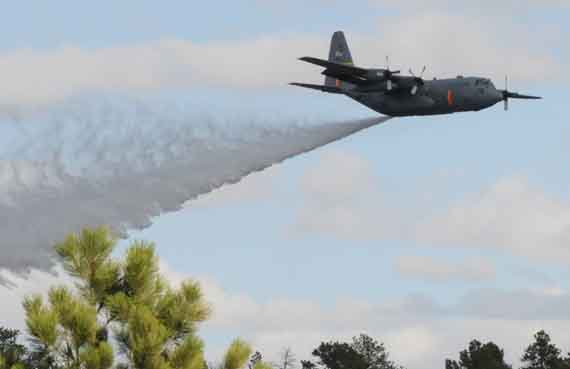
MAFFS C-130J makes a drop on the Las Conchas fire in New Mexico, 6-27-2011. Photo: Jayson Coil

Currently eight of the nine new MAFFS II units are assigned and available to be used in C-130Js at bases in California, Wyoming, Colorado, and North Carolina. Representative Gallegly’s bill, H.R.5965, would require that the one spare MAFFS II and the eight first generation MAFFS that are in storage be made available and ready for activation if needed for wildfire suppression. That would increase the numbers of MAFFS air tankers to 17.

There is at least one obstacle that would have to be overcome in order to implement the Representative’s proposal. The military has indicated that they are not interested in expanding their role in suppressing wildfires. According to the Conference Chairman’s Report from the Aerial Firefighting Conference held in Washington, D.C. in 2011, Lt. Col. Bryan Allen of the Air National Guard said that given the nation’s operational tempo, he would not be comfortable with extending this role for what are essentially warfighting assets. And Clark R. Lystra of the Office of Secretary of Defense reported that an increase in the use of military assets to combat wildland fires had been rejected by the Department.

If you want to know more about the MAFFS II units, we covered the details in an article we wrote in 2009.

Restrict the use of air tankers from a foreign government

The proposed legislation has an additional requirement:

The Chief of the Forest Service may not procure air tankers to fight wildfires from a foreign government unless the Chief of the Forest Service certifies to Congress that MAFFS air tanker support available from units of the Air National Guard and Air Force Reserve is being fully utilized or is not sufficient to address wildfires on National Forest System land.

On June 6 the U.S. Forest Service announced that that they had arranged to temporarily hire a CV-580 air tanker from the Canadian Interagency Forest Fire Centre. At that time the  two DC-10 air tankers based in California that carry five times more retardant than the CV-580s were not hired. Then on June 11 the USFS announced that they had activated on a call when needed contract (CWN) one of the two American-based DC-10s and also borrowed three more Canadian CV-580s. The USFS currently does not have a contract with Evergreen’s American-based 747 air tanker that carries 10 times more retardant than a CV-580.

A Canadian-owned, UK-built air tanker is being used today on fires in the United States. Missoula-based Neptune Aviation is leasing a BAe-146 from Tronos, the Canadian company that converted the airliner into an air tanker. Neptune has been awarded a contract for two more BAe-146s and expects to bring them on later this year. Aero Flite of Kingman, Arizona was also awarded a contract recently, for one air tanker, and is partnering with Conair of Abbotsford, British Columbia to convert an RJ85, which is similar to a BAe-146.

Status of the proposed legislation

The bill has only been introduced and has seen no action other than being referred to the House Committee on Agriculture.

CAL FIRE seeks agreement to use Channel Island National Guard base to reload air tankers

Channel Island MAFFS C-130 2012
A C-130J MAFFS from the 146th Airlift Wing during recertification, March 7, 2012. Photo by Senior Airman Nic Carzis.

The California Department of Forestry and Fire Protection (CAL FIRE) is negotiating an agreement with the California Air National Guard to enable Channel Island National Guard base (map) in Ventura County near Oxnard to be used as a reload base for air tankers working on wildfires. For years the base, the home of the 146th Airlift Wing, has been capable of reloading two C-130s stationed at the base outfitted with Modular Airborne Fire Fighting Systems (MAFFS) which can be slipped into the cargo hold enabling them to drop 3,000 gallons of fire retardant on fires, but other state or federal air tankers have not been allowed to use the base. John Winder, the CAL FIRE Assistant Deputy Director of Fire Protection Operations, told Wildfire Today that the goal of the agreement is for any military, state, or federal air tanker to be able to use the base for reloading. The U.S. Forest Service would also have to approve the use of the base before their contracted air tankers could use it since the federal agency has different requirements for reload bases than CAL FIRE.

The reload facility would be call-when-needed, most likely operated by CAL FIRE personnel who could have it up and running a few hours after being notified.

According to Mr. Winder, the Channel Islands base is one of only six locations in California where MAFFS air tankers can reload, with the others being Chico, Fresno, San Bernardino, Victorville, and Paso Robles. Not every base has runways, taxiways, and ramps that are capable of handling an aircraft the size and weight of a C-130.

The California Air National Guard C-130s can be activated for use on wildfires within the state fairly easily with approval from the Governor. To be used outside the state requires a more complex federal-level approval governed by an agreement specifying that the aircraft be able to respond within 48 hours, but they usually are mobilized within 36 hours. Both the state and federal approvals require some level of previous commitment of standard non-military air tankers on going fires.
Thanks go out to Johnny

Colorado MAFFS crews train for fire season

MAFFS II training conducted at the Wyoming Air Guard

Earlier this year the crews that fly the Modular Airborne Fire Fighting Systems (MAFFS) air tankers based in California and Wyoming conducted their annual training to be sure they are prepared to drop fire retardant on wildfires if all of the privately operated air tankers are committed. This week the Air Force Reserve unit at Peterson Air Force Base in Colorado Springs did the same, dropping water on the Base and in the Pike National Forest. In addition to the two C-130 MAFFS units in Colorado, three other bases in the United States have two aircraft each that are designated as MAFFS-deployable, stationed in California, Wyoming, and South Carolina.

Below are some photos that we received today of the Wyoming Air National Guard MAFFS crews that were taken during their training at Cheyenne and Camp Guernsey last week.

MAFFS II training conducted at the Wyoming Air Guard
Two C-130 MAFFS aircraft follow a lead plane during training for the WYOMING Air National Guard at Camp Guernsey, April 20, 2012. Photo by Master Sgt. Paul Mann
MAFFS II training conducted at the Wyoming Air Guard
Crews prepare to load the new MAFFS II unit into a C-130 at Cheyenne, Wyoming.
MAFFS c-130 air tanker
Crews load the replacement paratroop door through which the retardant will pass when it exits the C-130 in 2011 before deployment to assist with wildfires in Texas.
Crews install the replacement door for the MAFFS II in 2011 before deployment to assist with wildfires in Texas. Photo by Master Sgt. Paul Mann.


MAFFS training in Wyoming

MAFFS training Wyoming
MAFFS training at Camp Guernsey, Wyoming,
Wyoming Air National Guard MAFFS training at Camp Guernsey, Wyoming, April 16, 2012. Photo by Mr. Dewey Baars.

Last month the two Modular Airborne Fire Fighting Systems (MAFFS) air tankers based at the Channel Islands Air National Guard base in Port Hueneme, California participated in training for wildfire assignments. This week the two Wyoming Air National Guard MAFFS C-130s based in Cheyenne did the same thing. On Monday through Thursday they loaded the 3,000-gallon tanks with water instead of retardant, and flew 100 miles to practice dropping on the rolling terrain of Camp Guernsey in southeast Wyoming.

Besides the four MAFFS aircraft mentioned above, there are four others in Colorado and North Carolina, for a total of eight. The military C-130s are used only when the commercial air tankers on contract are totally utilized on going wildfires.

An article at trib.com has more details about the MAFFS training, and also has this about the federal fleet of air tankers:

…The number of commercial tanker planes under Forest Service contract has declined from 44 in 2002 to 11 this year. The planes are getting old and more expensive to maintain.

Western senators have taken note. Last month, four of them asked the Government Accountability Office to look into whether the Forest Service has done a good job of assessing its aerial firefighting needs.

Last week, Sen. Mark Udall of Colorado also expressed concern about the 1950s-era Lockheed P-2Vs that compose the remaining fleet.

“I am unconvinced the USFS’s current air tanker fleet is prepared to adequately address an immense wildfire or even what is sure to be a long fire season,” Udall wrote to Forest Service Chief Tom Tidwell.

The U.S. Forest Service is eager to work with Congress to develop a quicker and more effective commercial tanker plane fleet, said Tom Harbour, national director of fire and aviation for the Forest Service.

The Forest Service didn’t call on the military planes at all in 2009, he said, and it’s not a certainty it will need to in the months and years ahead.

The Wyoming National Guard produced a 2.6 minute video about the training.

MAFFS training in California

MAFFS training 5-1-2010
File photo from MAFFS training near Greenville, South Carolina May 1, 2010. Photo by Airman 1st Class Nicholas Carzis

The two Modular Airborne Fire Fighting Systems (MAFFS) air tankers based at the Channel Islands Air National Guard in Port Hueneme, California are participating in training this week for wildfire assignments. The portable MAFFS units can be inserted into the cargo holds of military C-130J aircraft within a few hours to be used when the privately-owned air tankers that are under contract to the federal government are committed on fires or otherwise not available. The training began on Monday and will conclude on Thursday.

Three other bases in the United States have two aircraft each that are designated as MAFFS-deployable, stationed in Colorado, Wyoming, and South Carolina. Usually the aircraft from multiple bases assemble in one area for their annual training and recertification, but this year the California aircraft and crews will not be joined by MAFFS aircraft from other states. Last year the Colorado and Wyoming units met in Idaho for the training, and in 2010 all four bases sent their aircraft to South Carolina. Major Kimberly Holman told us that a cost reduction initiative was the reason for the localized training.

MAFFS II
MAFFS II, built by Aero Union and sold to the USFS. It can be transferred from the green trailer into the cargo hold of a C-130J aircraft. Photo by Aero Union

This year in California, more than 100 personnel from he 146th Airlift Wing and the U.S. Forest Service will come together to accomplish the weeklong training sponsored by the USFS and the Air National Guard. The certification event will include classroom sessions and flight training for military flight crews, civilian lead plane pilots, and various support personnel. Water drops will be executed in the nearby Angeles National Forest and in Kern County. Rural residents in those areas may see low-flying C-130 aircraft and Forest Service lead planes throughout the week.

The Times-News has some other photos of the aircraft and personnel.

MAFFS air tankers activated, only one DC-10 crew left

Preparing a MAFFS air tanker for deployment
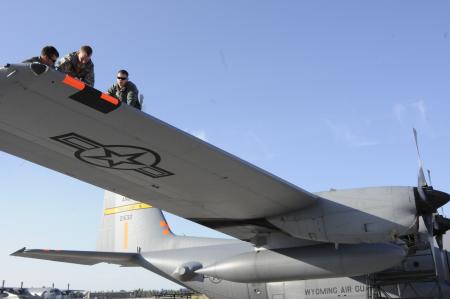
Tech. Sgt. Mike Konegni, left, Airman Travis Mader, center, and Airman 1st Class Colton Shirley, with the 153rd Aircraft Maintenance Squadron, Wyoming Air National Guard, based in Cheyenne, Wyo., place orange tape on a C-130 cargo plane identified for an aerial firefighting mission, in the western portion of the United States, Sept. 8, 2011. The tape helps other aircraft identify the plane as part of the coordinated firefighting efforts. Photo by 1st Lt. Christian Venhuizen

Yesterday the National Interagency Fire Center activated two C-130 Modular Airborne Fire Fighting System-equipped (MAFFS) aircraft and support personnel from the 187th Airlift Squadron, 153rd Airlift Wing, Wyoming Air National Guard, out of Cheyenne, Wyoming. They will be based in Boise to fight fires in Nevada, Utah, and Idaho.

This was done because there are only 11 large air tankers left in the United States that are on exclusive use contracts, contrasted with the 44 we had in 2002. Aero Union has closed its doors and shut down their P3 air tankers due to inspection, safety, and contract issues, and the U. S. Forest Service is not interested in awarding exclusive use contracts for Very Large Air Tankers (VLAT) like Evergreen’s 747 or 10 Tanker Air Carrier’s DC-10s. CAL FIRE cancelled their exclusive use contract on June 30 for one of the DC-10s due to the state’s budget crisis, even though they were very happy with the effectiveness of the aircraft on fires.

Both Evergreen and 10 Tanker were only offered Call When Needed (CWN) contracts by the USFS this year for their VLATs. The proposed contracts did not even have a minimum number of days that they would be used on each activation, such as the 5 days that are stipulated in CAL FIRE’s current DC-10 CWN contract. Evergreen told the agency that they could not maintain their 747 in response-ready condition, with crews, without any guaranteed income. 10 Tanker reluctantly signed the CWN contract.

Within the last few weeks the USFS temporarily brought on six CWN air tankers — three Convair 580s and three CL-215 scooper aircraft.

Two DC-10 air tankers
Two DC-10 air tankers. Photo: 10 Tanker Air Carrier

10 Tanker has two DC-10 air tankers, but at this time they only have one DC-10 air tanker crew, so they can only operate one aircraft at a time. When mandatory days off are required, they have to shut the aircraft down rather than bring in a relief crew. With no guaranteed contract, they can barely keep one crew  available for CWN use.

One of the stated reasons for the USFS’s reluctance to use the VLATs is cost. But the MAFFS, with their large support crews, are not inexpensive. And the issue of using government air tankers instead of privately owned aircraft can’t be easily swept under the carpet.

Since dozens of air tankers were permanently grounded after two very old military surplus air tankers fell apart in mid-air in 2002, three studies have been commissioned to develop recommendations on how to reconstitute the large air tanker fleet. The last one was due in January, 2011, but it may not see the light of day until next year. But in the 9 years following those tragedies, nothing meaningful has been accomplished, and we’re down from 44 to 11 large air tankers. And no one has been fired.

One of the DC-10’s, the only one with a crew available, has been hired by the state of Texas for their current fire bust. At 12:40 p.m. MT they were reloading the aircraft with retardant for the third time today.