Wildfire news, July 28, 2011

Wildfires may redistribute radioactive fallout debris

The NuclearCRIMES.org web site has posted a document that contains information about how radioactive fallout debris from nuclear bomb testing and the meltdown of the Chernobyl nuclear power plant can be transported initially to remote locations, and years later be re-suspended into the air during a wildfire.

Here is an excerpt from the site:

Over the past two weeks, a Chernobyl Reloaded has been in the making, thanks to wildfires that are breaking out in parts of Russia that received some of the greatest deposition levels from Chernobyl fallout. Long-lived radioactive isotopes, such as Cesium-137 and Strontium-90, which are deposited from fallout events such as nuclear weapons tests and large-scale radiological accidents, tend to reside in the top few inches of the soil and also become lodged in vegetation and dead biomass. Hot burning wildfires – such as a record-breaking, large wildfire in 2007 that lifted legacy fallout radiation north of Milford, Utah – can suspend back into the air up to 100% of this lingering radioactivity where winds can carry these carcinogens.

Followup on the lead plane photos

After we posted photos of lead plane 6-5 on July 19 and July 26, we received a message from Jonas Doherty, who provided some interesting details about the photos. Here is an excerpt:

I was the pilot flying the lead plane when you took those pictures. What makes it better is the fact that that actual mission was my final evaluation flight in order to become fully qualified for the lead plane mission. I have been training for the past 1.5 years, the final checkride consisted of 9 seperate missions over the course of a week, the whoopup being the last. It means so much to me to have the article that you wrote as a memory of that day. Your pictures are incredible, and I would love to see more if you would be gracious enough to share them with me.

Just a couple things to clarify regarding the article (as though they matter.) We were actually dispatched out of Silver City, NM. Also, the 5 aircraft that the BLM operates have smoke, but none of the 14 USFS aircraft have it…yet, that is.
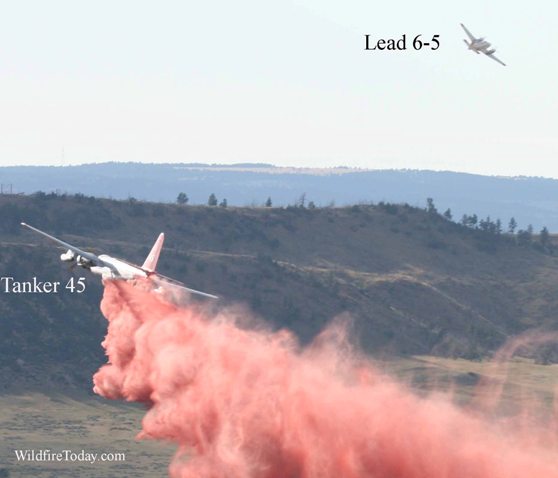
Whoopup fire Lead 6-5 and Tanker 45
Lead 6-5 and Tanker 45 on the WhoopUp fire near Newcastle, WY, July 18, 2011. Photo by Bill Gabbert

We also heard from Chuck Greenwood, the owner of the Greenwood Group, who told us that his company has the contract to supply the lead planes for the U.S. Forest Service. The pilots are USFS employees.

Eagle fire: activity “minimal”

The Eagle fire burning between Warner Springs and Borrego Springs in southern California, has slowed. At the end of the day on Wednesday, CalFire called fire activity on the fire “minimal”. As of Thursday morning it has burned 14,100 acres and has 20 helicopters and over 2,000 personnel assigned. Fire investigators determined that the cause of the fire was arson.

DC-10 worked the Eagle fire on Wednesday

CalFire activated one of the DC-10 air tankers for the Eagle fire in southern California yesterday. Air Tanker 910 flew 5 sorties and dropped 58,000 gallons of retardant on Wednesday.

Rick Hatton, the CEO and President of the company that operates the DC-10’s, 10 Tanker Air Carrier, told Wildfire Today that the aircraft was activated by CalFire on a 5-day Call When Needed (CWN) contract which specifies that any activation will be for a 5-day minimum. The USFS would not allow any minimum number of hours or days in their CWN contract with the company, so the agency apparently expects to use it for one drop, or more, and then shut it down. Mr. Hatton said it will be difficult to continue to operate their two DC-10 air tankers if they are only occasionally used on fires. They are single-purpose aircraft and can’t be diverted like helicopters can to other uses such as law enforcement or news.

Mr. Hatton said that yesterday tanker 910 refilled at Victorville airport, even though CalFire removed all of their property from the reload base on June 30. What remained was the actual reloading equipment, the tanks, mixing equipment, piping, and hoses, which belong to Phos-Chek. Personnel were dispatched to operate it, and they reloaded the tanker five times on Wednesday, each time with 11,600 gallons of Phos-Chek.

Two DC-10 air tankers
File photo of air tankers 910 and 911. Photo: 10 Tanker Air Carrier

CalFire reportedly likes to use the DC-10’s on fires, but the state’s budget problems required that they make $34 million worth of reductions in their fire program this year, including:

  • 730 fewer seasonal firefighters
  • Reducing the staffing on engines from four to three
  • Cancellation of the exclusive use contract for the DC-10 air tanker
USFS accepting comments on draft EIS for use of fire retardant

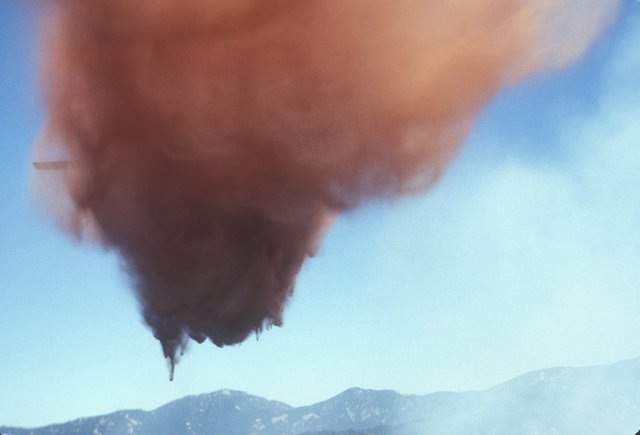
fire retardant dropping
Photo by Bill Gabbert

The U. S. Forest Service is accepting public comments on a draft Environmental Impact Statement (DEIS) they just completed on the use of fire retardant. The DEIS was written in response to a July, 2010 decision by U. S. District Court Judge Donald Molloy in a lawsuit filed in 2008 by the Forest Service Employees for Environmental Ethics.

The FSEEE claims that the use of retardant damages aquatic resources and terrestrial ecosystems. In October 2010 the organization stated their opinion on the effectiveness of retardant on fires.

There is no evidence that aerially-applied chemical fire retardant is effective in meeting any wildland firefighting objectives. For example, there are no studies or data that evaluate home losses to wildland fire as a result of etardant use vs. non-use. There are no studies or data that evaluate firefighter injuries or fatalities as a result of retardant use vs. non-use. There are no studies or data that evaluate the proportion of fire retardant drops that actually influence a fire’s ultimate disposition, as opposed to those drops that prove irrelevant to the fire’s fate, e.g., are dropped outside the fire’s final perimeter. Although retardant slows the rate at which fire spreads through some flammable materials in laboratory conditions, that’s a far cry from retardant affecting fire outcomes in the real world of wildland firefighting.

The DEIS is available online for review and comment. The USFS will consider public remarks submitted during the comment period in the development of the final environmental impact statement expected to be completed by Dec. 31, 2011.

The Forest Service will host several community listening sessions:

  • May 24, Ocala, Fla.
  • May 26, Missoula, MT
  • June 7, Santa Barbara, Calif.
  • June 9, Wenatchee, Wash.
  • June 15, Tucson, Ariz.
  • June 16, National Community Listening Session via webinar

More information about the listening sessions, including times and locations.

Black lining machine used in Nebraska

Blacklining Machine
Blacklining Machine being used on the Valentine National Wildlife Refuge, March 24, 2011. Photo: Sandy Benson/News Correspondent

Note: scroll down to see an update to this article.

Wildfire Today first wrote about the Blacklining Machine in January, 2008 when it was being tested by the US Fish and Wildlife Service in South Dakota. A month later they approved it to be used on prescribed fires.

The device, pulled behind a tractor over a grassy prairie, uses propane burners under a metal structure to burn a five-foot wide black line, an area of burned vegetation, on the edge of a planned prescribed fire. Water spray nozzles, 16 of them, wet down the edges as the unit moves forward at about one mile an hour. In association with an adjacent mowed line, this can serve as a barrier to the prescribed fire spreading beyond the planned perimeter.

On Thursday the USF&WS demonstrated it at the Valentine National Wildlife Refuge in northern Nebraska. The Norfolk Daily News covered the event, but they got a little confused about the number and placement of the water nozzles and propane burners.

I’ve never seen one in action, but it may put in black line more quickly, with fewer people and with less risk of escape than conventional methods. It no doubt works best on an area with gentle terrain, grass fuels, and few rocks. But it’s probably fun to play with.

=======================================

UPDATE March 27, 2011

It occurs to me from reading the comments that some people are not familiar with the concept of blacklining a prescribed fire prior to the main ignition of the project. Depending on the tactics and the wind direction, the process of igniting along the perimeter can be a rather slow and tedious process until you get 5 to 30 feet of burned area, or black, adjacent to the perimeter. If the project is small and you have plenty of time and resources this may not be an issue. But if your project is large and you would like to minimize the number of operational periods devoted to igniting it, blacklining days or weeks before the burn can save you a lot of time. And you can have a broader prescription for blacklining than the main burn, making it possible to black line on days that would not be suitable for the larger project.

Dillon Prescribed fire Blacklining 10-10-2002
Blacklining the Dillon Prescribed Fire, Badlands National Park, Oct. 10, 2002. Photo by Bill Gabbert

The Dillon Prescribed Fire shown above, was 3,132 acres. By blacklining the perimeter in advance, we were able to ignite the entire project in one day, while reducing the chances of an escape.

Blacklining can be especially useful prior to aerial ignition, as was the case on the Dillon project above. In some areas access on the Dillon was very difficult due to badlands. In those areas, instead of using engines and a water tender for support during blacklining, we used ATV’s with water tanks.


Thanks Judy

New requirements could be expensive for operators of firefighting helicopters

Helicopter Dippin
A Type 3 helicopter dipping from a portable tank on the Fossil 2 fire, South Dakota, August 11, 2009. Photo by Bill Gabbert

Some new requirements for Call When Needed (CWN) helicopters that are hired for temporary firefighting duty may be expensive for some contractors. In order to qualify for a U. S. Forest Service CWN contract, the new specifications require each Type 3 CWN helicopter, such as a Bell 206, to have wire-cutting kits (designed to help protect the aircraft if it runs into power lines), strobe lights, a heated defroster unit, and a specific type of cargo hook. The changes are supposed to enhance safety and promote standardization. According to contractors quoted in an article in the Washington Examiner, it could cost from $10,000 to $50,000 for each helicopter.

This could be a tough decision for a CWN operator to make. If they spend the money, they may or may not get called to perform any work for the USFS, since CWN resources are only used if the existing full time exclusive use aircraft are not sufficient to handle the work load.


At what temperature does a forest fire burn?

In an article we quoted earlier, a reporter wrote that forest fires burn at 4,000°F. We didn’t want you to be left with that impression, so here is more accurate information provided by Natural Resources Canada:

An average surface fire on the forest floor might have flames reaching 1 metre in height and can reach temperatures of 800°C (1,472°F) or more. Under extreme conditions a fire can give off 10,000 kilowatts or more per metre of fire front. This would mean flame heights of 50 metres or more and flame temperatures exceeding 1200°C (2,192°F).

The flash point, or the temperature at which wood will burst into flame, is 572°F, according to HowStuffWorks.

American Elk prescribed fire; Photo by Bill Gabbert
Photo by Bill Gabbert

And if you want to talk about high temperatures, the surface of the sun is 6,000°C (11,000°F). The cooler dark-colored sunspots are only 4,000°C (7,000°F). The core of the sun is a little warmer: 15,000,000°C (27,000,000°F).

New supplemental training video for fire shelters being produced

Alabaugh fire near hot springs sd
Alabaugh Fire, photo by Bill Gabbert

The Missoula Technology Development Center is producing a new supplemental training video for the use of fire shelters. Tentatively titled “Fire Shelter Deployments — Lessons Learned”, it will be a collection of stories of recent fire shelter deployments. One of those stories will be the Alabaugh Fire, of July 7, 2007, near Hot Springs, South Dakota in which two firefighters shared one shelter as they were burned over.

The Alabaugh fire has become rather infamous, and has been featured in the 2008 wildland fire refresher training, a staff ride, and a recently released book “Cascade of Flames”.

Some of the 65 photos we took during the early stages of the fire will be incorporated into the new training video when it is released in the next two to three months.

Chief Ron Coleman looks back 35 years at 2,400-acre fire

Ron Coleman
Chief Ron Coleman facilitating the International Association of Wildland Fire’s Wildland Fire Policy Summit, Feb. 12, 2002. Photo by Bill Gabbert

It was 35 years ago today that a wildfire in southern California burned from Camp Pendleton into the city of San Clemente, burning 2,400 acres, destroying 16 homes and damaging 144 others. Ron Coleman, who began his fire career with the U. S. Forest Service, was the San Clemente Fire Chief at the time and later became California’s State Fire Marshall, president of the International Association of Fire Chiefs, and well-known author and consultant. Soon after the fire, San Clemente passed the nation’s first ordinance requiring fire sprinklers in all new homes.

The Orange County Register has an interview with Chief Coleman on the anniversary of the January 21, 1976  fire. Here is an excerpt.

===========================

We asked Coleman to look back 35 years:

Q. Did the 1976 fire help change the fire service?

A. It helped to change the fire service throughout California. The day the fire occurred in San Clemente, we had a large number of wildfires burning throughout the state. The mobilization efforts were huge. As a result of fires in the ’70s, FIRESCOPE (Firefighting Resources of California Organized for Potential Emergencies) was created. FIRESCOPE has been directing policy and procedure on mutual aid ever since.

Q. Did code changes result?

A. There were no direct code changes as a result of that specific fire. However, beginning in 1973, up until the time I left San Clemente in ’84, there was a continued emphasis on fire-code development to build a safer community. San Clemente was on the leading edge of many fire-code developments that are now in international codes.

Q. What is San Clemente’s distinction in the fire service?

A. We created the first residential sprinkler ordinance. That concept has been embraced by the International Code Council and has resulted in a new paradigm for fire protection.

Q. Have others picked up on what San Clemente did?

A. At one point when I was state fire marshal, we identified in excess of 700 ordinances nationwide before the concept was introduced into the International Code Council. The Orange County Fire Authority is a leading contributor to that concept.

Q. If the fire happened today, what might be different?

A. The very area where we staged our initial lines of defense is covered with homes today, and the ridgeline where we had our backs to the wall is now in the middle of all that development. The outer fringes of San Clemente still face a threat. But more modern building and fire codes have altered the nature of that exposure. Another fire could occur. … Having said that, we have stronger codes and a highly developed mutual-aid system. The next fire is likely to have a different outcome.

Q. What did you do before you arrived in San Clemente?

A. I had served as the operations chief in the Costa Mesa Fire Department. Prior to that, I had been a wildland firefighter in the U.S. Forest Service. My introduction to California was San Clemente. I graduated from 2nd ITR at Camp Pendleton in October 1957. I took a bus into San Clemente and walked all the way down to the pier. From the end of the pier, I looked back into San Clemente and all I could see were palm trees, white houses and red roofs. I made a decision right then that I was never going back to Oklahoma.

American Elk Prescribed fire at Wind Cave

American Elk prescribed fire, Wind Cave National Park, photo by Bill Gabbert

Wind Cave National Park is conducting a 3,400-acre prescribed fire today and tomorrow. The name of it is “American Elk” and the project is east of Hwy. 385 and south of Hwy. 87, north of Hot Springs, South Dakota. There are approximately 130 firefighters assigned from Wind Cave, other National Park service units, the Black Hills National Forest, the State of South Dakota, U.S. Fish and Wildlife Service, and the Bureau of Indian Affairs. A press release about the prescribed fire can be found HERE (it is a large 616k file).

Here are some photos that I shot today. More photos are on our Facebook Page.

American Elk prescribed fire, Wind Cave National Park, photo by Bill Gabbert

American Elk prescribed fire, Wind Cave National Park, photo by Bill Gabbert

American Elk prescribed fire, Wind Cave National Park, photo by Bill Gabbert

Continue reading

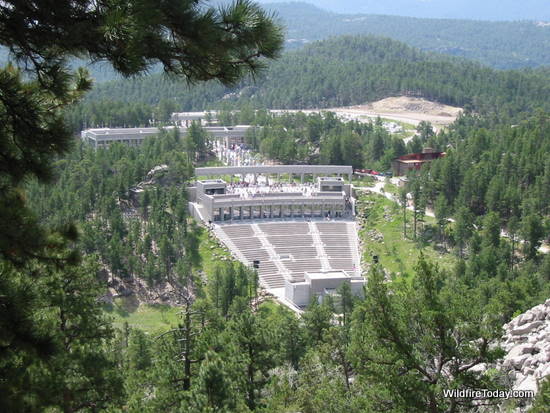
Mount Rushmore drafts plan for Mountain Pine Beetle

Mount Rushmore looking down from the top
Mount Rushmore administrative site, looking down from just below the sculpture . Photo by Bill Gabbert

Mount Rushmore National Memorial has posted a draft plan on how they intend to manage the mountain pine beetle (MPB) epidemic that is headed their way.  The problem is real, with the beetles staged just outside the memorial’s boundary on U.S. Forest Service land. While the critters are native to South Dakota and much of the western US, if they wipe out most of the Ponderosa pines near the sculpture in a epidemic caused by years of drought, it will not be a very pleasing sight for the 2.5 million visitors that trek there every year.

The plan calls for thinning most of the 1,200-acre site, spraying some areas, and treating much of the site with prescribed fire. They are asking for $5,653,150 through FY 2014. That works out to $4,710 per acre. Here is a summary of their treatment recommendations.

  • Spraying high value trees with insecticide to prevent loss within the developed area
  • Search, mark, and remove infested trees throughout the Memorial
  • Thin forests along the Highway 244 corridor to create a fuel and bug break
  • Thin forests throughout the Memorial to varying density and age class levels
  • Thin a 300 foot MPB and fire break along the south, west, and east boundary of the Memorial
  • Introduce prescribed fire throughout the Memorial after thinning
  • Communicate MPB management issues to the public

The memorial has enough funding to begin implementing the plan if it is approved, but they will be asking for more dollars to work on the list above, plus hiring four employees, including interpreters and a public information officer.

More on that below.

Continue reading

Wildfire news, November 3, 2008

Fire contractor volunteers to “detain troublemakers” on election day


An Evergreen helicopter at Custer, SD airport, September 9, 2008. Photo by Bill Gabbert

Here is an excerpt from an article on Wired.com:

CIA-linked private military contractor Evergreen Defense & Security Services offered to post sentries at Oregon election offices on Tuesday, “detaining troublemakers” and making sure voters “do not get out of control.”

In an e-mail to local election supervisors, obtained by the McMinnville, Oregon News Register, Evergreen president Tom Wiggins said he “recognized the potential conflict” that could occur on November 4th. “Never has there been a more heated battle in the race for president.”

The company, he said, ‘proposes to post sentries at each voting center on November 4th to assure that disputes amongst citizens do not get out of control. All guards will be unarmed, but capable of stopping any violence that may occur and detaining troublemakers until law enforcement arrives.’


In an update to the article, the author says that this proposal seems odd, since the state of Oregon conducts their voting by mail.

Evergreen owns and leases a fleet of 54 light, medium, and heavy helicopters, 30 of which can be used to fight fires. They are also seeking a firefighting contract with CalFire for their 747 “Supertanker”, which can carry over 20,000 gallons of fire retardant.


Changes at DHS after the election?

Will either candidate for President make significant changes, including response to wildfires, at the Department of Homeland Security (DHS) after they are elected? Domestic homeland security, other than protection from terrorist attacks and perhaps hurricanes, has not been a major topic of discussion during the campaign. The candidates have little time left after extensively covering plumbers and arguing about whose (tax cut) is larger.

However, in the DHS, the transition to a new administration has been receiving a lot of attention. Rear Admiral John Acton of the U.S. Coast Guard Reserve is leading the DHS transition team in the develpment of a massive briefing book as well as training exercises for the incoming administration.

Jacob Goodwin at the Daily Beast covered the proceedings at a roundtable discussion in Washington, DC on October 15 where the transition was the primary topic. Here is an excerpt from his report.

C. Stewart Verdery, Jr., who was an assistant secretary of DHS for policy and planning from 2003 to 2005 and is now a lobbyist, noted that he was not “formally” representing the McCain campaign at the roundtable discussion. But he went on to say, “I don’t expect you’d see wholesale changes to the DHS apparatus,” in a McCain administration.

On the campaign trail, McCain sometimes notes with pride that the U.S. has remained free from attack since 9/11, although in recent weeks issues of homeland security have largely been shouldered aside by more pressing economic concerns.

Verdery predicted that McCain would implement some measures, such as the Real ID drivers’ licenses—which have been resisted by local authorities because they were mandated without the funds to pay for them—and add an “exit” capability to the existing “entry” capability of the US-VISIT program at U.S. borders.

Verdery also implied that Joe Lieberman might be named the head of DHS in a McCain administration. The independent Senator from Connecticut, who currently chairs the Homeland Security and Governmental Affairs Committee, will “probably not be the most welcome guy” in the Democratic Party after this election, he said.

Senator Barack Obama also sits on that homeland security committee, and his legislative aide for DHS issues, Rachana “Ruchi” Bhowmik, presented his views at the Aspen event. She would not identify any individuals who might be appointed Secretary of DHS in an Obama administration, but she took her own swipe at the Republicans by saying that Obama “appreciates the need to restore professionalism and the need for management skills.”

Bhowmik agreed with Verdery that, given the huge financial problems confronting the U.S., neither candidate is likely to mount a wholesale reorganization of the five-year-old DHS.

Still, she said, Obama has some fundamental differences with the Bush adminstration about both the mission and the performance at DHS. Obama, she explained, favors an “all-hazards” approach that goes beyond counterterrorism to emphasize preparedness for natural disasters such as floods, hurricanes and wildfire. That stems, in part, from the fact that Obama’s home state of Illinois, has been hit with “everything but locusts this year,” she said.

In the past, Obama has floated the idea of moving FEMA out of DHS. But push-back from various quarters on Capitol Hill—including from Rep. Bennie Thompson (D-MS), chairman of the House Homeland Security Committee—makes it unlikely that Obama would propose anything like that in the first 100 days.

Nevertheless, Obama takes issue with the idea that state and local governments should respond to local disasters entirely on their own and turn to the federal government only as a last resort. On the contrary, Obama believes it is the proper role of the federal government to come into a dire situation, such as Hurricane Katrina, she explained.

But in the view of the Obama camp, the Bush administration politicized DHS and dictated homeland security policy unwisely to the state and local governments. “Unless we pull ideology out of the driver’s seat,” she said, “we’ll see first responders getting told what to do by the feds.”

But homeland security “has not been a very hot topic” on the campaign trail, Bhowmick admitted. “The American people have other things they’re thinking about.”

Until something terrible and unforeseen happens.

California: less prescribed burning?

According to an article in the San Diego Union-Tribune where a CalFire Chief, Thom Porter, was interviewed:

Porter, the CalFire chief, said the fire breaks and big backcountry burns went away when budget cuts coincided with environmental regulations protecting endangered species and limiting air pollution.

Burns to eliminate dry brush and other fuel for big fires are still done, but only after the effects on the environment are aired.

The article goes on to say:

Now, the kind of b
rush clearing that used to
be done by flame is mostly accomplished by hand and machine and is targeted, almost surgically, to protect individual homes and sites such as radio towers.

It’s more expensive, and fire officials say there isn’t enough money to deal with the huge expanses of tinder-dry backcountry.

“With the current resources we have, we will not ever catch up,” said Thom Porter, a Cal Fire staff chief who heads the Forest Area Safety Task Force in San Diego.

Porter said prescribed burns are still used but not very widely.

He estimates agencies in the county would have to clear about 27,000 acres every year simply to eliminate brush that hasn’t burned in more than 50 years.

“Our current capacity is about 7,000 acres,” Porter said.

Louisiana: smoke causes vehicle accidents

Firegeezer has a story about how smoke from a vegetation fire in a marsh degraded visibility on a Louisiana highway and caused at least a dozen wrecks.

This reminds me of the January 8 incident in Florida where smoke from an escaped prescribed fire smoked out a highway, causing over 70 accidents and 5 fatalities.