747 SuperTanker protects a village and later 5 firefighters

Chile fires 747 supertanker

This article originally appeared on Wildfire Today.

****
Above: A fire is approaching Llico, a small village near the Pacific Ocean about 130 air miles southwest of Santiago, Chile.

The 747 Supertanker had a productive day Friday in Chile. They completed four missions and were taxiing to take off on another when the lead plane pilot called saying smoke had degraded visibility making another drop impossible.

Elena Carretero, who has been associated with the flight crew, said one of the drops in the morning helped protect the lives of five firefighters who were in imminent threat of being overrun by a fire.

747 Supertanker Chile
At middle-left is Laguna de Torca. Beyond it is the village of Llico, and just beyond the village is the fire. This is looking southwest toward the Pacific Ocean.

All of these photos were taken from the 747 by the drop system operator, Don Paulsen. The images of the fire were shot just before 6 p.m. local time on Friday near Llico, a small village near the Pacific coast about 130 air miles (209 km) southwest of Santiago, Chile (map). Elena told us the village was in danger, like the five firefighters, of being overrun by the fire until the SuperTanker used all 19,200 gallons of water to make one long drop between the fire and the village, saving it.

747 Supertanker Chile Llico
The village of Llico being threatened by the fire.
747 Supertanker Chile
Structures in Llico can be seen at the bottom of the photo.

Continue reading

747 Supertanker in the Chilean media

747 supertanker

Above: The front page of the El Mercurio newspaper in Chile, January 26, 2017, shows one of the two drops the aircraft made on Wednesday. 

The arrival of the 747 Supertanker in Chile is generating a great deal of media interest, as well as capturing the attention of the Chilean people. A press conference at the airport the morning it arrived in Santiago drew a large number of reporters who shouted their questions at the government officials who were speaking.

747 Supertanker
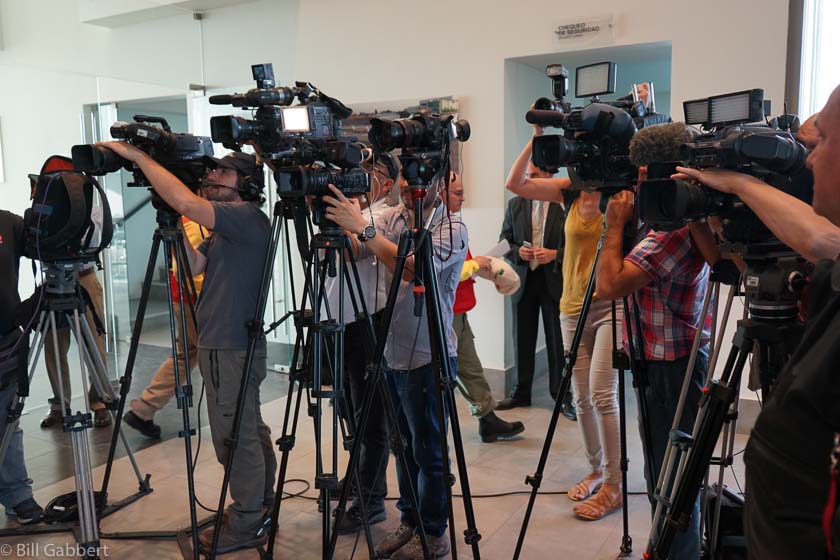
Some of the camera operators at the press conference the morning the 747 Supertanker arrived in Santiago, Chile.

The largest air tanker in the world combined with the busiest fire season in years and five firefighters killed (one pilot and four on the ground) would be big news anywhere.

The expectations of the aircraft may be a little high. Air tankers do not put out fires. Under ideal weather and vegetation conditions they can slow the spread of a fire, allowing firefighters on the ground to move in and construct a line around the fire and actually put it out.

Chile fires
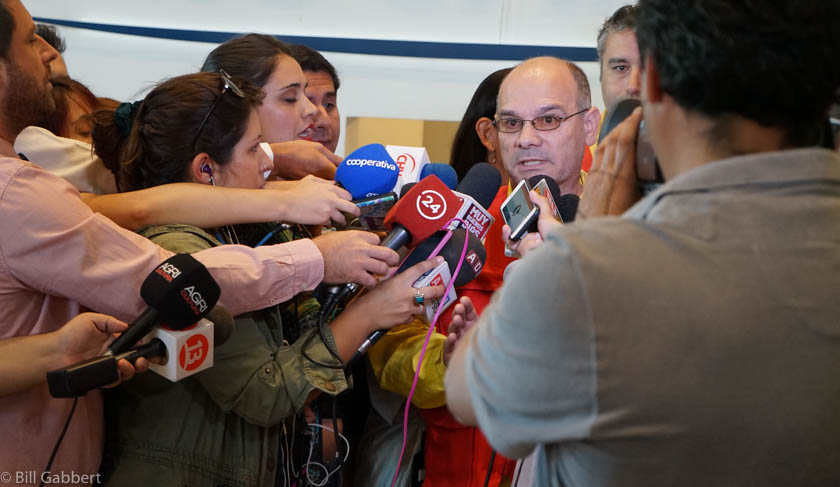
The morning the 747 arrived, Alfredo Mascareno of CONAF is mobbed at the Santiago Airport during a press conference about the aircraft and the wildfires in Chile.

747 Supertanker drops on its first fire in Chile

747 Supertanker

On its first day in Chile the 747 SuperTanker made two drops on a wildfire but had to abort working on two other targets due to dense smoke over the fires.

After arriving in Santiago at sunrise on Wednesday the pilots went to a hotel to get the required rest before they were allowed to get back in the cockpit.

The other Global Supertanker personnel spent the rest of the morning and part of the afternoon unloading cargo, configuring the aircraft, meeting with local officials, and confirming logistics and operational procedures.

After all of that was accomplished it took off for its first mission, but while en route was diverted to drop on a different location where people were in imminent danger of being overrun by a fire. The huge aircraft works with a lead plane that scouts ahead of the air tanker and helps to determine where and how it can attack the fire safely and provide the best assistance for firefighters, and in some cases, residents, on the ground. In this case the pilot of the lead plane and the pilots in the air tanker found that the smoke and the visibility made it unsafe to attempt to drop on the fire.

After that decision was made the lead plane and the 747 reverted to the original target. The flight crew watched from a distance as the lead plane flew a “show me” run over the specific target area, indicating exactly what track to take and where to drop the water. Next, the air tanker made a dry run over the target, that is, without dropping water. This is frequently flown a little higher than the eventual water or retardant drop, to evaluate the effects of wind, convection over the fire, and terrain. Then after doing a large 360 it came around with the lead plane and made the actual drop — in this case, half of the 19,200-gallon load. A little later it made another pass and dropped the rest.

After those drops it returned to Santiago to reload with water. Due to the confined space and scattered parked airplanes on the military side of the airport that has been designated as the reload site, or “pit”, the 747 can’t simply taxi in, reload, and taxi out. A tug has to help it maneuver during either the in or out trip. This is a very unusual, almost unheard of, situation for an air tanker that is fighting forest fires. If a few of those parked aircraft were moved it would significantly reduce the turnaround time for the air tanker. It could come in to the dead end ramp, do a U-turn, park, reload, and taxi out.

After reloading it flew to another designated target, but again smoke was a serious issue. Both the 747 and the lead plane explored and examined several potential tracks to the intended target, but it was deemed unsafe to attempt to fly through the smoke, so the SuperTanker returned to Santiago and landed with its tanks full, without having to jettison the load before landing like most other air tankers are required to do.

Like all air tankers, the 747 can drop either water or long term fire retardant, the red slightly viscous liquid that is seen being dropped from most air tankers in North America, Australia, and Europe. Retardant is more effective than plain water. It actually chemically interferes with the combustion process, while the thickened nature of it allows the wet, ketchup-like substance to stick to surfaces rather than running off onto the ground. But long term fire retardant is not available in Santiago.

There are a number of products that can be mixed with plain water to enhance its effectiveness, usually at less than one percent concentration. The one being used by the SuperTanker is Pyrocool which is stored on the aircraft and added to the tanks as needed. Pyrocool has not been approved for use by the U.S. Forest Service, but has been used on marine fires and on the World Trade Center fire.

We corrected the article to reflect that Pyrocool has not been approved for use on wildland fires by the U.S. Forest Service, but has been used on some other types of fires within the United States including marine fires and the World Trade Center.


747 SuperTanker arrives in Chile

chile fires

Above: The crew from the 747 SuperTanker is welcomed at the Santiago Airport, January 25, 2017.

Early Wednesday morning the 747 SuperTanker landed at Santiago, Chile to begin an assignment to help firefighters on the ground suppress some of the many fires burning in the country during an extended drought and heat wave.

After landing, the huge aircraft was towed by an airport tug to a remote corner of the military side of the airport where two very large bladder bags had been positioned, presumably containing water to fill the 19,200-gallon tank. It took quite a while for the tug to position the 747 in that location, so the aircraft crew will be working with the locals to reposition what will be a loading pit so that the aircraft can quickly taxi in and out to reload, without the use of a tug.

chile supertanker
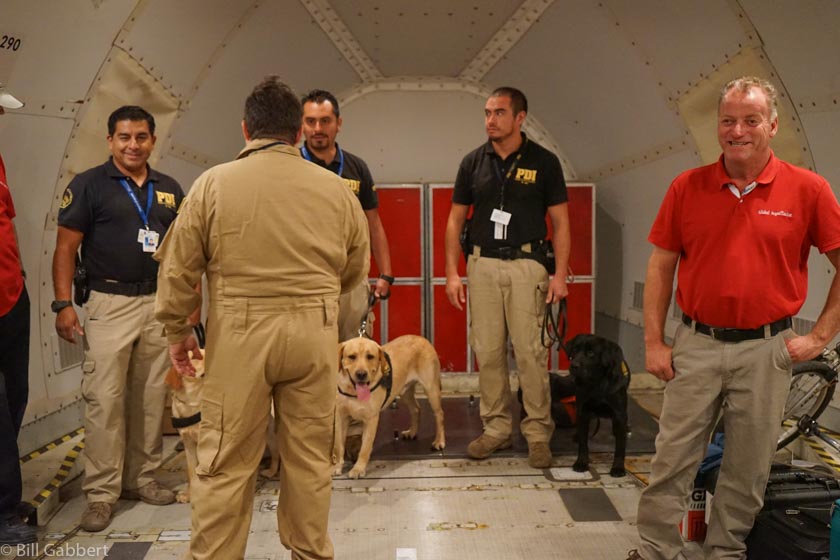
Drug-sniffing dogs searched the interior of the SuperTanker after it landed at Santiago.

The first order of business was to bring three drug-sniffing dogs on board. One of them had to be carried up the very steep ladder to the upper deck — not an easy task. Kudos to the dog’s handler who made it look fairly easy, even though the dog looked quite uncomfortable.

jim wheeler carol perez
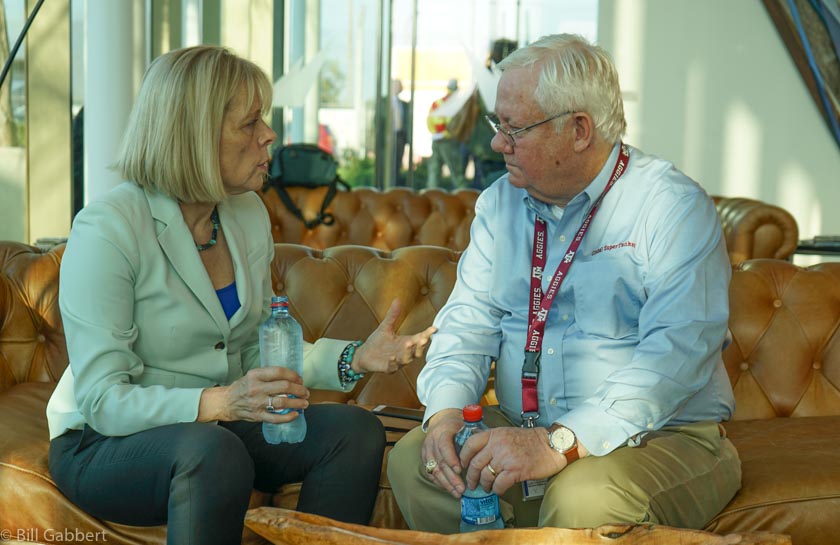
Jim Wheeler, President and CEO of Global SuperTanker, meets with the US Ambassador to Chile, Carol Perez.

After we were bussed to a VIP version of Customs, the U.S. Ambassador to Chile, Carol Perez met with Jim Wheeler, CEO and President of Global Supertanker. Next was a chaotic press conference where Alfredo Mascareno of CONAF, which is the Chilean version of the U.S. Forest Service, was mobbed by several dozen members of the media, including CNN of Chile. Mr. Wheeler told me he was grateful that he was not interviewed.

Chile fires
Alfredo Mascareno of CONAF (wearing glasses) is mobbed at the Santiago Airport during a press conference about the wildfires in Chile.

The two flight crews will get some rest Wednesday morning, and one of them will most likely be available in the afternoon to fly the aircraft. But many logistical and coordination details still need to be worked out.

Christopher M. Nyce of the U.S. Embassy told us that USA fire personnel have been deployed to Chile for this fire siege, including four from the USFS and a “team” from CAL FIRE. The USFS contingent arrived early Wednesday morning. CAL FIRE signed an agreement with Chile in November regarding mutual assistance during wildfires.  There may be firefighters from other countries arriving later this week. (UPDATE January 31, 2017: there was a change in plans, and the personnel from CAL FIRE did not deploy to Chile.)

A private foundation is funding the initial deployment of the SuperTanker

747 supertanker

Above: Ben and Lucy Ana Walton de Availés display a Chilean flag at the door of the 747 Supertanker the day before the air tanker departed for Chile. Photo by Bill Gabbert.

The assignment of the 747 SuperTanker to help fight the numerous wildfires in Chile is very different in at least one respect — a private foundation is supplying the starter funds for the huge air tanker to travel to Santiago and for approximately three days of actual use on fires.

An heir to the Walmart fortune, Ben Walton and his wife Lucy Ana Walton de Availés, of Denver, have worked out arrangements with the Chilean government and the operator of the 747, Global SuperTanker, to assist the firefighters on the ground in Chile. The funds are being provided by Ben and Lucy Ana’s foundation, Foundación Viento Sur, which has a connection to the Walton Family Foundation. They hope the government will retain the services of the air tanker for as long as it is needed after they see the effectiveness of the aircraft.

747 supertanker
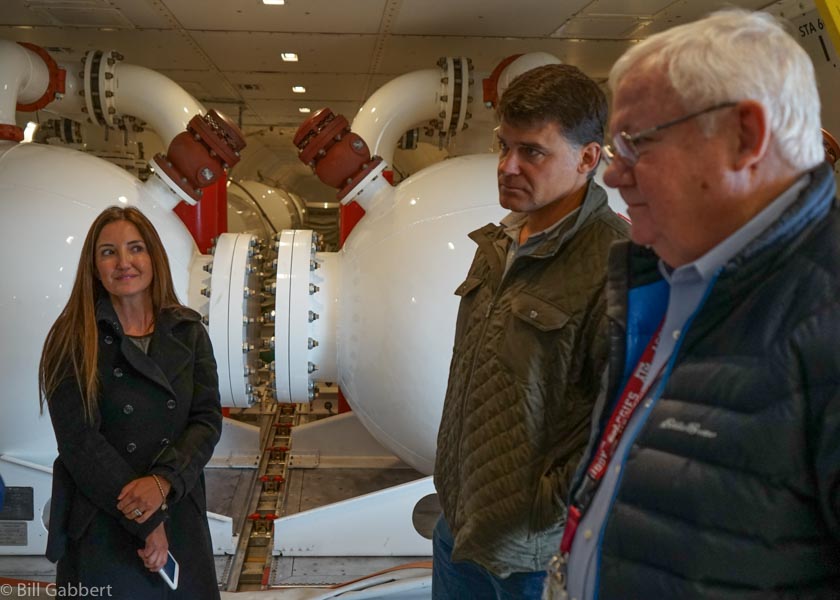
Lucy Ana Walton de Availés, Ben Walton, and Jim Wheeler (L to R) in front of the tanks in the SuperTanker. Photo by Bill Gabbert.

Lucy Ana is originally from Chile and has strong feelings about finding a way to help the residents in her homeland to defend against the fires that have destroyed scores of homes and damaged vineyards, a very important industry in the country.

Ben and Lucy Ana visited Global SuperTanker’s Colorado Springs facilities on January 23 and received a briefing on the use and capabilities of the aircraft. Ben has some pilot training and both of them, but especially Lucy Ana, were very enthusiastic about its capabilities and its potential to assist the residents of Chile.

Working out the details with the foundation, the Chilean government, and Global Supertanker was a complex procedure that took a few days. Finally late Tuesday morning, January 24, the flight crew received the GO order and departed for South America at about 1:40 p.m. MT.

Another cause receiving assistance from the foundation includes Postpartum Support International (PSI), an organization to help women suffering perinatal mood and anxiety disorders. The grant will strengthen postpartum treatment in the state of Colorado, although PSI has global connections. In 2016 the foundation helped arrange for $1.5 million worth of medical supplies to be sent to hospitals and rural clinics in Chile. And they also rebuilt a school after it was destroyed by the earthquake and resulting Tsunami in Chile a few years ago.

Lucy Ana Walton
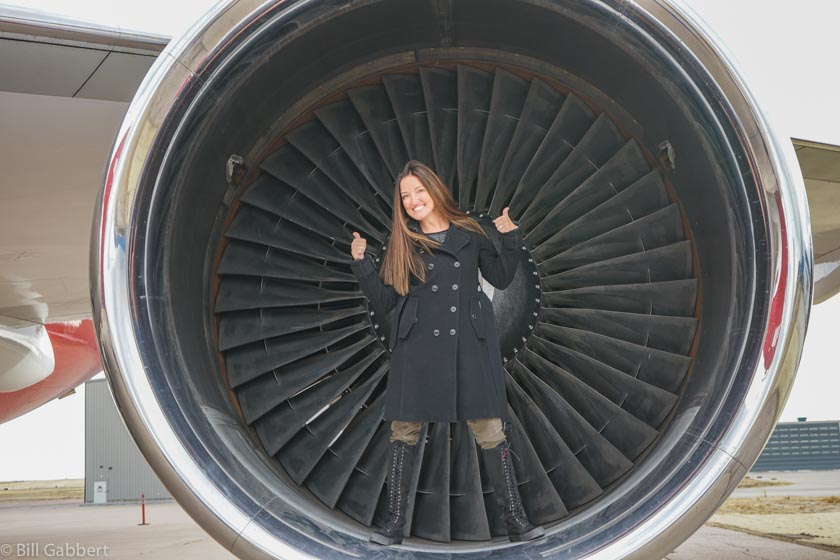
Lucy Ana Walton de Availés enjoys the classic jet aviator’s pose.

747 SuperTanker en route to assist with wildfires in Chile

747 supertanker Chile

The 747 SuperTanker has been dispatched to South America to assist firefighters who are dealing with numerous fires occurring during a drought in the country. The aircraft is expected to depart from Colorado Springs sometime after 1330 MT on January 24 and should arrive in Santiago around 14 hours later after a stop in Houston to pick up a liquid fire suppression agent that will be mixed with water in the 19,200-gallon tank.

If you want to follow the track of the aircraft, it will show up as “GST944”. GST used to be used by Ghana Airlines, but the company is now out of business.

The initial stage of this deployment, the first few days, is being funded by a private foundation. We will write more about this in a later article.

I will be embedded with the crew, traveling with them in order to report for Fire Aviation on their assignment. As with any wildland fire assignment, we don’t know how long we’ll be in Chile.

747 Chile supertanker
The interior of the 747 during the gear loading process.  Bill Moody, VP of Incident Response for Global Supertanker, can be seen climbing the stairs to the upper deck. Photo by Bill Gabbert.

The fire siege in Chile has been going on for several weeks destroying more than 60 homes and portions of vineyards, an important industry there. As far as we know, Chile has not received much assistance from outside the country.

A recent emergency declaration by the President has authorized the use of military assets to help combat the fires.

Unusually high temperatures for the last 30 days have contributed to extreme fire behavior. On January 15 three firefighters were entrapped and killed and the pilot of a single engine air tanker was killed December 28 when the aircraft crashed about 15 kilometers from the town of Santa Juana after working on a wildfire in the Bío Bío region.

Using the 747 Supertanker to drop on fires at night

747 Supertanker

Above: The 747 Supertanker at McClellan Air Field March 22, 2016. Photo by Bill Gabbert.

While the 747 Supertanker was in Israel November 24 to 30, a Jordanian web site wrote that the aircraft was capable of dropping at night. This was a surprise to us, since no large fixed wing air tanker owned or operated by a government agency or private company has ever, to our knowledge, established or approved a policy of dropping water or retardant on a wildfire at night. As far as we can tell it has never been done, other than, perhaps, by a cowboy pilot who bent the rules.

We checked with Jim Wheeler, the President and CEO of Global Supertanker Services, who told us, “Under certain circumstances we will drop at night”. The final decision, he said, was up to the pilot in command.

He went on to say:

In Israel the conditions would be different than what you would find in the United States. The Israelis were looking at a potential for night flight in certain areas that they felt might need it. Fortunately none of those came up while we were over there.

The Supertanker flight crews do not have Night Vision Goggles (NVG), have not trained with the aircraft for night flights, and before they use NVG the lights in the cockpit would have to be modified to be compatible. Conventional panel lights are far too bright for NVG.

At the Night Aerial Firefighting Operations Summit held last January in Rifle, Colorado, Bill Moody and Cliff Hale of Global Supertanker put on a presentation about the use of the 747 for night drops. It was recorded and can still be seen HERE. Their presentation begins at 78:20 and they begin talking about night drops at 84:10.

One of their key points was the drops might have to be done at 400 to 800 feet above the ground, but that is still unknown. One feature of the Supertanker that would help to make higher altitude drops more feasible is the pressurized system that pumps the water or retardant straight down, reducing the side drift and the footprint.

They said in the presentation that there would be a requirement for an infrared equipped air attack aircraft, ATGS, to be at a higher altitude than the air tanker. This is the inverse of having a lead plane flying in front of the tanker. The ATGS would identify the targets and the start and end points for the drop, then relay those to the tanker where it would be displayed on a map.

When the U.S. Forest Service restored the night flying helicopter program on the Angeles National Forest in 2013, they had a similar requirement, a fixed wing air attack ship orbiting overhead in the darkness. In this case it was a Turbo Commander 690 equipped with technology to support ground and air firefighting operations at night, including an infrared camera and command and control avionics equipment.

The January presentation included this:

Can it be done safely? That’s what we need to evaluate. We think it can at the altitudes we would be operating at and with the drop system we have but this is something that would have to be further evaluated during an R&D project.

Below is a screenshot from their presentation, outlining the Research and Development project if they were going to consider dropping at night:

R&D proposal for night drops
Global Supertanker R&D proposal for night drops.

Mr. Wheeler said wildland fire personnel in Israel and Australia are very interested in using fixed wing air tankers at night.

“We’re not ready for night flight in the U.S., period”, he said. “And whether or not the Forest Service ever allows it is a monumental question. There are a lot of things that will happen offshore long before they ever happen over here.”

How the 747 Supertanker was used in Israel

Tanker 944's flight

Above: Tanker 944’s flight over Israel November 27, 2016. 

After being deployed November 24 to assist firefighters in Israel, the 747 Supertanker returned to Colorado Springs November 30. While overseas it dropped on two fires during two sorties, discharging the full 19,200-gallon load each time.

The Israelis were extremely aggressive in attacking emerging fires, according to Chief Pilot Cliff Hale and Sr. VP Program Manager Bob Soelberg of Global Supertanker Services. Talking with them on a speakerphone Friday they said there were more than 40 air tankers in the country while they were there, including the 14 privately owned Single Engine Air Tankers the country has under contract.

At all times surveillance aircraft were airborne, able to quickly detect new fires and track any vehicles leaving the scene. About 39 people were arrested for arson during the recent fire bust.

At times the crew was on hot standby, with orders to be wheels-up within 15 minutes if necessary.

Frequently there were multiple air tankers loitering off the coast out over the Mediterranean ready to drop within minutes on new fires. In flight planning the Supertanker crew was told to take off with enough fuel for three hours of loitering. They also carried another three hours of fuel for working over a fire.

As you can see in the screengrab from FightRadar24, they were flying a racetrack pattern as they waited for an assignment. Other air tankers loitering at the same time were, of course, flying at a different altitude.

Tanker 944, a 747-400
Tanker 944, a 747-400, at Colorado Springs, May 4, 2016. Photo by Bill Gabbert.
Supertanker Watch Party
Found on Instagram: “Supertanker Watch Party”.