
The retardant delivery system to be reinstalled in a different aircraft
Continue readingThe 747 Supertanker is ceasing operations
The company is in discussions with prospective buyers for the huge air tanker
Continue readingHow much does it cost to drop retardant on a fire?
We calculated the cost per delivered gallon
Continue readingStatistics for the use of air tankers, 2000 through 2019
And, more details about the new Call When Needed contracts
Continue reading747 air tanker begins working on wildfires in Bolivia
 Air Tanker 944 at Viru Viru International Airport in Bolivia. Global Supertanker photo.
The 747 Supertanker arrived in Bolivia at 1:37 a.m. local time Friday August 23 at Viru Viru International Airport outside the capital city of Santa Cruz de la Sierra and began sorties on fires later in the day.
It appears from the photos above that the method of filling the 19,200-gallon tank may be similar to that used in 2017 when the 747 was working on fires in Chile. In that case there was no robust infrastructure for the distribution of water, so the Santiago Fire Department established a system of portable water tanks filled by water trucks. Fire engines then pumped water from the tanks to the aircraft.
 Firefighters in Chile created a system to fill the 19,200-gallon tank on the 747 Supertanker in Chile. Photo by Bill Gabbert, January 25, 2017.
News from the Aerial Firefighting conference in Sacramento, Part Two

Above: Ron Hooper, CEO of Neptune Aviation
Earlier we posted Part One of a few notes that I scribbled in a notebook at the Aerial Firefighting conference in Sacramento this week. Here is Part Two.
Neptune Aviation
Ron Hooper, CEO of Neptune Aviation, said their air tankers in 2016 averaged 180 hours while working on wildfires. In 2017, a very busy year, that number increased to 276. Their P2V’s have retired from firefighting, leaving the company with nine air tankers, all BAe-146’s.
No one outside the U.S. Forest Service knows when the agency will issue the next round of exclusive use and call when needed next-generation air tanker contracts, affectionately called Next-Gen 3.0. When forced to guess, Mr. Hooper said the aircraft receiving those new contracts may not be activated until 2019. He may know more than most, since his former job was supervising air tanker contracting for the FS.
Phos-Chek
One of the major suppliers of fire retardant, Phos-Chek, is changing hands again. In a matter of days its parent company will be Perimeter Solutions. But as in the previous four iterations it will retain the brand name Phos-Chek.
Here is the product’s history of parent companies:
1963-1997: Monsanto
1997-2000: Solutia
2000-2005: Astaris
2005-2018: ICL
2018- ???? : Perimeter
Global Supertanker
 L to R: Bob Soelberg and Jim Wheeler of Global Supertanker
Jim Wheeler, CEO of Global Supertanker Services, said the company currently has CWN contracts with CAL FIRE and two counties in Colorado — Douglas (just south of Denver) and El Paso (Colorado Springs). Other pending contracts that they hope to sign later will be with the states of Colorado, Texas, and Oregon.
Colorado
 Vincent Welbaum, Colorado’s Aviation Unit Chief
, said they are talking to vendors and expect to award a call when needed contract to at least one vendor that can supply large or very large air tankers. The state has been operating their own two Pilatus PC-12 Multi-mission aircraft for several years, using it to detect and map wildfires.
Colorado will have two Single Engine Air Tankers on exclusive use contracts supplied by CO Fire Aviation and Aero Seat as well as four other vendors on call when needed contracts. The state will also have two Bell 205’s on exclusive use contracts.
Helimax
 Pat Pilolia, of Helimax
Helimax Aviation is one of two subsidiaries of Heligroup Holdings. The other is CHI at Howell, Michigan which concentrates on heavy lift, while Helimax, at Sacramento McClellan Airport is in involved in aerial firefighting. Helimax recently sold all of their Type 2 helicopters, and now have six Type-1’s, Chinook CH-47D’s.
MAFFS Group
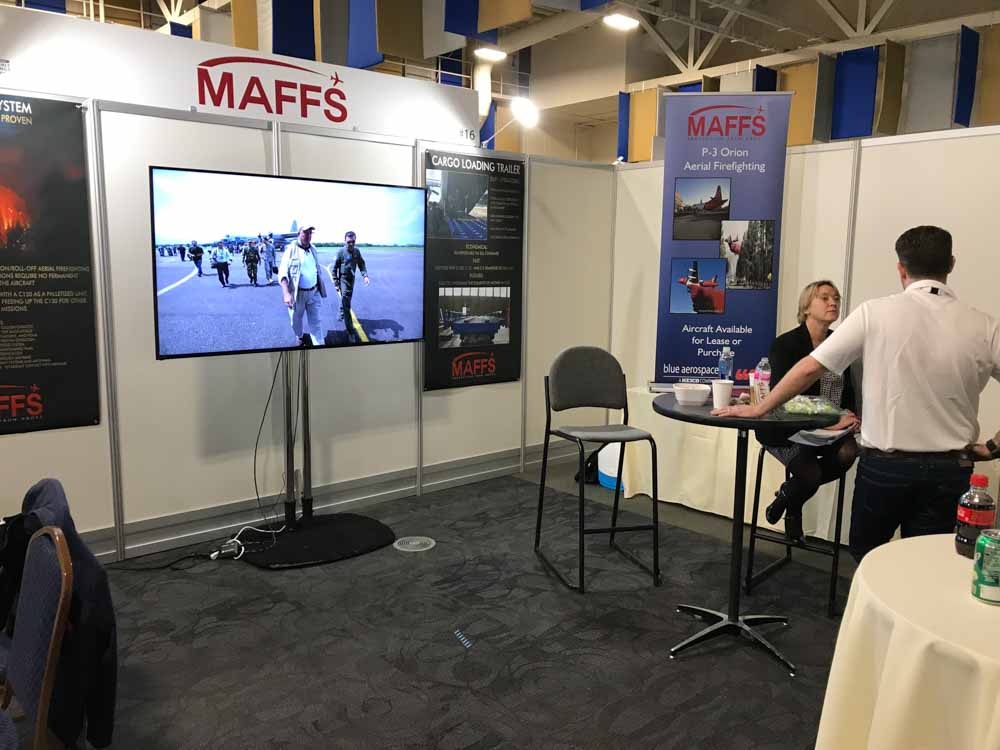 Bradford Beck, COO of MAFFS Group said the company recently sold a MAFFS II system to the Tunisia Air Force in Northern Africa. The country has operated two of the original versions of the MAFFS for 10 to 15 years. They will continue to operate the MAFFS I systems on a C-130B and will use a C-130H for the new MAFFS II which will be delivered in the third quarter of this year. The most challenging wildfires in Tunisia occur in the Atlas mountains.
This is the second MAFFS II that the MAFFS Group has sold. The first is now being used in Columbia, South America.
Viking Air
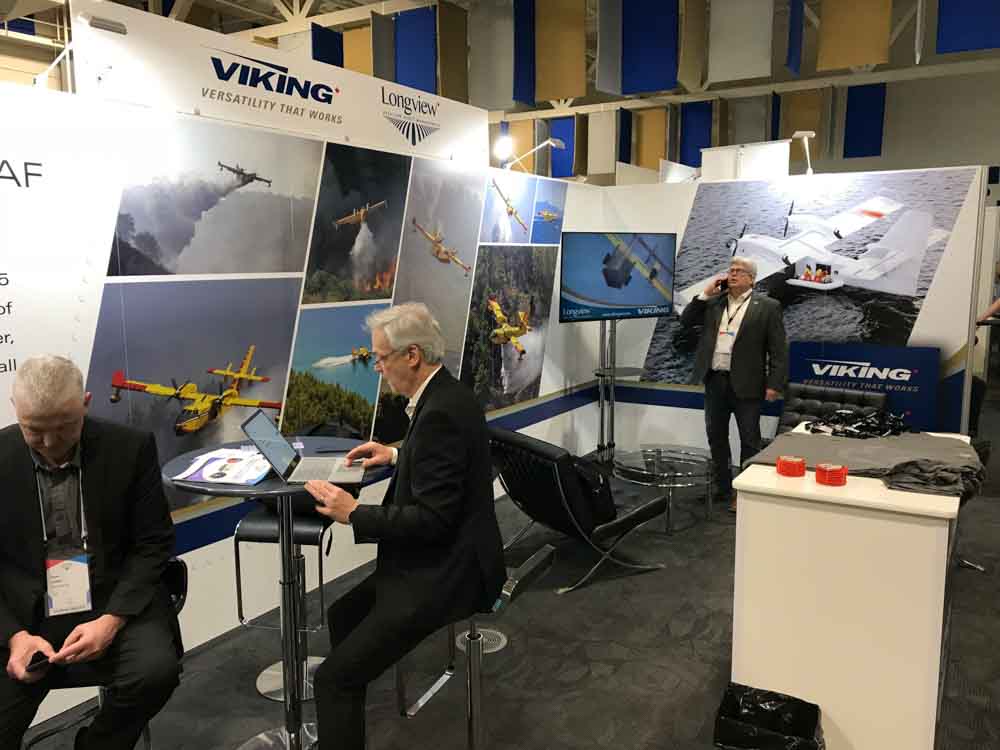 The Viking Air display at the conference.
Viking Air director of Special Projects, Sales, and Marketing Christian Bergeron said the company is currently gathering information from potential customers about what they would like to see on a new version of the CL-415 water scooping air tanker. The company expects to decide by the third quarter of this year if they will proceed with the project, which will be named CL-515. At this stage, Mr. Bergeron said, they expect it to have a larger cargo door, glass cockpit, updated avionics, and will be able to land with a full load of water. Available options will include an infrared camera system and night vision compatibility. Viking’s manufacturing facility is in Calgary, Canada.
Video of 747 dropping on the Thomas Fire
(Originally published at 10:50 a.m. PST December 10, 2017)
We shot this video that was on a TV screen of the 747 SuperTanker dropping on the Thomas fire in Ventura County in Southern California. It was broadcast by ABC7 today, Sunday morning December 10, but the reporter said it was shot “earlier”. Based on the flight history of the aircraft it was probably initially recorded between December 7 and 9, 2017, since its first planned flight today is scheduled to depart McClellan at 11:05 a.m. PST.
 Screenshot from ABC7 video of the 747 SuperTanker dropping on the #ThomasFire in SoCal.
GAO decides against Forest Service in Global SuperTanker’s contract protest

The Government Accountability Office said the FS failed to provide a reasonable justification for limiting the maximum size of the retardant tank.
Continue readingA tour through the 747’s retardant delivery system

The air tanker holds about 19,000 gallons of retardant or water to aid firefighters on the ground suppressing wildland fires.
Continue readingOutstanding photo of the 747 on the Palmer Fire (new: added videos)
(Originally published at 7:22 a.m. MDT September 5, 2017)
A few days ago Cy Phenice sent us an excellent photo of Air Tanker 944, the 747 SuperTanker, dropping on the Palmer Fire south of Yucaipa, California which we published September 3. Now we have another great photo of the huge airplane dropping on the fire.
It was taken by Leroy Leggit with a Nikon D810. He shot it at 1/800, F 5.6, using a 70-200mm lens at 150mm.
He said he took the photo from the top of a hill looking down at the aircraft.
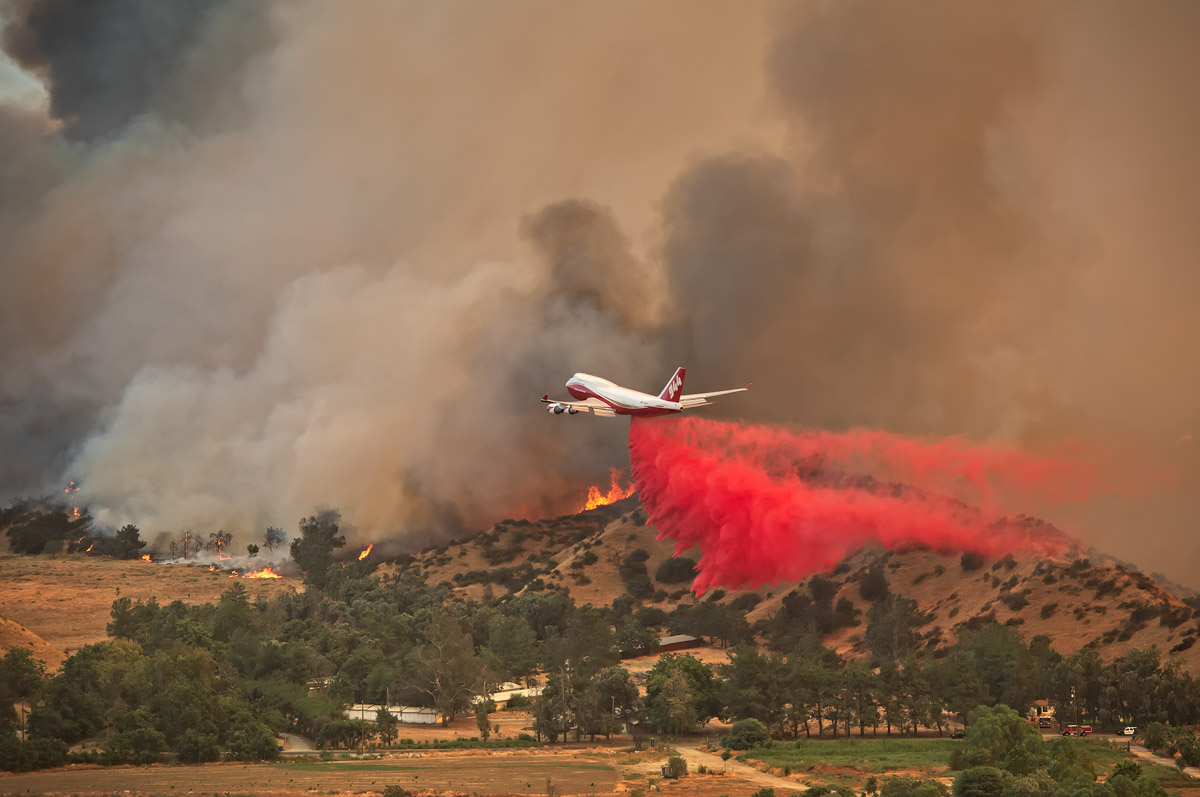 Air Tanker 944, a 747-400, drops near structures on the Palmer Fire south of Yucaipa, California at 4:25 p.m. PDT September 2, 2017. Photo by Leroy Leggitt, used with permission.
He told us:
I didn’t know anything about the 747 supertanker until it appeared to my right (at eye level) headed straight toward the fire… what an amazing and unexpected sight… I looked online and saw that it had only been in service for a few days.
The Palmer Fire was reported at 1:33 p.m. MDT September 2, 2017. It is nearly officially contained according to CAL FIRE after burning 3,874 acres.
This was the second fire the aircraft was used on after receiving certification and a contract from CAL FIRE. The 747 was dispatched from McClellan Air Field near Sacramento. According to FlightAware it cruised south at over 600 mph at times before dropping on the fire about an hour later, then reloaded at McClellan and completed a second sortie, dropping almost 19,000 gallons again, splitting the load into two drops.
(UPDATED at 10:07 a.m. MDT September 5, 2017)
After Johnny commented that videos are available, we checked and found these. The first one appears to be the same drop seen in the photo above.