


Two aerial firefighters were killed July 10 in the crash of an air attack aircraft associated with a wildfire in Arizona. It occurred on the Cedar Basin Fire which is 14 miles northeast of Wikieup, Arizona and 43 miles southeast of Kingman, Arizona.
Below is the statement released Saturday night July 10.
“The Bureau of Land Management is currently working with other local, state, and federal agencies to respond to a fatal aircraft accident associated with the Cedar Basin Fire near Wikieup, Arizona. The accident occurred around noon today (July 10) and involved an air attack aircraft performing aerial reconnaissance and command and control over the fire. Two crew members were on board and we are sad to report there were no survivors. We will provide additional information pending next of kin notification. Our hearts go out to the families of our brave wildland firefighters.”
The Cedar Basin Fire, a result of thunderstorms, was reported to dispatch July 9 after 6 p.m. That night it was not possible to get a good visual due to darkness. On July 10 a helicopter performed a reconnaissance and discovered an active fire. Later that night the fire had burned about 300 acres.
We send our sincere condolences to the families, friends, and co-workers of the two firefighters.
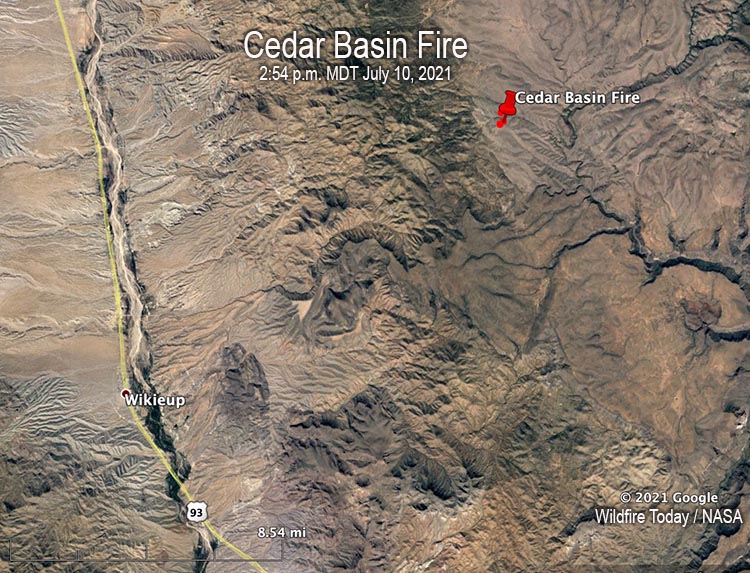 Map showing the location of the Cedar Basin Fire at 2:54 p.m. MDT July 10, 2021.





5 Comments
Two folks ‘on point’ recon . . . a loss to all of us. Sad condolences to family and team. Would like to know A/C type. Was it fixed-wing (S-2) or rotary? Tough job & possibly former mil.
More . . .
Local res thought he saw a turkey vulture. Wife said “airplane . . . coming down at a steep angle . . . saw the plane slam into the ground.” (fixed-wing?)
https://thehill.com/homenews/state-watch/562428-two-firefighters-die-in-arizona-plane-crash
Aircraft was a Beechcraft King Air C-90; vendor owned on a gov’t contract.
No structures threatened. Values at risk unknown. Witness reports indicate the Falcon Aviation King Air 90 (on BLM contract) had a wing separate in mid air!!!
There have been a bevy of fatal aircraft accidents since the “surge” began with nothing from the agencies except “thoughts and prayers”. I for one have had enough T&P and feel it’s past time to have a mandatory stand down. The best way we can honor those lost is to make sure, if the incident was avoidable, it never happens again. Instead we get T&P, a form email goes out and nothing changes. If Southwest Airlines lost a wing, or engine (or if that was even suspected) they would immediately ground the affected aircraft until aircraft failure could be ruled out. There are ATGS’s in KA C90’s as I right this, the situation is exigent. The BLM owes it to the aerial firefighters and their families to ensure their contracted (or agency) equipment is safe!!!! Thoughts and prayers and hope are not tenets of a sound risk management plan but it seems the BLM keeps them as pillars.
Hello: I wish to make it plain to all readers that EVERY Firefighter, without exception, whether involved in Aerial Attack or a Hot Shot Crew is an unheralded HERO in my book. This IS a fact that people must realize!
I also wish to state the following:
For several years now, I have followed the use and implementation of the current VLAT fleet and have noticed that these assets are rarely used for IA. I am sure there are many policies in place which stipulate the reasons for this.
As a constant observer, who has been around aviation (Commercial, Military, and General A/C ) since 1973, I do have some concerns about the current fleet of air tankers.
1. Why are very high time aircraft (B-727 and DC-9 aircraft) being used? Is this not an added danger to the brave crews who fly them? Everyone remembers the C-130 video in which the right wing folded killing the crew. This always seemed to be a metallurgy issue from the start. The recent sell off of the only B-747-400 to be retrofitted for aerial attack was not good news for everyone. I read about the deficiencies in offloading all of the retardant as being much of the reason for this. The real tragedy here was the loss of a nearly 20,000 gallon capability, which is very close to double the capability of the 10-Tanker DC-10 VLAT’s currently in service.
Over the years, and after spending 15 years in the USAF, I have tried numerous times to rally the Forest Service and Cal Fire to consider retrofitting the C-5M A/C at Kingman for this. I am not the only person who has suggested this as well. If one considers the offload capability of these military assets (properly retrofitted), it could literally change the methodology of aerial attack. I have studied the aerodynamic and related flight safety issues as well.
This can be done. I DO realize the financial issues as well, but let’s consider those on the ground who have endured some of the worst fires in California’s history.
I am submitting this idea again for the benefit of ALL!
Comments are closed for this article!