


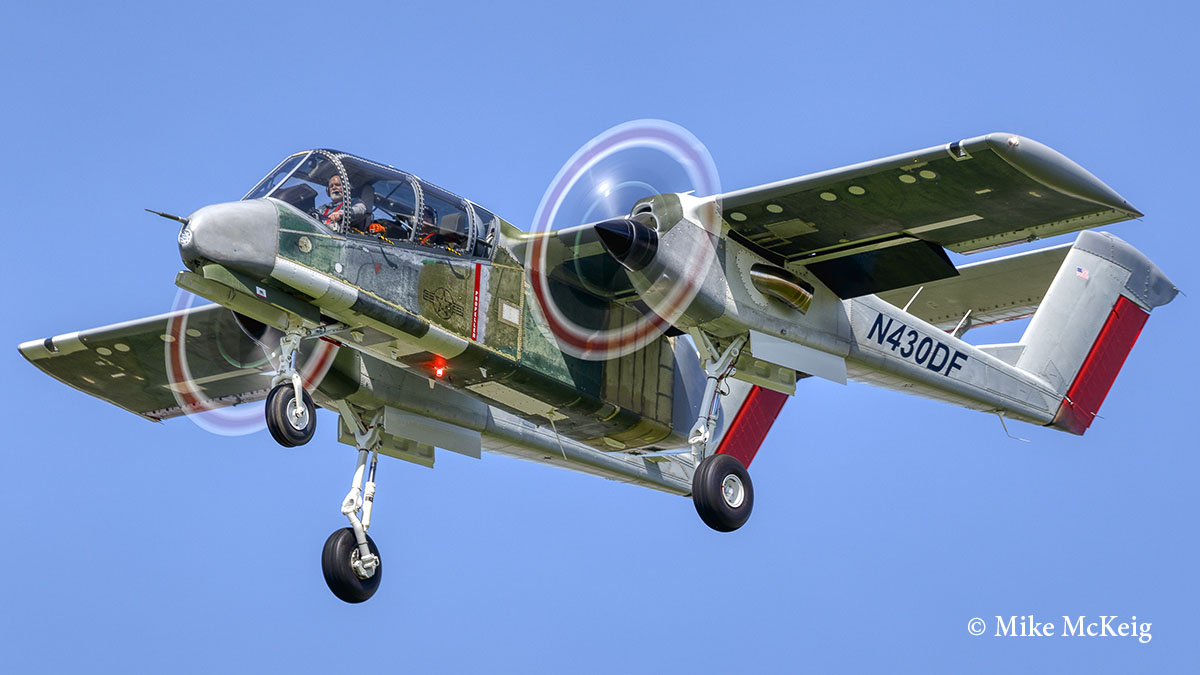
 One of the first flights of the most recently converted CAL FIRE OV-10 Broncos. Photo by Mike McKeig.
The California Department of Forestry and Fire Protection is nearing completion on the conversion of another OV-10 Bronco. This will bring their OV-10 fleet up to 16; they are all OV-10A’s except for one OV-10D. The difference is the D’s have much more powerful engines and have a maximum speed of 280 mph, 22 mph faster than the A’s.
CAL FIRE began acquiring the OV-10’s in 1993 to replace the Cessna O-2A Skymasters which had two engines, one pulling and the other pushing, with a maximum speed of 199 mph.
The OV-10’s are flown by contract pilots working for DynCorp with a CAL FIRE Air Tactical Group Supervisor in the other seat, responsible for managing the incident airspace and coordinating the air tankers and helicopter operations over the incident.
 A lineup of OV-10 air attack ships at McClellan Air Field, March 24, 2016. Photo by Bill Gabbert.
This year the agency will have 22 S-2T air tankers plus one spare, the same as last year.
 Tanker 91, an S-2T (N482DF), at Medford, OR July 18, 2020 by Tim Crippin.
The new Sikorsky S-70i helicopters that CAL FIRE has ordered have been arriving one or two at a time over the last year. There are now five of the “CAL FIRE Hawks”, as the agency calls them, in the state. Then it can take weeks or months before they finish their final inspections and outfitting and arrive at their new homes.
 CAL FIRE’s Firehawk helicopter 903 at Sacramento McClellan airport October 12, 2019. United Rotorcraft/Sikorsky.
CAL FIRE expects to pick up two more at the end of May at Air Methods/United Rotorcraft in Englewood, Colorado where they are being converted into firefighting machines. Another is being painted now in Texas before it flies to Colorado for the conversion. The next one in the chain recently arrived on a barge in Texas after being shipped from Sikorsky’s production facilities in Poland where two others are still being built for CAL FIRE. Unfortunately COVID-19 is slowing work on the helicopters in Poland.
The conversion of the seven C-130 aircraft into air tankers is creeping along like a herd of turtles. Congress appropriated the funds in December, 2013 and directed the U.S. Air Force to perform the needed maintenance on the aircraft and to arrange for all of the conversion work, including installing the retardant tanks. The earliest they are expected to be fully operational as air tankers will be in late 2022 or in 2023. We have more information about this project, that looks like it will take a total of at least nine or ten years before it is done, in another article. “Opinion: Congress should hold hearings on Air Force delays in converting C-130 firefighting air tankers.” The Department of Defense and the Biden administration need to fix this fiasco.




3 Comments
Once the CAL FIRE Hawks are received by CAL FIRE from United Rotorcraft we are looking at a week or two before they are operational, not several weeks or months. The time required to get the crew trained and transitioned into the new aircraft also takes some time, especially depending on when the aircraft arrive, fire season versus winter months. Example, C-104 arrived at McClellan March 12th and this week is flying in Air Rescue training.
Regarding the seven C-130s and it ‘looking like it will take a total of nine or ten years before it’s done…” What in the world would make this take ten years? What a waste of time and money. They should just throw MAFFS in these like the USFS was doing and be done with it!
The MAFFS II systems in existence are all owned by the US Government and are with the USAF ANG units. So that alone presents one problem, since they are all in use. The second being the tank system was designed and built by Aero Union, whom no longer exists. The new patent holder would have contract out a company to build new MAFFS tanks, which are considerably more complicated to manufacture than a constant flow tank. The MAFFS in the USFS Hercs were stop gap options as well, they too were supposed to get the more efficient, better coverage constant flow tanks, and then the MAFFS tanks were to be transferred back to the ANG units (where they are now). The MAFFS II system wasn’t designed to be a long term solution for the USFS Herc program because of the system’s shortfalls compared to the constant flow tanks. Long term, the constant flow tank is cheaper, more efficient, lower maintenance, and works considerably better. It’s arguably why pressurized drop systems like MAFFS aren’t in larger use. MAFFS and the 747 being the only platforms that use it. Everything else out there is a gravity fed, constant flow style tank.
Comments are closed for this article!