


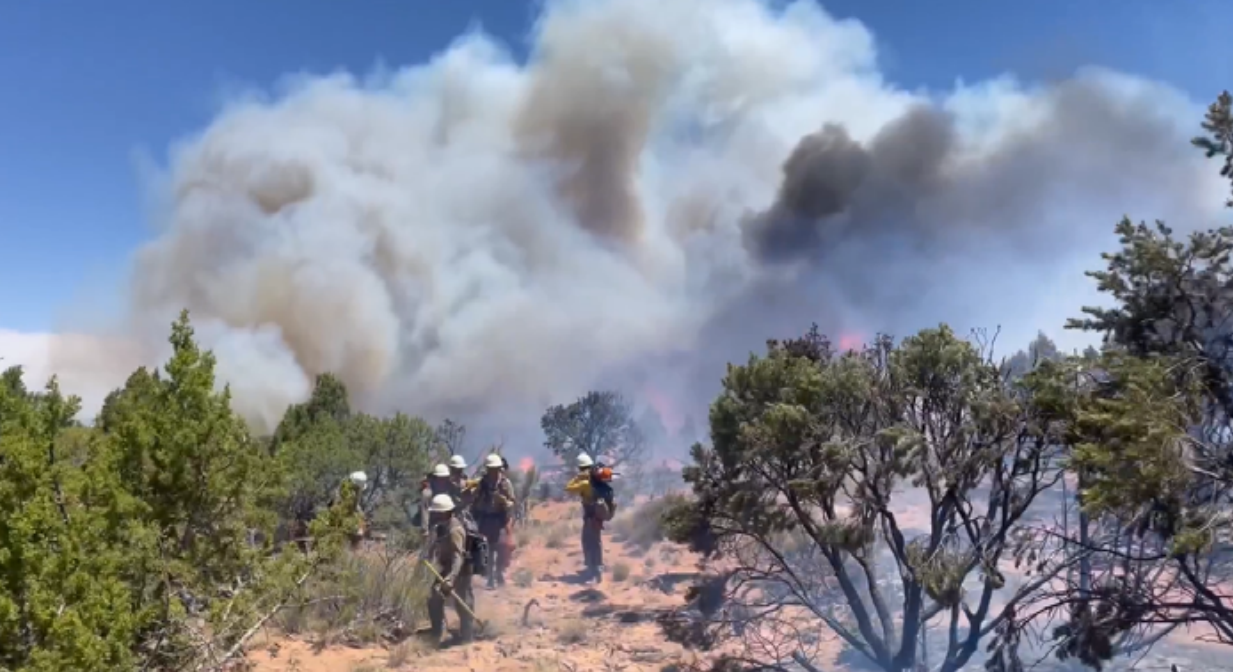
Grassroots Wildland Firefighters, an advocacy organization made up of current and former federal firefighters, recently published a new analysis showing that the U.S. Forest Service, under the President Donald Trump Administration, has massively reduced hazardous fuel treatments.
The analysis found hazardous fuel reduction work across National Forest lands was down 38% in 2025 compared with the same period over the previous four years, according to the analysis. Fuel reductions between June and August were barely half of what it was compared to previous summers.
Mitigation work was the furthest behind schedule in Idaho and Montana, where fewer than 30% of average treated acres have been managed in 2025. Oregon, Washington, California, and Nevada all fall under 40% while Arizona and New Mexico barely surpass half of the amount of land mitigated in recent years.
The organization blamed the personnel and budget cuts to the USFS that Trump’s Department of Government Efficiency, or DOGE, made at the start of the new administration. Around 6,000 United States Department of Agriculture employees were terminated on Feb. 13 before an independent federal court ordered the department to rehire all 6,000 employees a month later. Grassroots previously told Wildfire Today that around 75% of the temporarily terminated employees had secondary wildland fire duties.
Grassroots said the USFS’s recent assurances that the Service is fully staffed are contradicted by the reality.
“Funding cuts have already led to a steep drop-off in forest mitigation projects across the West,” said Bobbie Scopa, a retired firefighter with 45 years of experience and Executive Secretary of the Grassroots Wildland Firefighters. “This is basic work that must be done, year after year. Without the prescribed burns, fuel break and fireline construction, and brush clearing that the firefighters rely on, wildfires will be harder to contain, and our firefighters and communities will be at greater risk.”





7 Comments
Who would ever imagined such a thing happening? Chase out a bunch of skilled folks including many overhead. Create chaos among the rank and file. Reduce the operating budget. I doubt anyone could have gotten this.
DOGE cuts and the incompetence of many currently in power-whodathunk all that, eh?
Then blame it all the leadership OUTSIDE the DC Beltway…..40 yrs in and out of this business either Fed or State…..wow just wow!
Yes sireee…….easy blame it on the GSs out there doing the plannin’ and lightin’ and then to put up goals that surely can not be attained by the loss of 6K.
BTW…….what’s a gross of rakes cost these days?
Good, maybe many people will be spared from smoke inhalation diseases that are caused from government subsidized prescribed burning.
Oh Steve…. I think you forgot to take your meds again. Did you even read the article?
Leave Steve be…
Better be careful of making smore’s in one’s back yard or camping using clay asador (sp) and / or using briquets…never know where those come from
1 year does not make a trend. As always, this requires quite a bit of nuance in viewing. Yes, we (USFS) have missed our targets this year. Yes, there has been much uncertainty regarding funding and staffing, especially with regard to our support personnel. However, you must also understand that the prior admin, during the prior years attempted to throw billions of dollars at prescribed fire that did not net a huge increase. On my previous Forest we were offered a high, 9 digit sum to increase our prescribed fire program but we struggled to find projects that we could spend it on, and ultimately were only able to find places for about 5% of the funding we were offered. The problem is long term and the solution will also be long term.
Comments are closed for this article!