


By Jan Sudmersen and Detlef Maushake
Germany is a little smaller than California but has almost twice as many people, about 84 million. Though the country is densely populated and industrialized in large areas, about 30 per cent is defined as forest land – half the trees are conifers – and 50 per cent of Germany’s land mass is used for agriculture. There is a lot of vegetation.
This article is first published in Wildfire Magazine – read the full edition.
SITREP Germany
A first glance at available data shows no real wildfire problem in Germany, but the country faces more wildfires and an increase in fire intensity. In addition, wildfires on military ranges with unexploded explosive ordinance (UXO) contamination from two world wars and the training areas used during the Cold War create significant problems.
Fires on UXO-contaminated areas are difficult to fight considering that ground forces must stay away 1000 meters from the fire because of the imminent risk of exploding UXOs; the use of aircraft is hampered by the high altitude at which they must fly, for the same reason.
The long-lasting drought from 2018 to today – which resulted 2022 being the first real fire season in Germany with several large campaign fires – has led to predictions that the fire regime and fire behavior from the Mediterranean areas will extend slowly but steadily north in the next 20 to 30 years or even sooner.

In Germany, fire suppression is generally provided by municipal fire departments. Beside the armed forces fire service there are no federal- or state-owned fire resources due to Germany being decentralized by the allies after the Second World War.
Most fire departments are volunteer – there are about one million volunteer firefighters and just 30,000 paid firefighters in Germany. There are also 330,000 members of the Jugendfeuerwehr, fire explorers for young people from age 10 to 16.
Wildland fire tactics rely heavily on the use of fire engines and tenders, of which there are 40,000 in Germany; specialized brush trucks are still rare and not standardized. The use of handlines exceeding the capability of water shuttle operations is one of the main reasons firefighters lose a lot of battles.
A new training curriculum was put together by a working group over four years that offers guidance in the use of LACES (Lookouts, Anchor Points, Communication, Escape Routes, and Safety Zones) and safe tactics as a base for the general firefighter in Germany.
Regarding air operations, there is only one fixed wing (a PZL 18 Dromader on seasonal contract in one county) and helicopters must be ordered from the army, police or contractors – if they are available, and even if they are, there may be a two-to-six-hour response time. The same applies to heavy equipment such as dozers, which are not commonly used or even considered by incident commanders.
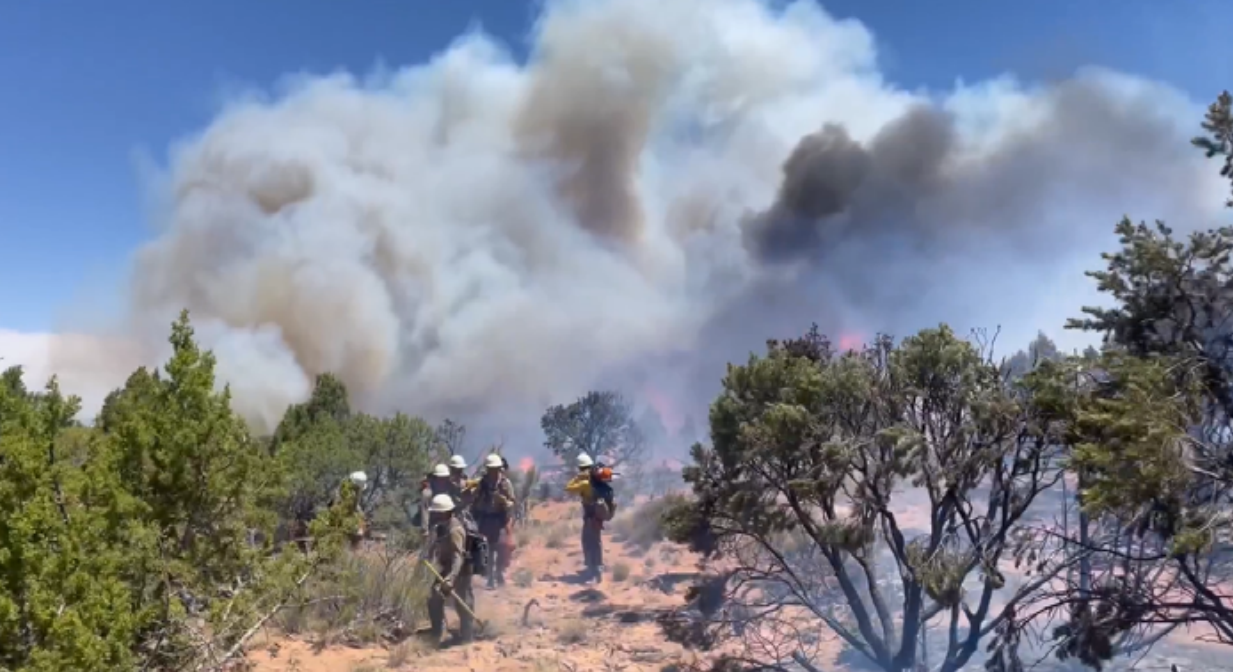
The concept of an autonomous working handcrew is not known to the German fire service so far, because there are simply none (yet). Although many fire departments purchase hand tools such as Pulaskis and combination tools like the Gorgui, members are not sufficiently trained to cut handlines for a prolonged time, and there is no utilization of tactical fire.
Volunteer handcrews?
Predicting the need for specialized units such as handcrews, the non-profit @fire was founded in 2002, followed by Waldbrandteam in 2015; both are non-governmental, independent organizations. The founding teams collected a lot of experience and knowledge from internships with several handcrews and fire services in the United States, Canada and southern Europe.
Coming from outside the traditional fire services (even though the majority of the members in both NGOs are firefighters too), we were mostly considered rogues in the beginning; this did not stop us from continuous networking and providing wildland fire training for hundreds of fire departments (there was no specialized wildland fire training available until 2020), which resulted in more acceptance and integration. Both organizations built an international network, trained members according to international standards such as those of the US-based National Wildfire Coordinating Group, and sent them on internships to gain experience – without any federal funding and by 100 per cent volunteering. Both NGOs have the status of fully accepted civil protection measures by German law.
During the 2022 fire season our NGO-handcrews were requested for several deployments, which clearly pointed out the need for specialized handcrews in Germany. Feedback from the fire departments working with the NGOs on the 2022 fires was positive given the fact that the work was in conjunction with local resources and that the experience was also for training and an exchange of experiences.
Capacity building is beginning
In the aftermath of the 2022 fires, things started to shift. Being Germans, the focus was on purchasing specialized fire trucks, a discussion that resulted in a new variety of brush fire trucks based on the French medium forest fire tanker trucks, but again with no nationwide standardization.
Finally, post-2022, some fire departments started to build specialized units similar to handcrews, following the example of the NGOs. Being asked for advice and training for these units, Waldbrandteam and @fire developed and published a guideline for handcrew capacity building https://www. at-fire.de/veroeffentlichung/fachempfehlung-loeschmannschaften/ (Fachempfehlung Löschmannschaften).
Applying National Wildfire Coordinating Group standards adapted to the German and European setting, we defined two types of handcrews: Type A and B.
Type A handcrews mainly support engine crews with long-distance hoselays and mop-up operations. The idea is that these crews are widespread regional teams organized and founded at the county level with limited training and equipment, so that they are easy to build and to maintain.
Type B handcrews are essentially copies of National Wildfire Coordinating Group Type II Initial Attack crews made for working autonomously, nationwide and even internationally. This requires:
• Adapting fitness standards (pack test, work capacity test)
• Language capabilities (everybody must speak English)
• (Online) NWCG courses: NWCG S-100/130/190/270/ L-180, S-211 and S-212
• Field days or even weeks depending on the level of expertise and training to harden the knowledge
• Personal gear including a line pack
• International deployment preparedness (vaccines, cultural awareness, safety and security)
• Building a tool and logistics cache
• Being self-sufficient for at least 24 hours
• Training with their own tools, but also knowing tactics and tools in Europe
Both @fire and Waldbrandteam are in the process of establishing Type B handcrews.

What’s next?
Type A handcrews: There is a growing number of fire departments interested in building Type As. The NGOs, @fire and Waldbrandteam, are building a network, mentoring, and training these new crews. Both organizations are also supporting state fire academies, forestry units and helicopter companies in establishing specialized training to work with the handcrews.
Type B handcrews: The NGOs can deploy their own Type B crew, or a combined crew from both @fire and Waldbrandteam. There is some discussion about
incorporating and cooperating with qualified personnel from larger fire departments and applying to become a certified module of the European Union Civil Protection Mechanism.
Besides funding, the biggest challenge in building the handcrews is to provide (volunteer) members with firsthand training, and then to gain experience on the fireline. It is very difficult to explain the idea and goals plus the structure of the NGO crews to governmental agencies abroad. Often the combination of the terms NGO and volunteers lead to a break in communications and the misunderstanding that that there is a lack of professionalism due to this combination.
A big step forward was the signing of a memorandum of understanding with CalFire in 2024; @fire was given the opportunity to attend classes and send some members to internship with various handcrews.
At this point, the NGOs are reaching out to the international wildland fire community looking for more possibilities for training and internships.
A model for other nations?
Seeing the numbers in Germany you might think that there is a deep conflict between paid and volunteer firefighters, because if you have enough volunteers, you just don’t need paid firefighters.
Honestly, we can’t claim that conflict doesn’t exist. But, beside our passion for wildland fire fighting, we both are members of paid and volunteer fire departments and from our experience, we regularly see the synergy of those systems working together. Not only are volunteer fire departments very successful at providing fire protection for most German communities, but there is also a large number of combined fire departments, where paid firefighters provide the initial response and volunteer firefighters provide manpower at bigger events and specialized units with backup for the full-time, career firefighters. It works!
Transferred to wildland fire
Beside using volunteers in supporting roles, volunteer handcrews – well trained (to the same standards!) and led by experienced crew captains – could be valuable assets in initial attacks and structure defence, especially in large-scale events or intense fire seasons where resources are stretched.
Volunteers are not a substitute for paid, full-time crews because of their limited availability and limited deployment length of 24 to 72 hours.
We are aware that there are many more points for or against this idea, so we invite you to open your mind and discuss it.
What would Ben Franklin (or, in Germany, Conrad Magirus) think of implementing volunteer handcrews to protect their communities?
Jan Südmersen is division chief for the City of Osnabrück Fire Department and the founder of @fire Germany.
Detlef Maushake is a captain with the City of Salzgitter Fire Department and the founder of Waldbrandteam. Maushake was the recipient of the 2019 IAWF Firebreak Award for Excellence in Wildfire Management.





1 Comment
These German Firefighters have proven to be a great asset to the profession of Wildland Firefighting. I have first hand knowledge of their dedication and commitment and wish them luck in the future.