


Nearly 70,000 people in the United States are expected to die annually from wildfire smoke by 2050, according to newly published research.
Findings of a study were published in Nature on Sept. 18, which prompted public discussion due to the strikingly dire figures. The analysis estimated that smoke from wildfires already contributes to around 40,000 deaths each year in the nation. The additional 30,000 annual deaths by 2050 are primarily attributed to climate change, which is making already fire-prone regions in the U.S. hotter and drier.
The study, however, identifies the location of the forecasted spike in wildfire smoke deaths as eastern US, where historically there are fewer large wildfires compared to the western US. The research team, from a range of universities including Stanford, University of California, Harvard, and the National Oceanic and Atmospheric Administration, said that over half of the 70,000 wildfire smoke deaths will come from eastern states, due to higher population densities and damage from low smoke concentrations.
“Because of the mortality effects we uncover at low annual smoke concentrations, we project large mortality burdens not only in heavy smoke regions but also in populous regions with low smoke concentrations (e.g., the eastern US),” the researchers said. “Similarly, we estimate substantial mortality increases even in the low warming scenario because of projected increases in low-level annual smoke concentration.”
The study’s findings, however, directly contradict separate research published a week beforehand, which found that an overlooked aspect of wildfires overinflates mortality estimates.
This study – published in Science – was conducted by a research team from several Chinese universities with input from colleagues in the US and Canada and funded by the National Natural Science Foundation of China. It found that most predictive wildfire models currently do not include heat-induced weather changes caused by wildfires.
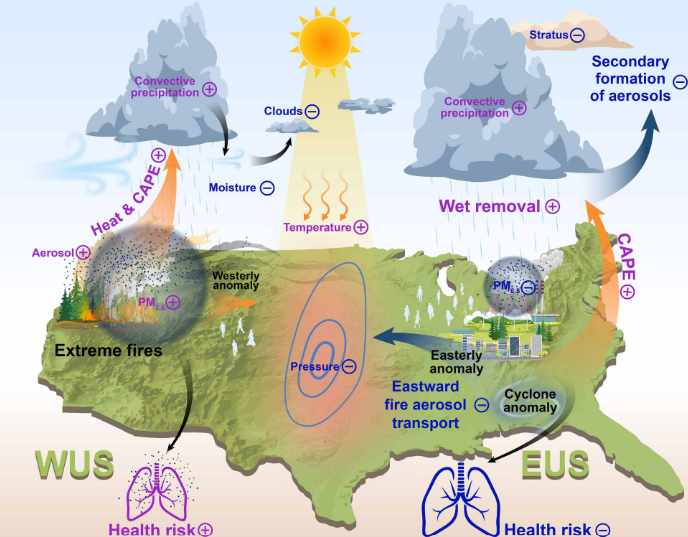
The phenomenon, called heat-induced convection, and subsequent meteorological changes actually lower air pollution in eastern states while worsening particulate matter in western states. The researchers said that current models overestimate wildfire smoke deaths by 1,200 and overestimate economic losses by $3.3 billion USD, particularly in eastern states.
“The findings … imply that wildfire-excited jet-stream waves can propagate atmospheric energy eastward, beyond North America, to alter the global air circulation,” according to a commentary in Science that accompanied the main research paper. “This underscores the need to approach wildfire research from a broader, global perspective. Strengthening cross-border and interdisciplinary collaboration is key to improving predictability and driving more effective solutions for wildfire control and recovery.”
The weather data used in the study published in Nature included air temperature, precipitation, relative humidity, soil moisture, vapor pressure deficit, wind speed, and runoff, but there is no indication that the researchers accounted for fire-induced convection.
The phenomenon is one of many uncertainties that fire researchers are continually working to address, including the current limitations of scientific models addressed in the paper, like the difficulty of predicting wildfire impact at local scales and evaluating the repercussions of future unprecedented climate conditions with historical data.
“Addressing these uncertainties could further improve understanding of the climate influences on wildfire pollution and health, and thus inform relevant policies,” the Nature study’s researchers said.
Wildfire Today reached out to both research teams for further insight into the different findings of the two studies, but received no reply.





3 Comments
I don’t believe these findings are anywhere near accurate. I worked in wildland fire for 57 years and I am still living.
really? I was a wildland firefighter for 45 years! Should I be dead?
The term over-engineered comes to mind as they spent a lot of time with their scientific models and could have simply used the 40,000 death statistics to see if there was more deaths due to smoke inhalation in the east or west.
Perhaps they should spend their time & $ on the solutions to prevent homes from burn down during wildfires vs hypothethical theories where most people will die from smoke.
For your family safety sake see fire safety info and the solutions for keeping your homes from burning down inside and out regardless if you live in wildfire safe homes or not.
Comments are closed for this article!