


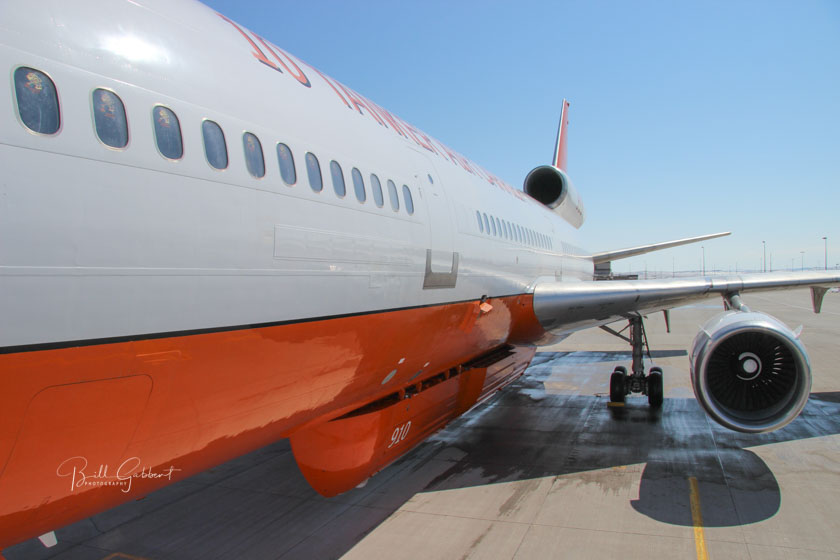
 Air Tanker 910, a DC-10.
Today we are looking back at an article we published in 2017, titled, “Does anyone know how many large air tankers we need?”
In the interview with Shawna Legarza published on Wildfire Today this morning, the National Fire Director for the U.S. Forest Service said in response to a question about how many large air tankers are required:
I would say we need anywhere from 18 to 28, you know that’s what it says in the [2012 Large Airtanker] Modernization Strategy. I think that’s a good range.
We re-read that Strategy, and could not find any independent conclusion reached by the authors about the number of air tankers. But, on page 3 there was this:
Continued work is ongoing to determine the optimum number of aircraft to meet the wildfire response need, but studies have shown that it is likely that between 18 and 28³ aircraft are needed.
The referred to footnote #3 is this:
³The requirements for large airtankers have been derived from the “National Interagency Aviation Council Phase III Report, December 7, 2007”, and the “Interagency National Study of Large Airtankers to Support Initial Attack and Large Fire Suppression, Phase 2, November 1996”.
The first of the two studies recommended increasing the number of large air tankers on exclusive use contracts from 19 in 2008 to 32 in 2018. Plus, there would be three water scoopers by 2018, bringing the total up to 35. The table below is from the study.
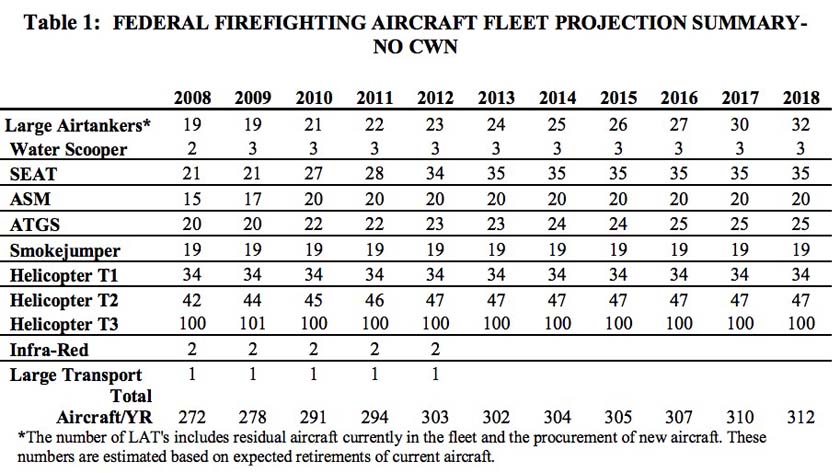 Screen grab from the 2007-2009 NIAC Interagency Aviation Strategy document. Phase III, page 21.
The second document, the 21-year old study from 1996, recommended 20 P3-A aircraft, 10 C-130B aircraft, and 11 C-130E aircraft, for a total of 41 large air tankers.
The “18 to 28” air tankers mentioned in passing in the “2012 Large Airtanker Modernization Strategy” is not reflected in the referrals indicated in the footnote.
Much has changed in the world of aerial firefighting in the 10 to 21 years since those two studies were written. (They are two of the 16 air tanker studies and reports listed on the Wildfire Today Documents page.)
But what has not changed is that the numbers in these studies, written by smart, well-meaning people, are basically back of envelope stuff. There has not been in the United States a thorough, well designed analysis of the effectiveness of aerial attack, exactly how much retardant is needed in a certain time frame, where aircraft need to be based, and how many and what type of aircraft are required.
Under pressure from Congress and the GAO to justify the aerial firefighting program, in 2012 the U.S. Forest Service began a program to develop metrics and collect data to document and quantify the effectiveness of aircraft in assisting firefighters on the ground. This became the Aerial Firefighting Use and Effectiveness (AFUE) program. It will be several more years before they expect to release findings related to the effectiveness and probability of success of aerial resources.
We asked “Bean” Barrett, a frequent contributor on Fire Aviation, for his view on how many air tankers are needed. He started by saying the general theme of the letter written in 2012 by Ken Pimlott, the Director of CAL FIRE, to the Chief of the Forest Service, is still applicable today. Director Pimlott said in part that the then-recent USFS Large Air Tanker Modernization Strategy was insufficient to meet the needs of the combined federal, state and local wildland firefighting missions.
Bean’s further input is below.
****
“18-28 Large Air Tankers as the Federal inventory objective? Could we be a little more precise? What if the federal requirement was defined by referring to something like required retardant gallons delivered/ hour/ mile from base/ dollar. At least then, some basic economic analysis could be used to justify inventory when it comes around to contracts and budget time. What about required number of LAT sorties/ year / GACC?
“Do the NICC UTF numbers actually identify requirements shortfalls? How many IMT’s don’t bother to request air support when they don’t think any air is available? UTF data would be very useful to demonstrate inventory shortfall if UTF’s represented all the unfilled need. In 2015 UTF’s represented a 10% shortfall in LAT sortie generation requirements. In 2016 UTF’s represented a 15% shortfall. Based on what I would say are very conservative UTF numbers, there has been at least a 10-15% shortfall in available LAT inventory over the last two years.
“Really hard to comment on inventory objectives when it isn’t clear what the Large Air Tanker mission is. To paraphrase Lewis Carroll, if you don’t know what you want to do with them, any number will be enough.
“Is the mission IA or extended attack? Is it ground support or independent tasking? What effects are trying to be achieved and how well are they achieved? Should an attack within 24 hours really be considered IA for an aircraft? CALFIRE wants aircraft on scene in 20 minutes. The Australians want <30 minutes.
“Just for openers, this is a very good ops analysis piece using real data from real fires: https://www.fs.fed.us/rm/pubs_journals/2016/rmrs_2016_stonesifer_c001.pdf
Our results confirm earlier research results related to LAT use and challenge a long-held assumption that LATs are applied primarily to assist in the building of line to contain fires during IA.
Perhaps most importantly, we highlight system-wide deficiencies in data collection related to objectives, conditions of use and outcomes for LAT use.
Our current inability to capture drop objectives and link specific actions to subsequent outcomes precludes our ability to draw any conclusion about the effectiveness of the federal LAT programme.
“A finding in the study … Mean time of day for drops was 15:39 and only about half of the drops were IA. This makes it really difficult to say that LAT’s are there to support the ground crews.
“Why not tie LAT requirements directly to the number and type of IMT’s mobilized? Perhaps some ops analysis would find a ratio of number and type of tankers to type of IMT’s mobilized? Or perhaps a ratio of days IMT’s mobilized to LAT sorties required for support? Start thinking like an integrated air-ground team and define air requirements in terms of IMT’s or crews mobilized and supported. When the definition of Head Quarters units [ IMT’s] composition or types of ground crews includes the number and type of aircraft included in support, the inventory objective for tankers will fix itself. I expect everyone has a much better handle on the amount and type of ground support required today compared to the very vague understanding of tanker requirements. Tie air requirements to the better understood ground requirements.
“Once the real data gets collected and analyzed, it may be found that the best air IA assets for type 3 IMT’s aren’t fixed wing tankers. (Provided IA is redefined to something like arrival within 20-30 minutes of dispatch.)”





14 Comments
You never mentioned the findings and recommendations in the Rand Report. Not sure if this was deliberate or an oversight.
There are dozens of air tanker studies. We can’t list everyone’s favorite.
I agree CLguy
Numerous studies over the years haven’t solved much. MAYBE the monitoring of airframes have brought newer information on stressors of airframes.
BUT
All those studies since 1994 have NOT solved the airframe issues, the need of mission specific airframes unless we bring 100+ CL415 and 415 EAF series….LOLOL
Funny …I haven’t heard Lockheed Martin spool up the assembly lines for the C130J/ LMJ1000 series even after all that fanfare Mark Rey was supposed to be “in like flint” with Lockheed over
you know the old sayin’ …… Money talks BS walk
Studies can be effective in certain areas. In Aviation…it’s mettle, metal, maintenance, moxie, and mo money that’s going to bring the airtanker industry to the former 44 ship standard of yesteryear!
There are SO MANY FIRES OUT OF CONTROL — AND,
these fires are
SO LARGE THE CURRENT AIRCRAFT ARE INEFFECTIVE!!!
The Fire Service has always been stuck on fighting Fire the same ole way, day after day, year after year!!!
Getting leaders in the fire service to admit their tactics and strategies just don’t work is like getting Jesus to allow Lucifer to become The Next Pope!!!
There are 747s, DC-10s, C-5s aircraft which with some research funded by federal, state and local budgets could haul much more water than they are currently capable of holding, NOT RETARDANT, and with a 100 bird firefighting Air Force this size fleet would have today’s fires EXTINGUISHED!!!
Look, so many of the ground pounding firefighting crews have been told for decades starting in their Training that Air Power never puts fires out.
THAT IS A DAMN LIE!
THE ONLY DAMN THING THAT IS HOLDING BACK AIR CRAFT FROM BEING TESTED AND BUILT THAT WOULD SNUFF OUT THESE COSTLY/DEADLY CONFLAGRATIONS — is a lack of will power to fund the research to develop the best equipment and then develop the most efficient tactics & strategies!
And that money is not being spent because the ole school ground forces do not want to give up their power.
Look all I care about is saving LIVES AND MONEY. I’ve seen the Tanker Ten save my daughter’s neighborhood, it took all day. Had there been TEN OF THE TANKER TENS, all that work would have been accomplished in an hour!
When Brush Fire turn into out of control Raging CONFLAGRATIONS (3 -5 times a Summer) — there is no way in HADES Hand Crews or Strike Force Teams can even make a dent in the amount of damage, distraction and deaths that occurs!
Get you damn heads out of the past and move on with science!
And one more thing.
Yes CalFire has been buying and deploying DC-9 Tankers.
Let’s look at the dollars spent and INCREASED safety offered by the larger AirCraft. One 747 SuperTanker can do the work of SIX DC—9. One plane replacing 6 and doing it faster.
Money saved, less lives risked! Put the crews in bigger planes and put out that much more fire!
Go a head Air Power Haters!
Talk all the crap you heard from all of the old men that trained you up!!!
The Fires aren’t just brush fires — they are CONFLAGRATIONS…
Those ole school tactics fail with the newest disasters we have NOW!!!
Not just for the money it costs, the lives that pass away in these fires each year are growing.
We USE THE WORDS Fire Science, but SCIENCE has NOTHING TO DO WITH doing the same old damn thing the same damn way year after year after year!
I began working on these Ideas ever since a August afternoon in 1976 when I arrived at Altus AFB Fire Station, reporting for my first USAF Duty Station. There sitting behind Altus AFB FD Station sat five C-5A Aircraft.
You can say I am crazy, but I’m sure there are many families that wished their sons and daughters lives were not taken by the out of control fires this Nation can’t extinguish!!!
Everyone can have their own opinions, but we need to stick to facts. To begin, CAL FIRE has never purchased a DC-9.
Is he suggesting someone should tank a C-5A ?
… and I’m not sure where ten Tanker 10’s could land, load, and take off together.
I believe they are “MD” Mad Dogs which still have to many cycles and total hours on the airframes.
CAL FIRE has never purchased or owned an MD-80 or MD-87. Get your facts straight. They are leasing an MD-87 this summer from Erickson Aero Tanker, which as far as I know, it’s the first time they have contracted for an MD-87.
Brian,
I won’t say you’re crazy, and it’s obvious that you’ve “been working on it” for a lot of years.
It’s equally obvious that you have no experience putting out wild fires, because there are so many inaccuracies in your statements that it’s hard to know where to begin.
I get it. You don’t believe the science. You don’t believe the facts, the studies, the experience, the data, or those who actually do go fight wildfires, and have done so for many years. You term anyone that doesn’t think your way as “airpower haters.”
I’m not an “airpower hater,” and have a decades of experience doing fire in SEATS and large air tankers, and have flown airplanes ranging from single radial engine aircraft through the 747, in and out of fire, and have fought it on the ground. I’m no expert, and don’t claim to be, but I do have a fairly good idea of what can and can’t be done by aircraft of most sizes, and what it takes to make them do it. I will say that based on my limited (actual) experience, while your ideas are ambitious, they are not based on fact, nor grounded in reality.
You don’t believe in science or facts, and your comments are grounded in emotion. I get that, too; there’s a lot of loss and a lot of pain associated with these fires, and they’re both tragedies and nightmares. We cannot fight fires based on emotion or bad information, however, and aluminum overcasts of VLATS sound great, but are impractical and not a workable solution. Moreover, they are not a solution, and contrary to what you think fires that burn today cannot simply be extinguished from the air. Watching C-5’s on the ramp does not equate to fire experience; there’s a big difference between looking at an airplane sitting on the ground, and actually fighting a fire.
Terrain, smoke, fuels, winds, and fire behavior are dynamic, change constantly, and affect the way a fire reacts to water, retardant gel, etc, and the way the fire spreads, and in relation to your comments, how the fire can be fought (and how it can’t).
I’ve put a lot of water, foam, retardant, and gel on active fires that range from rapidly moving grass to ponderosa and lodgepole pine, and fires that raced through forests, and through urban interface. I’ve fought them on the ground, too, and much as I would love a magic solution that presents a paradigm shift in our firefighting capabilities, the truth is that nature and the physics of fire in it exceed our capabilities , and will exceed our capabilities. Brute force to put it out sounds great, but it’s naive, and not realistic. I wish it were otherwise, but it is not.
Brian,
Based on your aerial tanker experience you have described, which I respect, I would like to ask you a hypothetical question: If you had unlimited resources (aircraft, finances, political capital, ground crews, etc.), what would be your best course of action OR with the present situation as it now exists, what would be your recommended course of action?
Having 35 or 41 on EU contracts for 6 or more months doesn’t really make sense, but having more than 23 for the busiest part of the season would be beneficial, obviously. Having a mix of ac, and with the states supplementing, eases the need some. Also, ground folks need to make ac available sooner and not continuously drop water and retardant endlessly on fires with no rate of spread or are contained.
Just like ground equipment, you need different size aircraft to make it into different locations. a DC-10 cannot get into smaller canyons like the MD-80’s or similar size aircraft. Water dumps from fixed wing aircraft have varying effectiveness due to altitude and spread. Not to mention the complexities of flying directly over fires in dangerous terrain at 160+ kts. Retardant line are effective. There is no single solution, nothing is perfect. Having many of everything at all times is not realistic for anything. Lockheed has a many year long wait for a C130J. You can only make them so fast. Not to mention, unless you make them MAFS aircraft, the Lockheed does not own the technology to make a C130 into a tanker. Coulson does. This is the same problem the FS ran into with their USCG “H” models that are now part of CALFIRE, and still not tankers. There will always be a business and bureaucratic aspect to this issue.
“Brian Curwick” aka Joseph C. Coomer
Look. Your entire unhinged rant was bursting at the gunwales with inaccuracies and abject fiction. Next time throw some more Unicorns and Dragons in there to make it more plausible. In the mean time, leave the firefighting to the firefighters. Thank you.
Lots of very low-time A380s available!!
Comments are closed for this article!