


Like an archeologist examining artifacts to learn about historical events, a wildfire investigator pieces together fire pattern indicators – FPIs – to interpret directional travel of fires, and the origin and cause of wildfires.
The National Wildfire Coordinating Group (NWCG) in the United States has developed an internationally recognized methodology for wildfire investigations based on the fundamentals of FPIs.
When historical events can’t be physically witnessed or reproduced, evidence is gathered to reconstruct the past.
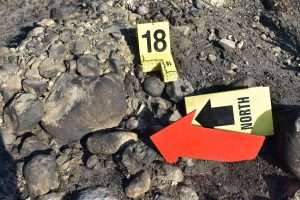
Whether an archaeologist or investigator, context is crucial. Without context, artifacts or FPIs are just standalone items of evidence. Context provides background information that influences how a scene is interpreted. Wildfire context includes but is not limited to weather, topography, fuels, and suppression actions. When evaluating a wildfire scene, a comprehensive standard approach is required to understand the relationship between FPIs and its overall context.
FPIs are fire effects created during the passage of a wildfire; they are the physical evidence of fire progression and provide information about the fire’s behavior, weather, spread, and intensity. FPIs develop within the localized fire behavior context and applicable fire behavior principles and dynamics. When properly analyzed each FPI reflects the direction of fire progression at its location; each FPI is a valuable tool to locate the origin and cause of a wildfire.
For the full story on the NWCG work with fire pattern indicators see Wildfire magazine by Shawn Zimmermaker




Comments are closed for this article!