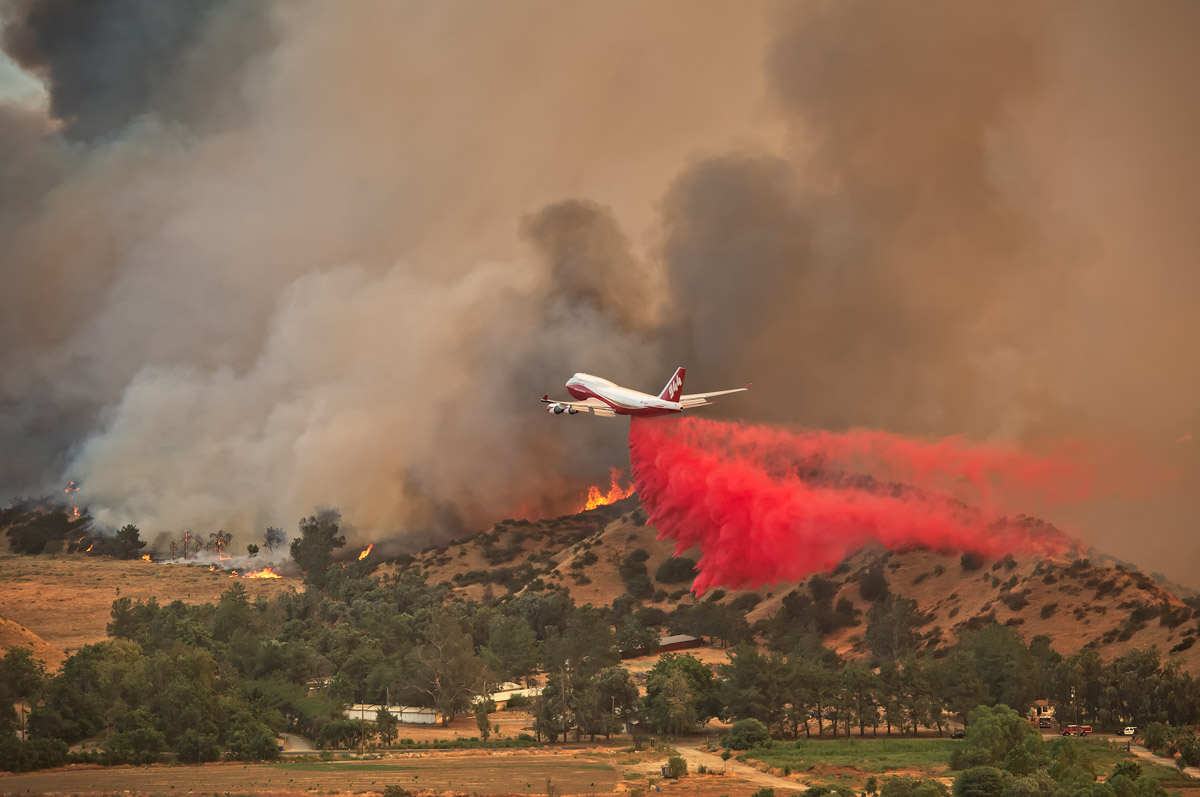
(Above: The 747 SuperTanker drops on the Palmer Fire south of Calimesa and Yucaipa in southern California, September 2, 2017. Photo by Cy Phenice, used with permission).
A 747 Supertanker will assist firefighters battling a series of fires that erupted overnight Sunday in California’s wine country.
Global Supertanker announced Monday morning it would assist with efforts to battle the Atlas Fire in Napa County, California. The fire broke out about 9:20 p.m. Sunday and quickly burned approximately 5,000 acres, fanned by high winds, CAL FIRE reported.
The Atlas Fire is among a number of blazes that started Sunday night and Monday morning, forcing thousands of residents from their homes and leaving crews scrambling through the night to get a handle on the sheer number of fire starts.
The largest, the Tubbs Fire, scorched in excess of 20,000 acres within just a few hours, Santa Rosa Fire reported. The fast-moving fire forced the evacuation of area hospitals, closed schools and led officials to recall all city employees to help staff the emergency operations center.
Details about damages or injuries were not immediately available by daybreak Monday.
It was taken by Leroy Leggit with a Nikon D810. He shot it at 1/800, F 5.6, using a 70-200mm lens at 150mm.
He said he took the photo from the top of a hill looking down at the aircraft.
Air Tanker 944, a 747-400, drops near structures on the Palmer Fire south of Yucaipa, California at 4:25 p.m. PDT September 2, 2017. Photo by Leroy Leggitt, used with permission.
He told us:
I didn’t know anything about the 747 supertanker until it appeared to my right (at eye level) headed straight toward the fire… what an amazing and unexpected sight… I looked online and saw that it had only been in service for a few days.
The Palmer Fire was reported at 1:33 p.m. MDT September 2, 2017. It is nearly officially contained according to CAL FIRE after burning 3,874 acres.
This was the second fire the aircraft was used on after receiving certification and a contract from CAL FIRE. The 747 was dispatched from McClellan Air Field near Sacramento. According to FlightAware it cruised south at over 600 mph at times before dropping on the fire about an hour later, then reloaded at McClellan and completed a second sortie, dropping almost 19,000 gallons again, splitting the load into two drops.
(UPDATED at 10:07 a.m. MDT September 5, 2017)
After Johnny commented that videos are available, we checked and found these. The first one appears to be the same drop seen in the photo above.
Above: Air Tanker 944, the 747 SuperTanker, at Colorado Springs, May 4, 2016. Photo by Bill Gabbert.
Originally published on Fire Aviation at 2:23 p.m. MDT August 28, 2017.
Jim Wheeler President and CEO of Global SuperTanker said today their 747 SuperTanker has received a call when needed (CWN) contract with the California Department of Forestry and Fire Protection (CAL FIRE). The aircraft and crew were also issued cards by CAL FIRE, meaning they passed the inspections and meet the qualifications. The U.S. Forest Service participated in the process but they do not issue cards until a USFS contract is in place.
Mr. Wheeler said the air tanker is presently at McClellan Air Field and is available.
Above: Air Tanker 944, the 747 SuperTanker, at Colorado Springs, May 4, 2016. Photo by Bill Gabbert.
Originally published at 2:23 p.m. MDT August 28, 2017.
Jim Wheeler President and CEO of Global SuperTanker said today their 747 SuperTanker has received a call when needed (CWN) contract with the California Department of Forestry and Fire Protection (CAL FIRE). The aircraft and crew were also issued cards by CAL FIRE, meaning they passed the inspections and meet the qualifications. The U.S. Forest Service participated in the process but they do not issue cards until a USFS contract is in place.
Mr. Wheeler said the air tanker is presently at McClellan Air Field and is available.
Warning: Trying to access array offset on value of type bool in /home/customer/www/wildfiretoday.com/public_html/wp-content/themes/jupiterx/lib/api/image/functions.php on line 61
Deprecated: ltrim(): Passing null to parameter #1 ($string) of type string is deprecated in /home/customer/www/wildfiretoday.com/public_html/wp-content/themes/jupiterx/lib/api/utilities/functions.php on line 206
Deprecated: preg_replace(): Passing null to parameter #3 ($subject) of type array|string is deprecated in /home/customer/www/wildfiretoday.com/public_html/wp-content/themes/jupiterx/lib/api/image/class-image-editor.php on line 177
Warning: Undefined array key "extension" in /home/customer/www/wildfiretoday.com/public_html/wp-content/themes/jupiterx/lib/api/image/class-image-editor.php on line 179
Deprecated: preg_match(): Passing null to parameter #2 ($subject) of type string is deprecated in /home/customer/www/wildfiretoday.com/public_html/wp-includes/functions.php on line 3089
Deprecated: is_file(): Passing null to parameter #1 ($filename) of type string is deprecated in /home/customer/www/wildfiretoday.com/public_html/wp-includes/class-wp-image-editor-gd.php on line 95
Deprecated: preg_match(): Passing null to parameter #2 ($subject) of type string is deprecated in /home/customer/www/wildfiretoday.com/public_html/wp-includes/class-wp-image-editor-gd.php on line 95
Chief Dennis Brown of CAL FIRE, when describing under what conditions his agency might use the 747: “You don’t use a sledgehammer to do your finish work.”
Above: Firefighters in Santiago, Chile pose with the 747 Supertanker January 27, 2017.
(Originally published at 4 p.m. MDT July 25, 2017)
Today the Interagency Airtanker Board (IAB) bestowed “interim” approval status on the 747 Supertanker so that it can help suppress wildfires. This means the operator of the aircraft, Global SuperTanker (GST), can compete for federal air tanker contracts, if any become available, and can drop on fires for the duration of the 17-month interim period.
States and countries that will only contract for air tankers that have IAB approval may now consider signing the aircraft. California has not been hesitant to use very large air tankers like the DC-10 when they first became available. The U.S. Forest Service is much more conservative about making significant changes to their fire aviation program, and only used the DC-10 after it had been proven successful by California. The agency is also very hesitant, for example, to use water-scooping air tankers that have been in service worldwide for decades.
An IL-76 air tanker and 747 at Santiago Chile, January 30, 2017.
The 747 received interim approval from the IAB in January of this year but it expired six months later on June 15 even though most new air tanker designs are given 18 months of interim status, the objective of which is to provide a period for real world use on actual fires so that bugs, if any, could be worked out and the users of the service could evaluate the effectiveness. During the winter and spring there was little opportunity for an additional very large air tanker to be called up to fight wildfires. However during that period it was used for several weeks in Chile, dropping on dozens of fires.
The video below, filmed in Chile, shows the 747 dropping water because retardant was not available. But it was mixing into the water an enhancer that increased the effectiveness.
Jim Wheeler, the President and CEO of GST, said that during retardant drop tests in June the aircraft passed every one except for the last one on the last day, and that was because it was done during strong winds. The maximum wind speed allowed for the tests, Mr. Wheeler said, is 10 mph, but at the time of that last drop the wind was gusting at 17 to 25 mph. The test was suspended, and since it was the last day there was no opportunity to repeat it during allowable wind conditions.
We asked the USFS about the results of the test and they declined to answer our question, saying to check with GST.
Today the USFS released a statement confirming the interim approval for the 747:
The interim approval is for 17 months during which time GST must take steps to ensure its 747 aircraft delivers retardant in a manner that is effective and efficient and aids firefighting efforts on the ground.
Under certain circumstances, limited contractual options for VLATs are also available to the Forest Service and various states that maintain agreements with the agency. These certain circumstances could potentially include the severe wildfire situations in California and Colorado.
GST filed a protest with the USFS when they were not allowed to bid on a Call When Needed (CWN) contract for air tankers that had specifications making very large air tankers ineligible to apply. The USFS denied the protest, and Mr. Wheeler said he will be deciding soon if their company will carry the protest further to the Government Accountability Office (GAO).
While CAL FIRE embraced the DC-10 and used it extensively until the state ran out of money, the USFS was very skeptical, to say the least. The agency is extremely slow in making any changes to their aerial firefighting program. They appear to have a bias against Very Large Air Tankers, like the DC-10 and 747, and water-scooping air tankers, even though they have all been used very successfully by other agencies. Finally after it had proven itself over a few years, a DC-10 received a Call When Needed contract, and later an Exclusive Use Contract, and Incident Commanders and Air Operations personnel were often very happy to see it in the air over their fires.
A lot of people, including some who leave comments on this site, have viewpoints about the effectiveness and performance of specific models of air tankers. Some of them are based on indisputable facts, and others are opinions developed from…. something else. So, like reading political news, be careful when consuming information.
On July 24, 2012 we wrote an article on Wildfire Today with quotes from evaluations of a DC-10 that were written by lead plane pilots hours after they had directed it on fires. The DC-10 almost always carries at least 11,600 gallons of retardant, rarely having to reduce the load because of density altitude issues.
Here’s the article:
****
Evaluations of Tanker 911, one of the DC-10 very large air tankers
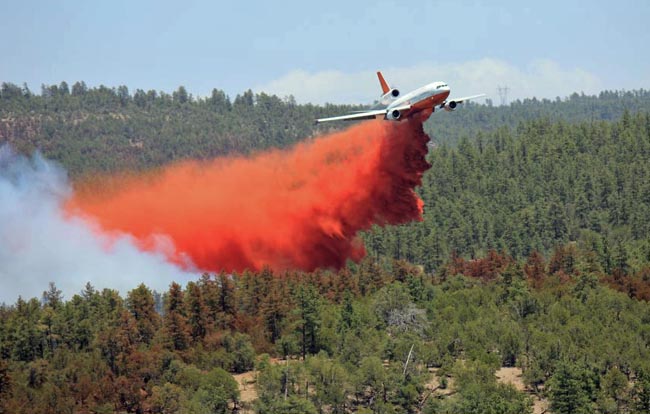
Tanker 911 dropping on the Poco Fire in Arizona, 2012. Photo by Ian James.
We have seen the written evaluations of Tanker 911, one of the DC-10 very large air tankers, for some of the retardant drops the aircraft completed on fires in Arizona and Utah in June and July. The forms were signed by individuals identifying themselves as lead plane pilots.
The evaluation form consists of two parts; a narrative section, and assigning a grade for specific aspects of performance: Reload Turn Times, Maneuverability, Steep Terrain Operations, Drop Patterns, and Uniformity of Coverage. All of the grades were “Above Average” or “Exceeded Expectation”.
Here are the details that were hand written in the narrative section on the forms:
Poco Fire, Phoenix, Arizona; Gallons Delivered 11,700 x 6; June 16-19, 2012
Six loads
All drop patterns were good and uniform. Flat and steep terrain – excellent performance in all profiles.
CL [Coverage level] 6 utilized in timber and mixed brush.
Quantity and mass of load delivered allowed for higher than standard drop altitudes to minimize exposure in challenging terrain and still achieve good pattern on the ground.
Quantity delivered also means 1 pass, 1 exposure instead of 7 from a legacy platform carrying 2,000 gallons!
Very uniform and consistent pattern on the ground. Very accurate starts. Performed some split loads as needed.
Fox Fire, Tucson, Arizona; Gallons Delivered 11,700 x 2; 2 loads; 3 drops; June 18, 2012
1 – CL 6 – Split Load – Started and stopped to tie in a road in front of structures. Very accurate start and stop. Last 2,000 gal reinforced first drop.
2 – CL 4 – One drop. Excellent coverage! It would have taken 6 or 7 loads from a legacy platform to get same length of line.
Quick effective line production.
Six Shooter Fire, Globe, Arizona; Gallons Delivered 11,700; 1 load; 8 drops; June 17, 2012
This was an initial attack fire. The location of this 5-acre fire, 1,500 to 2,000 ft below a ridge line, necessitated a substantial decent profile to get over the target on speed and altitude. The DC-10 was very capable and provided excellent coverage on and around the entire fire. The fire was successfully stopped at the same perimeter when the tanker dropped!
Excellent drops and performance.
Shingle Fire, Cedar City, Utah; Gallons Delivered 11,700 x 4; 4 loads; July 2-3, 2012
CL 6
Good coverage and line production. Excellent pattern on the ground and saved lots of time vs utilizing smaller aircraft. We would not have been able to get the line needed done without this tool.
Long turn arounds loading at [illegible; looked like “IVA”, “IWA”, or “IUA”]. 2 hour flights but dollars/gal still comperable considering speed and gallons!
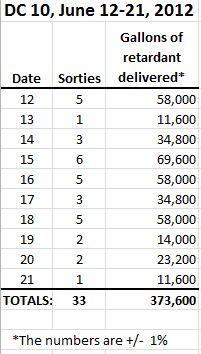
**** DC-10 air tanker delivers 373,600 gallons of retardant
One of the DC-10 air tankers has dropped about 373,600 gallons of retardant during 33 sorties on seven wildfires in Arizona and New Mexico over the last 10 days. The fires were: Little Bear fire, 257 fire, Grand fire, Poco fire, Six Shooter fire, Fox fire, and 177 fire. They were all in Arizona except the Little Bear which was in New Mexico.
Eight of the nine air tankers currently on exclusive use contracts with the U.S. Forest Service are 50+ year old P2Vs designed for maritime patrol. Their average retardant load is 1,948 gallons according to a 2007-2009 air tanker study. If all of those 373,600 gallons the DC-10 dropped in those 10 days had been delivered by a P2V it would have taken about 192 round trips to the fires.
Above: The 747 Supertanker makes a demonstration drop at Colorado Springs, May 4, 2016.
(Originally published at 2 p.m. MDT July 17, 2017)
While large wildfires have been burning recently in the Southwest, California, and the Northern Rockies, many local news outlets as well as national media organizations like CBS News and the Associated Press have been covering the story about the 747 Supertanker that does not yet have a long-term contract with the U.S. Forest Service (USFS).
In January, 2016 the aircraft received interim approval from the Interagency Airtanker Board (IAB). This meant that it qualified to be used on fires, but did not include a contract. A couple of years ago the IAB began giving new air tanker designs interim approval to provide a period for real world use on actual fires so that bugs, if any, could be worked out and the users of the service could evaluate the effectiveness. The duration of the temporary approval has usually been 18 months, but the IAB only gave the 747 about 6 months, and that expired June 15, 2017. During those six months the air tanker was not used on fires in the United States (but was used extensively in Chile), so there was no evaluation in this country.
The USFS currently is soliciting bids from vendors for Call When Needed (CWN) air tankers. The closing date for the solicitation is June 20, 2017. The specifications only allow air tankers that carry between 3,000 and 5,000 gallons to apply. The 747 holds 19,200 gallons, six times more than a “next generation” BAe-146 and about 60 percent more than the 11,600 gallons a DC-10 holds, so it can’t even be considered. There are other requirements that may also eliminate Very Large Air Tankers such as the DC-10 and 747. Currently there are two DC-10’s on Exclusive Use Contracts and a third on a CWN contract.
Global Supertanker, the company that owns and operates the 747, is in talks with the USFS about this not-qualified-to-apply issue.
Last year the current version of the Supertanker was used on fires in Israel, and earlier this year it spent several weeks working on fires in Chile. On February 1, 2017 working out of Santiago it conducted a total of 11 drops on 7 sorties. Six of the sorties were near Navidad and Matanzas 115 miles (185 km) southwest of the Santiago airport where many structures were threatened. The seventh was near Concepcion, 404 miles (650 km) south of Santiago. In total, 138,400 gallons (508,759 l.) were delivered to assist the firefighters on the ground who actually put out the fires.
The 747 Supertanker operated by Evergreen drops on the Railbelt Complex of Fires in Alaska July 31, 2009. Photo by Mike McMillan, Fairbanks Area Forestry.