
The video has an animated demonstration of how Erickson Air-Cranes might use a front-mounted water cannon and a personnel rescue basket on high-rise fires. The water cannon has been around for a while, as you can see in this 2011 video, but I have not heard of it being actually used on a structure fire. Does anyone have more information?
Erickson Air-Crane — As the Rotors Turn, 2012
This video, titled “As The Rotors Turn with Erickson Air-Crane 2012”, was published to YouTube September 7, 2014, by BDudasProductions. On January 5 we posted another video about the Air-Cranes that covered the years 2007-2011.
Erickson Air-Crane — As the Rotors Turn, 2007-2011
Here is another video by Bryan Dudas, showing an assortment of video and pictures captured, this time, between 2007-2011 while he was with Erickson Air-Crane. All video and photos are by Bryan Dudas
LA County brings on an Air-Crane and two scoopers

As they have done for the last 21 fire seasons, the Los Angeles County Fire Department has contracted for two water-scooping air tankers. The CL-415s, leased from the Quebec government, started at the first of this month and will be able to carry up to 1,620 gallons of water with each drop. Due to numerous fires late in 2013 and the Colby Fire in January, 2014, they worked several weeks beyond their planned December termination date last year.
The department also brought on a Helitanker, an Erickson Air-Crane S-64F that can hold 2,650 gallons of water or retardant.
These three aircraft join the Department’s own fleet of nine helicopters to help County firefighters on the ground suppress fires during the windy Santa Ana season.

Wildfire conditions in Australia the worst in 40 years
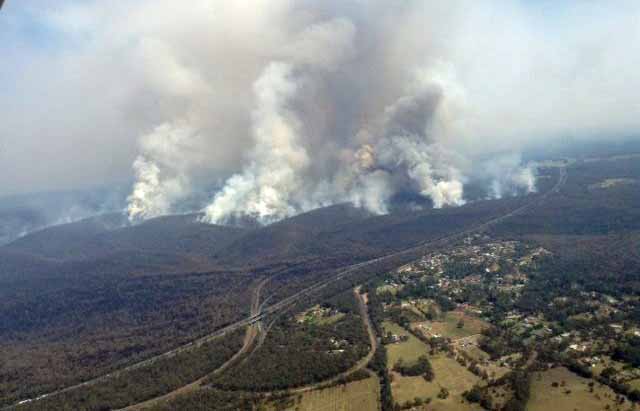
Australian fire officials on Sunday warned that residents of New South Wales are facing the worst wildfire conditions in more than 40 years. Already more than 200 homes have been destroyed and another 120 damaged. One man has died so far trying to protect his property. The weather forecast for Wednesday is even more severe.
The last time firefighters faced a situation like this was in the late 1960s.
Monday some areas received lightning with little or no rain.

Assistant police commissioner Alan Clarke said mandatory evacuation orders would be enforced in some areas, describing the risk as “far more extreme” than in past fires.
“Police will be doing forced evacuations if the risk is necessary,” Clarke told reporters.
“At the end of the day we hope we have buildings standing, but if we don’t have buildings standing we don’t want bodies in them.”
The typical wildfire season in Australia is from December through February, but this year firefighters are having to deal with numerous large fires weeks earlier than normal. The contracts for large Erickson Air-Crane helicopters that can carry 2,650 gallons of water were not yet in effect but two of the ships were rushed into service to assist firefighters.
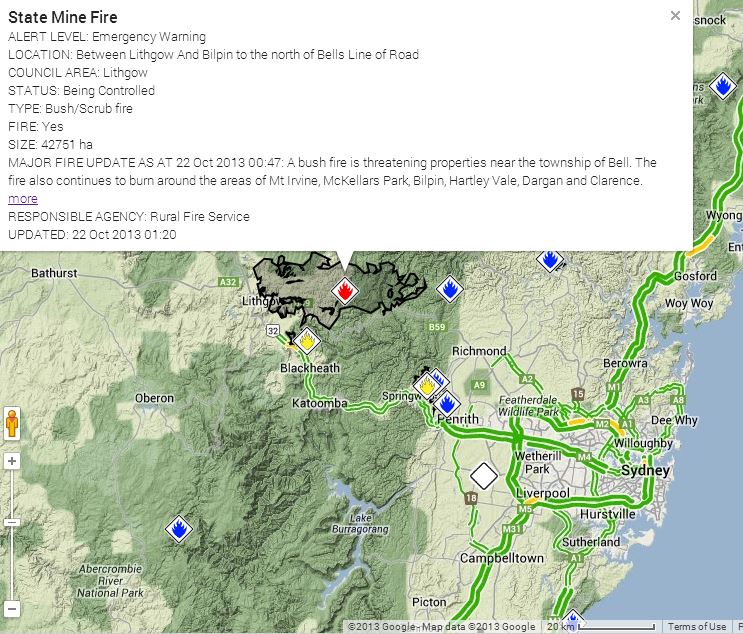
One of the largest fires is the State Mine Fire about 70 km northwest of Sydney between Lithgow and Bilpin which as burned 42,751 hectares (105,000 acres). It is likely to merge with the New York Road/Mt. Victoria Fire just to the south, which is 2,017 hectares (5,000 acres).
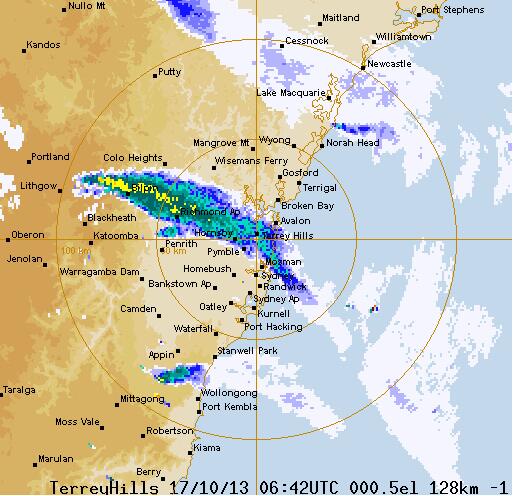
Two sources for current maps of fires in Australia: New South Wales Rural Fire Service, and ESRI.
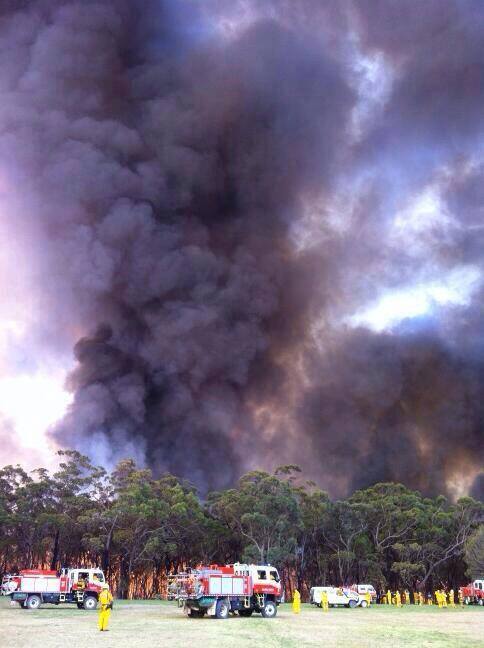
Australians impatient to get Air-Cranes into the air

The Australian government has been contracting for Erickson Air-Crane helicopters during their down-under fire seasons since ”Millie” (N223AC) was deployed there in 1997. They seem to have a special fondness for the ships which can carry 2,650 gallons of water, especially since the 2001-2002 bushfire season when ”Georgia Peach” (N154AC) and “Incredible Hulk” (N164AC), were rushed out from the U.S.A on board a Russian Antonov An-124 air freighter to assist with bushfires near Sydney, working with “Elvis” which was already “in the building”.
Their fire season this year has caught the Aussies by surprise, starting in New South Wales weeks earlier than usual — before the contract for the Sky-Cranes begins. While at least two Air-Cranes had already been shipped to the country from Greece by air freighter, not all of the flight crews had arrived when dozens of very large bush fires broke out that so far have burned about 200 homes and caused the death of one person. There is a bit of a controversy going on with some residents not able to understand why the huge helicopters can’t be used to fight fires without a flight crew.
One headline shouted the news:
Critical US water bomber grounded during NSW bushfire crisis
Reports say that by this weekend both Air-Cranes were actively fighting the fires.

Photos of aircraft on Fern Lake Fire

Paul Filmer took some excellent photos of aircraft working on the Fern Lake Fire in Rocky Mountain National Park west of Estes Park, Colorado, December 4, 2012. The photo above is the first one I can remember seeing of an air tanker dropping with snow in the background.
We thank Paul for allowing us to use his photos. You can see a couple of dozen more that photos he took December 4 at his web site. More information about the Fern Lake Fire can be found at Wildfire Today.


Erickson buys back the Air-Crane it sold to power company
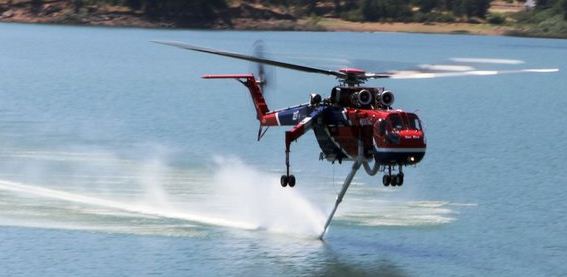
Erickson Air-Crane has bought back an Air-Crane helicopter that it sold two years ago to a power company in California. In 2010 Erickson sold a $30 million S-64F Air-Crane to San Diego Gas and Electric which acquired it to facilitate the construction of a powerline in eastern San Diego County. The company also made it available for fighting wildfires, using the call sign Helicopter 729 when operating on a fire, and “Sunbird” when working on the powerline. The Air-Crane can carry 2,650 gallons of water when suppressing a fire.
Erickson paid SDG&E $21.75 million, according to Portland Business Journal, to purchase the Type 1 helicopter in October.
In conjunction with the aircraft transaction, Erickson entered into an agreement with SDG&E to provide an Air-Crane for fire suppression support in San Diego County this Fall. SDG&E leased the aircraft for a 3-month period from September through November 2012, with an option to renew the lease for the same period each year through 2016.
Erickson added the aircraft to its fleet which now expands to 18 Air-Cranes. The company said it will allow the Company to meet the growing demand for heavy-lift aerial services in the oil-and-gas and powerline construction sectors.
Erickson Air-Crane went public April 11, 20121, selling stock at an initial public offering. Listed as EAC on NASDAC, it sold for about $8 that day, which netted $32 million for the company, about half of what they hoped for a few months earlier. The company used the proceeds to help pay down their debt which as of December 31, 2011 was $130.6 million. Since the IPO the stock price has ranged from $5.35 to $8.50 and closed at $8.03 Friday.
In 2007, ZM Private Equity Fund bought the company, and in 2009 moved the headquarters to Portland. ZM retained 63 percent ownership after it went public with the sale of stock.
Australians gear up for bushfire season

At the beginning of the bushfire season in Australia, Peter Ryan, the Deputy Premier of Victoria, held a press conference to announce that “Elvis is back in the building”. The Premier was referring to an Erickson Air-Crane, a Type 1 helicopter which can carry 2,650 gallons of water. The Australians have a special fondness for the Air-Cranes, and especially for the one named “Elvis”, which is credited for helping to protect almost 300 homes near Sydney in 2001 and also for helping save the lives of 14 firefighters in the Burragorang Valley in New South Wales.

In addition to “Elvis” (N179AC), Victoria’s Country Fire Authority has contracted for a second Air-Crane, “Gypsy Lady” (N189AC).
Through contracts with various state and territory governments in Australia, Air-Cranes and Skycranes have been helping the Australians during their fire seasons since “Millie” (N223AC) was deployed there in 1997. One of the more notable missions was the 2001-2002 bushfire season when “Georgia Peach” (N154AC) and “Incredible Hulk” (N164AC), were rushed out from the U.S.A on board a Russian Antonov An-124 air freighter to assist with bushfires near Sydney, working with “Elvis” which was already “in the building”.
Australia to contract for aerial resources

 The National Aerial Firefighting Centre in Australia intends to award new contracts for helicopters and fixed wing aircraft for fighting wildfires. Over the next few months they will be accepting tenders or requests for proposals for:
- Type 1 (High Volume) rotary wing firebombing services
- Type 1, 2, and 3 rotary wing services
- Type 4 fixed wing firebombing services
- A number of other specialist aircraft services, including intelligence gathering
- A small number of conventional light fixed wing aircraft services for reconnaissance
- Very Large airtankers
- Type 1 and 2 multi-engine airtankers
- Scooping or self-filling fixed-wing aircraft
- Proposals to supply data integration services for AFAMS – the national aircraft tracking and event logging system
The request for proposals for very large air tankers is a little surprising after their experiment during the 2009-2010 fire season. After that trial the Aussies were not entirely pleased with the overall performance of a DC-10, however most of the problems were a result of insufficient skill on the part of the crew, rather than the aircraft — for example dropping far too low or completely missing a target. The first pilots who flew the DC-10 very large air tankers had little or no previous experience flying air tankers when that program began. In the last two to three years they have gained a quite a bit more experience flying low and slow over mountainous terrain and have a good reputation in the United States. The two DC-10s have proven to be a reliable and valuable aviation asset.