CAL FIRE Director Thom Porter taking the oath of office. CAL FIRE photo.
The new Director of the California Department of Forestry and Fire Protection had strong feelings about climate change before that was cool. (And some people still deny climate change, the moon landings, and they think the Earth is flat.)
Thom Porter was appointed Director of CAL FIRE by Governor Gavin Newsom on January 8, replacing Ken Pimlott who retired December 15, 2018.
In 2009, ten years after he began working for CAL FIRE, Mr. Porter was featured in a 90-second video produced by Greenpeace USA in which he talked about how climate change was affecting wildland fire.
Below is a partial transcript from the video:
As a firefighter I’m a student of the weather, and I’ve noticed that there’s a change that’s occurred in the last several years.
Thom Porter as he appeared in a 2009 video.
These patterns are not what I have grown up with. They are also not what I have seen in the historical record. We’re starting to see more monsoonal type of weather that’s causing more dry lightning which ignites fires — sometimes thousands of fires in a 24-hour period. We’re stretched for resources when that happens. We don’t have enough fire engines and aircraft to take care of all those fires.
California has a very diverse economy. A lot of it depends on water. If the climate changes and we don’t have the water we need to support that business or the people who live here, we could see all of society start to have to move out of certain areas. California could dry up and blow away.
Before his appointment by the Governor, Chief Porter had served as Chief of Strategic Planning in CAL FIRE’s Sacramento Headquarters since January 1, 2018.
Prior to his CAL FIRE career, Chief Porter worked as a forester in the timber industry in Washington, Oregon and California, developing timber harvesting plans, planning and directing prescribed burns, and managing company safety programs.
He signed on with CAL FIRE in 1999 as a Forester I in the Forestry Assistance Program at the Southern Operations Center. He eventually served as the Southern Region Chief, Assistant Region Chief, and San Diego Unit Chief.
He holds a bachelor’s degree in forest management from the University of California Berkeley and is a Registered Professional Forester.
Thank you, Chief Pimlott, for your years of dedicated service and leadership. I’m honored by the opportunity to serve as CAL FIRE’s Director and continue positioning the department as a leader in forest management and fire protection. pic.twitter.com/IZKgWHOwr3
In an interview Friday with KPIX, Ken Pimlott Chief of the California Department of Forestry and Fire Protection addressed the criticism lobbed Wednesday at California by President Trump during a cabinet meeting. The President said in part:
California’s a mess. We’re giving billions and billions of dollars for forest fires in California. There’s no reason for those fires to be like they are…
So I think California oughta get their act together and clean up their forests and manage their forests because it’s disgraceful.
What’s happening should never happen. I go all over the country. When I meet with governors the first thing they say is there’s no reason for forest fires like that in California.
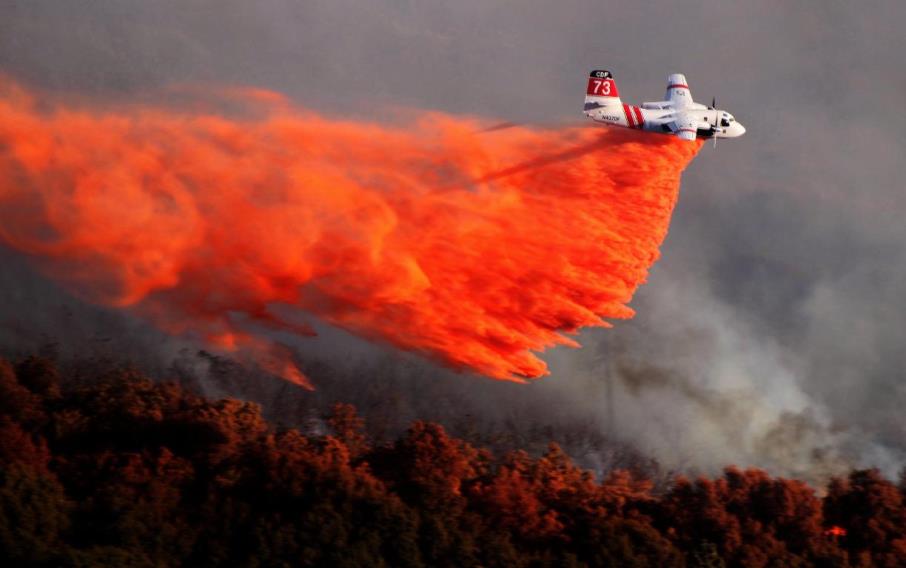
Air tanker 73, an S2T, flown by Mike Venable, July 15, 2013 on the Mountain Fire in southern California. USFS photo by Steve Whitby.
James Barnes wrote the article below for the Associated Aerial Firefighters’ Facebook page September 2, 2018. We asked and received permission to use it here. Mr. Barnes retired after flying S-2T air tankers for CAL FIRE and DynCorp.
A reporter from the Sacramento Bee called me the other day and told me that she was advised, by unnamed persons, that I may be able to shed some light on the problems that are resulting from the pilot shortage CAL FIRE is now experiencing. As a retired, former airtanker pilot, I am not encumbered by any affiliation to any organization, employer or agency. That being said, I still follow my own protocol or personal code with regard to statements that I make that could be harmful to persons or organizations or programs that in my opinion are doing a great service for our Citizens and Taxpayers.
In my experience in dealing with the press I have found that there is always “the law of unintended consequences” looming in the background. It must always be considered before and during any interview where your opinion could potentially be used as a weapon in a salacious report. In speaking with this lady during the preliminary discussion before the interview it was my determination that her intent was to get the story right and get it out to the public. That left me with two choices; to refuse the interview and hope that someone else would get the facts straight or tell the facts as I understand them and accept the consequences. I chose the latter.
In the beginning of our discussion she demonstrated that she had already gained a substantial understanding of CAL FIRE’s Aviation Program and the current situation. She cited the worldwide pilot shortage and I agreed that, yes, it had finally come. She inquired about why CAL FIRE quite suddenly was unable to staff all of their airtankers and air attack ships. She even mentioned some names of management personal that she had heard might have contributed to the current situation. My reply was simply this; “I cannot confirm allegations concerning individuals and the fact is, it isn’t that simple”.
“For years The California Fire Pilots Association, the IAM, our Union, and the Associated Aerial Firefighters have advocated for the development of new and better aircraft and an air program that stabilizes both the pilot and maintenance workforce. Many times, dedicated agency officers worked with us to accomplish these goals. They realized that improvements in “quality of life” issues and job security are essential to retaining skilled employees. Sometimes, individuals in management did work against our efforts but for the most part we prevailed and together developed an air program that is light years ahead of anything that came before. The pilots and maintenance technicians in CAL FIRE’s air program are today now better than ever.
She was aware of the high dropout/attrition rate of airtanker pilots in training and she wanted to know what was causing it. I gave her a very lengthy response.
“First aerial firefighting is far more complex today than it was when I started thirty years ago. A fatal accident every other year in the S-2 airtankers convinced us we were doing something wrong. We needed better training. New training programs were developed and instituted and our casualty rate was greatly reduced. Greater demands and expectations were placed on our trainees. This resulted in an intensive training regimen that spans one to two fire seasons no matter what walk of aviation the trainee came from. During these grueling sessions some trainees decide that tanker flying isn’t for them. In other cases, trainees have trouble adapting to the environment. Multi-tasking in conditions of low visibility, at very low altitudes, at minimum safe airspeed can produce very high stress levels for even the most seasoned airtanker pilot. Still others find that the life style of an airtanker pilot is not compatible with their life style or the needs of their families.
All these situations point to the need for a better screening program of applicants before they are accepted in the training program. It would help to have them ride along or act as a co-pilot to introduce them to the environment and see if they are adaptable before being designated as a trainee. Impressing upon them that the demands placed upon them will be very great requiring a dedication to the mission that may be beyond what they are willing to deliver.
Secondly, the current situation is a result of circumstances. Three tanker pilots retired, one of our best tanker pilots died suddenly of natural causes, two pilots are temporarily out of service for illness and one of our young, skilled tanker pilots quit to fly a large airtanker for another industry company.
Until recently there were enough reserve and relief pilots that could fill the seats as needed. With such a high turnover in such a short time all the relief pilots were absorbed forcing them to fly the line. Now on any given day at least three S-2 airtankers are parked because there are no pilots to fly them”.
She asked me “if having three airtankers parked would make a significant difference in fighting a fire?”
“From the instant of ignition, the window of opportunity for stopping the fire is beginning to close. CAL FIRE’s primary strategy is Rapid Response Initial Attack. During the extreme burn conditions, we are now experiencing air support for our ground firefighters is crucial. in some cases, an air response will be the only response in the first critical twenty minutes. The loss of three airtankers puts big holes in our tactical spread that delivers that air response in the first 20 minutes. Any delays in our ground and air forces will cause some fires to escape the initial attack resulting in more large fires”.
She asked about the fatigue levels of pilots because off the intensity of this fire season and the lack of any relief pilots to give them a break.
“The stress and fatigue levels our pilots are experiencing are currently off the scale. The only comparison would likely be tactical military pilots in time of war.”
She expressed concern for the safety of our pilots. “Is the fatigue the pilots are experiencing affecting their ability to fly?”
“I can only speak from my past experience. When I was assigned to fires that caused me to time out day after day and fatigue set in I began to make more and more little mistakes.”
“Like what kind of mistakes?”
“Things like omitting an item on a check list or having trouble changing a radio frequency but it is the little things that add up and ultimately result in a mishap or an accident.”
I expressed my opinion that it is imperative that everything possible be done to give those pilots a break. Current demands are keeping our southern bases open year-round. Under these conditions the six days on, one day off schedule is untenable.”
“Is anything being done to resolve this problem?”
“Both CAL FIRE and the CFPA have been working together to find a solution. Firefighting pilots make their entire annual income during the period of the contract. Flying a southern contract involves demands beyond what the standard four-month contract requires. They shouldn’t receive a penalty in pay to achieve the necessary adjustment in duty schedule but something must be done soon”.
She asked me if there were other factors affecting pilot recruitment and retention.
“It’s the little things that count. One example of a small thing that caused a large reaction from the pilots was a newly implemented state policy to have pilots who were working away from home base to find a motel room that cost no more than $90.00 per night and that if one couldn’t be found to price three motels and choose the cheapest one. After flying for seven hours on fires and finishing a ten-hour duty day it doesn’t seem reasonable that a pilot should have to shop around for the cheapest possible motel room. I guess the Comptroller didn’t know the difference between a computer operator and a tanker pilot. It wasn’t the money so much as it seemed to be a lack of respect. No one would ask every individual firefighter to go out on their own and find the cheapest room available in town after fighting a fire all day. Fortunately, that policy was discontinued this year”.
“Our highly skilled, young airtanker pilots are a coveted item for many other industry companies. Offers to fly a large, four engine jet airtanker for more money are very tempting. Too many little things or quality of life issues can sway a young Tanker Pilots judgement from staying in CAL FIRE’s air program or moving on to what looks like greener pastures”.
We talked about the terrible problem with vegetation management in California. She said that the Bee is doing a story on that issue too. She commented briefly on that story.
“The U.S. Forest Service told us that they only have a budget to address vegetation management on one percent of their responsibility area.”
Then I got on my soap box again; “Vegetation management is the single most important thing we can do to alleviate the threat of wildfire. They could mitigate the threat in some areas by allowing selected logging to both generate revenue and reduce the fuel load in areas that are trigger points. The USFS is also only one of thousands of firefighting agencies in the United States. To have any meaningful results action must be taken by all stakeholders beginning with property owners and on up through local fire departments, County, State and Federal agencies.”
I got a little off the track but I thought she had done a comprehensive study on the issues and I can only hope that her story has a positive effect.
Above: Tanker 116, an HC-130H, on final approach at Fresno, July 22, 2017. Photo by L.S. Braun.
(Originally published at 2 p.m. PDT July 267, 2018)
Now that the U.S. Forest Service has decided that they do not want the seven HC-130H aircraft that were in the process of being transferred from the Coast Guard to the Forest Service, the door has opened for Plan B for those aircraft.
This story began in 2013 when Congress passed the National Defense Authorization Act directing that the Coast Guard transfer the planes and that the Air Force would arrange to take care the backlog of maintenance and the work needed to turn them into air tankers, appropriating up to $130 million to complete the work. At least two of the planes were close to completion with the exception of installing a retardant delivery system. Tankers 116 and 118 have been seen occasionally working on fires using a borrowed Modular Airborne FireFighting System in lieu of a permanent tank.
CAL FIRE has been considering the long range plans for their fixed wing fleet for a while. The 1,200-gallon S2T’s are not getting any younger and in recent years the agency has been supplementing those 23 air tankers with large and very large air tankers on a call when needed and exclusive use basis. At various times CAL FIRE has used BAe-146’s, DC-10’s, the 747 Supertanker and other tankers, all holding from 3,000 to 19,200 gallons. CAL FIRE was an innovator, being the first to contract for the Very Large DC-10 and 747 air tankers.
CAL FIRE Chief Ken Pimlott announced in an email July 26 that the agency is hoping to obtain the seven HC-130H’s:
…Senator Feinstein and her staff have worked tirelessly to seek amendments to the National Defense Authorization Act that authorize the transfer of the seven C-130H air frames to the State of California. This amended language will be voted on by Congress in the next week.
If approved, there are a number of steps which must take place before California, and ultimately CAL FIRE, can take possession of these aircraft. Additionally, they must be developed into firefighting air tankers, which will require funding through future budget processes. The number of aircraft to be built and the ultimate base locations have yet to be determined, and may take several years to implement. However, the acquisition of these aircraft are an important step forward in bolstering our capacity to address the State’s wildfire risk.
The U.S. House and the Senate are considering different versions of the National Defense Authorization Act referred to by Chief Pimlott. The conference committee charged with modifying and merging the versions agreed to require the Air Force to complete the conversions of the seven aircraft and give them to the state of California.
Here is what they came up with, in Congress-speak:
The House bill contained a provision (sec. 1075) that would amend section 1098 of the National Defense Authorization Act for Fiscal Year 2014 (Public Law 113-66) to relieve the Air Force from the mandate to modify United States Coast Guard (USCG) HC-130H aircraft with firefighting capabilities for use by the United States Forest Service (USFS). The Senate amendment contained no similar provision. The Senate recedes with an amendment that would maintain the mandate for the Air Force to modify the USCG HC-130H aircraft, but designate the state of California as the ultimate recipient of the aircraft, vice the USFS.
The amended bill still has to be voted on and approved by the Senate and the House and then signed by the President, which could happen as soon as next week.
Model of CAL FIRE Firehawk, by Sikorsky. Photo by Bill Gabbert.
After several false starts over several years, CAL FIRE selected a variant of the Blackhawk to replace its aging fleet of 12 Super Huey firefighting helicopters, but that acquisition is stalled. In what appeared to be the final hurdle an administrative law judge ruled in December against a protest filed by a competing company clearing the way for CAL FIRE to purchase up to 12 new Sikorsky S-70i’s (Firehawks), from Air Methods/United Rotorcraft (AMUR).
When the effort began years ago to replace the fleet of aircraft that is now at the end of its useful life, the legislature was told each new helicopter would cost around $12 million, but they realized the price could escalate. The new Firehawks will run $24 million each with the additional features recently added by CAL FIRE and the Department of General Services.
Below is an excerpt from an article in the Sacramento Bee:
The Governor’s Office and Cal Fire are ready to start buying the new machines. “We believe we have provided the Legislature with all the necessary and requested information to move forward on this project,” Finance Department spokesman H.D. Palmer said.
Thanks and a tip of the hat go out to Jim. Typos or errors, report them HERE.
The aerial firefighting program in the California Department of Forestry and Fire Protection has grown over a couple of decades into a highly respected, professionally managed organization. After spending some time at their aviation headquarters at McClellan Air Field on Thursday [March 24, 2016] in Sacramento, I developed as list of 16 facts that you may not know about the program:
1. CAL FIRE has 22 S-2T fixed wing air tankers that can carry up to 1,200 gallons of retardant. They are presently converting an aircraft to replace the one destroyed in the October 7, 2014 crash that killed Geoffrey “Craig” Hunt. That process should be complete in 18 to 24 months.
S-2T air tankers at McClellan Air Field, March 24, 2016. Photo by Bill Gabbert.
2. They have 15 OV-10 Air Attack fixed wing aircraft.
A lineup of OV-10 air attack ships at McClellan Air Field, March 24, 2016. Photo by Bill Gabbert.
3. And 12 Super Huey helicopters.
Super Huey at McClellan Air Field, March 24, 2016. Photo by Bill Gabbert.
4. All of the above aircraft were discarded by the military.
5. The S-2T air tankers were designed to be based on aircraft carriers, and therefore have wings that fold. They still retain this feature, which makes it possible to cram more aircraft into a hangar.
An S-2T with the wings folded. Photo by Bill Gabbert.