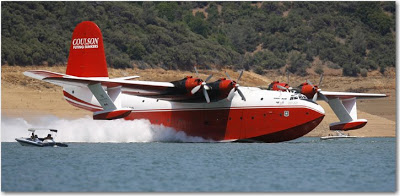
Martin Mars reloads

Martin Mars scooping
Hawaii Martin Mars scooping water at Lake Shasta.

I wonder what kind of wake the Martin Mars creates when it skims along a 3-mile stretch of Lake Shasta filling its 7,200 gallon tank at 80 miles per hour? It probably makes the lake a little choppy for the water skiers for a few minutes.

Always film posterOn Friday, it did this 20 times, reloading about every 25 minutes, dropping the water on the nearby 16,700-acre Motion fire. That is a damn good turn around time for an air tanker. The pilots have the option of dropping plain water on the fires, or mixing class A foam or fire retardant gel into the water.

Do you remember the opening sequence in the 1989 movie, the Steven Spielberg production with Richard Dreyfuss, Holly Hunter, and John Goodman that is centered around air tanker pilots? Turn up the sound when you play the 55-second clip below….it’s more fun that way.

One of the lines in the movie is still food for thought for firefighters.  John Goodman said to Richard Dreyfuss:

Pete, there ain’t no war here… And this is why you’re not exactly a hero for taking these chances you take. You’re more of what I would call a dickhead.

Some trivia about the movie, from Wikipedia:

The movie is set in the Kootenai National Forest in Montana, with some scenes filmed in and around Libby, Montana. Some 500 people from Libby were recruited for the movie as extras to act as wildland firefighters.

In the opening scenes the forest fires were created by Pathfinder Helicopter Inc.. They were hired by the Forest Service to burn some clearcuts near Libby that were filmed for the movie. The helicopter Pilot was Steve Tolle and the Ground Crew Manager was Jim Leighty.

The Libby airport was used to double as the Forest Service Headquarters in the movie.

Video of Martin Mars air tanker

Here is a pretty good 5 minute video of the Martin Mars air tanker dropping on the Motion fire near Shasta Like north of Redding, CA. It has a musical sound track that is only a little obnoxious. (I don’t know why, but the media keeps insisting on calling it a “water bomber”.)

California: Two dozer rollovers

Two dozer operators rolled their dozers on Tuesday. One was wearing a seat belt and one was not.

A private contractor assigned to the Cold fire in Plumas County suffered a fractured skull, a dislocated shoulder and injuries to one ear when the bulldozer he was operating rolled over, said Dave Olson, a fire information officer for the Canyon Complex of fires on Plumas National Forest.

The employee of Oilar Agricultural Services, based in MacArthur, was flown to Enloe Medical Facility in Chico, where he was in stable condition Wednesday with no life-threatening injuries, Olson said.

In Siskiyou County, a contract operator was digging a fire line between the Alps Complex fire and the Ironside fire when his bulldozer rolled 80 feet down an embankment, said Alexis West, a fire information officer on the complex of fires burning on Shasta-Trinity National Forest.

The operator was wearing a seat belt, which probably saved his life, West said. He was taken to a Redding hospital, where he was treated for arm and shoulder injuries.

He was conscious and alert in Mercy Medical Center on Wednesday morning, West said.

From the Sacramento Bee

Martin Mars lands at Lake Shasta

The third time proved to be the charm for the Canada-based Martin Mars air tanker. After having engine problems on Friday and Saturday, it successfully completed it’s 4-hour trip to Lake Shasta north of Redding, California this morning. It will stage there until it receives an assignment, which will likely occur today, visibility permitting. On each mission it can drop 7,200 gallons of water, Thermogel, or water mixed with foam concentrate on a fire and then will refill it’s tank by scooping water from a lake.

Wildfire Today covered the saga of this aircraft earlier, here and here.

Martin Mars Shasta
The Martin Mars anchored on Lake Shasta, June 29. It has already been outfitted with an American flag and a USFS decal. Photo courtesy of ShastaLake.com.

Martin Mars expected at Lake Shasta, California

Martin Mars Lake Elsinore, California
Martin Mars at Lake Elsinore, California October 28, 2007. USFS photo by the Air Operations Branch Director.

A Martin Mars water-scooping amphibious air tanker lost an engine yesterday 10 minutes before it was due to land at Lake Shasta in northern California to help with the forest fires. It turned around and flew back to its base at Port Alberni, British Columbia where the engine was going to be repaired or replaced. If the repairs go well, their plan is to land the plane at Lake Shasta at 10 a.m. today, Saturday. But as this is being updated at 7:45 a.m. PT, the aircraft, Canadian number CFLYL, is not showing up on flight tracking.

The aircraft can carry 7,200 gallons of water, Thermogel, or water with a 0.4% solution of foam concentrate. It may be the only air tanker with Thermogel capability. The ship was used for a while last fall in southern California during their fire bust and flew out of Lake Elsinore. This year it will be under contract with the U.S. Forest Service.

Engine burnover near Lincoln, California

Another engine burnover–this time it was two Placer County Fire Department brush engines on the Nicolaus fire near Lincoln, CA on June 11. Here is an excerpt from CalFire’s “24-hour report” recently released:

On June 11, 2008 at 0949 hours, Placer County Fire units were dispatched to a vegetation fire at Nicolaus Road near Dowd Road, west of the City of Lincoln in Placer County. The fire occurred during a north wind event under a Red Flag Warning. BR 75, staffed with one Placer County Volunteer Firefighter, arrived first at scene reporting a wind driven five acre fire.

BR 75 drove down a dirt road paralleling the left flank of the fire. Engine 70 (E70) arrived and reported 7-10 acres with no structures threatened and assumed incident command (IC). BR 73 arrived next, staffed with one CAL FIRE Fire Apparatus Engineer and one Firefighter I. BR 73 followed BR 75 down the dirt road on the left flank. The right flank was inaccessible at this time.

Approximately seven minutes into the fire, E70 (IC) reported that units were being burned over. Appropriate EMS was requested.

The volunteer firefighter from BR 75 sought refuge on the leeward side of the apparatus. The fire intensity continued to increase and he retreated to safety, crossing a barbed wire fence, into a stubble field immediately to the east of the dirt road. He was met by apparatus and personnel from Lincoln Fire Department and escorted to ambulance personnel.

The CAL FIRE Firefighters from BR 73 tried to seek refuge in the cab, but were quickly overrun. They retreated through the flame front to the west, into the burn. Both of the firefighters walked north through the burn and exited where E70 was parked on Nicolaus Road.

All firefighters were treated and transported to UC Davis Medical Center. The volunteer firefighter from BR 75 received burns to the nose, was treated and released. The firefighters from BR 73 remain in the Burn Unit in stable condition with burns to the face and hands. They are expected to remain at UC Davis Medical Center for 7 to 10 days.

The Nicolaus Fire was contained at 1140 hours to 65 acres on June 11, 2008.

More details about Los Padres engine burnover

The US Forest Service released some additional information about the engine burnover that occurred on the Indians fire on the Los Padres National Forest in California on June 11:

Narrative: At approximately 1615 hours while supporting a firing operation, Engine-71 was involved in a localized fire blow-up. A cyclonic fire wind event caused four members of Engine-71 to be overcome by the fire. The crew was suppressing spot fires near the roads edge when they experienced extreme fire and wind behavior. Winds were estimated to be 60 – 70 mph. Limbs from large oak trees were blown out of trees and small, golf ball size rocks, were thrown into the air. The radiant heat caused the burns to the fire fighters. Initially, the firefighters were treated at the ICP medical unit, two were sent to a local hospital for further treatment and the most serious burn victim was flown to Valley Burn Center in Santa Clara. A fourth firefighter did not initially seek treatment. After further consideration, the 4th firefighter chose to see a physician. The three firefighters have been referred to the Fresno Burn Center for further examination.

An Accident Prevention Analysis (APA) team has been ordered to review this incident.

California: Summit fire progression map

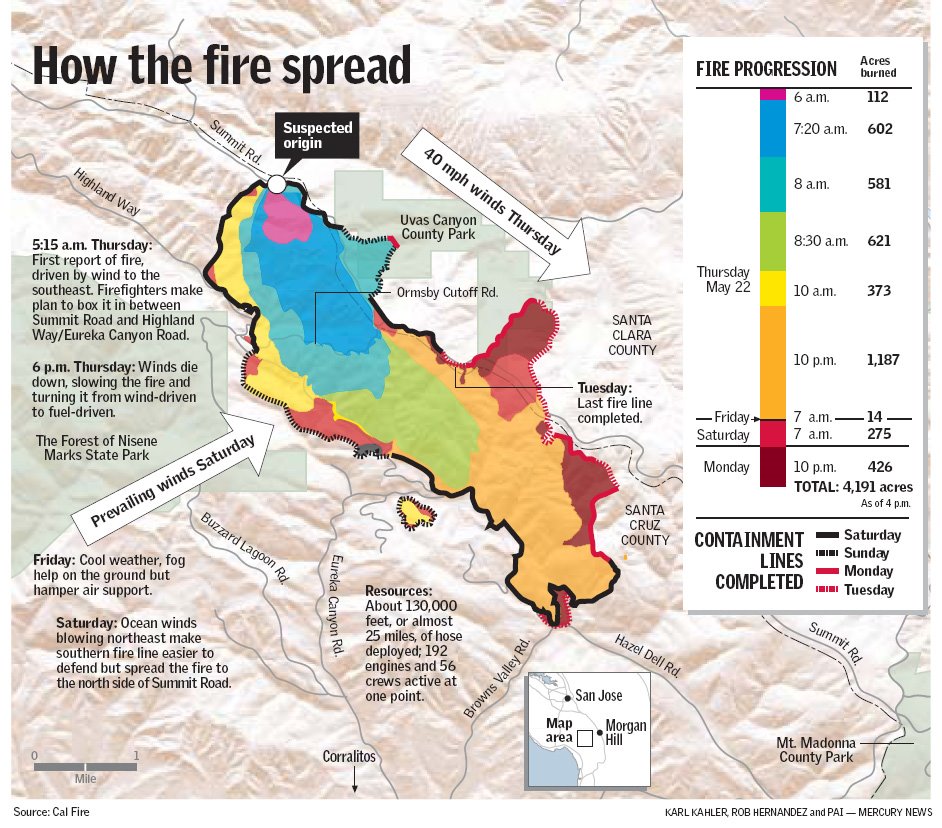
I just finished teaching a Situation Unit Leader S-346 class. Much of the class is about maps. The next time I teach it in September, I’ll use this fire progression map produced by the Mercury News as an example of what can be done. It includes some interesting facts about the fire that most official firefighter-made maps would not have, but it’s a great product for public consumption.

According to the map, within the first 16 hours the fire spread at least 5 miles and burned 3,376 acres.

Click on it to see a larger version.

Summit fire progression map


Private firefighting companies in southern California

There are at least two private companies in southern California that offer protection from wildland fires. From a story in the North County Times:

FALLBROOK —- The emerging business of private firefighting just got another competitor in North County.

Based in Fallbrook, Fire-Pro USA opened for business in April, said founder Don Green. That’s just a few months after the debut of another private firefighter, Pacific Fire Guard.

Fire-Pro differs from traditional firefighting by putting more stress on prevention and preparation, Green said. Public fire agencies use what he calls “the Ben Franklin model,” of waiting until a fire occurs and then dousing it with water.

Green, a veteran of firefighting, founded the company with partner David Wilterding last fall. Its services start at $519 per property per year. Fire-Pro will examine a customer’s fire risk, treat the property with a fire retardant and, in the event of an approaching fire, apply a heat-absorbing gel, Green said.

“That buys us time,” Green said of the fire retardant, which is clear and can be applied to surrounding brush as well as to the home. “We can spray this long-term fire retardant, and it literally makes their brush and wildland area a fire barrier.”

The fire retardant is not toxic to animals who eat the treated vegetation, Green said.

Pacific Fire Guard’s services cost $1,800 per year, according to a Feb. 9 story in the North County Times. The company also uses a heat-absorbing gel substance on property, and its firefighters will stay on the property until the fire threat has passed.

Nick Schuler, a Cal Fire spokesman, said homeowners who use such private firefighting companies still need to create a “defensible space” by clearing brush around their property for 100 feet.

“Cal Fire supports any homeowner who’s doing things to help reduce their fire risk,” Schuler said. “This does not replace defensive space, it does not replace good clearance and it doesn’t replace the need for having a protection plan for you and your family.”

Green said skepticism is understandable because Fire-Pro is so new. The company will have to prove its mettle by actually saving homes, he said.

The company may soon get that chance.

On Friday, Gov. Arnold Schwarzenegger issued an executive order ordering the California Department of Forestry and Fire Protection, or Cal Fire, to “immediately mobilize” its resources.

“This year’s fire season has already begun,” Schwarzenegger said in a Friday press release announcing the executive order.

Dry weather throughout the state in the last two months has heightened the risk of fire, Schwarzenegger said in the press release. In Southern California, dead and dying trees infested with bark beetles add to the fire risk, he said.

Trees stressed or injured by a lack of water are known to be susceptible to bark beetle infestation.

HERE is a link to a video of one of the companies applying a long term fire retardant to some property.

California: Schwarzenegger's fire preparedness

The California governor seems to be concerned about the wildfire potential this summer. In a press conference he was talking about the fire hazards around his home:

“I was not aware of it until an expert from the fire department told me that, ‘This is terrible. This is a fire hazard all around your house — you are living in the middle of it, get rid of this grass, get rid of these shrubs or you are going to be in trouble.’

He issued a lengthy Executive Order that detailed numerous policies that will affect CalFire this year. Here are some of the highlights:

Staff additional fire crews, fire engines, helitack crews, fire bulldozers, equipment and aviation resources as warranted based on fire threat conditions.

Assign a crew of four firefighters to selected CAL FIRE fire engines as warranted based on fire threat conditions.

Provide for immediate availability and utilization of the Supertanker aircraft.

IT IS FURTHER ORDERED that the California National Guard prepare its aviation assets, and pre-position ground support equipment, as appropriate for immediate response to major wildfires and report to OES weekly on the status of all aircraft.

IT IS FURTHER ORDERED that CAL FIRE shall provide educational information to homeowners on defensible space and California Building and Fire Codes ignition-resistant building materials, and shall develop training for defensible space inspection and building ignitability in consultation with the Department of Insurance, OES, and the Federal Emergency Management Agency (FEMA).

IT IS FURTHER ORDERED that CAL FIRE shall conduct vigorous defensible space inspections, and shall impose fines and/or liens pursuant to applicable authority if necessary.

IT IS FURTHER ORDERED that to assist landowners to meet their 100-foot defensible space requirements to reduce hazardous vegetation and landscaping, CALFIRE, in consultation with the California Biomass/Biofuel Collaborative, may enter into contracts, agreements, and arrangements for the chipping, hauling, burning, or other methods of disposal of hazardous vegetation removed by landowners as required by Public Resources Code section 4291 and Government Code section 51182.