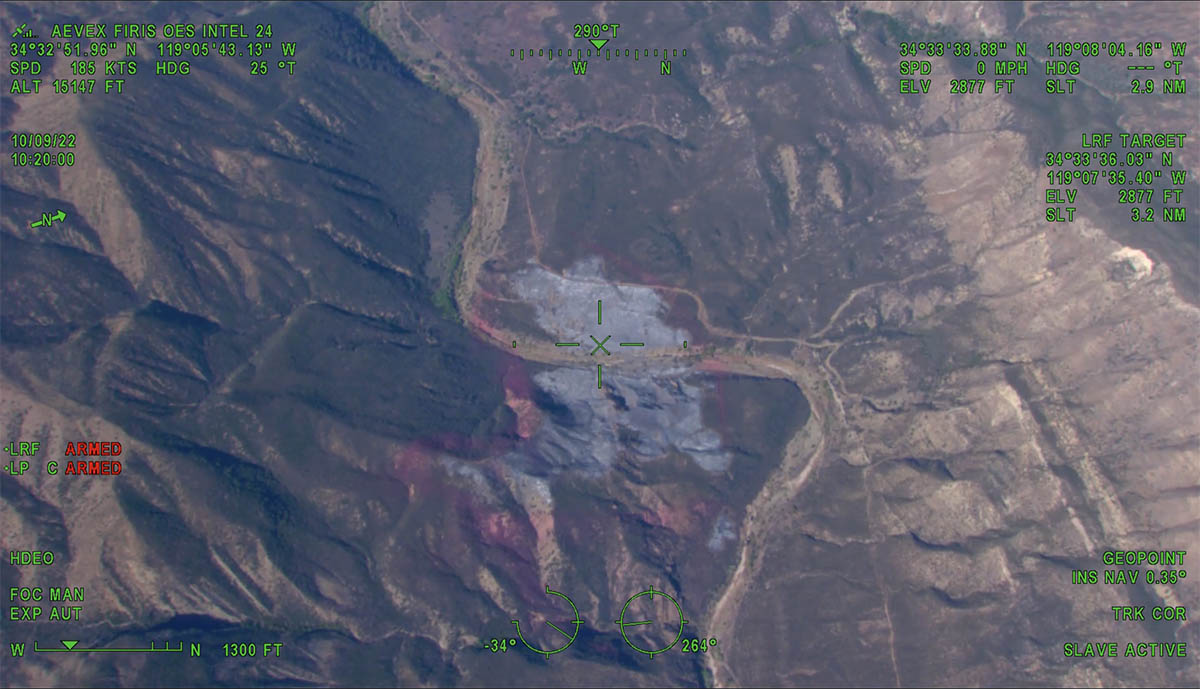
Howard Fire photo, looking west at 10:20 a.m. Oct. 9, 2022. FIRIS.
Aircraft were over the Howard Fire Sunday morning, including a lead plane and water-dropping helicopters.
The FIRIS OES 24 aircraft created an updated map at about 10 a.m. showing that the fire had grown to 85 acres, an increase of 10 acres since it was mapped Saturday evening.
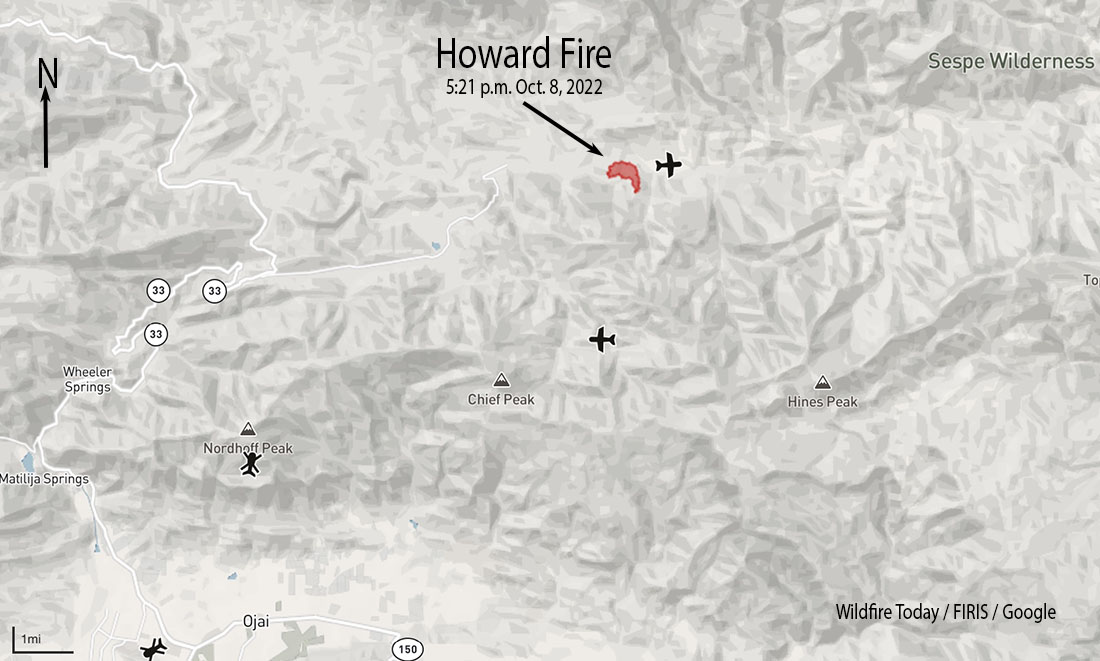
The incident is 8 miles northeast of Ojai, California. It is burning on both sides of Sespe Creek and the 20W13 Road, 6 miles east of Highway 33.
FIRIS was able to see fire retardant around much of the fire as well as hand-constructed and dozer-constructed fire line on portions of the perimeter. The video below is from FIRIS.
7:15 p.m. PDT October 8, 2022
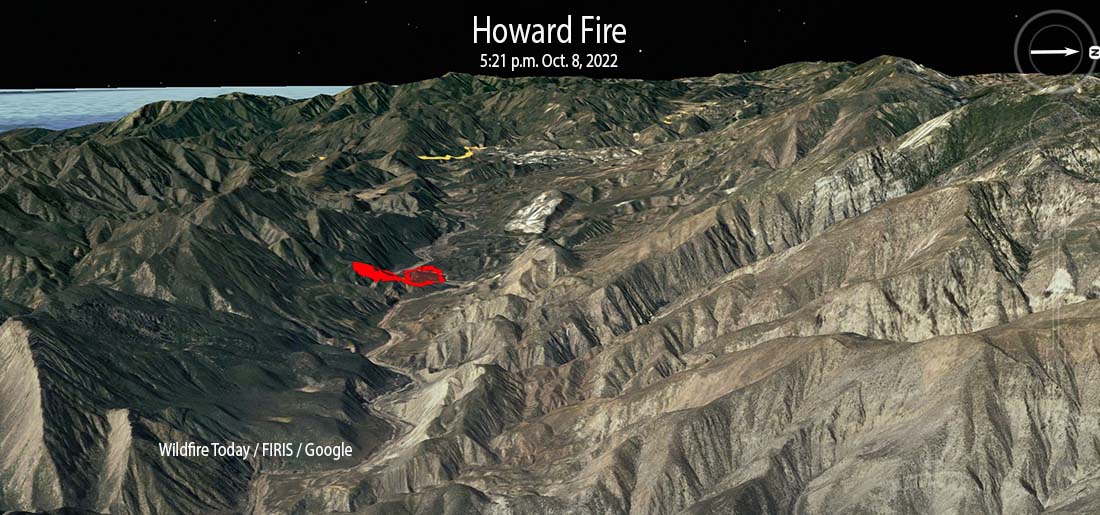
Howard Fire 3-D map (in red) 5:21 p.m. Oct. 8, 2022
The Howard Fire started Saturday afternoon in a remote area 8 miles northeast of Ojai, California. It is burning on both sides of Sespe Creek and the 20W13 Road 6 miles east of Highway 33.
At about 5:50 the incident commander estimated it had burned 80 to 85 acres. About half an hour earlier it was mapped by the FIRIS aircraft at 75 acres.
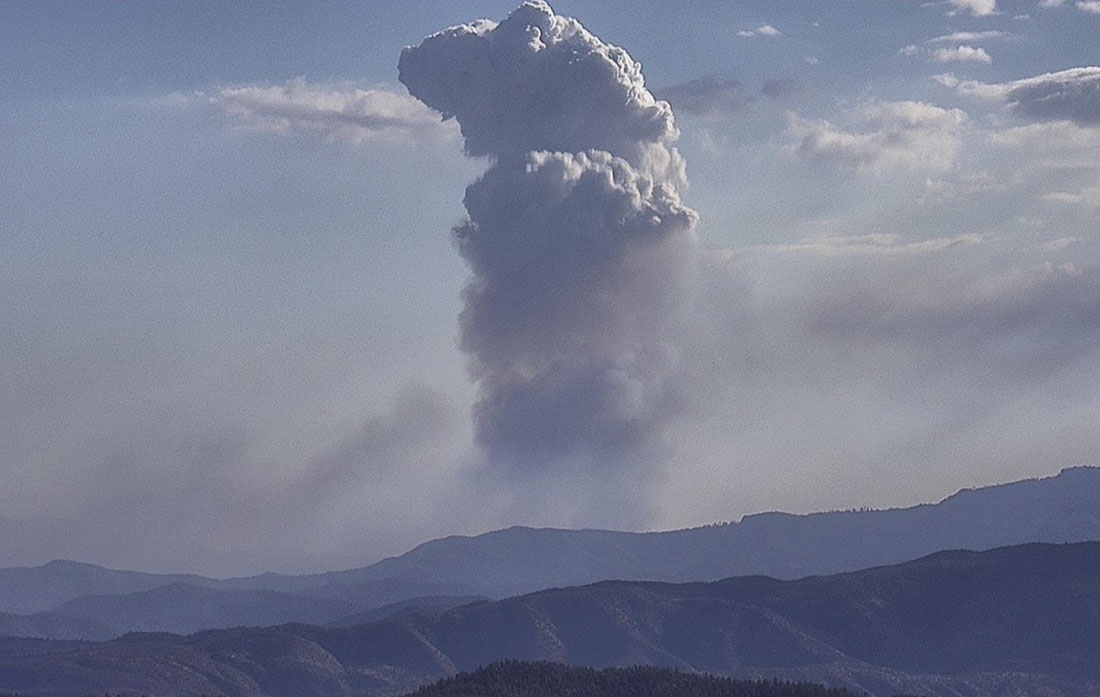
Howard Fire, looking southeast from Tecuyamtn1 camera at 4:32 p.m. Oct. 8, 2022. AlertWildfire.
For the first hour or so it was growing quickly putting up a convection column of smoke. Firefighters said it had the potential for 1,000 acres, but after aggressive initial attack by hand crews and aircraft in the difficult terrain, little smoke was seen as the sun was setting. Air tankers were able to complete a retardant line around 80 percent of the blaze by flight cutoff time. Orders were placed for aircraft to be available on the fire Sunday morning.
Several hikers were rescued by fire department helicopters.
Last year’s Caldor Fire and the community that was heavily damaged by it, Grizzly Flats, has been in the news recently. The latest is a piece aired on CBS’ 60 Minutes yesterday (see video below) about the fire southwest of Lake Tahoe, California. On August 16 Cap Radio wrote about the fuel treatment program the US Forest Service planned to conduct around the town, but barely started. Then on September 26 and 27 National Public Radio published articles about the failed project and difficulties in conducting prescribed fires.
The 13-minute piece on 60 Minutes concentrated on the initial attack of the fire, which was first reported at about 7 p.m. on August 14. One of the first challenges was gaining access, complicated by a washed out road and others that had not been maintained. According to a dispatch log the Incident Commander ordered everyone off the fire at 1:42 a.m., about seven hours after it started. The reason stated in the log was for “accountability.” 60 Minutes said the Forest Service told them it was for the safety of the firefighters. Later on day 2, according to 60 Minutes, the agency “dismissed a half dozen CAL FIRE engines and crews, letting most of them go before their replacements arrived.”
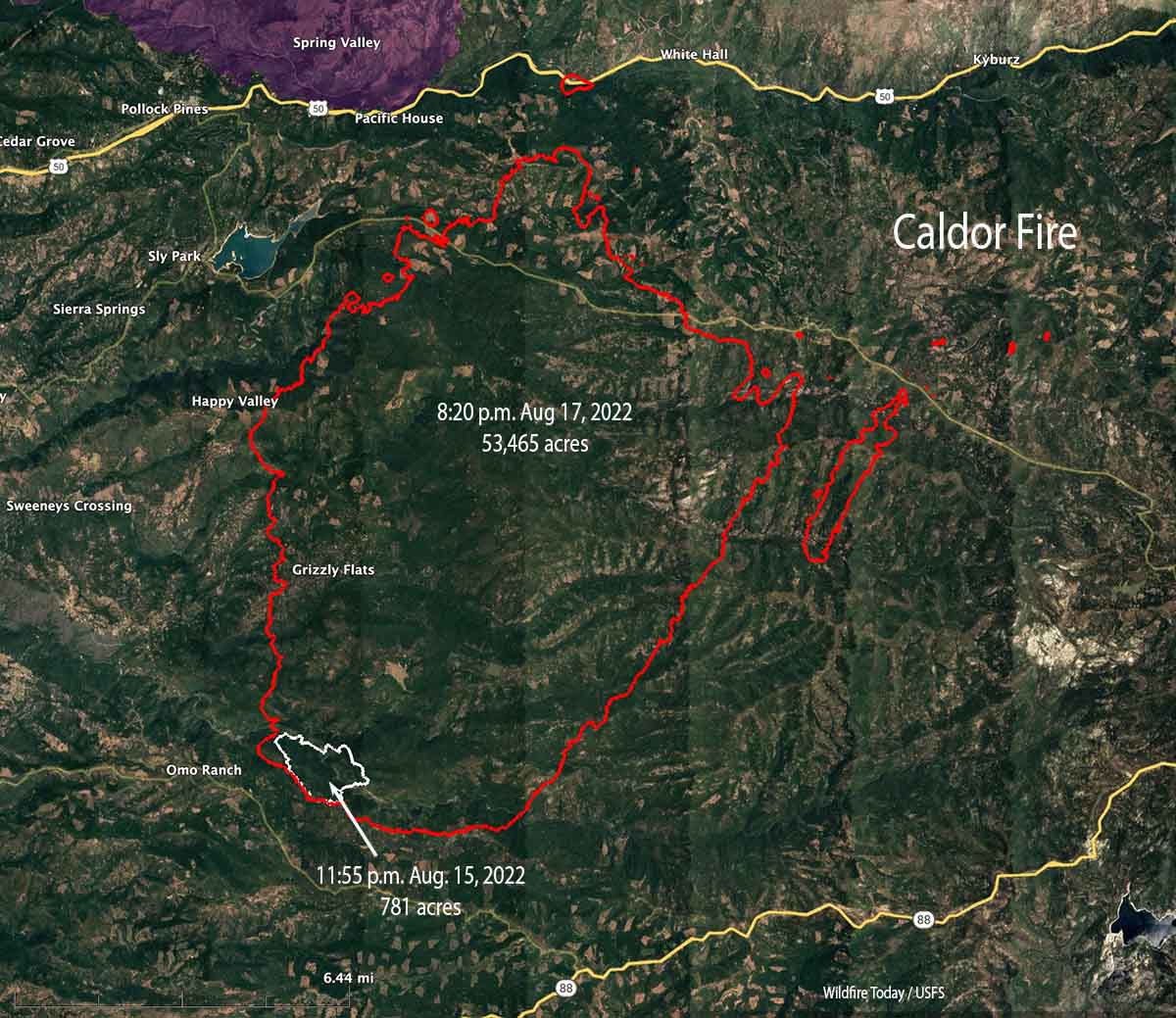
As you can see on the map below, about 29 hours after it started the fire was mapped at 781 acres. After another 44 hours it had burned through Grizzly Flats, growing to more than 55,000 acres.
Caldor Fire map, August 15 & 17, 2021.
Our take
I strongly believe in aggressive initial attack “with overwhelming force using both ground and air resources, arriving within the first 10 to 30 minutes when possible.” But it is difficult to criticize, especially a year later, an Incident Commander’s decision to pull everyone off a fire due to concerns about safety. Obviously the burning conditions were in favor of the fire that first night, not the firefighters. In 44 hours it grew from 781 to 53,465 acres while spotting more than a mile ahead according to mapping data from infrared aircraft.
If the Forest Service had completed the huge fuel treatment project they had promised around Grizzly Flats, that does not automatically mean no structures would have been destroyed in the community. Would the treatment have been a mile wide, reducing the number of burning embers landing in the town? Probably not. And it only takes one — landing in a leafy gutter, on a deck, on wooden steps, in a vent, on firewood, or dead grass near a structure and the home can be destroyed. When one home ignites, it becomes another ember generator, showering the rest of the community with ignition sources, resulting in the fire growing exponentially.
In September of 2021 Jack Cohen and Dave Strohmaier wrote about the Home Ignition Zone on Wildfire Today:
“Surprisingly, research has shown that home ignitions during extreme wildfires result from conditions local to a home. A home’s ignition vulnerabilities in relation to nearby burning materials within 100 feet principally determine home ignitions. This area of a home and its immediate surroundings is called the home ignition zone (HIZ). Typically, lofted burning embers initiate ignitions within the HIZ – to homes directly and nearby flammables leading to homes. Although an intense wildfire can loft firebrands more than one-half mile to start fires, the minuscule local conditions where the burning embers land and accumulate determine ignitions. Importantly, most home destruction during extreme wildfires occurs hours after the wildfire has ceased intense burning near the community; the residential fuels – homes, other structures, and vegetation – continue fire spread within the community.”
On November 8 California voters could approve a proposition that would add up to $1 billion to the California Department of Forestry and Fire Protection budget.
Proposition 30 would create an additional 1.75% state tax on personal income above $2 million that would used for zero-emission vehicle subsidies; zero-emission vehicle infrastructure, such as electric vehicle charging stations; and wildfire suppression and prevention programs.
The nonpartisan Legislative Analyst’s Office expects the measure would would raise $3.5 billion to $5 billion annually, growing over time. Of that, 20 percent would be spent on wildfire response and prevention activities. In general, the state would have to prioritize spending to hire, train, and retain state firefighters. The rest of the money could be used for other wildfire response and prevention activities. The proposition would increase state funding for wildfire response and prevention activities by $700 million to $1 billion annually. The state typically spends about $2 billion to $4 billion annually on wildfire activities, mostly on firefighting.
The other 80 percent of the additional revenue would be used to help households, businesses, and governments pay for part of the cost of new passenger zero emission vehicles, as well as electric vehicle charging stations at apartment buildings, single-family homes, and public locations.
In other news about California’s spending on its wildfire program, Governor Gavin Newsom has proposed $800 million over the next two years to implement various efforts to improve forest health and make communities more resilient to future wildfires.
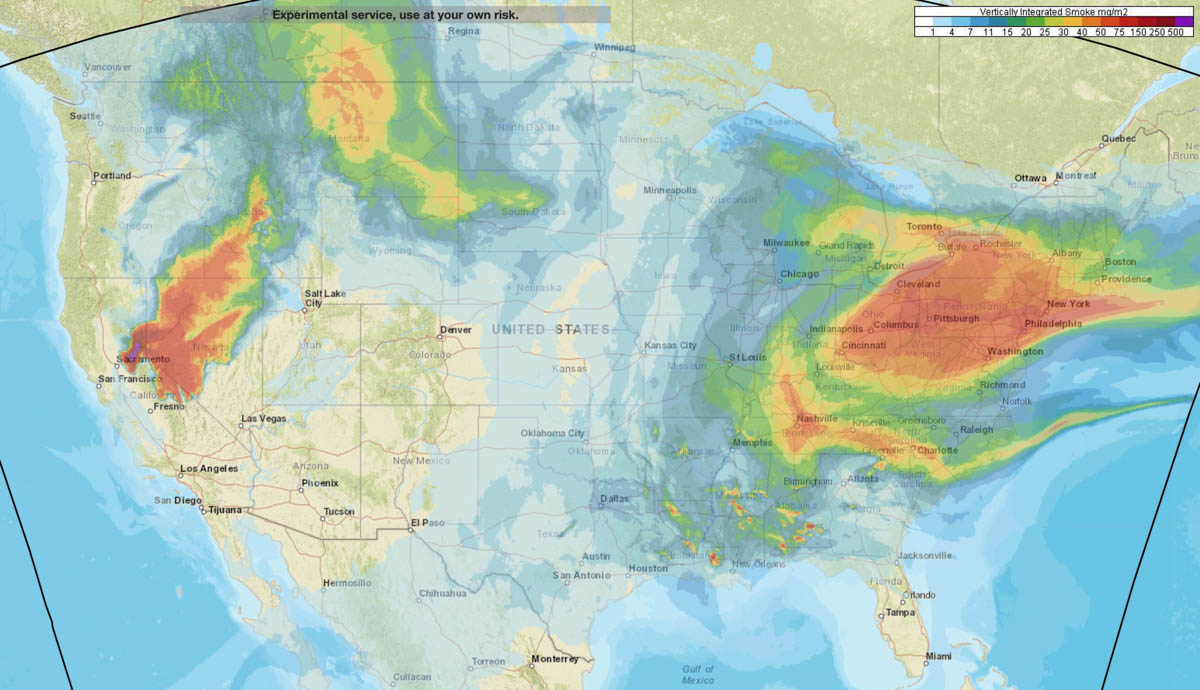
Forecast for distribution of smoke at 1 a.m. PDT Sept. 16, 2022. NOAA.
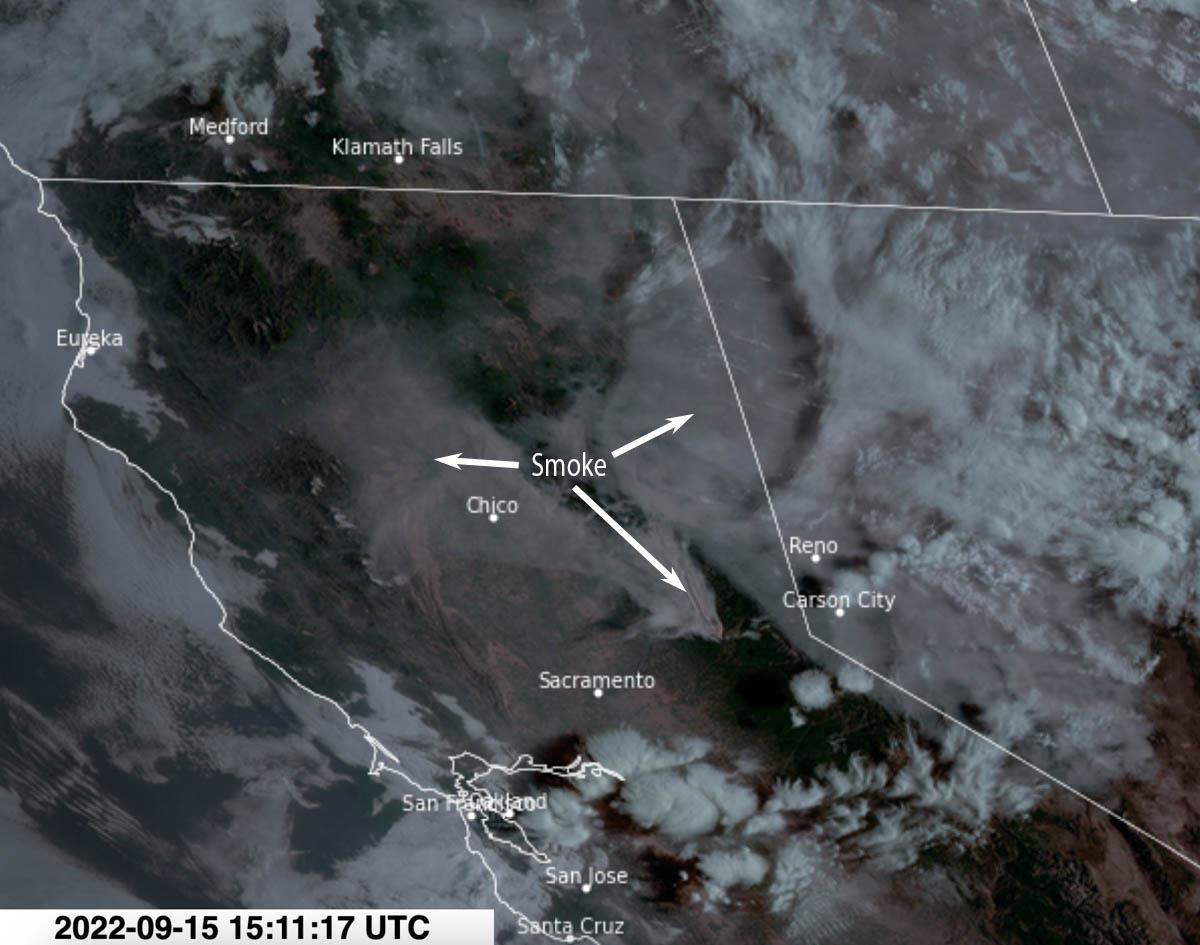
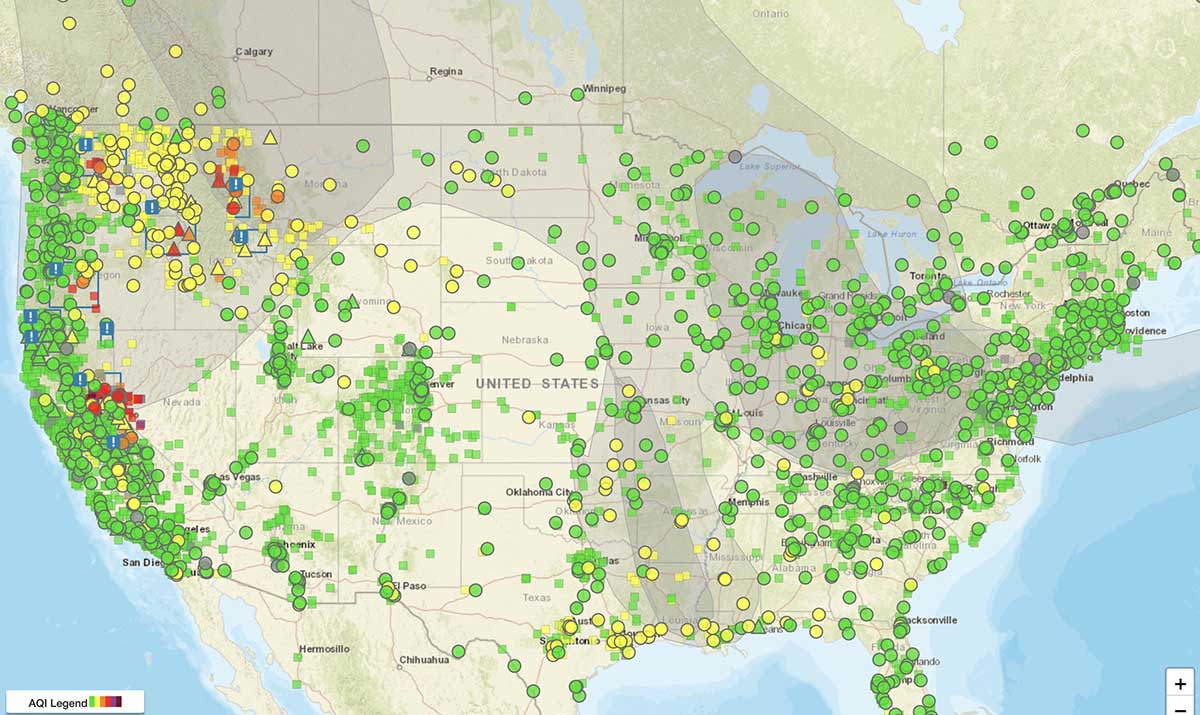
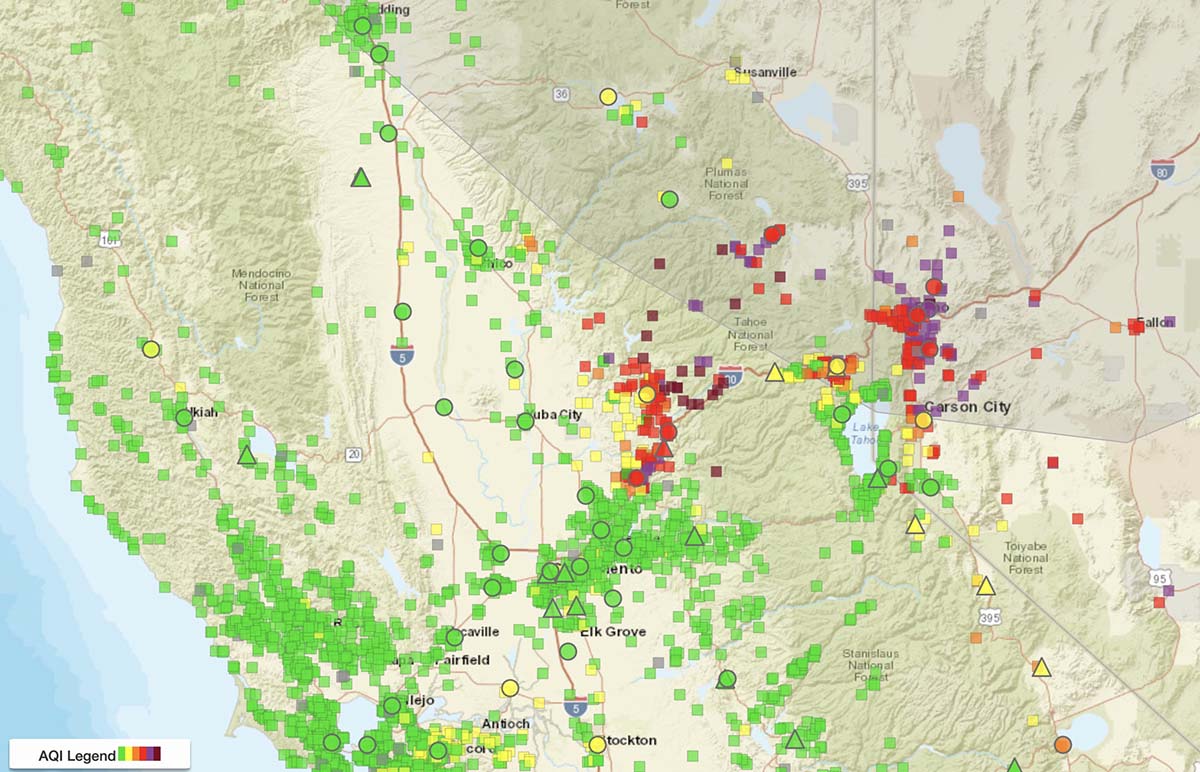
Wednesday afternoon most of the smoke from the Mosquito Fire 35 miles northeast of Sacramento was moving into Northern Nevada. But that changed overnight as it spread northwest toward Chico and Redding in north-central California.
A forecast produced by NOAA expects that by 1 a.m. Friday it will again be moving into Northern Nevada, Eastern Oregon, and Southern Idaho. And from there, most likely Montana.
Satellite photo showing smoke from the Mosquito Fire at 8:11 a.m. PDT Sept. 15, 2022.
Below is the current air quality, produced by AirNow.
Air quality, from AirNow, at 8:54 a.m. PDT Sept 15, 2022. Air quality, vicinity of Mosquito Fire, from AirNow, at 8:54 a.m. PDT Sept 15, 2022.