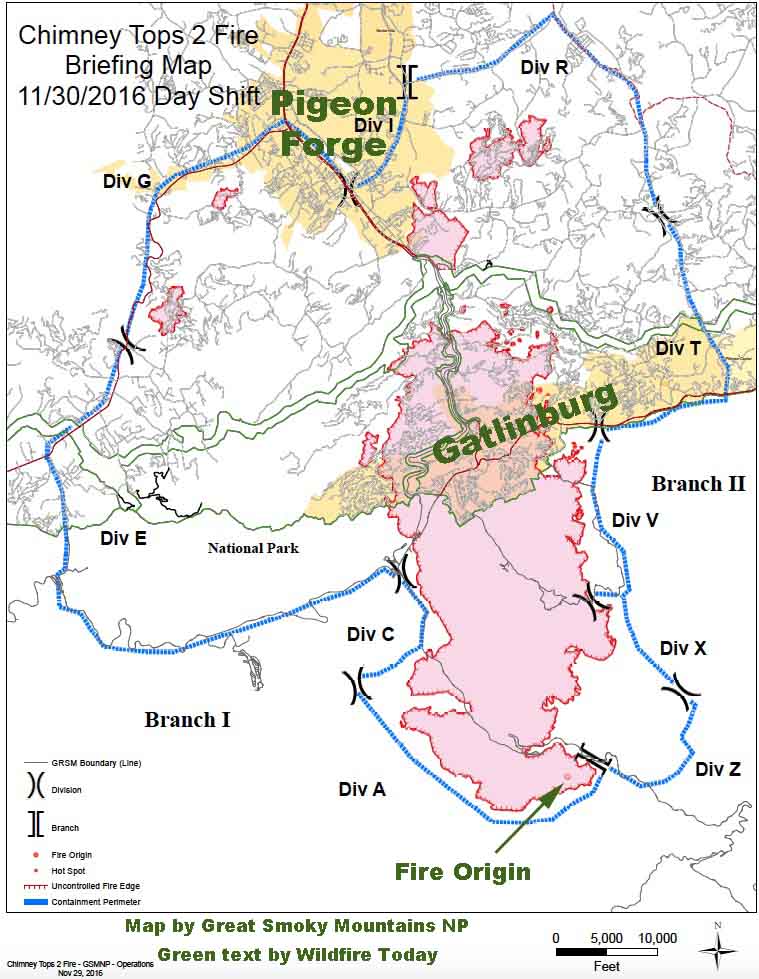
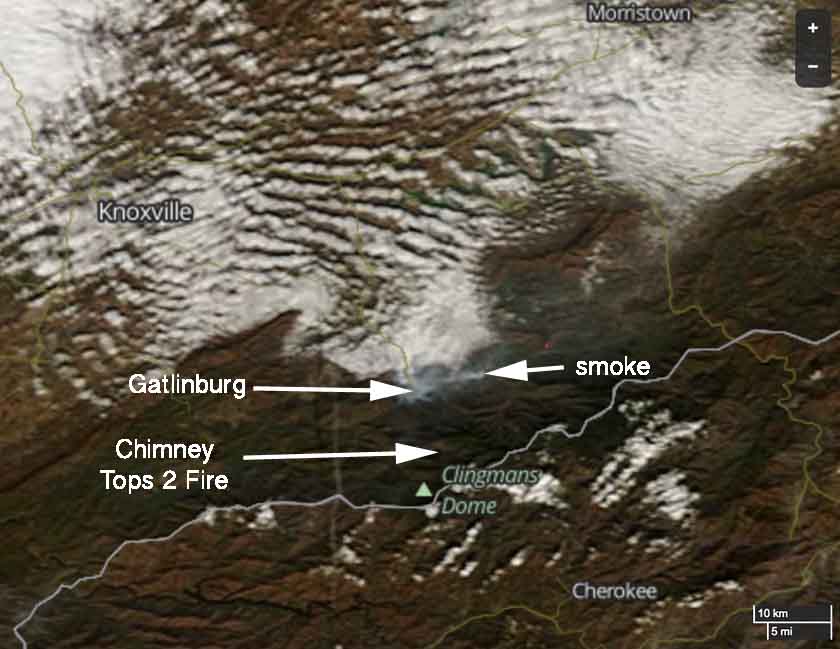
Briefing map of the Chimney Tops 2 Fire. Prepared by Great Smoky Mountains National Park November 29, 2016 for the November 30 day shift. The green text was added by Wildfire Today. Click to enlarge.
As far as we know this is the first publicly available map of the Chimney Tops 2 Fire that burned from Great Smoky Mountains National Park into Gatlinburg and Pigeon Forge, Tennessee. The incident management team reports it has burned 15,653 acres.
We are not aware of an official estimate of the number of structures destroyed in the fire since Tuesday morning’s report from the Tennessee Emergency Management Agency (TEMA) of approximately 100 homes in Sevier County Tennessee having been either damaged or destroyed.
WBIR has a list of areas affected by the fire with brief descriptions of the damage. From that information it appears that the number of structures destroyed will be much larger than the early estimate.
On Wednesday a Type 1 Incident Management Team run by Mike Dueitt assumed command of the Chimney Tops 2 Fire. Teams like this are made up of federal and state interagency team members from across the country who collaboratively manage wildland fires and other natural disasters.
The evacuation of Pigeon Forge has been lifted but is still in effect for Gatlinburg.
Firefighters will be aided on Wednesday by rain. The NWS predicts a 73 to 100 percent chance of precipitation into the evening with accumulations of about a third of an inch.
Sevier County officials reported that there have been three fatalities related to the fires in the Gatlinburg, Tennessee area. Sevier County includes Pigeon Forge, Gatlinburg, and part of the Great Smoky Mountains National Park. At least 14 people have been injured.
Three individuals with severe burns were transferred from the University of Tennessee’s Knoxville (UTK) Hospital to Vanderbilt Medical Center in Nashville Monday night. A fourth person with burns to their face continues to be evaluated at UTK.
Pigeon Forge officials estimate 500 people were evacuated on Monday night. Approximately 125 people remain displaced and in local shelters in Pigeon Forge. About 14,000 residents and visitors evacuated from Gatlinburg.
The National Park service estimates that a total of 15,000 acres have burned in Great Smoky Mountains National Park and in the areas in and around Gatlinburg and Pigeon Forge. On Wednesday the NPS will transfer command of the fires within the park to a Type 1 Incident Management Team run by Mike Dueitt. Teams like this are made up of federal and state interagency team members from across the country who collaboratively manage wildland fires and other natural disasters.
Map of the Gatlinburg, TN area, November 29, 2016.
Eventually we hope to obtain a map, much better than the one above, of the fires in the Gatlinburg area. Check back later. (UPDATE: we posted a much better map on November 30.)
We do not yet have complete information about how many fires are burning, where they are, the causes, and where all of the fire(s) started that eventually burned into the communities of Gatlinburg and Pigeon Forge.
The NPS reported Tuesday morning that 80 mph winds gusts, low humidities, and drought conditions…
…caused the fire burning in the National Park to spread rapidly and unpredictably, in spite of suppression efforts on Sunday that included helicopter water drops. Wind gusts carried burning embers long distances causing new spot fires to ignite across the north-central area of the park and into Gatlinburg. In addition, high winds caused numerous trees to fall throughout the evening on Monday bringing down power lines across the area that ignited additional new fires that spread rapidly due to sustained winds of over 40 mph.
Presumably the fire within the park was the Chimney Tops 2 Fire, which started November 23 and was reported to be 10 acres Sunday evening, November 27. Apparently the NPS was not able to completely suppress the fire during that four-day period.
The Tennessee Emergency Management Agency, in their Tuesday update, wrote:
The Chimney Top Fire, which began in the Great Smoky Mountains, spread very rapidly yesterday evening as high winds pushed flames onto private property.
They were probably referring to the Chimney Tops 2 Fire.
****
(UPDATED at 10:13 a.m. EST November 29, 2016)
About 100 homes in Seiver County Tennessee have been either damaged or destroyed in wildfires that started in or near Great Smoky Mountains National Park in eastern Tennessee. The state’s Emergency Management Agency (TEMA) which conducted a quick preliminary survey, reported at 3 a.m. ET Tuesday that about 10 of those homes were in Gatlinburg. In addition, 30 other structures in Gatlinburg have been damaged or destroyed, including a 16-story hotel on Regan Drive and the Driftwood Apartments near the Park Vista Hotel.
After 32 years of trapping wild hogs, darting nuisance bears and chasing wandering elk, Kim Delozier, the Great Smoky Mountains National Park Chief Wildlife Biologist, is retiring. Knoxnews.com has an article, describing some of his more interesting memories. Here is an excerpt.
…In the early 1990s, the Smokies and the U.S. Fish and Wildlife Service tried unsuccessfully to reintroduce red wolves in the park. None of the wolf pups born in the park survived, and after 10 years, the project came to a halt.
“We couldn’t release enough wolves to out-compete the coyotes in the park,” Delozier said. “You just can’t take a captive animal, open the cage and expect it to make it in the wild.”
In 2001, the park launched an ambitious program to bring elk – a species that hadn’t roamed the mountains since the late 1700s – back to Cataloochee Valley in North Carolina. Delozier said what he remembers most about this successful campaign was the tremendous support from partners like the Rocky Mountain Elk Foundation, the Friends of the Smokies and the public at large.
“Unlike the wolf reintroduction, bringing elk back to the park was something people genuinely wanted to see happen,” he said.
Delozier’s favorite memory from his three decades on the job? That would be a late afternoon in Cataloochee Valley when he was greeted with the sight of 15 or 20 elk grazing just hours after their release.
And his worst memory? Delozier said that by far it would be May 21, 2000, the day Glenda Ann Bradley, a 50-year-old elementary school teacher from Cosby, was mauled to death by a 112-pound black bear while hiking in the Elkmont section of the park.
In his office, Delozier keeps Bradley’s funeral announcement on the wall. Delozier said even though the bear had no prior record of aggressive behavior, he still felt guilty.
“I feel responsible for all the bears in the park, nomatter what they do, whether they’re good or bad,” he said. “Part of the reason I’m ready to retire is this feeling of responsibility for every pig, elk and bear in the Smokies. You just know when it’s time.”
Prescribed fire at Cades Cove in Great Smoky Mountains National Park. Photo: Joe Strickland.
The National Park Service planned to burn 700 acres at Cades Cove in Great Smoky Mountains National Park last week. This photo from their Facebook page was posted on November 13. It is undated, but is most likely from that project. The park burns some of their fields on a three-year rotation to keep trees from invading and to preserve the historic scenes.