Australia to standardize air operations

Aussie helicopter
A helicopter works on a fire in Australia. Photo: Queensland Fire and Rescue Service

As a result of recent accidents involving aircraft working on wildfires, authorities in Australia are developing standardized procedures across the country in order to reduce the chances of additional mid-air collisions and other accidents involving firefighting aircraft.

Here is an excerpt from an article at Flightglobal:

Australia’s fire authorities are reviewing a draft firefighting operations manual designed to standardise aerial firefighting procedures across the country.

The development of the manual follows a firefighting review conducted in 2009 by the Civil Aviation Safety Authority after a number of accidents involving firefighting aircraft in the 2009 fire season.

The issue of a lack of standardised procedures was highlighted in the investigation by the Australian Transport Safety Bureau of a midair collision between a Eurocopter AS350B and a Eurocopter/Kawasaki BK117 performing aerial firebombing operations 20km (11nm) south-east of Orange aerodrome, New South Wales in December 2009.

The final report into the accident was released in late November. During one of the water drop sequences, while in the vicinity of the drop point, the BK117’s main rotor blade tip contacted the trailing edge of the AS350B’s vertical fin above the tail rotor arc, resulting in slight damage to the latter.

Although there were no injuries, “the outcome could have been more serious”, the ATSB points out. One of the accidents involving firefighting aircraft in New South Wales during the 2009 fire season resulted in the loss of a life.

In its investigation of the BK117 and AS350B collision, the ATSB found that there were no published procedures for pilots to follow to ensure separation from other aircraft when there was no air attack supervisor present.

Rather, the system relied on the airmanship and experience of pilots to mutually arrange separation. The ATSB determined that neither pilot in that incident was aware of the position of the other helicopter as they approached the drop point.

Thanks Shane

Helicopter shot while working on prescribed fire

A Bell Jet Ranger was shot twice with a high powered rifle while it was flying under contract to do aerial ignition using a heli-torch on a prescribed fire in Idaho. The pilot was 69-year old Vietnam War veteran Earl Palmer, operating the ship for Hillcrest Aircraft Company out of Lewiston, Idaho.

Mr. Palmer says there were four shots, two of which struck the helicopter. The pilot was quoted as saying that a control tube was struck and cracked by a bullet. He said the helicopter was “within minutes of coming apart at which point the helicopter would have wrecked.”

The last time he was shot down was in Vietnam when the gunship he was flying sustained a bullet through the engine, and he ended up in  a rice paddy.

Several people heard the shots and a suspect was identified within 24 hours. The FBI is working with local authorities to determine what charges will be filed.

The prescribed fire was on land owned by Potlatch Corporation near Clarkia, Idaho. Check out the video below.

USFS modifies night flying requirements

A Los Angeles County fire helicopter does a drop over a hotspot in Rancho Palos Verdes on Aug. 28, 2009. (Mark J. Terrill/Associated Press)
A Los Angeles County fire helicopter does a drop over a hotspot in Rancho Palos Verdes on Aug. 28, 2009. (Mark J. Terrill)

The U. S. Forest Service (USFS) has modified their internal regulations for operating helicopters at night. Effective October 13, 2010, multi-engine helicopters are no longer required for night flights. Single-engine helicopters may now be used if they are powered by a turbine engine.

This was the standard that had been in effect since April 19, 2009 (From FSM 5700, 5716.2):

5716.2 – Night Flying
Use only multi-engine aircraft for night flights.

The new regulation:

5716.2 – Night Flying
Use only multi-engine or turbine powered single-engine aircraft for night flights that meet the applicable requirements in FAR Part 91 and Part 61as referenced in FSH 5709.16 or applicable contracts.

[…]

Low-level helicopter flight operations will only be conducted using NVG [Night Vision Goggles]. Helicopters will be approved for such an operation.

This will make a much larger pool of helicopters available to be considered for night flying. However it is our understanding that modifications may have to be made to some helicopters in order for them to be compatible with night vision goggles, including the ability to turn the instrument lights down to a very low level so that they do not overwhelm the goggles.

This change may indicate that the USFS actually IS beginning to take a look at restoring the night-flying helicopter program. After the USFS was criticized by the Los Angeles County Fire Department and some politicians for not using helicopters during the first night of the Station Fire in August, 2009, their Fire and Aviation Management Director Tom Harbor was quoted as saying:

We are in the process . . . of one more time taking a look at night-flying operations. But we will have to make sure that those operations, before we change our policy, are worth the benefits.

The USFS had a night flying program in the mid-1970’s until two helicopters collided 1977, one operated by the USFS and the other by the Los Angeles County Fire Department. The helicopters were preparing to land at a water reloading point. Both pilots were wearing night-vision goggles. One of the pilots was killed, and the other sustained serious injuries.

In July of 2008 Wildfire Today conducted a poll, asking:

“Should helicopters fight fire at night?”

At the close of the poll 231 people had voted. The results were:

Yes: 39.8%
No: 51.9%
Don’t Know: 8.2%

Poll helicopters night flying July 2008

Firefighting helicopter crashes in B.C, 2 pilots hospitalized

A 214-B, from Tranwest's web site

A firefighting helicopter with a two-person crew went down on Thursday while working on a fire in British Columbia, about 340 kilometers (211 miles) northeast of Vancouver. Here is a report from CTV:

A helicopter bucketing water to a wildfire blazing in B.C.’s southern Interior crashed Thursday afternoon, sending its occupants to hospital.

Two people were on board when the Bell 214-B, carrying a full load of water, hit the side of a large hill while fighting the Jade Wildfire burning northwest of Lillooet, about two hours west of Kamloops.

The pilot was taken to Royal Inland Hospital in Kamloops with pain in his legs, while the co-pilot is being held for observation in Lillooet.

The helicopter was on contract to the B.C. Fire Service by TransWest Helicopters, based in Chilliwack.

It is still not known what caused the crash.

We are glad the pilots are not too seriously hurt, and hope they get well soon. It could have been a lot worse.

UPDATE @ 11:00 p.m. MT, July 29:

News1130 reports:

Transwest Helicopters confirms one of its choppers has crashed while fighting a wildfire near Lillooet Thursday afternoon.

The helicopter went down as the crew was bucketing the fire from above near the active edge of the blaze. Another chopper was in the area and was able to call for help immediately.

The pilot, a 61-year-old man from Vernon, and his 27-year old co-pilot from Abbotsford, survived the accident and have been taken to hospital with minor injuries. The pilot suffered a concussion and a leg injury, while the co-pilot ended up with bumps and bruises.

The cause of the accident is not known. Transwest is expecting to be able to remove the wreckage by Friday.

The pilots walked away from the crash.

“Extraction crews worked very quickly in getting to the two men and moving them out of further harm’s way, given the danger that the crash location posed,” said RCMP Cpl Dan Moskaluk in a press release. “It was essentially at the fire’s edge in a very highly active fire area.

From the Toronto Sun:

VANCOUVER – Two pilots involved in a wildfire helicopter crash Thursday are expected to recover, according to Transwest Helicopters.

The Bell 214B helicopter lost power while carrying a bucket of fire retardant up a hill towards an active forest fire in the Porcupine Creek area of Lillooet, B.C.

The 61-year-old pilot was forced to make an emergency crash landing on a logging road.

“The helicopter was damaged pretty extensively,” said Alison Maas, co-owner of the Chilliwack-based helicopter company. “I can’t say what happened, only what appears to have happened. [The cause of the loss of power] will be up to the Transportation Safety Board people.”

From Aviation.ca:

“They dropped the water bucket and flew downhill trying to make a clearing but had a hard landing and the aircraft bowled over, ” said the owner of Transwest Helicopters. “Our pilot has been working for us for over 10 years,” he said. “He’s also a personal friend of mine and our concern was strictly for the crew. The helicopter can always be repaired.”

Firewatch Cobra helicopter

Firewatch Cobra
Pilot Steve Jensen with the Firewatch Cobra Helicopter. Photo by Rick Hartigan, Fire Information Officer, Arizona Central West Zone Incident Management Team. 8/3/2006

The U.S. Forest Service has two helicopters they call Firewatch Cobras which are retrofitted Bell AH-1 Cobra attack helicopters. The USFS has them outfitted with infrared sensors so that they can be used for close in intelligence support for ground troops, GIS mapping, real time color video, geo-referenced infrared, and infrared downlink. In addition to intelligence gathering, they are also used as a platform for an Air Attack Group Supervisor (ATGS) or a Helicopter Coordinator (HLCO).

Firewatch Cobra turret
The FLIR Turret (Forward Looking Infrared) is equipped with an infrared camera, low light color camera, spotter scope, laser range finder, and a laser pointer.
Firewatch Cobra
Firewatch Cobra on the Bar Complex Fire. USFS photo

This year one of the ships is based at Redding, California, and the other is just outside of Boise, Idaho at Lucky Peak Helibase. They are owned by the USFS, and staffed by an ATGS, but they are contractor supported and maintained. (Could this be the model for a new fleet of modern, safe, air tankers? Government-owned and contractor supported?)

The helicopter module includes a “Data Van” staffed with a GIS technician who can use the shape files produced on the helicopter to make perimeter maps of the fire. The van is also used for receiving and viewing the downlinked live video feed from the helicopter.

Firewatch Cobra Data Van

Specifications of the Firewatch Cobras (from the Firewatch Cobra web site)

Propulsion

  • Number of Engines: 1 [a newer version currently being used by the Marines has two engines]
  • Engine: T53-L-703
  • Horsepower: 1800

Performance

  • Range: 362 miles
  • Cruise Speed: 166 mph
  • Max Speed: 219 mph
  • Climb Rate: 1,680 feet per minute
  • Ceiling: 10,800 feet

N109Z was manufactured in 1969.  N107Z was manufactured in 1983.

New Keenwild helibase opens

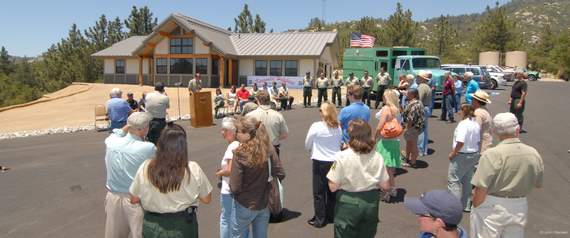
Keenwild helibase

The San Bernardino National Forest held an opening ceremony for their new helibase at Keenwild earlier this month. The seven-member crew works with Helicopter 535, a Bell 407, at these new facilities in southern California near Idyllwild.

Keenwild helibase

Below is an excerpt from an article in the Press Enterprise. The USFS sent us these photos, and we were told that the photo credit should go to John Miller.

Rep. Mary Bono Mack, R-Palm Springs; San Bernardino National Forest Supervisor Jeanne Wade Evans and Idyllwild District Ranger Laurie Rosenthal were among event speakers but they referred to the “gray beards” in the crowd as those who knew the history of the base, which opened in 1963.

Bono Mack credited Norm Walker as the “squeaky wheel” who shared information about the facilities need and answered questions that came up. Walker was the forest’s Idyllwild district fire chief before he retired, and is now interim chief of a community fire district in Idyllwild.

In the beginning, there was a makeshift helicopter landing pad down a single-lane access road near the Keenwild fire station. As Rosenthal told the story, in the 1970s the crew used the dismantled remains of the old Ranger Peak fire lookout to build the 560-square-foot office that was moved uphill in 1974.

Lack of funds forced based closure, but six years later it reopened in 2001 with the showing that the base was a firefighting asset and a spot on a competitive capital projects list.

An initial $600,000 was set aside in 2007, and then Congresswoman Bono Mack assured that the remainder needed was part of an appropriations bill. Bono Mack said her job is “to make sure you have the resources to do your job best.”

The $1,024,000 project by CGO Construction Co. of Rancho Cucamonga began in June 2009. The work included reconstruction of the helipad and access road and the building, which includes an operations center, offices, a kitchen, restrooms and a locker room.

The crew moved back in last month from temporary quarters by the Cranston Ranger Station on Highway 74 east of Hemet.

Check out the helitack crew’s Facebook page.

Thanks John

Firefighting helicopters in Hawaii

Windward Aviation helicopter
Windward Aviation helicopter working on a wildfire on Maui.

The Maui News has an interesting article about the helicopter pilots that helped fight the recent fire on Maui that is currently 90% contained at 6,200 acres. Windward Aviation used some of their Hughes 369D (aka MD 500) helicopters to drop water on the wind-driven fire.

Here is an excerpt:

[Windward Aviation pilot Cliff] Cates said it was apparent from the time he and three other pilots arrived on the scene shortly after dawn Tuesday that the fire would soon get out of hand.

“It was around 200 to 300 acres and growing rapidly,” he said. “You can kinda tell when you show up on something like that. It’s very dependent on wind speed and unburned fuel. We saw that, and we knew it would be quite a fight.”

The fire was “raging” toward Maalaea Harbor, threatening Buzz’s Wharf Restaurant, the Harbor Shops and a small residential enclave.

“We did everything in our power to protect the homes down there, along with the ground crews,” Cates said.

With a cracker-dry mountainside and winds gusting at more than 40 mph, the fire was “spotting,” and spread quickly, said Windward Aviation owner Don Shearer.

“It was picking up embers and throwing them a quarter to a half-mile downwind,” he said.

Under those conditions, firefighters on the ground and helicopters making water drops from above can only try to “steer” the blaze, not stop it, he said.

“We were trying to hold it at the windmill break road, and the fire went right up to the (60-foot-wide) road and jumped a quarter-mile downwind,” he said.

“You can’t do too much with the head, because it’s burning so hot and fast,” Cates said. “You just try to control the flanks.”

The high winds also buffet the helicopters, making flying along the treacherous ridgelines even more difficult, and frustrating pilots as they try to drop 120-gallon buckets of water with perfect accuracy, he added.

“You’ve only got one shot at it, and if you don’t make it, it’s a total waste,” Cates said.

Pilots draw from whatever source of water is closest, and even drained swimming pools in Launiupoko when battling a fast-moving brush fire that threatened homes there a few years ago.

Cates said the team got lucky when the fire began burning through native forests high in the West Maui Mountains; they found a natural water source at around 4,000 feet of elevation.

“We were able to get in there and stop most of that,” he said.

In the middle of an already difficult operation Tuesday, Cates and his fellow pilots got a jolt when one helicopter dropped a bucket of water on a separate fire that had broken out near the Maui Electric Co. Maalaea power plant.

“Apparently salt water is more conductive than fresh water, and he dropped 120 gallons right through the powerlines,” Cates said with a laugh. “Thirty-thousand volts just arced through it. It was a really, really bright flash, and then a sonic boom.”

Cates was joking about it Friday, but he said the incident gave him and the other pilot a scare.

“I thought either his helicopter was coming apart, or mine was,” he said.

Cates said fighting fires was one of the most “intense” things he’d ever done as a pilot.

“There’s times when we’re literally 15 feet away from each other, pulling water from the same pond,” he said. “You just get used to it. I have to have confidence in the guys I’m working with. You grow a tight bond, and you know you can count on the guy next to you.”

If you follow the Adventures of Chopper Chick!, the name Windward Aviation might be familiar to you. The site is written by Desiree Horton who flies helicopters in support of wildfires, heavy lift operations, and Los Angeles television stations.  In August 2008 she was asked to appear in one episode of a reality series that featured her and Windward. The story line was supposed to be that she was applying for a job there, but the producers were simply trying to find a way to get her into the show. They probably figured that a pretty helicopter pilot would add another dimension to the program. The show was called Maui Choppers and at least six episodes aired on TruTV in December, 2008.

Here are a couple of pictures from her site that were taken at the filming for the television show. They were taken by Bob Bangerter.

Maui Choppers
Desiree Horton at the filming for Maui Choppers
Maui Choppers
Desiree Horton and a helicopter mechanic from Windward Aviation.

San Diego power company to purchase Air-Crane and share with County

San Diego Gas and Electric, the target of criticism and law suits for starting fires, is purchasing a large Type 1 helicopter that it will share with San Diego County for suppressing them. SDG&E has ordered a new Erickson Air-Crane S64F Helitanker at a cost of $30 million, and expects it to be delivered in late August after it is built in Oregon.

The power company has reached an agreement with the County which calls for each organization to put $150,000 into an account this year that could be used for up to 40 hours of wildland firefighting.  If the ship is needed for a fire, it will be dispatched through the San Diego City Fire-Rescue Department. Last year SDG&E leased an Air-Crane, which like the new one on order, was primarily used for maintaining their power lines.

Currently the City and the County of San Diego each have two helicopters that can be used for firefighting. In addition, I believe the U.S. Forest Service has another one nearby at Ramona.

More information.

Families of Iron 44 helicopter crash victims reportedly settle suits

The Oregonian newspaper reports that seven of the families of the firefighters that were killed and three that were injured in the crash of the helicopter on the Iron 44 fire in 2008 have reached a tentative settlement in various lawsuits.

On August 5, 2008, a Sikorsky S-61 helicopter crashed as it was taking off from a helispot on the fire in the Shasta-Trinity National Forest in northern California. Nine were killed, including a pilot, a check pilot, and seven contract firefighters with Grayback Forestry.

An attorney representing some of the families said a tentative agreement has been reached with Carson Helicopters, Columbia Helicopters, and the U.S. Forest Service, but the dollar amount is still being finalized. No agreement has yet been reached with Sikorsky, the manufacturer of the helicopter, or General Electric, which built the engines.

The Oregonian reports that the families of Roark Schwanenberg, the pilot who died, and Jim Ramage, a Forest Service check pilot, as well as surviving pilot William Coultas, did not reach settlements with any of the five defendants.

A contributing factor in the crash may have been the weight of the helicopter as it attempted to take off from the helispot with the ten firefighters, tools, two pilots, and one check pilot. In their report, the National Transportation Safety Board estimated that the actual empty weight of the helicopter was 13,845 pounds, while Carson Helicopters stated in their contract proposal that the weight was 12,013 pounds. For the purpose of load calculations on the day of the crash, the pilot assumed the weight to be 12,408 pounds, which was 1,437 pounds less than the actual weight estimated by the NTSB. In addition, the manifest for that fatal flight calculated that the payload was 2,355 pounds, while the NTSB report estimated that the actual payload was 3,005, a difference of 650 pounds. So the actual total weight of the loaded helicopter as it attempted to take off from the helispot may have been 2,087 pounds heavier than anyone at the fire realized, according to data in the report.

After the crash, the U.S. Forest Service weighed the 10 Carson helicopters that were under contract. They found that seven of them were heavier than Carson had stated in their contract proposals, by an average of 490 pounds. The USFS later canceled their contract with Carson.

In 2009 Carson obtained a contract to supply seven Sikorsky S-61 helicopters to haul supplies for the U. S. military in Afghanistan. The company is partnering with a subsidiary of Blackwater Worldwide, which recently changed their name to “Xe”.

Killed on the Iron 44 incident were pilot Roark Schwanenberg, check pilot Jim Ramage, Shawn Blazer, Scott Charlson, Matthew Hammer, Edrik Gomez, Bryan Rich, David Steele, and Steven “Caleb” Renno. Injured were William Coultas, Richard Schroeder Jr., Jonathan Frohreich, and Michael Brown.

The Wildland Firefighter Foundation has a tribute page online [HERE] and CALFIRE has one [HERE].

Night flying helicopters discussed in Senate hearing

Did anyone see the hearing conducted by the Senate Appropriations Subcommittee on Interior this morning? The agenda was supposed to be “Examination of the firefighting policy with U.S. Forest Service and U.S. Department of Interior”. The following report by 89.3 KPPC Southern California Public Radio concentrates on the use of night flying helicopters for fire suppression, as did other reports.

The U.S. Forest Service won’t deploy night-flying aircraft to fight fires before the end of Southern California’s traditional fire season.

The Forest Service has maintained a ban on fighting fires by air after dark since a helicopter crash back in 1977. Critics say that if the agency had allowed water-tanker planes in the air after dark, that equipment might have stopped last summer’s deadly Station Fire much sooner.

At a U.S. Senate hearing, Forest Service officials said they’re reconsidering the ban on night time aerial firefighting. The problem is that the Service doesn’t have the technology to do it. Democratic Congressman Adam Schiff of Burbank says they “no longer have the night time flying goggles or the equipment in the helicopter to be able to use them.”

Schiff was invited by his California colleague Senator Dianne Feinstein to join senators who questioned the Forest Service’s night time ban. Schiff says the Service is considering two options.

“One is to acquire the capability in house. Another is to work with some of their cooperators — which is what they call L.A. County, L.A. City, that already have the capacity. Whether they should basically contract with them.”

The problem is that local governments have their own equipment challenges. Last summer, a Los Angeles County helicopter was in the air, fighting the Station Fire after dark until a medical emergency diverted the chopper from the fire scene.

If the Forest Service lifts its ban, the earliest it could have aircraft ready to fly at night would be November, well into the Southland’s wildfire season.

UPDATE:

Here is an excerpt from the LA Times’ coverage of the hearing:

The head of the U.S. Forest Service told a Senate panel Wednesday that water-dropping helicopters would have been deployed during the critical first night of last summer’s disastrous Station blaze if they had been available and that the agency is considering ending its decades-long ban on using federal firefighting aircraft after dark.

Under pointed questioning by Sen. Dianne Feinstein (D-Calif.) and Rep. Adam Schiff (D-Burbank), Forest Service Chief Tom Tidwell also defended the agency’s handling of the fire the next morning, when a heavy air assault did not begin until several hours after daylight. He said aircraft alone would not have stopped the flames from raging out of control.

But Schiff expressed doubt that an earlier air attack on Day 2 would have been ineffective because of steep terrain, as the Forest Service determined in November after an internal review.

“The conclusion that it would not have helped anyway is a little too facile,” he said.

Feinstein, who chairs the Senate subcommittee that held Wednesday’s hearing, said equipping the Forest Service with night-flying aircraft is a “real priority,” especially in California. She said global warming and enduring droughts have heightened the danger of huge wildfires that threaten neighborhoods.

“Fires are not going to get better, they’re going to get worse,” she said.