Long-term health scars left by LA’s historic wildfires

The fires have been long extinguished, but the health effects of Los Angeles’ destructive 2025 wildfires are still living on one year later.

The Palisades, Eaton, Hurst, Kenneth, Hughes and Sepulveda fires killed 440 people, destroyed nearly 16,000 homes, and burned more than 55,000 acres of land from Jan. 7 through February. The Palisades Fire alone caused an estimated $51.7 billion worth of home damage, according to a July analysis from Redfin.

LA residents are dealing with not just the emotional toll of the tragedy on its anniversary, but the physical toll as well, according to health experts from the University of California, Los Angeles. Residents’ lungs, in particular, face ongoing health challenges.

“Many individuals who followed up with me six months later also mentioned their symptoms flared with the fires,” UCLA Health pulmonologist and associate clinical professor May-Lin Wilgus said in a recent article posted by the university. “These patients often had continued exposures — such as returning to smoke-damaged homes or encountering high levels of heavy-metal contamination — so it does seem to be a trigger.”

A study published in December by LA’s Smidt Heart Institute and other researchers found that more severe forms of illness presented early in some susceptible LA residents, including excess emergency encounters for not only pulmonary illness and acute myocardial infarction. But, less severe effects have persisted or started to present with delayed timing, including increased systemic illness through blood chemistry laboratory abnormalities.

“Systemic health effects are not often reported in post wildfire outcomes studies, perhaps because they are not easily detected or because they are associated more with WUI than wildland-only fire exposures,” the research said. “Indeed, the smoke produced by WUI compared with wildland-only fires is known to contain not only a more complex aggregate of volatile and semi-volatile chemical constituents but also toxic metals, which may alter the epigenetic profiles of immune cells with broad tissue distribution in exposed individuals.”

Dr. Wilgus advised communities to start preparing for the next major wildfire now to lessen future adverse health effects, including using high-quality air filters, creating evacuation plans, and storing an emergency go-bag with food, water and medications.

“We have a very wide network of pulmonology clinics throughout the region, where we are treating patients who may have been affected,” Dr. Wilgus said. “Throughout Los Angeles, we need to be more aware and prepared, as well as support ongoing research to help reduce these impacts.”

Video helps children learn about firefighting helicopters

In a comment below our article about the Los Angeles County Fire Department Air Operations program, Chris pointed us to this excellent video that introduces firefighting helicopters to young children, saying his two-year old is obsessed with it. It has commercials, but you can skip through most of them after a few seconds.

The video features Los Angeles Fire Department’s Leonardo AW139 intermediate twin engine helicopters. The department has six helicopters, four AW139’s and two Bell Jet Rangers.

Thanks Chris!

Firefighting at Los Angeles International Airport

Los Angeles Fire Department airport rescue
Screen grab from LAFD video.

Airport firefighting is a very specialized niche —  there are not many similarities in what they do compared to most other firefighters. For example, one of the Los Angeles Fire Department’s rigs at the city’s airport can apply by the push of a button on the dash, water, foam, dry chemical, or Halotron (a clean agent). That truck also has a penetrator device which can pierce the fuselage of an aircraft in order to apply one of the four suppressing agents in the interior of the aircraft.

Los Angeles Fire Department airport rescue
A penetrating nozzle on a Los Angeles Fire Department airport rescue truck. Screen grab from LAFD video.

Much more information is in the video below about the Los Angeles Fire Department Airport Rescue Firefighting organization.

Introduction to the Los Angeles Fire Department helicopter program

LAFD helicopter
AgustaWestland AW139. Screenshot from the LAFD video.

The Los Angeles Fire Department(LAFD) aviation program started in 1962 with one Bell 47. Today they have six helicopters, four AgustaWestland AW139’s and two Bell Jet Rangers. To work as a pilot with the Department, you can’t simply walk in off the street. The minimum qualifications are:

  • Private helicopter license,
  • At least 100 hours of flight time in a helicopter, and,
  • Four years experience as a firefighter with the LAFD.

LAFD helicopter crane rescue
Screenshot from the LAFD video.

After a pilot is accepted into the program they are shipped over to the Los Angeles Police Department aviation program where they receive training with 150 hours of flight time, a commercial license, and an instrument rating. If successful there, they go back to the Fire Department and get another 200 flight hours of training. Then there is additional schooling at AgustaWestland to fly their 139.

The video below has much more information.

NTSB investigating LAFD helicopter tree strike

lafd fire 4 helicopter
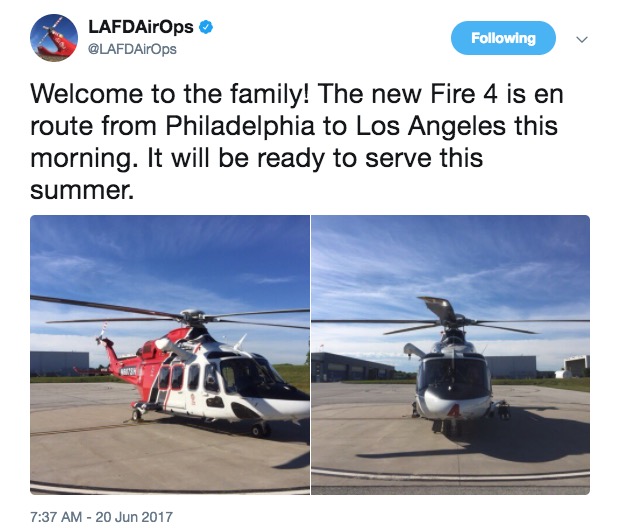
On June 20 the Los Angeles Fire Department announced their just-purchased helicopter, “Fire 4”, was en route to LA.

The Los Angeles Fire Department is not saying much about an NTSB investigation into an accident that involved their brand new firefighting helicopter, Fire 4, an AW139 that they just put into service one or two months ago. On September 2 Fire 4 was making water drops on the La Tuna Fire in Los Angeles and struck a tree, according to a preliminary accident report by the FAA.

At least one person told NBC 4 in Los Angeles that while monitoring fire traffic on a scanner he heard the pilot say he hit something and put out a Mayday call. The pilot made a successful emergency landing at the Verdugo Hills High School football field.

fire 3 lafd helicopter
File photo of Fire 4’s sister ship, Fire 3. Both are AW139’s. LAFD photo.

You’ll probably want to click on full screen at bottom-right in the video below.

Heliweb has photos that appear to show small tree branches embedded in the damaged areas of the fuselage while the aircraft was parked on the football field. The helicopter apparently received substantial damage to the tail boom, stabilizers, and left side sponson/wheel housing. The left side stabilizer is missing in the photos.

Continue reading

Air-Crane starts contract in Southern California

An Erickson Air-Crane just started its summer contract with the Los Angeles City Fire Department.