A California National Guard Blackhawk helicopter that was working on the Scotts Fire east of Ukiah, California (map) had to make a precautionary landing Friday, September 7 when a warning light came on. It set down on private land and was unable to be repaired on the site. It was not accessible to a flat bed truck that could haul it away so the National Guard brought in a Chinook helicopter which extracted the Blackhawk. The video of the operation was shot by John Jensen of Lake County News.
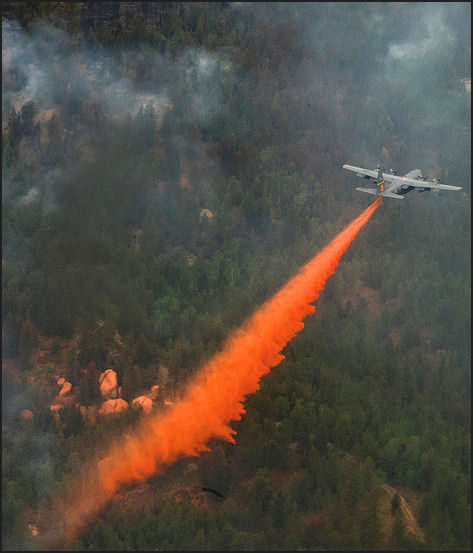
And speaking of the Scotts Fire, in case you missed the excellent video shot by Tim Walton that we posted on September 10, here it is again. It shows four different models of air tankers dropping retardant on the fire, an S-2T, DC-10, BAe-146, and a MAFFS C-130.
The Scotts Fire is 100 percent contained after burning 4,618 acres.
Tim Walton sent us a link to a video that was shot on Sunday at the Scotts Fire east of Ukiah, California (map). The cast of the film includes:
One or more S-2Ts (tanker 96 was one of them)
Tanker 911, the Very Large Air Tanker, a DC-10
Tanker 40, a BAe-146
A MAFFS C-130, (possibly MAFFS #8)
Tim, who has been capturing images of fires for 30 years, shot the video. Thanks Tim!
CAL FIRE says the Scotts Fire has burned about 4,600 acres and is 15% contained. Approximately 300 homes are threatened. In Addition:
The fire continues to burn southeast towards Little Cow Mountain and east towards the Scotts Valley Road area in steep and rugged terrain. Fire crews and equipment have been successful in holding the fire south of Highway 20, west of Scotts Valley Road, and east of Cow Mountain Road. Today, a heavy commitment of aircraft, bulldozers, and fire crews will continue to build and strengthen containment lines. Efforts continue to protect BLM lands, as well as critical communications infrastructure in the Cow Mountain Road area.
10 Tanker Air Carrier’s two DC-10 Very Large Air Tankers. Photo: 10 Tanker
The two DC-10 air tankers operated by 10 Tanker Air Carrier have dropped more retardant this year than the seven to eight Modular Airborne FireFighting System (MAFFS) C-130 aircraft flown by the military. The DC-10s have dropped, according to 10 Tanker, 2.408 million gallons through August 27 during 215 flights for an average of 11,200 gallons per flight.The MAFFS, according to the August 29 Government Security News, have dropped 2.153 million gallons through August 24, employing 899 flights to do so. This indicates an average of 2,394 gallons per flight for the MAFFS aircraft.
The DC-10s have a Call When Needed contract with the U.S. Forest Service and are only activated when the USFS decides to use them. This year one of them, Tanker 911, was called up (these dates are approximate) June 11 and released on June 16. It was reactivated around August 3 and the second DC-10, Tanker 910, was put on active duty on approximately August 7.
One of the eight MAFFS C-130s crashed July 1, 2012 while dropping on the White Draw fire west of Hot Springs, South Dakota, killing four crewpersons and injuring two. While the military has many C-130s, there were only eight of the second generation MAFFS2 units which can be loaded into the cargo hold of the aircraft making it possible for it to hold up to 3,000 gallons of fire retardant. And of course the crew can’t be replaced, only substituted.
The North Carolina Air National Guard’s 145th Airlift Wing crews will return to firefighting missions in the West on Monday. They’re headed back to Idaho, nearly a month and a half after a tanker crash in South Dakota killed four of the unit’s members.
“We all feel it’s extremely important for our people to get back to this critical mission,” said Col. Roger Williams, 145th Airlift Wing Operations Group commander. “We will carry the memory of MAFFS 7 in our hearts as the wildland firefighting continues.”
Waldo Canyon Fire 06/27/12 ~ USAF photo by Staff Sgt. Stephany D. Richards
WBTV News reported that the 145th will send two aircraft and 16 airmen to Boise, where they’ll start duties on Tuesday. One aircraft is MAFFS-equipped and the other will transport equipment and personnel. MAFFS 7 was assigned to the White Draw Fire on July 1 when it crashed, killing four crew members and severely injuring two others. The Charlotte unit decided to retire the tanker’s tail number; they will operate MAFFS 8 for the upcoming assignment, and one of the California MAFFS tankers will return to its base for maintenance.
A wildfire burning in heavy timber 50 miles east of Boise continued to spread even after pilots dropped more than 100,000 gallons of retardant on it. Boise State Public Radio reported that the fire burned through retardant lines on Sunday — the Trinity Ridge Fire grew from 200 acres on Saturday to 1,300 acres Sunday; it is now at 1,800 acres.
Trinity Ridge Fire
The fire gained ground in spite of the 46 runs made by four C-130 MAFFS tankers operating out of Boise. Three SEATs also worked the fire over the weekend.
Dave Olson, incident information officer, said the fire took off Friday in sub-alpine fir and lodgepole, both prone to torching and throwing embers. He said the fire is suspected to be human-caused; firefighters found a burned utility terrain vehicle at the fire’s source. Investigators are seeking the owner of the vehicle.
Additional fire crews have arrived, and a Type 2 team has assumed command.
Yesterday, the fire burned aggressively in the mostly sub-alpine fir and lodgepole pine, with considerable torching and spotting. NWCN.com reported that fire managers say current conditions are much drier then they’d originally thought. “It’s actually drier this year than it was in 2006 and 2007,” said Olson.
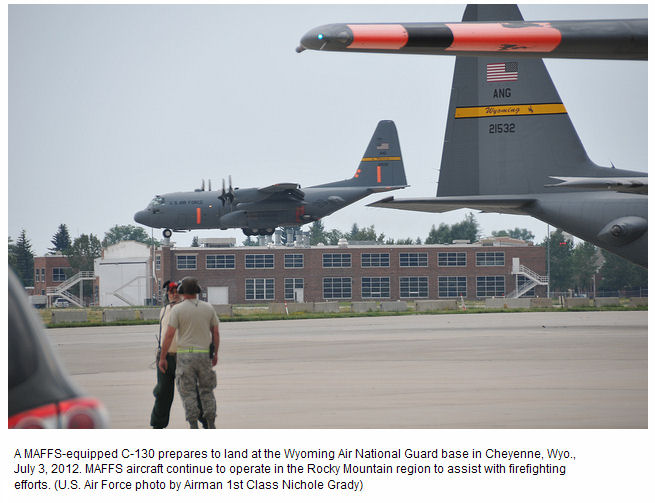
The U.S. Forest Service has requested additional MAFFS-equipped C-130 airtankers, and two aircraft from the 302nd Airlift Wing at Peterson Air Force Base in Colorado will soon be on duty. MAFFS tankers have dropped nearly 889,000 gallons of retardant on fires in eight states since they were activated on June 25.
Another USFS request recently prompted the Joint Training and Experimentation Center (JTEC) in Wyoming to prepare an unmanned aerial vehicle for recon missions on the Sawmill Canyon Fire. JTEC, which tests and develops unmanned vehicles, is a partner with the Wyoming National Guard, the University of Wyoming, and the Department of Defense’s Joint Ground Robotics Enterprise.
John Offe, senior electronic technician for JTEC, said the request came from the fire’s incident commander. JTEC’s capabilities include aerial reconnaissance, forward-looking infrared cameras, video, still photos, and night flying.
Offe said the JTEC team began preparing the T-16 aircraft for use on the fire, but it was contained before the JTEC aircraft was launched. Limiting conditions that affect the aircraft’s use include a requirement for restricted airspace and maintaining operations inside of their Department of Defense contracts.
“It’s not a service contract,” said Offe. “We don’t have a contract in place where we can go out and do this kind of work for them. We would love to. That’s our ultimate goal, which is to provide a system like this to somebody, be it game and fish, fire, homeland security, whoever.”
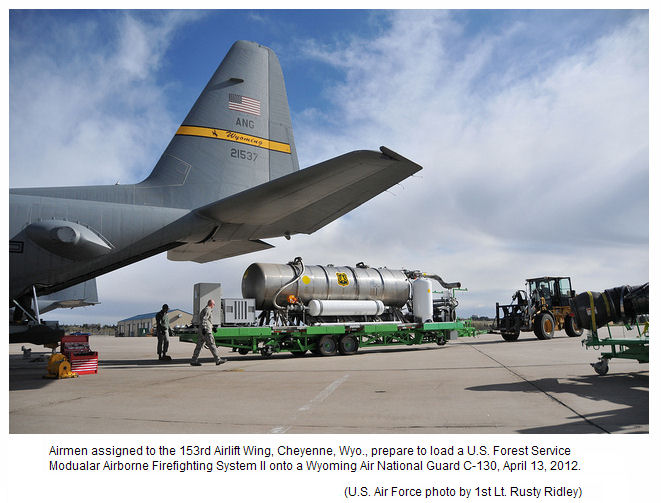
The 302nd Airlift Wing in Colorado Springs, Colo., an Air Force Reserve unit, and three Air Guard units – the145th AW in Charlotte, N.C.; the 146th AW in Channel Islands, Calif., and the 153rd AW in Cheyenne, Wyo. – each have two MAFFS-equipped C-130s able to respond to wildfires throughout the U.S.
We will update this article throughout the day on Friday as new information becomes available.
================
UPDATE at 3:29 p.m., July 20, 2012:
The reason that Tanker 43, one of the two P2V air tankers assigned to the Myrtle fire, is not in operation, as we reported below, is that the 50-year old aircraft experienced a loss of power in one of its two main engines when taking off with a load of retardant at Rapid City Regional Airport. The Rapid City Journal reports that the tanker had to jettison its 18,000-pound load of retardant just after lifting off in order to safely remain airborne and return for a landing. Some of the retardant landed on two runways and a taxiway, closing the runways for about 40 minutes. Two inbound commercial flights orbited waiting for fire trucks and people with brooms to remove the retardant, but they eventually had to divert to Casper, Wyoming to refuel before they were finally allowed to land.
The retardant is very slippery and vehicles and aircraft should not attempt to drive or land on roads or runways covered with the chemical.
These very old air tankers that were discarded by the military 40 years ago have 18-cylinder radial piston engines with many, many moving parts. They frequently have a variety of problems that put the pilots in danger. Thankfully, the air crew survived this life-threatening emergency.
There is only one large air tanker working on the fire right now. There were two, both P2Vs, Tankers 07 and 43, but 43 is down with a mechanical issue. There was a rumor that Tanker 40, the jet-powered BAe-146 was dispatched from Missoula to the fire, but it got diverted to another fire in Montana while en route.
The DC-10 Very Large Air Tanker, which carries as much retardant as five P2V air tankers, 11,600 gallons, was laid off Monday by the U.S. Forest Service. There is currently a very significant shortage of air tankers. We only have 9, plus 3 that are borrowed temporarily from the state of Alaska. That number, 9, is down from the 53 we had in 2002. That is not enough to provide quick initial attack on new fires to keep them small, or enough to support large fires when the small ones become huge due in part, sometimes, to a lack of aggressive initial attack on new fires using overwhelming force. Air tankers do not put out fires, but under some conditions can slow them down enough to allow ground-based firefighters to contain them. The DC-10 is not the perfect tool for every fire, but it works very well on a large number of them. A P2V, BAe-146, or a Single Engine Air Tanker are not perfect for every fire either.
When the air tanker fleet has been reduced from 44 to 9, it’s an All-Hands-On-Deck situation. The DC-10 should not have been laid off from its Call When Needed Contract. There are also two other Very Large Air Tankers that are not being used at all; another DC-10 and a 747.
Air Tanker 07, a P2V, the only air tanker working on the Myrtle fire, while evacuations are in progress. Photo July 19, 2012 by Bill Gabbert
Hot Springs Fire Department was dispatched at 12:52 p.m. to assist the Minnekata Fire Department (west of Hot Springs) with voluntary evacuations “above Cottonwood”, the dispatcher said.
Only four of the seven military Modular Airborne FireFighting Systems C-130 air tankers are mobilized. If they were assigned to the Myrtle fire, they could not reload at the Rapid City Air Tanker base because the U.S. Forest Service is dragging its feet on approving the base for MAFFS air tankers, in spite of the fact that the base has been approved by the Air Force. MAFFS air tankers have been commonly used since the early 1970s, but the USFS has not gotten around to approving Rapid City for their use during the last 37 years.
Wildfires are very difficult to suppress even when competent leaders make excellent decisions and funding levels approved by Congress and the President are adequate. When the opposite is the case, it puts a tremendous burden on firefighters who are doing the best they can under very difficult conditions.
(End of update.)
================
UPDATE at 12:45 p.m. July 20, 2012:
The Myrtle Fire is very close to Wind Cave National Park, but as far as I know has not yet burned into the park, which is closed to the public, of course. On Thursday the staff gave pre-evacuation notices to all park residents. Today the power has been shut off and hand-held radio batteries are being charged off a generator that is running the gas pump. The high today will reach 99 degrees, the minimum relative humidity will be 21 percent, and the winds will be 10-14 mph with gusts to 18 out of the east and northeast. These conditions are conducive to significant fire spread to the west and southwest. HERE is a link to detailed weather forecast information for the specific area in which the fire is burning.
(End of update.)
====================
Myrtle Fire map at 2:00 am, July 20, 2012. Credit: Incident Management Team. Each square is a Section; one mile by one mile. Click to enlarge. Map of the Myrtle Fire, showing heat detected by a satellite at 2:35 a.m., July 20, 2012. MODIS/Google. Click to see larger version.
Here is some information provided by the Incident Management Team at 10:04 a.m on Friday:
The Myrtle Fire, reported yesterday, July 19, 2012 at 1:30pm approximately 1 mile east of Pringle, SD, has grown to 7500 acres and is 5 percent contained.
Residents north of Argyle road to highway 385 have been placed on evacuation notice. For more information on evacuations, please call Frank at (605) 673-8307. Argyle road remains open.
The American Red Cross has opened an emergency evacuation center [in Custer] at the Armory/Custer Middle School.
Wind Cave National Park has been closed until further notice.
Resources continue to arrive on scene and a type 1 [Incident Management] team [which is used for managing large, complex wildfires] will arrive today.
“Right now we are concerned about the area south of 385 and Pringle,” said Mike Carter, Emergency Coordinator for Custer County. “We have no concerns about Custer,” he said.
The public can go to Denver from Custer via Highway 385 and Highway 89 south to Denver.
People can get to Hot Springs from Custer- by going south on 385 and 89 to Minnekahta Junction.
Approximately 300 firefighter personnel are on scene.
Myrtle fire, July 19, 2012. Photo by Brian Carrico. Click to enlarge.
Four employees of Aero Union contacted Wildfire Today and followed up with a letter, saying the company still exists, in spite of the attempt to sell their assets in a February auction. The air tankers and the items related to the Modular Airborne FireFighting System (MAFFS) did not sell in the auction. Aero Union still controls the assets and they have not been turned over to a bank, according to Thomas F. Dooney, the Chief Financial Officer, who called us and signed the letter along with Leigh Ann Ackermann (Director of Operations), and two Co-Directors of Maintenance, Jerry Edwards and Mike Prunty.
CNN did a story on the state of the air tanker fleet (below) and pointed out that the Aero Union P-3 air tankers meet the FAA standards but “sit idle because they don’t meet US Forest Service requirements”.
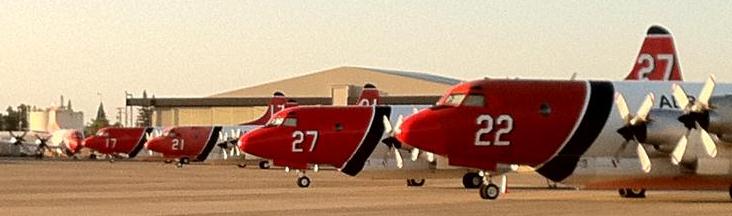
The Forest Service cancelled the contract for the company’s eight P-3 air tankers saying that the company did not meet the safety standards which were specified in the contract. The USFS requires a Continued Airworthiness Program be followed for the air tankers they have under contract, all of which are at least 20 to 50 years old. The last P-3s were produced in 1990, and 8 of the 9 large air tankers remaining under exclusive use contracts are P2Vs that were built in the 1950s.
The employees that contacted us said the USFS has recently indicated a willingness to consider the P-3 under a “legacy contract” in 2013, for older, not “next generation” aircraft. The four of them said some of the eight Aero Union P-3s could be flying over fires in 4 to 6 weeks if they had a contract with the USFS. In order for that to happen some financial issues would have to be resolved and maintenance would have to be done on some of the aircraft. Seven of them are sitting at McClellan Air Force Base near Sacramento, and one was in the middle of major maintenance when the contract dispute occurred and is still torn down.
However, the P-3 appears to meet the USFS specifications for their next generation air tankers, which require turbine engines, a cruise speed of 300 knots, and a 3,000-gallon capacity.
The C-130 military air tanker that crashed while helping to suppress the White Draw fire near Edgemont, South Dakota on July 1 was based in Charlotte, North Carolina with the state’s National Guard. The Charlotte Observer has been running one or two articles a day about the tragedy, and yesterday columnist Mark Washburn, after visiting Edgemont and the fire’s Incident Command Post, posted a particularly interesting article that you should read. Here is an excerpt:
…I got there on the Fourth of July. Main Street was vacant. I was reading fire advisories posted on the window of the city hall when Tami Habeck, the town’s finance officer, stopped and got out of her car.
“You look sort of lost. Can I help you?” she said.
People out here never got the memo on Stranger Danger. They are friendly beyond measure, even to newspaper reporters.
She directed me to the Fall River County Fairgrounds a few blocks away. It is there a brigade of nearly 400 firefighters drawn from as far away as Michigan are based to battle the White Draw Fire, which has consumed 9,000 acres of parched prairie and pine and imperiled Craven Canyon.
I wasn’t there long when Edgemont Mayor Jim Turner pulled in. He’d already heard I was in his town of nearly 800, where news travels fast.
He said he’d already sent a letter to the Observer hoping it would be printed to express condolences on behalf of the citizens of Edgemont for the fallen airmen from the 145th Airlift Wing of the N.C. National Guard.
“Please tell people back there how terribly sorry we all are,” he said. “It was a heroic act for those guys for a community and people they don’t even know.”
A comment that Katy Kassian left at the bottom of the article on the newspaper’s site is not really about the fire, but it’s about Edgemont:
We have been to Edgemont many times. I agree.Incredibly friendly…The first time we were there it was a fluke. We stopped to eat at the bar/cafe downtown. Next thing you know it’s sun up and hubby’s still chatting with the ‘guys’. We made it a point to go there to ‘get away’ when we needed a break. We also were part of BIkers and Bulls. What a great time the city put on! The Hog Catch was definately a highlight and still much talked about!
We are a little late getting this to you, but the day after the North Carolina Air National Guard C-130 MAFFS air tanker crashed in South Dakota, killing four crew members and injuring two, President Obama released this statement:
Yesterday (Sunday), a military C-130 from the North Carolina Air National Guard crashed while supporting firefighting efforts in South Dakota. The full details are still under investigation, but the crew of this flight – along with their families and loved ones – are in our thoughts and prayers.
The men and women battling these terrible fires across the West put their lives on the line every day for their fellow Americans. The airmen who attack these fires from above repeatedly confront dangerous conditions in an effort to give firefighters on the ground a chance to contain these wildfires – to save homes, businesses, schools, and entire communities. They are heroes who deserve the appreciation of a grateful nation.
I know Americans across the country share my concern for the well-being of the surviving members of the crew and my deep condolences to the families of those who lost their lives. And I know that Americans join me in expressing my deepest gratitude for the selfless determination they and thousands of men and women involved in this fight in states across the country demonstrate every day.