Eucalyptus trees contribute to Portugal’s wildfire problem

When numerous fires burned through large expanses of Portugal in June killing more than 60 people, they were fueled in some areas by monocultures of eucalyptus trees. Many areas around the world grow them in order to harvest the wood, leaves, and oil to make paper and medicine. But wildfires burn rapidly under the trees and through the crowns, fed by the stringy bark, oil, and the leaves and forest litter on the ground that do not decompose. Earlier this year we took this photo after a fire in Chile spread through a plantation.

wildfire eucalyptus plantation
The aftermath of a wildfire that burned through a eucalyptus plantation in Chile, February 2, 2017.

The New York Times published an article today that looks at how eucalyptus and other issues combine to create a wildfire environment in Portugal that is difficult to manage.

Here is an excerpt:

…Even so, Portugal’s wood industry no longer relies on native species like oak and pine. Instead, it is increasingly built on eucalyptus, which feeds a pulp and paper sector that makes up 10 percent of Portuguese exports. The area of eucalyptus planting has more than doubled since the 1980s.

Eucalyptus can be harvested in half the time needed for pine. And unlike other species, “you have absolutely no need for people on the ground” to supervise its growth, said João Camargo, an environmental engineer.

The tree, however, contains a highly flammable oil that helps fires erupt more easily, spread and intensify.

Yet after every fire, more landowners switch to eucalyptus, hoping that a shorter production cycle can allow them to recoup their losses faster and to harvest their trees before the next fire erupts.

It is an accelerating sequence that has turned Portugal “from a pretty diverse forest into a big eucalyptus monoculture,” Mr. Camargo said.

Large fires hit areas in Portugal and France

fire in France satellite photo

Above: Satellite photo showing smoke created by a fire in France, July 26, 2017. The red dots represent heat.

(Originally published at 8 p.m. MDT [UTC -6] July 26, 2017)
(Revised at 9:36 a.m. MDT July 27, 2017)

Wildfires in France and Portugal are disrupting the lives of thousands of residents and tourists. Each country has multiple large fires, but one of the largest in France is near the Mediterranean coast 77 km (48 miles) east of Marseille between La Londe-les-Maures and Le Lavandou and has forced the evacuation of about 12,000 people.

Mistral winds spread the fires quickly causing 60 people to be evacuated by boat while others spent the night in gyms, public places, or on the beach.

There was also a 2,000-hectare  (4,950-acre) fire on the French island of Corsica.

More than 1,000 firefighters are working on wildfires throughout the country.

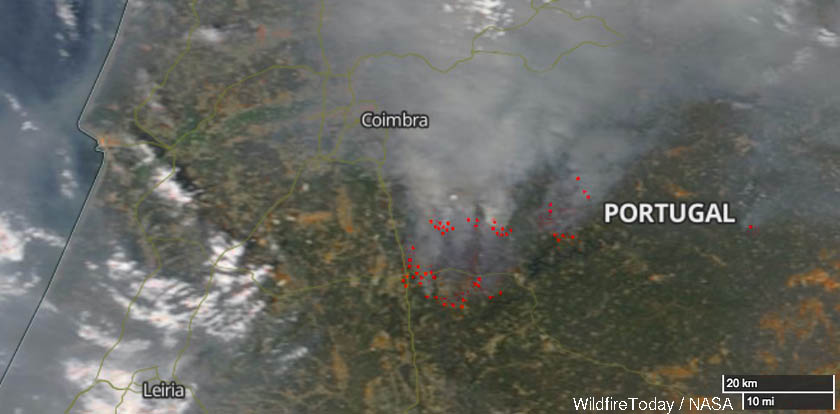
fire in Portugal satellite photo
Satellite photo of smoke created by a fire in Portugal, July 26, 2017. The red dots represent heat. Click to enlarge.

Portugal is also struggling to contain a group of fires about 152 km (94 miles) northeast of Lisbon. It was just five weeks ago that a wildfire southeast of Coimbra, Portugal killed at least 62 people, most of whom were attempting to escape in their vehicles. Those fires were about 63 km northwest of the current blazes that are south of Perdigao burning in dense pine and in some cases non-native eucalyptus plantations. Many areas around the world grow eucalyptus in order to harvest the wood, leaves, and oil to make paper and medicine. But wildfires burn rapidly under them and through the tree crowns. Earlier this year we took this photo after a fire in Chile spread through a plantation.

wildfire eucalyptus plantation
The aftermath of a wildfire that burned through a eucalyptus plantation in Chile, February 2, 2017.

About 2,000 firefighters with 700 vehicles are battling wildfires around Portugal.  As in France, the fires are being pushed by strong winds.

Portugal’s fire season usually begins after July 1 but it got an early start this year.

Reports of an air tanker crash in Portugal appear to be false

(Published at 4:55 p.m MDT June 20, 2017)

Reports from numerous media outlets that an air tanker crashed in Portugal on Tuesday appear to be false.

A spokesman for Portugal’s Civil Protection Agency says none of the aircraft fighting the wildfires in the country are missing, in spite of the fact that Portugal’s Air Accident Office said it had received a call from the Civil Protection Agency notifying it of a plane crash.

The origin of the erroneous information may have come from a reporter for Antena 1 radio who said he heard an explosion about 10 miles away from the Pedrogao Grande area which has been hit by devastating wildfires in recent days. He said a local woman told him she saw a plane crash in a fireball on Tuesday. There have also been reports of propane tanks exploding in the fires.

It is possible that the lady saw an aircraft and the unrelated explosion, which appeared to be associated with the plane.


Wildfires continue to cause evacuations in Portugal

Portugal Fire Destruction

Above: screen grab from Wall Street Journal video.

(Published at 11:50 a.m. MDT June 19, 2017)

The wildfires in Portugal are continuing to spread, forcing residents to leave their homes. Approximately 1,000 firefighters are battling the fires that have killed at least 62 people, including a firefighter who died in a hospital.

weather forecast for Coimbra, Portugal
The weather forecast for Coimbra, Portugal. Weatherunderground.

Below is an excerpt from a BBC article:

Twelve people survived one of Portugal’s deadliest fires by seeking refuge in a water tank after access to their village was cut off by the blaze.

The residents, including a disabled 95-year-old woman, spent more than six hours in the tank as the fire prevented them from being rescued.

[In the village of Mó Grande] 30 bodies were found inside cars, with another 17 next to the vehicles, on the N-236 road, which leads on to the IC8 motorway. The N-236 was being described as the “road of death” in Portuguese media.

A few kilometres north of Nodeirinho, 11 people died in the village of Pobrais. Local reports said a third of the population had lost their lives, many as they tried to escape the fire. A survivor spoke of the roads being blocked and of no-one coming to their aid.

And from the Business Insider:

Despite government assurances that the first response by the emergency services was swift and adequate, many media and residents questioned the efficiency of the operation and the strategic planning in a country which is used to wooded areas burning every year.

“So what failed this Saturday? Everything, as it has failed for decades,” read a headline in the daily Publico, which blamed a lack of coordination between services in charge of fire prevention and firefighting and poor forestry reserve planning.

map fires wildfires Portugal
The red dots represent wildfire heat detected by a satellite over Portugal June 19, 2017.

Death toll rises to 62 in Portugal wildfire

Vehicles burned fire Portugal

Above: Photo by Euronews.

(Updated at (9:55 a.m. MDT June 18, 2017)

The number of people killed in the wildfire southeast of Coimbra, Portugal has risen to at least 62, according to the BBC. That number will probably increase as many remain missing and not all affected areas have been reached by authorities. Six firefighters have been seriously injured and two that were reported missing have been found with injuries.

Hundreds of firefighters and 300 pieces of fire apparatus are battling the fire southeast of Coimbra, one of 60 that broke out Saturday. Approximately 1,700 firefighters have been mobilized across Portugal during the recent extremely hot weather which brought temperatures over 100F. Dry thunderstorms are one of the possible causes of the fires. The government reports that 360 soldiers are assisting firefighters.

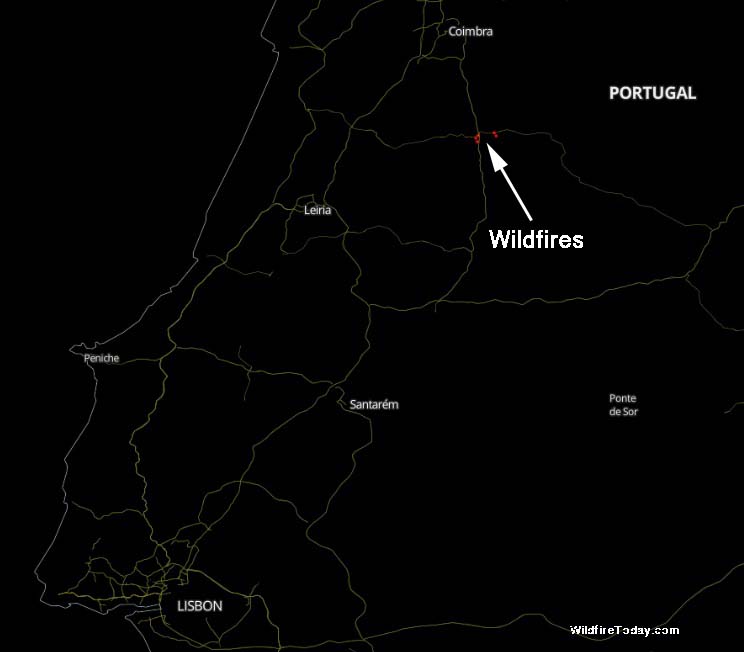
wildfires southeast of Coimbra, Portugal
Map showing the location of the wildfires southeast of Coimbra, Portugal.

Most of the fatalities occurred while residents were attempting to flee in their cars from the Pedrógão Grande area about 30 miles southeast of Coimbra.

Wildfires southeast of Coimbra, Portugal
Wildfires southeast of Coimbra, Portugal.

The European Commission says it is working with EU member states to respond to the call for assistance issued overnight by Portuguese authorities. The Prime Minister of Greece, Alexis Tsipras, said “Greece will offer any help necessary to fight the fires.” Spain and France are both sending several firefighting aircraft.

Wildfires kill 25 in Portugal

Portugal Fire

(12:42 a.m. MDT June 18, 2017)

The BBC is reporting that 25 people have been killed in wildfires in central Portugal. Several firefighters are reported to be among about 20 people injured.

Most of the fatalities occurred while attempting to flee in their cars from the Pedrógão Grande area about 30 miles southeast of Coimbra.

From the BBC:

Secretary of State for the Interior Jorge Gomes earlier said that three people died from smoke inhalation and 16 died in their cars on the road linking Figueiró dos Vinhos to Castanheira de Pera.

About 60 forest fires broke out across the country overnight, with 1,700 firefighters working to put them out. The flames spread “with great violence” on four fronts, Mr Gomes said.

Spain has sent two water-bombing planes to help tackle the fires.

Portugal has been experiencing dry thunderstorms and temperatures well above 100F in recent days.

wildfires west of Pedrógão Grande in Portugal
Map showing the location of wildfires west of Pedrógão Grande in Portugal. Click to enlarge.

Be-200ES strikes tree, lands safely

Be-1200ES wing damage tree strike
This is reportedly damage to the wing of a Be-200ES after striking a tree while fighting a wildfire in Portugal.

A Be-200ES struck a tree August 14 while fighting a fire in Portugal but thankfully was able to land safely at Leiria. The jet-powered amphibious water scooper sustained major damage to a pontoon, the right wing leading edge, and the right side wing flaps. There were no reports of injuries to the crew. Other photos of the damage can be seen here.

Since last week two Be-200ES air tankers have been on loan to Portugal by the Russian Ministry of Emergency Situations after a rash of numerous fires in the country and on Madeira Island.

This is not the first time a Russian Be-200 hit a tree in Portugal. A similar accident occurred July 6, 2006 when the aircraft was leased to the Portuguese government as a trial to evaluate its effectiveness. After scooping water on a lake the left wing hit a tree.

From the Portuguese newspaper Correio da Manhã at the time:

…While hitting the top of the trees, leaves and some wood entered the left engine, which didn’t blow up, but that had to be turned off and the pilot was forced to release fuel for safety reasons. The release of the fuel started small wildfires across the area, reaching some houses, which were quickly extinguished by firefighters and helitack units of the GNR’s Intervention, Protection and Rescue Group.

The airplane was able to do an emergency landing at the Monte Real Air Base.

Until this month, Be-200 air tankers had not been used in Portugal since the 2006 incident. Maybe they’ll wait another 10 years before they try again.

Be-200 scooping air tankers reportedly effective working in Portugal

Be-200ES
File photo of a Be-200ES rolling out of the factory.

A Russian news service is reporting that the two Be-200 Russian-made amphibious scooping air tankers have been effective in Portugal. Quoting the Russian Emergencies Ministry, Sputnik News wrote:

“Overall, two Emergencies Ministry aircraft carried out 37 discharges of water, the total mass of which amounted to 444 tonnes, tackling fire in four spots and saving four settlements and two national parks,” the statement reads.

And:

“The Russian Emergencies Ministry’s airgroup, consisting of two Be-200ES aircraft, continues to work on extinguishing large forest fires in Portugal. On August 15, [Russian pilots] extinguished two fires covering a total area of 500 hectares [over 1,200 acres],” the statement reads.

It is possible the effectiveness of the aircraft is exaggerated. Air tankers do not “extinguish” fires. Under ideal conditions they can slow them down, allowing firefighters on the ground to move in closer and put them out.

Wildfires kill three on Portugal’s Madeira Island; fires force thousands to evacuate on the mainland

Map of Madeira

Above: A Google Earth 3-D map of the Portuguese Island of Madeira, looking northwest.

(UPDATED at 7:25 a.m. MDT August 13, 2016)

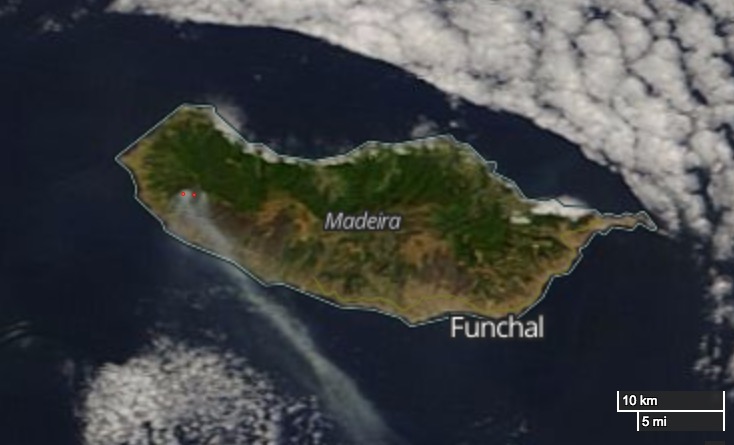
The satellite image below from Friday August 12, shows fewer heat sources on Madeira and less smoke from the wildfires.

Madeira fires August 12, 2016
The red dots represent heat detected by a satellite over Madeira on August 12, 2016. Smoke can be seen drifting to the southeast. Click to enlarge.

****

(Originally published at 4:42 MDT August 2, 2016)

Wildfires on the Portuguese archipelago of Madeira have taken the lives of three civilians and destroyed over 150 homes while firefighters on the mainland are battling nearly 200 blazes. The fire has reached Madeira’s largest city, Funchal, which has a population of 110,000.

Madeira has no firefighting aircraft. They sometimes borrow CL-215’s, CL-415’s, (both are water-scooping air tankers) and Polish SOKOL helicopters from the Canary Islands 280 miles to the south.

Italy and Morocco have sent a total of three firefighting aircraft across the ocean to help control the fires. Russia has dispatched two Be-200 water-scooping air tankers, which last operated in Portugal in 2006.

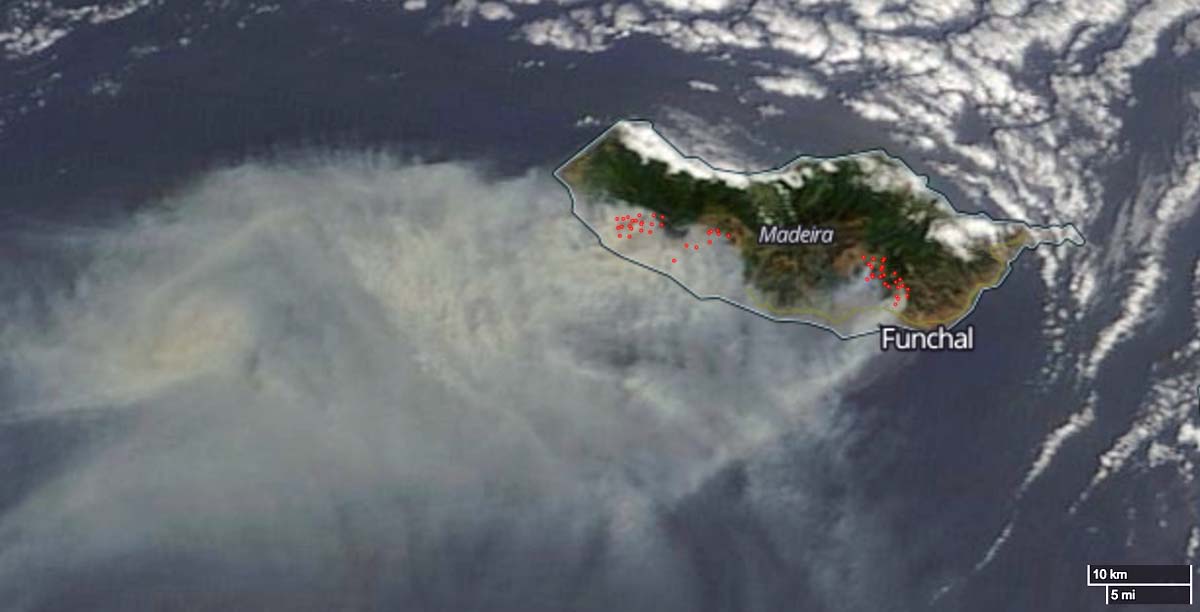
Map of fires on Madeira
The red dots on the photo of Madeira represent heat detected by a NASA satellite on August 10, 2016. Smoke can be seen drifting off to the southwest.

Madeira is in the north Atlantic, 530 miles southwest of Portugal. The terrain on the popular tourist island is very steep which no doubt presents a challenging environment for firefighters.

Below is an excerpt from an article in the New York Times:

…The fire caused chaos, panic and despair around Funchal. Portuguese television showed elderly people, many of them barefoot or in wheelchairs, being escorted to safety in the middle of the night by emergency services or neighbors. Residents watched in tears as their homes burned down, and some were seen running around helplessly, trying to cover their faces to minimize smoke inhalation…

The four images in the tweet below are very impressive.

This video, uploaded today, was shot from a cable car as it travelled over areas affected by the fire. It’s a little long at 18 minutes, but if you skip around it gives an overview of some of the effects of the fire.

Wildfires rage in Portugal and Spain; one firefighter killed

From the Daily Mail at 8:29 p.m. MDT August 8, 2016:

****
“More than 4,400 firefighters battled hundreds of forest blazes in Portugal as a man admitted causing a huge Spanish wildfire by lighting soiled toilet paper.

The National Civil Protection Authority in Portugal said by late afternoon almost 1,500 vehicles and 32 water-dumping planes were deployed at 702 wildfires, some of which have been burning for days.

Wildfires in Portugal
NASA satellite image showing in red the location of wildfires and smoke produced by the blazes in Portugal at 12:55 UTC August 9, 2016. The image shows most of Portugal and the west coast of Spain.

Meanwhile, after raging for six days, a Spanish wildfire which started when a German lit his spoiled toilet paper was finally brought under control as 500 residents were evacuated and a forest worker was killed.

In Spain, authorities said firefighters had managed to bring a six-day-old forest fire on the Atlantic island of La Palma under control and were allowing evacuated residents to return to their homes.

The regional government for the Canary Islands archipelago said the measure affected 500 residents evacuated a day earlier from the town of Villa de Mazo.

The fire claimed the life of one forest worker and has destroyed more than 4,000 hectares (9,900 acres) of forest on the volcanic island off the northwest coast of Africa.”