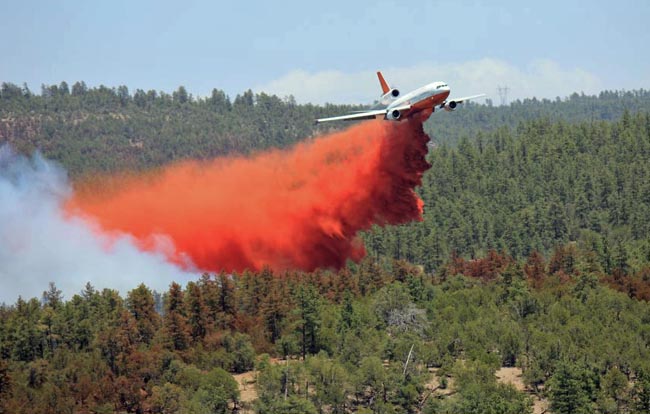
Tanker 911 dropping on the Poco Fire in Arizona, June 15, 2012. Photo by Ian James.
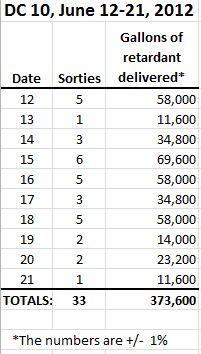
One of the DC-10 air tankers has dropped about 373,600 gallons of retardant during 33 sorties on seven wildfires in Arizona and New Mexico over the last 10 days. The fires were: Little Bear fire, 257 fire, Grand fire, Poco fire, Six Shooter fire, Fox fire, and 177 fire. They were all in Arizona except the Little Bear which was in New Mexico.
Eight of the nine air tankers currently on exclusive use contracts with the U.S. Forest Service are 50+ year old P2Vs designed for maritime patrol. Their average retardant load is 1,948 gallons according to a 2007-2009 air tanker study. If all of those 373,600 gallons the DC-10 dropped in those 10 days had been delivered by a P2V it would have taken about 192 round trips to the fires.
The U.S. Forest Service has a call when needed contract with one of the two DC-10 air tankers. Yesterday and today the pilots are on mandatory days off, making it unavailable. The USFS is not interested in awarding exclusive use contracts for the DC-10 or the 747 air tankers. The 747 can carry 20,000 gallons of retardant, more than 10 times more than a P2V, while the DC-10 almost always carries 11,600 gallons, more than five times the average load of a P2V.
We originally posted this video shot by KASA TV of the DC-10 dropping on June 14, but in case you missed it….
“An environmental watchdog group on Wednesday sued the U.S. Forest Service for a second time over the agency’s use of aerial fire retardants.
The Forest Service Employees for Environmental Ethics, an Oregon-based nonprofit group, filed the lawsuit in U.S. District Court in Missoula.
The lawsuit is part of the group’s campaign to reform the Forest Service’s wildland firefighting mission.
The campaign includes banning retardant airdrops nationwide unless people or homes are threatened, focusing on fire prevention around communities, and allowing more remote wildfires to burn as a natural part of the ecosystem. The lawsuit accuses the Forest Service, the U.S. Fish and Wildlife Service and the National Marine Fisheries Service of failing to fully evaluate the environmental impact of the aerial retardants.
Studies show the ammonium-based retardants are toxic to fish and other aquatic organisms, and promote the spread of flammable invasive weeds.
FSEEE won an earlier retardant-related lawsuit against the Forest Service when U.S. District Judge Donald Molloy ruled that the agency had violated federal law by failing to properly review the environmental impact of retardants on national forests.
That lawsuit – which was filed in 2003, a year after a retardant airdrop killed 20,000 fish in an Oregon stream – was dismissed in February when the Forest Service complied with Molloy’s order to complete an environmental assessment of aerial retardants.
FSEEE’s latest lawsuit challenges the Forest Service’s assessment, which found that the chemical red slurry has no significant environmental impact.
In their biological opinions, the Fish and Wildlife Service and National Marine Fisheries Service said retardants jeopardize 45 endangered or threatened fish, plant, insect, mussel and amphibian species and their critical habitats.
The lawsuit includes those two agencies because they said the Forest Service could avoid jeopardizing the environment if it followed “reasonable and prudent alternatives” when dropping retardants.
[…]
The new lawsuit challenges the three agencies’ environmental analyses, conclusions and decisions, saying they violate the National Environmental Policy Act, the Endangered Species Act and other federal laws.
FSEEE said the Forest Service should be forced to complete an environmental impact statement, which is more detailed than an environmental assessment, and that the “reasonable and prudent alternatives” do not prevent harm to the protected species and their critical habitat.”
The Flathead Beacon at Kalispell, Montana had this to say, in part:
[…] “Nuts? Yep, yet FSEEE righteously claims its “mission is to forge a socially responsible value system for the U.S. Forest Service.” They intend to ram their retardant version of social responsibility through the courts, and just might.
Don’t be surprised if FSEEE files their case, and on some trivial technicality, an injunction comes down at the worst possible time. Some poor fire boss will have to announce: “Folks, we need to ground our air fleet and wash out the tanks today. We’re also pulling all our crews, as the bombers were the last chance we had of holding this line without killing someone. Sorry. The judge says a one in 5,000 chance of killing a few minnows overrides any of your trivial concerns. We hope you got your heirlooms and families out in time, have a nice day.”

 the DC-10 air tankers has dropped about 373,600 gallons of retardant during 33 sorties on seven wildfires in Arizona and New Mexico over the last 10 days. The fires were: Little Bear fire, 257 fire, Grand fire, Poco fire, Six Shooter fire, Fox fire, and 177 fire. They were all in Arizona except the Little Bear which was in New Mexico.
