Wildfire dispatching in Russia

В 2012 году была образована Федеральная диспетчерская служба лесного хозяйства. Сотрудники ФДС проводят ежедневный мониторинг лесопожарной обстановки на территории лесного фонда и землях иных категорий. Предоставляют полную информацию о динамике лесопожарной обстановки, наращивании сил и средств на тушение лесных пожаров в субъектах РФ для работы оперативного штаба Федерального агентства лесного хозяйства. Специалисты ФДС, также являются операторами Прямой линии лесной охраны, на которую по единому бесплатному номеру 8-800-100-94-00 в круглосуточном режиме наши граждане сообщают о различных происшествиях в лесу – возгораниях, незаконных рубках, свалках мусора и др., а также получают консультации по интересующим их вопросам. Лесники благодарят всех, кто не остался равнодушным и сообщил об увиденном дыме, свалке или незаконной рубке. #леснойпожар #лес #пламя #героизм #парашютисты #десантники #огонь #пожар #лесной_пожарный #Avialesookhrana #Forest #fire #firefighter #smokejumpers #лесныепожары #bomberos #авиация #firefighterslife #пламя #helicopter #aviation #aviales #экстрим #air #plane #sky #bombeiros #авиация #авиалесоохрана

A photo posted by Федеральная Авиалесоохрана (@avialesookhrana) on

Google’s machines translated the caption:

“avialesookhranaV 2012 Federal dispatch Forest Service was established. Employees FDR conducted daily monitoring of the forest fire situation in the territory of the forest and lands of other categories. It provides complete information on the dynamics of the forest fire situation, a buildup of forces and means for extinguishing forest fires in the regions of Russia for the operational staff of the Federal Forestry Agency.

FDR Specialists are also operators of hotline forest protection, which according to a single toll-free number 8-800-100-94-00 round the clock our citizens informed about various incidents in the forest -. Fire, illegal logging, garbage dumps, etc., and also receive advice on matters of mutual interest.

Foresters are grateful to all those who did not remain indifferent and told about what they saw smoke, landfill or illegal logging.
Lesnoypozhar # # # Forest flame heroism # # # paratroopers paratroopers fire # # # fire lesnoy_pozharny #Avialesookhrana #Forest #fire #firefighter #smokejumpers # lesnyepozhary #bomberos # Aviation #firefighterslife # flame #helicopter #aviation #aviales # extreme #air #plane #sky #bombeiros # # aviation Avialesookhrana”


And then there’s this, which appears to be about prescribed fire:


Google’s translation:

“We give the opportunity to burn a large forest debris (waste), releasing a fire in the forest. Then we bring down the flame
We give the opportunity to burn forest debris. We produce fire in the forest. then extinguish the flames
____
# # Avialesookhrana FFA KhMAO # # # Soviet Yugorsk #avialesookhrana #rosleshoz #hmao #smokejumpers #smokejumper #firefighter #firefighters #bomberos #russia #yugorsk #sovetskiy
patriotic.usMy God!”

First modernized Be-200 amphibious air tankers rolled out

Be-200ES

Above: A Be-200ES rolls out for the public while another makes a demonstration water drop.

On Monday, May 30 the Beriev Aircraft Company rolled out the first Be-200ES firefighting aircraft produced at their Taganrog manufacturing facility. The versions introduced to the public yesterday have been “modernized”, according to the information from the company, with a reinforced airframe and upgraded avionics.

They expect to flight test and deliver two aircraft this year from the Taganrog factory, and by 2017 hope to produce four annually for the next five years. Orders have been placed by Russia’s Ministry of Emergency Situations for six Be-200ES aircraft to serve as air tankers, while the Russian Ministry of Defense ordered one Be-200ES capable of fighting fires and another four of the Be-200PS version that would serve other purposes.

Beriev has been manufacturing the Be-200 since 2003. The aircraft can land or take off on water or land, and the firefighting version can scoop water to refill its tanks. It can be converted to haul passengers or serve as a search and rescue aircraft, landing on water to retrieve victims if necessary.

Specifications:

  • Engines: two high-mounted turbo jet, D-436DTP
  • Max cruise speed: 700 km/h, 435 mph
  • Economic cruise speed: 560 km/h, 349 mph
  • Operational altitude: 8,000 m, 26,000 feet
  • Water tanks, maximum capacity: 12,000 liters, 3,170 gallons
  • Minimum speed while dropping: 200-250 km/h, 124-155 mph
  • Minimum drop height: 50 meters, 164 feet
  • Maximum wave height while scooping water: 1.2 m, 4 feet

Be-200ES Be-200ES

Be-200ES Be-200ES

All photos by Fotografersha.

Environmental activists estimate 7 million acres have burned in Siberia

Siberia fire
Photo by Anton Klimov

While the government of Siberia reported on May 26 that 319,000 acres (129,000 hectares) had burned this year, environmental activists insist the number is far higher. Greenpeace Russia believes officials and regional authorities intentionally announce figures that underestimate the scale of forest fires. Using open source satellite data, Greenpeace says about 7.4 million acres (3 million hectares) have burned as of May 23.

Below is an excerpt from an article at the Siberian Times:

…Rosleskhoz, the Federal Agency for Forestry, a federal executive body responsible for oversight of forestry issues, admitted that official figures from regions may be at odds with the actual area of raging fires. Among other reasons this could be ‘because of political factors’.

The agency promised to provide correct data about damage at the end of the [fire] season.

Nikolai Krotov, deputy head of Rosleskhoz, said: ‘We have concerns about differences in Amur region, Buryatia, Chelyabinsk and Irkutsk regions. We don’t rule out that there can be political factors, subjective factors, when information is submitted in a different way.’

Greenpeace has argued for information in real time, not at the end of the season, so fire-fighting resources can be switched between regions to be deployed in most needed areas.

Related:
—Wildfires in Russia may be sending smoke to northern Canada, May 22, 2016
—Early spring fires in Russia, April 1, 2016

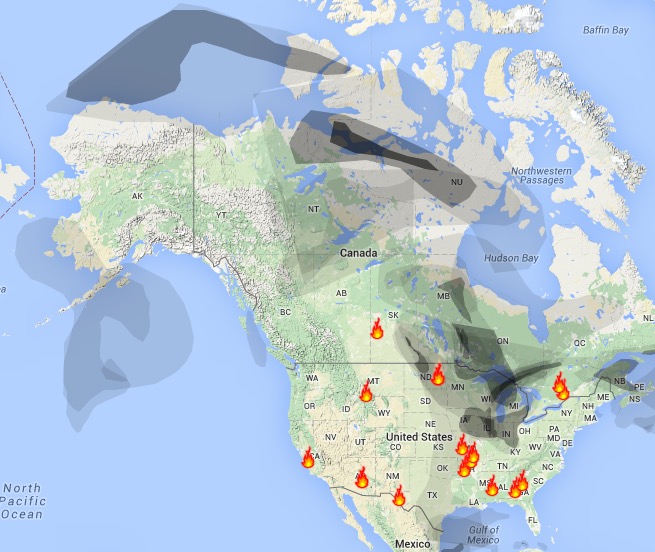
Wildfires in Russia may be sending smoke to northern Canada

Wildfire smoke map
Wildfire smoke map, May 22, 2016. Weatherunderground

Wildfires in Siberia may be to blame for some of the smoke that has passed over Alaska and northern Canada in recent days. Meanwhile, fires in Saskatchewan and Manitoba are contributing to the smoky skies in Ontario, Canada and the Midwest in the United States.

Below is a video showing a vehicle in the Chernyshevsky District of Russia, 300 km from Chita, driving through smoke near a wildfire. It was uploaded May 17, 2016.

Articles on Wildfire Today tagged “smoke”.

Russian smokejumpers appear to fly in formation at sunset

Google attempted to translate the caption:

Practice jumping parachutist-firefighters Avialesookhrana. Photo Valery Korotkov, 2002

Wildfire in Russia

Основная причина ранних весенних пожаров – это массовые самовольные выжигания сухой травы на полях, дачных участках. Под воздействием ветра огонь молниеносно переходит на населенные пункты, объекты экономики, в леса и на торфяники, не щадит ни людей, ни животных. #леснойпожар #лес #пламя #героизм #парашютисты #десантники #огонь #пожар #лесной_пожарный #лес #avialesookhrana #Forest #fire #firefighter #smokejumpers #лесныепожары #bomberos #авиация #firefighterslife #героизм #пламя #helicopter #widlandfire #widlandfirefighting #aviation #airguards #aviales #экстрим #air #plane #sky #bombeiros #авиация #авиалесоохрана

A photo posted by Федеральная Авиалесоохрана (@avialesookhrana) on

This Instagram was posted by the Russian Aerial Forest Protection Service, an account that frequently has photos of their smokejumpers.

Here is Google’s attempt to translate the caption (without the hashtags):

Main reason for early spring fires – a massive unauthorized burning of dry grass in the fields, suburban areas. Under the influence of wind fire lightning moves on settlements, economic facilities, in forests and on the moors, spares neither people nor animals.

Photos of Russian smokejumpers

Парашютисты-пожарные федеральной Авиалесоохраны в Бурятии, на тушении возле озера Байкал. 2015 год. Russian smokejumpers of the Federal aviation forest protection (Avialesookhrana) extinguish a fire near Baykal lake. Buryatia, In august 2015 #леснойпожар #лес #пламя #героизм #парашютисты #десантники #огонь #пожар #лесной_пожарный #лес #avialesookhrana #forest #fire #firefighter #smokejumpers #лесныепожары #bomberos #авиация #firefighterslife #героизм #пламя #helicopter #widlandfire #widlandfirefighting #aviation #airguards #aviales #экстрим #air #plane #sky #bombeiros #авиация #авиалесоохрана

A photo posted by Федеральная Авиалесоохрана (@avialesookhrana) on

Russian fire chief arrested over out of control wildfires

Putin meets with residents
Russian President Vladimir Putin meets with local residents and officials of the region at a temporary shelter for people affected by recent wildfires in Abakan, the Republic of Khakassia, April 21, 2015. Photo provided by the Kremlin.

From the Moscow Times:

****

“Shortly after President Vladimir Putin said Tuesday that officials should be held responsible for damage caused by recent wildfires in a southern Siberian region, investigators said the head of a local fire department had been arrested for negligence.

Viktor Zenkov, a district firefighting head in the Khakasia region, “did not personally go to the area affected by the fires or arrange for people and their property to be saved,” federal Investigative Committee spokesman Vladimir Markin said in a statement, adding that the arrest was one of several being made.

The wildfires, believed to have originated as small-scale agricultural grass burning that grew out of control amid abnormally dry conditions, have killed at least 31 people and left about 5,000 people homeless in the region in recent weeks.

During a visit to the region on Tuesday, Putin told Governor Viktor Zimin that firefighting officials should be evaluated “for what they did and didn’t do,” state media reported. The president also told Zimin to promptly distribute aid payments to the victims of the fires and rebuild their homes.

The governor assured Putin that within the next three days the regional government will have paid 90 percent of those individuals entitled to compensation, state news agency TASS reported.

The governor said that 1,722 payments ranging in size from $200 to $2,000 have already been made. He added that the local administration was prepared to rebuild the victims’ homes by the Sept. 1 deadline set by the president.

Putin said he would return to the region in about two months to check on the progress of the work, according to a statement on the regional administration’s website. Last week during his annually televised call-in show, Putin promised $100 million in federal aid to the region.”

Siberia fire
The aftermath of one of the wildfires in Siberia. Siberia Times photo.

Vehicles driving through a wildfire in Russia

The video shows vehicles driving through a wildfire on April 13, 2015 near the suburban village of Zabaykalets in eastern Siberia. Over the last week wildfires in the region have killed 15 people and destroyed 1,000 structures.

At 0:50 a vehicle can be seen that appears to have something burning on its roof.