GAO issues report on Arizona Border area fires

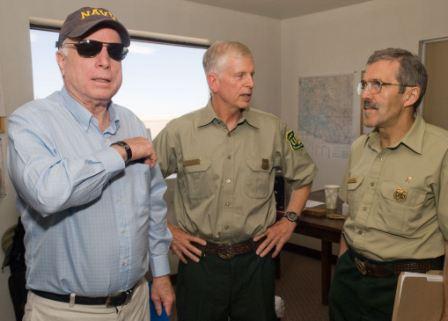
McCain, Tidwell, Harbour at Wallow fire
Sen. John McCain, Thomas Tidwell (Chief of the Forest Service), and Tom Harbour (Director of Fire and Aviation, USFS) at the Wallow fire, June 18, 2011. Photo by USFS.

On June 18 Senator John McCain flew with Tom Harbour, Director of Fire and Aviation for the USFS, and Thomas Tidwell, Chief of the Forest Service, to Arizona to be briefed on the Wallow fire. He met with reporters that day and started his own firestorm when he was quoted as saying:

There is substantial evidence that some of these fires have been caused by people who have crossed our border illegally. The answer to that part of the problem is to get a secure border.

McCain received a great deal of criticism for his rather vague statement, some of which accused him of unfairly pointing the finger at “vulnerable populations”. It was not clear to which fires McCain was referring, but two cousins from southern Arizona were charged with starting the Wallow fire by leaving a campfire unattended. McCain may have been thinking of the Monument fire which started June 12 near the Arizona/Mexico border and, according to a well-publicized theory by Cochise County Sheriff Larry Dever, may have been caused by illegal border crossers. We checked today and the cause of the Monument fire is officially still “under investigation”, according to the Coronado National Forest.

It turns out that in 2010 McCain and three other senators, Lisa Murkokwski, John Barrasso, and Jon Kyl requested that the Government Accountability Office (GAO) conduct a study about wildfires in the Arizona border area. The 55-page report which was released today, covers:

  • The number, cause, size, and location of wildland fires from 2006 through 2010;
  • Economic and environmental effects of human-caused wildland fires burning 10 or more acres;
  • Extent to which illegal border crossers were the ignition source of wildland fires on federal lands; and
  • Ways in which the presence of illegal border crossers has affected fire suppression activities.

From the report, here are some numbers relating to Arizona border area fires. The GAO looked at data for fires that occurred from 2006 through 2010:

  • 2,467 fires were examined in the report
  • 2,126 or 86% of the fires were caused by humans
  • 1,364 fires burned less than one acre
  • 1,553 or 63% of the 2,467 fires started on federally managed or tribal land
  • $35 million, the suppression costs for the fires that burned more than 10 acres
  • ?… the number of fires ignited by illegal border crossers on federal lands is not known because not all fires were investigated
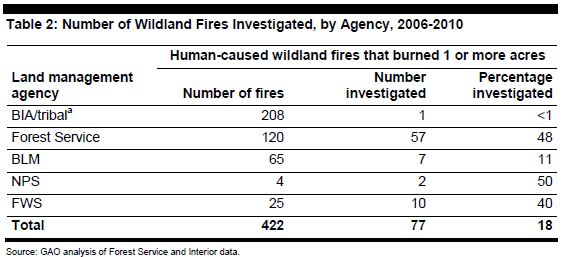
  • 422 human-caused wildland fires occurred on Forest Service, Interior, or tribal lands and burned at least 1 acre
  • 77 of the above 422 fires were investigated.
  • 30 (or 39%) of the above 77 investigated fires were identified as being caused by illegal border crossers
  • 57 additional fires were not formally investigated but were suspected (by individuals who completed fire reports) of being caused by illegal border crossers
  • 4% of the 2,216 human caused fires were identified by investigators or by individuals who completed fire reports as being caused by illegal border crossers

Below are three graphics from the GAO report, followed by Conclusions and Recommendations:

Continue reading

Air tanker studies

CL-415_LA_County
CL-415. Photo: LA County FD

(Note: we edited this on 9-10-2011 to add two additional air tanker studies that we became aware of today.) 

As we wait for another air tanker study to be completed, someone reminded me of one that was completed in the mid 1990s. Luckily, a summary of the study was published in the US Forest Service’s Fire Management Notes. We found out today that two of the reports about the 2009 fatal helibase rappel accident that we had linked to have been removed from the Wildland Fire Lessons Learned Center site, so we put a copy of this edition of FMN on our Wildfire Documents page, along with the Blue Ribbon Panel report we refer to below.

Called the National Air Tanker Study (NATS), it had two phases. The first was released in 1995 and had this recommendation:

Phase 1 used initial-attack efficiency analysis to recommend staffing for 38 large airtankers nationally. These 38 airtankers, as staffed in the 1996–98 National Airtanker Contract, came from the existing fleet, which had retardant tanks that range in capacity from 2,000 to 3,000 gallons (7,570 to11,360 L). Goals for phase 1 were to optimize the existing available large airtanker fleet and to find the best airtanker base locations. Accordingly, the optimum number of 38 airtankers was determined based on an aggregate of geographic-area analyses called “scenarios.” In each scenario, the number of large airtankers was increased and decreased from existing levels to determine the number within the geographic area that minimized total airtanker program costs (fire suppression costs plus net value change costs).

Phase 2 had eight recommendations. Here is one of them:

Establish a future fleet of 20 P3–A aircraft, 10 C–130B aircraft, and 11 C–130E aircraft.

So the study recommended 38 to 41 large air tankers. It seems odd, then, that there are now 11 large air tankers under exclusive use contracts and the USFS keeps saying we have plenty. Tom Harbour, the Forest Service’s director of fire and aviation, referring to the cancelled contract for the six P3 air tankers operated by Aero Union in July, was quoted by aNewsCafe.com on July 31, 2011:

This contract termination notwithstanding, we possess the aircraft support needed for this year’s fire season.

And an article from the Riverside Press-Enterprise published on September 3, 2011, happens to be on Senator Dianne Feinstein’s web site. In this article, Mr. Harbour is referring to the air tanker situation:

This fall in SoCal, we’ve got more than enough stuff to cover the fire needs.

While it may have been a reasonable decision for the USFS to cancel the Aero Union contract for the six P3 air tankers based on safety, this just further exposes the fact that we we keep losing air tankers in chunks, in addition to an average of one a year being lost in a crash. In 2002 we had 44 large air tankers. Now we have 11. As we have said many times before, a long-term large air tanker strategy should have been developed and implemented shortly after the two mid-air wing failures in 2002. It’s been nine years and nothing significant has been done. And nobody has been fired.

To summarize, there have been at least three five air tanker studies either completed or overdue for completion in the last 16 years:

  1. 1995-1996, National Air Tanker Study (NATS) was summarized in Fire Management Notes. The study recommended 41 large air tankers be staffed nationally. While there should be debate about the models of aircraft they suggested, the sheer numbers of air tankers may still be valid, since recent recommendations for future air tankers (3,000-5,000 gallons and speed of 300 knots) have similar performance capabilities as those that were recommended in this 1996 report, which was a capacity of 3,300 gallons and a speed of 260 knots.
  2. Blue Ribbon Panel report. (1.1Mb) Federal Aerial Firefighting: Assessing Safety and Effectiveness; Blue Ribbon Panel Report to the Chief, USDA Forest Service and Director, USDI Bureau of Land Management; December 2002. This five-person panel was co-chaired by Jim Hall, former Chairman of the National Transportation Safety board. They were tasked with identifying weaknesses and fail points in the aviation program, focusing on safety, operational effectiveness, costs, sustainability, and strategic guidance. The panel (on page 17) seemed to shy away from recommending that we acquire additional ex-military aircraft and leaned toward development of “a fleet of purpose-built, turbine-engine, fixed-wing air tankers based on well-defined requirements”. Their report said: “The panel believes obtaining and outfitting newer military aircraft, such as C-130s and P-3s, would only perpetuate a cycle that has proven to be unsustainable and dangerous. Unless the FAA and operator community change its methods, one could expect to see another cycle of structural failures and pilot fatalities within a decade or two.”
  3. 2005 Wildland Fire Management Aerial Application Study. This study recommended 34 to 41 air tankers.
  4. 2009, National Interagency Aviation Council. This study endorses the acquisition of 25 new large air tankers which was recommended in the 2005 study. It projects on page 21 the number of large air tankers increasing from 19 in 2008 to 32 in 2018, and 3 scoopers. This takes into account the air tankers on hand when the report was written plus additional acquisitions. It also considers attrition through age of retiring P-3s and P-2Vs. The table with the numbers is below. The report recommends on page 73 that the new air tankers be C-130Js.
  5. The study by the RAND Corporation that was due in January of 2011. This study is supposed to craft still another large air tanker strategy, meant to guide the Forest Service’s acquisition of air tankers in the years to come. The U.S. Forest Service intends for the report to remain secret and has refused a Freedom of Information Act request. Copies of the report have been leaked.
  6. UPDATE September 26, 2011. The USFS announced they intend to give the Rand Corporation still another contract for still another study. This, apparently, is not a joke. UPDATE October 12, 2011. After the USFS announced that they would give a non-competitive contract to Rand, they changed their mind and are opening it up to competition. UPDATE June 12, 2012; the contract for this study was awarded to AVID. It is required to be completed by the end of 2012.
Air tanker numbers, projected through 2018
The number of firefighting aircraft on exclusive use contracts, not CWN, projected through 2018. Source: page 21 of the 2007-2009 report referenced above.

Here is an interesting excerpt from a letter from the USDA Office of Inspector General, written in 2009 to the Chief of the Forest Service, Tom Tidwell, responding to the US Forest Service’s “replacement plan for firefighting aerial resources”:

…For example, FS’ initial attack success rate has dropped since it began losing air tankers in 2004 due to safety concerns. By 2007, FS’ success rate had dropped from 98.8 percent to 97.3 percent. FS estimates that this 1.5 percent decrease represents approximately 150 more fires that escaped initial attack and cost FS an additional $300 million to $450 million to suppress. In comparison, new airtankers cost up to $75 million each. So, if FS can demonstrate that new, faster, more reliable, higher-capacity airtankers increase the agency’s initial success rate, then it can show that acquiring them is cost effective.

If we have learned anything from history, around 2017 to 2022 we will be left with three to five large air tankers on exclusive use contracts and we should be expecting a new air tanker study. And nobody will have been fired.

NASA evaluates "supertankers"

The evaluation that the U.S. Forest Service commissioned NASA to do of the suitability of large jet-powered airliners to serve as air tankers concluded that they can do the job in flat or rolling terrain but not in the mountains.

Here is a excerpt from an AP article by Jeff Barnard.

=================

Two aviation companies are trying to convince the U.S. Forest Service that converted jumbo jet airliners are a great new tool for dropping super-size plumes of pink fire retardant on wildfires, whether they are on flat ground surrounding Los Angeles or in rugged mountains.

After an initial flicker of interest, the Forest Service is being more cautious about using DC-10s and 747s to do the job now done by smaller, propeller-driven planes. Although California is using a DC-10, federal officials want to know more about both safety and cost before making any commitments.

A NASA evaluation has concluded that the jumbo jets can do the job in flat or rolling terrain, but they do not have the maneuverability to handle rugged mountains.

And a study will be done to see if the bigger bang is worth the extra bucks, or as Forest Service official Pat Norbury puts it: “Are they producing value for us besides just a great CNN shot?”

NASA will brief Forest Service officials April 7 in Boise, Idaho, on its report.

“It basically says, yes, these aircraft can be operated within the fire environment within certain restrictions,” said Norbury, national aviation operations officer for the Forest Service at the National Interagency Fire Center in Boise, Idaho. “You can’t put them in steep, rugged terrain. They can’t turn fast enough.”

[…]

NASA spent nine months on the report of nearly 400 pages, interviewing personnel, flying the aircraft with tanker pilots, and using flight simulators.

“It was a very legitimate science-based approach,” Norbury said.

The Forest Service withdrew an earlier call for bids on a super-size air tanker, and Norbury said it has no immediate plans to issue another. It can, though, call on 10 Tanker because of the California contract.

Meanwhile, the Forest Service continues to work with 10 Tanker and Evergreen International Aviation, Inc. of McMinnville, Ore., which has a Boeing 747 Supertanker, Norbury said.

Photo: 747, by Evergreen Aviation

“We’ve put five years and $50 million dollars into this program,” said Jim Baynes, Evergreen sales manager. “Let’s get the thing out there and see what it can do.”

Evergreen is eager to use the 747 for other projects, as well, such as dispersing oil spills.

Cal Fire is in the third year of a $15 million contract with 10 Tanker to provide exclusive use of its airplane, which also gets $5,500 for each hour it flies. A second plane is on call.

Cal Fire uses helicopters and smaller air tankers, the S-2T, for initial attack, which catches more than 90 percent of fires when they are still small.

But the DC-10 has been used in big fires, particularly when a long, heavy line of retardant is needed along a ridge line, said Jim Winder, battalion chief in charge of air operations on the Riverside Unit.

“Overall, it’s been positive,” he said. “It’s another tool in the toolbox.”

NASA Partners With Forest Service On Air Tanker Safety Study

EDWARDS, Calif. — NASA is partnering with the U.S. Department of Agriculture’s Forest Service on a project to examine the mission suitability of Boeing 747 and McDonnell Douglas DC-10 fire retardant delivery aircraft. The aircraft under study are a DC-10 belonging to 10 Tanker Air Carrier LLC and a 747 owned by Evergreen International Aviation, Inc. The DC-10 tanker has already been successfully employed by the California Department of Forestry and Fire Protection in past wildfire suppression missions.

NASA’s Dryden Flight Research Center at Edwards Air Force Base, Calif., is working with the Forest Service to help determine the safe flight envelope for these very large air tanker aircraft for both the Forest Service and the U.S. Department of the Interior. Additionally, NASA Dryden will recommend operational usage regimes, policies and procedures for the aircraft. The Forest Service and the Interior Department approached NASA for help because NASA provides a range and depth of necessary flight test planning skills to develop and conduct the assessment.

Mark Dickerson, Dryden project manager, calls this important work.

“The entire team is very excited about helping the forest service with this effort. It is a bit different from our typical research projects, but we all enjoy being able to help find new tools to fight wildfires,” Dickerson said.

As project lead, NASA Dryden is performing operational test and evaluation assessments. Project engineers will report findings and recommendations on these aircraft in cooperation with NASA’s Ames Research Center at Moffett Field, Calif. NASA Ames’ engineers are supporting the effort with pilot-in-the-loop simulations and are coordinating simulator models, flight profiles & data analysis with project staff at NASA Dryden.

Engineers at NASA Dryden will also develop, implement, and direct an evaluation test plan for use in flight test and in simulation. The test plan will be designed to evaluate the suitability of large tanker aircraft for the firefighting mission environment. Based on this analysis, NASA will propose appropriate interim flight envelope limitations to enhance safety and operational utility in the fire retardant delivery mission.

NASA Dryden personnel are working with the crews of the large tanker aircraft to capture flight validation data, assess the effectiveness of proposed procedures, and refine those as required. The final project report will include initial recommendations for such factors as flight over various terrain types, density altitude limits, turbulence, and horizontal wind shear limits.