Wednesday night the Wallow fire in Arizona burned through the community of Greer. Tonight the incident management team running the fire confirmed what had been feared, that almost two dozen houses burned as the fire moved through the area.
The tally in Greer after an assessment of the damage:
22 houses have been destroyed
5 houses have been damaged
24 outbuildings have been destroyed
1 truck has been destroyed
Apache County Sheriff’s Officials are in the process of notifying the property owners.
Here is a link to a Google map of Greer, which is a small community with some tourist lodges and about 177 people, according to the 2000 census.
Earlier today it was announced that the Apache County Sheriff’s office was in the process of notifying the owners of the five residences that burned in Alpine, Arizona. They plan to make personal contact with those five individuals or families, but will send certified letters in the next few days to the owners of property on which outbuildings burned. The residents of Alpine were ordered to evacuate at 5:00 p.m. on June 2.
The Sheriff’s office’s announcement stated:
Due to current fire activity and structure protection efforts in the Town of Greer, the Assessment Team has not been able to start the process in structure loss confirmation and identification.
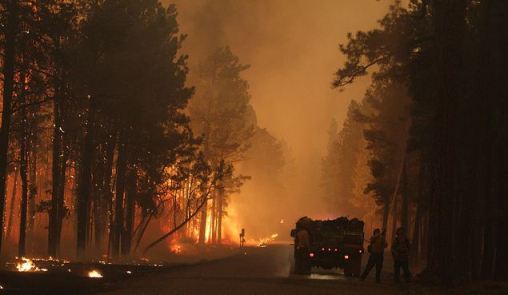
Firefighters at the Wallow fire attempt to keep the fire from crossing a road. Photo: Apache-Sitgreaves National Forest
Updated at 8:30 p.m. MT, June 9, 2011: A damage assessment of the fire’s run through Greer last night revealed that 22 houses burned. More information. And the size of the fire has been revised again. Wednesday morning it was reported by the incident management team to be 389,000 acres, then Thursday morning, 348,235, and later on Thursday, 386,690 acres and for the first time, some degree of containment: 5%.
Information from the IMTeam released tonight:
Dozer line construction took place along Highway 260 going west from Eagar to Highway 373 junction; then southeast to Greer Lake in prep for burnout for tonight’s operational period. Firefighters are prepping with dozer line in the south end of Greer Valley heading southwest to Highway 273 at Sheep’s Crossing for an additional burnout. Dozer line will take place on the east side of Escudilla Mountain extending southeast towards Luna, New Mexico for burnout. All fuel moistures are extremely low.
Updated at 4:01 p.m. MT, June 9, 2011: Replaced map of north portion of Wallow fire with updated version.
Updated at 2:57 p.m. MT, June 9, 2011: Added a new type of map, showing Fire Radiative Power, or fire intensity.
Updated at 11:56 a.m. MT, June 9, 2011: An update from the incident management team posted at InciWeb at 11:00 a.m. MT included information about evacuations, and this information:
Size: 348,235 acres based on last night’s infrared flight
0% contained
Structures lost: 16
Fire Upate: Last night, fire crews concentrated their efforts prepping roads and dozer lines for burnout operations south of Route 851 and Circle Flat area that leads into New Mexico. Fire activity increased on the west side of the fire towards the communities of Greer and Eagar due to high wind and low humidity.Crews are currently stationed at Big Lake to reduce travel times, ensuring firefighter safety. Structural protection is in place in Greer, South Fork, Eagar, Alpine, Nutrioso, and Escudillo Flats. Firefighters will be conducting burnout operations on the northern and eastern portions of the fire to p limit the fire’s spread. Firefighters continue to hold line, mop-up, and patrol other areas of the fire. Creeping, smoldering, and active backing fire with short upslope runs was observed yesterday on the southern portion of fire. Firefighters are constructing indirect line and conducting burnout operations. Today southwest winds of 8-15mph with gusts to 25 mph are expected.
=================
Updated at 9:22 a.m. MT, June 9, 2011: added information about the 747 and DC-10 air tankers.
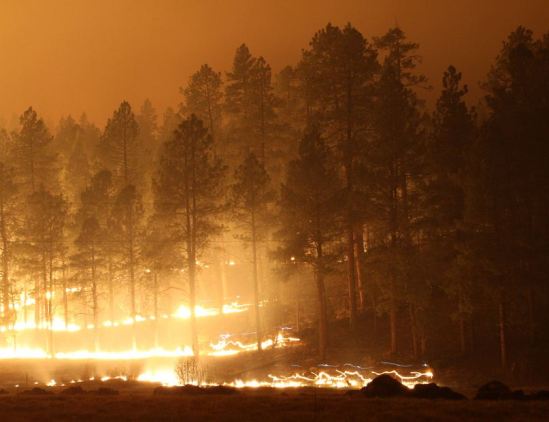
Wallow fire 6-7-2011. In this long exposure, you can see the trails of what appear to be firefighters with headlamps carrying lit drip torches igniting a burnout. Photo: Apache-Sitgreaves National Forest
The Wallow fire burned through the small unincorporated community of Greer, Arizona Wednesday evening. Greer has a population of about 177 people and some tourist lodges. The incident management team posted this at InciWeb at approximately 10:00 p.m. Wednesday:
Fire has gone through Greer. We do not know the extent of the damage at this time. Firefighters are on scene in Greer conducting structure protection activities.
The last acreage reported was 389,000, a figure supplied by the incident management team Wednesday morning. That will no doubt be revised upward later today. They are reporting that the fire is 0% contained.
Very Large Air Tankers
KPHO, the CBS television station in Phoenix, reported on Wednesday that Evergreen’s 747 Supertanker was going to be used:
PHOENIX — Fire officials said they are bringing in a Boeing 747 supertanker that is retrofitted to drop a mile-long line of fire retardant.
Evergreen International Aviation said the supertanker has more than eight times the drop capability and twice the speed of any other federal air tanker currently fighting fires.
That report, even though it was picked up by numerous web sites and spread around the internet like, uh, wildfire, is incorrect. Wildfire Today talked with Steven Daniels who leads the 747 Supertanker program at Evergreen and he said the 747 is not being dispatched. As we reported yesterday in a story about the use of Very Large Air Tankers, the U.S. Forest Service is not interested in agreeing to an exclusive use contract with Evergreen or 10 Tanker Air Carrier for their 747 or the DC-10 air tankers.
However, Rick Hatton, the CEO of 10 Tanker Air Carrier, told Wildfire Today Thursday at 9:30 a.m. MT that one of their two DC-10 Very Large Air Tankers, Tanker 911, was en route to Phoenix Mesa Gateway airport to work on the fires. They still do not have any kind of a contract with the USFS, so they are being activated through a Call When Needed contract the company has with CalFire. This is the same methodology used when the DC-10 was used in Texas a few weeks ago. The other DC-10, Tanker 910, is on a fire assignment in Canada.
More information about the Wallow fire
Scroll down to see more information and the latest maps of the Wallow fire. We will update the maps on Thursday as new data is available.
Updated at 6:10 p.m. MT, June 8, 2011: Full evacuation of Springerville and Eagar.
Updated at 5:36 p.m. MT, June 8, 2011: new evacuation notice, and replaced the two maps with more updated versions.
Map of the Wallow fire, showing heat (the red and yellow dots) detected by satellites over the 24-hour period ending at 2:26 p.m. p.m. MT, June 8. A mapped fire perimeter is shown (the red line) current as of 1:38 a.m. on 6-7-2011. MODIS/Google
Update: From the Apache Sitgreaves National Forest Twitter account at about 5:47 p.m. MT, June 8, 2011:
Apache County Sheriff’s Office has ordered a full evacuation of Springerville and Eagar effective now.
The incident management team posted this on InciWeb at about the same time:
The Apache County Sheriff’s Office has issued a full evacuation for Eagar and Springerville, effective immediately. A pre-evacuation notice is in effect Greens Peak, Hidden Meadows, and the surrounding areas.
The public meeting planned for this evening at the Round Valley HS has been canceled.
============================
Update: At approximately 3 p.m. on Wednesday the incident management team posted a notice of more evacuations:
New evacuations are currently underway in portions of Eager and Springerville. Essentially, all areas WEST of Main St are under evacuation, including all areas north of Highway 260, South of Hwy 60 and the airport.
The phones at the call center are currently down. For public information call: 702-308-3238, 702-308-3357, 702-308-8227
Tonight’s public meeting has been canceled.
=========================
The massive Wallow fire in eastern Arizona has been marching steadily towards the north and northeast and on its eighth day burned close to the communities of Eagar and Springerville. Portions of Eagar have been evacuated and Springerville is under a “pre-evacuation alert”. The towns appear to be adjacent and have a combined population of about 6,400 residents.
An update today from the incident management team reports that the size of the fire has increased to 389,000 acres; it is 0% contained. Several areas are under evacuation orders; see below for links to more details about the evacuations.
From the IMTeam, Wednesday morning:
Last night, the lower winds, higher humidity, and cooler temperatures enabled firefighters to conduct burnout operations to reinforce fire line. Crews constructed 10 miles of dozer line south of Eager and Springerville. As conditions allow, crews will continue burnout operations to reinforce that line. Extreme fire behavior is predicted again today due to the forecast high winds and low humidity. Red Flag Warnings are still in effect for the area. Spot fires are occurring up to 3 miles ahead of the fire. Today’s firefighter activities include: burnout operations, building fire line, perimeter control, structure protection, and patrolling for spot fires.
The fire has burned almost completely around the communities of Nutrioso and Alpine. The incident management team running the fire reports that 10 structures have burned, but have not provided details about their locations.
CNN reports (see the video below) that due to smoke from the fire, four planes had to be diverted from landing at Albuquerque, New Mexico. The Wallow fire is now the second largest fire in Arizona’s recorded history. The Rodeo/Chediski fire of 2002, at 468,638 acres, is the largest.
Jim Loach
Jim Loach’s Area Command Team 3 assumed command of the Wallow fire at 6:00 a.m. today. Up until then, the two incident management teams suppressing the fire had been reporting directly to the local agency administrator, but now they will report to the Area Commander. The main purposes of an Area Command Team are to work for the agency administrator to relieve the local unit of some of the duties of running a massive multi-team fire operation, and to coordinate the use of what may be limited firefighting resources — personnel, equipment, and aircraft. The last two years have been relatively quiet fire seasons nationally, and as a result this team has not had an assignment as a unit since they managed a multiple fire situation in northern California in July of 2008.
Loach’s AC Team will be supervising four Incident Management Teams, assigned geographically around the fire:
We will be updating this article during the course of the day. And as usual we will update the maps of the Wallow fire as new data is available.
Wallow fire. Photo by Ron Sander, US Forest Service
Scroll down to see a zoomed-in map of the fire and its relationship to the communities of Eagar and Springerville.
A call center has been established by the White Mountain Joint Information Center (aka “Call Center”) for information, including evacuation information, regarding the Wallow fire. Their NEW PHONE NUMBERS ARE 702-308-3238, 702-308-3357, 702-308-8227 , and their web site is 593.org. InciWeb is another source.
Here are some links to live cameras in the general area of the Wallow fire:
Sunrise Ski Resort in Greer; web cam #2; may only be available from 7:00 a.m. to 5:30 p.m. MST.
Springerville, Round Valley High School (Near Eagar); click Time-Lapse
Molly Butler Lodge in Greer; click Time-Lapse
Greercabin.com (a view of a forest and a thermometer, no sky view)
Weather data from a RAWS weather station near Alpine, AZ and a RAWS station near Greer, AZ.
Below are two satellite photos of the Wallow fire.
The first one was captured from the Landsat 7 ETM+ (SLC-Off) sensor today around noon. The active fire is orange and burned areas are red; you can easily see the smoke blowing to the north east. The linear “gaps” that look like venetian blinds in the imagery indicate a sensor malfunction in those areas. Other than that, a gorgeous image. Spatial resolution (pixel size) of this imagery is 30m. The MODIS thermal detects that we have in some of the other satellite images are 1km.
The second image is a standard weather satellite image, captured today at 6:15 p.m.
Updated at 10:25 a.m. MT, June 5, 2011 (added links to live web cams)
Smoke plume over the Horseshoe 2 fire as seen from an airplane. Photo: Todd Abel, Southwest Incident Management Team
The two very large fires in eastern Arizona were very active on Saturday, putting up large convection columns of smoke and adding thousands of acres.
Wallow fire
The largest of the two fires, the Wallow fire at Alpine, Arizona, has now burned 144,000 acres and has caused the evacuation of several communities, including Alpine, Blue River, and Nutrioso. Other areas are under a pre-evacuation advisory. There is no estimate of containment of the fire.
Firefighters conducted burnouts ahead of the Wallow fire Saturday and Saturday night, completing over 30 miles on the north half of the fire. Much of the burning was done near Nutrioso and along Highways 191 and 180. The west side of the fire has burned into the San Carlos Apache Reservation, where more burnout operations may occur on Sunday.
Maps of the Wallow and Horseshoe 2 fires are below. Some of the red and yellow squares representing heat detected by satellites are probably burnout operations being conducted by firefighters.
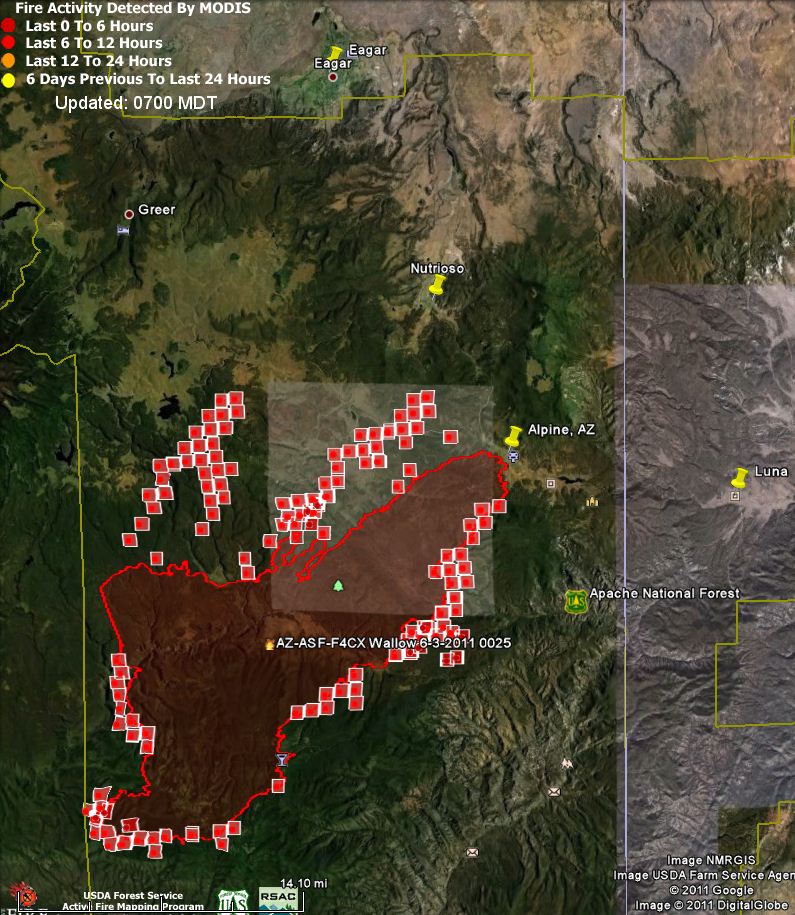
(Click to enlarge.) Map of the Wallow fire, showing new heat detected by satellites within a 12-hour period sometime prior to 7:00 a.m. June 4. An earlier perimeter, mapped at 12:23 a.m. 6-3-2011, is in red. MODIS/Google
The Wallow fire in southeastern Arizona, one of two huge fires burning in the area, spread an additional four to eight miles to the north on Friday partially due to long-range spotting, forcing more evacuation notices. The residents in the communities of Alpine and Nutrioso had been previously forced to leave and those in Greer were given a pre-evacuation notice on Friday. The residents of Blue River have been evacuated by Greenlee County officials. Inciweb has more information about evacuations.
An 8:30 a.m. update on June 4 from the incident management team included this information:
The fire advanced to the north and north-west and impacted Big Lake Lookout but not the Big Lake Recreation area. The has fire crossed the 249 road. The perimeter of the fire is close to Nutrioso and Mongollon rim but has not gone over yet.
Making some rough measurements based on the map showing heat detected by satellites early Saturday morning, the fire at that time was approximately 4 air miles from Nutrioso, 9 miles from Greer, 15 miles from Eagar, and 11 miles from Luna, NM. These distances are estimates based on satellite data.
The Wallow fire burned an additional 14,600 acres on Friday, bringing its total to 120,600 an estimated 140,000 acres according to InciWeb. This makes it the third largest in state history, behind 2002’s 469,000-acre Rodeo-Chediski and 2005’s Cave Creek fire which burned 248,000 acres. The Willow fire now stands at number four, having burned 120,000 acres in 2004.
Below is a zoomed-in map showing the north half of the Wallow fire.
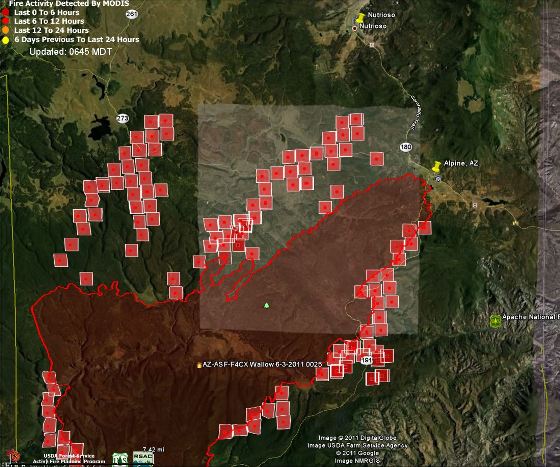
Map of the northern portion of the Wallow fire, showing new heat detected by satellites within a 12-hour period sometime prior to 7:00 a.m. June 4. An earlier perimeter, mapped at 12:23 a.m. 6-3-2011, is in red. MODIS/Google
A call center has been established by the White Mountain Joint Information Center for information, including evacuation information, regarding the Wallow fire. Their phone number is (928) 333-3412, and their web site is 593.org. InciWeb is another source.
There are two “weather cams” that may occasionally have a view of the smoke. One is at Springerville near Eagar, about 15 miles to the north, and the other is at Greer, about 9 miles north of the fire. Click the “Time-Lapse” buttons to see earlier images.
The other large fire burning in Arizona is the Horseshoe 2 fire, near Portal.
Weather
The weather forecast for the Nutrioso area just north of the fire does not look favorable for the firefighters. On Saturday afternoon the winds should be out of the southwest at 21 mph with gusts up to 30 and a relative humidity of 8%. The winds are expected to decrease to 1-3 mph during the night but on Sunday afternoon increase to 17 with 26 mph gusts along with a RH of 6 to 25 percent. There is a chance of thunderstorms Sunday afternoon through Monday afternoon.
Map of Wallow fire, showing new heat detected by satellites within a 6-hour period sometime prior to 9:30 a.m. June 3. An earlier perimeter, mapped at 12:13 a.m. 6-2-2011, is in red. MODIS/Google
The Wallow and the Horseshoe 2 fires in southeast Arizona appear to be competing for the position of 4th largest fire in Arizona history; the Wallow fire just became the 4th largest fire ever recorded in the state. As you can see from the map above, the Wallow fire has grown substantially over the last day and a half. On June 1 the fire was 6,699 acres in size. Today, according to a report on InciWeb, where additional information about the fire can be obtained, it has burned 106,000 acres. Much of this fire growth can be attributed to the fact that it was spotting three miles ahead, that is, burning embers being carried up into the smoke column are landing and starting new fires three miles ahead of the main fire. There is no way firefighters can suppress the head of a fire when it is exhibiting that kind of extreme fire behavior.
Smoke column over the Wallow fire carried by wind in the late afternoon of June 1. Photo: Kay Dyson
The Incident Management Team working on the fire has enough problems dealing with a fire that has burned 100,000 acres in two days, but adding to that is the lack of electrical power and phone service that went out on Friday at the Incident Command post.
Large smoke column over Wallow Fire on June 1. Photo: Chris Haese
Some areas have been evacuated, including Alpine, Arizona. More information can be found at InciWeb and the web site for the Apache and Sitgreaves National Forest. However, those sites may not be current due to the lack of power and phone service at the Incident Command Post.
The weather is not helping the firefighters. A RAWS weather station near Alpine, AZ (elevation 8,209′) at 1:16 MT on Friday recorded 71 degrees, 17% humidity, with southwest winds of 9 gusting to 21. A weather camera at Springerville about 20 miles north of the fire occasionally has a view of the smoke.
Below is a map that shows the relative positions of several fires in southeast Arizona and southwest New Mexico. Continue reading